Featured

What’s in Belgium?

I have been to Belgium twice, and both times were unanticipated.  The first time was a family vacation during my summer in the Netherlands. The second time was during my summer in France.  Both trips are well documented in my erstwhile diary, and both make for a read that is astonishing in its testament to the fallibility of human memory, as well as to the weirdness of teenage travels, and in the 80s to boot.

My first trip to Belgium started in Antwerpen (I do not call it “Antwerp”), but we only stopped at the port where a friend of my Dutch mother was a “shturman” https://oldladywriting.com/2025/09/21/poison-fire-and-flood/ on a cargo ship and gave us a cool private tour.  We then made our way to the coastal resort of Koksijde—close to the French border, but because I was traveling on a refugee travel document and had no visa to France, France was not available to me then.

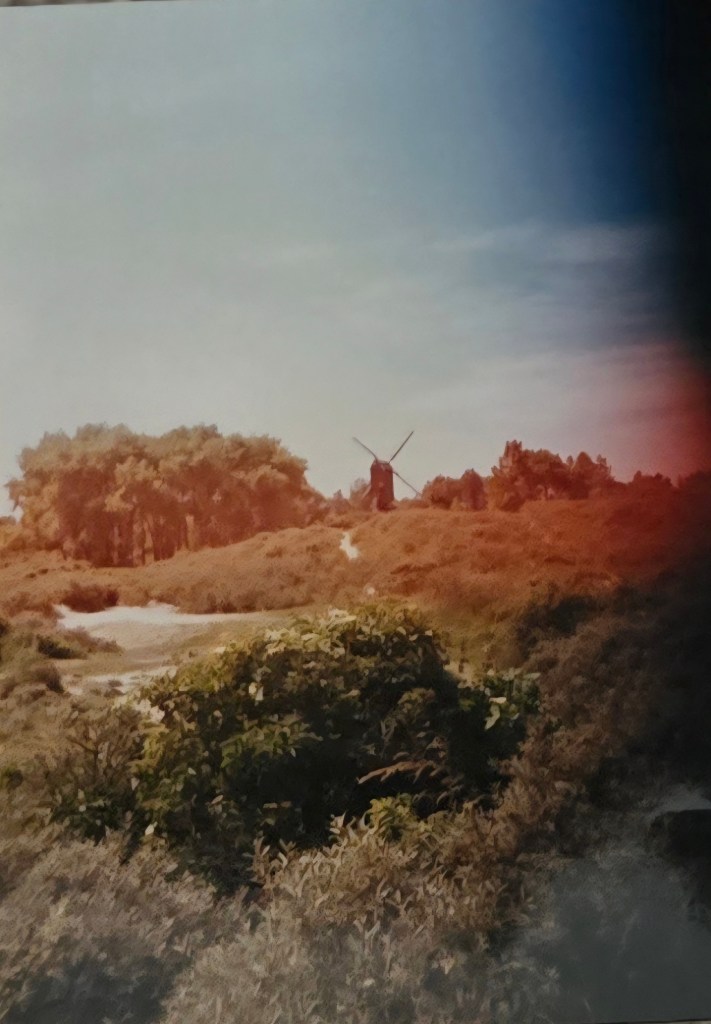
It was the first and probably the last time in my life I was at a campground.  We (my Dutch mother, little brother, and cousin) came with two tents, table and chairs.  As at any resort, there was time spent on the playground, time playing cards and badminton, going to a nearby bar and to a bakery, neither of which I can visualize now, hanging out on the sand dunes, and visiting coastal towns nearby.

I liked Belgium.  I was happy to see the signs in French, which I was already studying, along with the Dutch.  Past recollection recorded has it livelier, prettier, and cleaner than the Netherlands, but I would say now that it was the novelty and the relaxed vacation atmosphere that made it seem so.  The beach, however, did not impress me.  I made a note to go to Romania’s or Bulgaria’s Black Sea beaches when I grew up—this goal remains unmet to this day. 

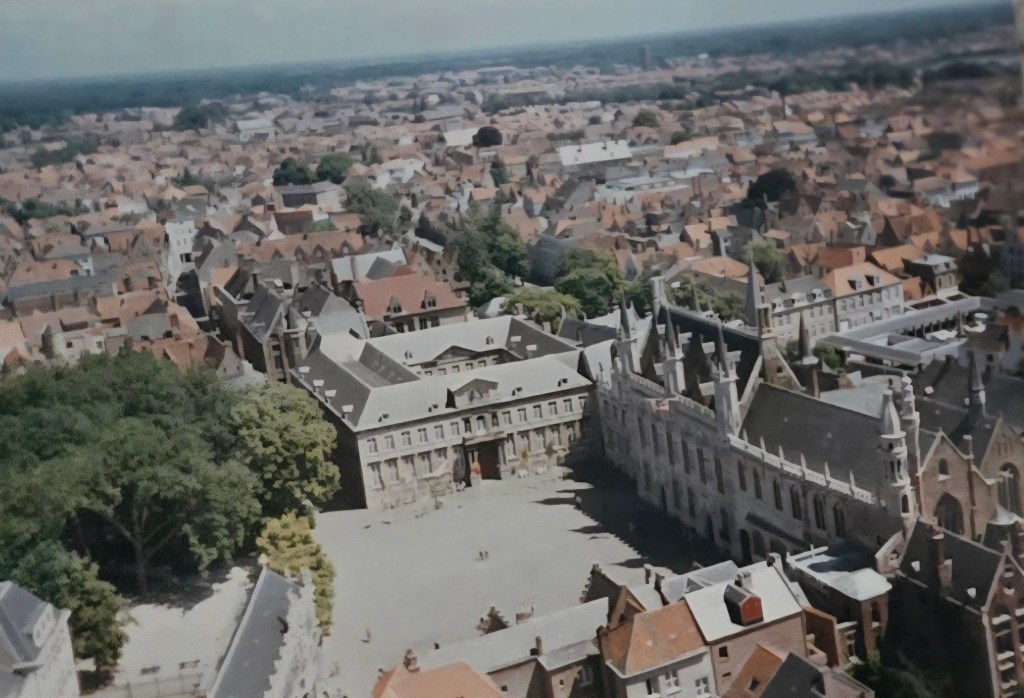
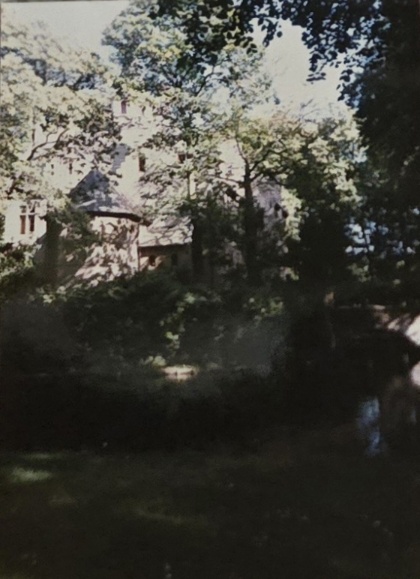
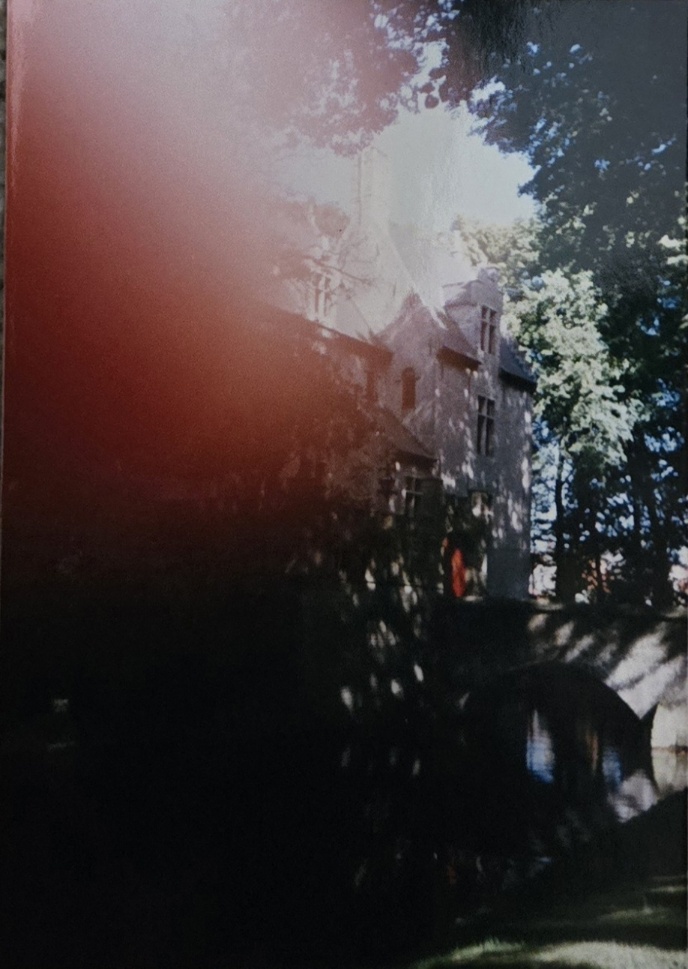
We had a lovely day in Brugge (I do not call is “Bruges”), that most picturesque of Belgian towns, despite our car being towed from a no parking zone.  We retrieved it and continued to have a lovely time despite the car subsequently being totaled in an accident halfway through our two-week trip.  It was a most bizarre thing:  we were stopped at a red light in a small town called De Panne (which literally means “breakdown”) and were suddenly rear-ended by an old man who apparently should not have been driving.  It was a small European car, but it should have still been visible in broad daylight. 

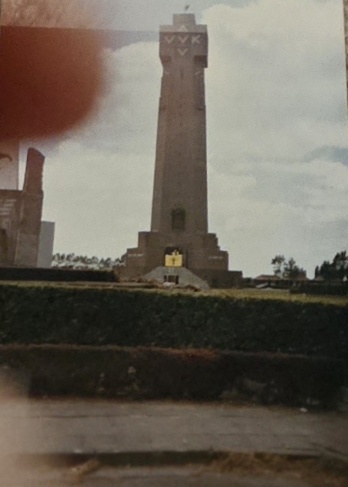
By macabre coincidence, similar to the one when my dog was hit by a car in care of a dog sitter while spouse and I were touring Dachau, the accident happened on our way back from visiting the World War I Trench of Death in Diksmuide.  We then arrived too late for an excursion at some castle, were detained by cows crossing a road, and decided to skip our customary café outing to rush back to Koksijde to see “Amadeus” at a movie theater.  It was a veritable Appointment in Samarra, albeit significantly less fatal.

I was awed then, and remain to this day, by the composure of my Dutch mother who, after some deliberations with adult family members, made the decision to continue our holiday sans auto.  If there was any stress, tension, or worry of any kind, it was either not recorded by me (extremely unlikely) or she assessed the situation and moved on with minimum disruption and maximum determination.  I see no similar scenario in which I or any member of my biological family would not completely freak out and flee.  There was some talk of leaving me with the adult (21 year old) cousin, but ultimately (after learning that this is not permitted by the exchange program’s rules), all four of us rented bikes and proceeded to continue to enjoy our holiday.  Special mention goes to the now defunct bee-themed amusement park, Meli Park, which we visited and found hilarious in its earnestness, and to me, who rode a bike like a [very sore] champ and held her own [at a somewhat lower speed] among the Dutch. And we also saw “Amadeus”.

I managed to visit Antwerpen once more.  In college, another Dutch cousin and I went there for the weekend by train to visit her brother (the cousin of the family vacation fame) and his then boyfriend.  I remember walking through some heavy iron door into the deafening noise and strobe lights of a disco and drinking a lot (“I drank three mugs of beer and a shot of Baileys”, I wrote then).  I remember that we slept through the day and have not a single recollection of seeing anything of the city, but the diary says that “during the day we walked around Antwerpen.”  I took several photos of all of us, and for that I am grateful, because “some are no longer there, and others are far away”, as Pushkin famously said (sounds better in Russian).  I cherish the memory of that weekend with my Dutch cousins; the city is just background noise.

That same summer, my roommate Kathy and I https://oldladywriting.com/2021/04/10/meet-me-in-sistine-chapel-or-rome-second-try/ did that European train loop which had us crossing Belgium on our way to and from Luxembourg.  We missed our connection in Basel and spent the night in the cold train station. The next train to Brussels was full, and we hopped on the one going to Calais (the joys and perils of Eurail Pass!).  In Thionville, the train split, and while I was checking to make sure there was room for us, I almost left without Kathy, and we again ended up waiting in a train station.  But, there was a vending machine that yielded an extra cookie, so there was that.  This is all to say that by the time we finally arrived in Brussels, we were so excited about real beds, hot shower and impending hot breakfast (included) that we decided to skip the city altogether, though we did make it to Brugge in passing, mainly hunting for lace doilies.

I never saw Brussels to this day, Antwerpen remains a mystery, but the Flemish Coast is a very fond memory.  To be continued…

Featured

Time Shelter: Reminiscence, not Review

“The past is not just that which happened to you.  Sometimes it is that which you just imagined”*. 

The older I get, the more disappointed—and, frankly, disbelieving—I am that we cannot travel back in time.  The more years pass, the farther I get from certain cherished moments, the harder it is to accept the permanence of their departure.  Watching Doctor Who, the ultimate wanderer in time and space, I get a vague sense of unease from the episodes set in the future.  What is the far future to me?  I will not see it, so I am not curious about it and not invested in it.  But the past, well, it is full of second guesses disguised as second chances.  It is full of the comfort of nostalgia. “It’s been written that the past is a foreign country.  Nonsense.  The past is my home country.  The future is a foreign country, full of strange faces, I won’t set foot there”*.

In “Time Shelter”, Bulgarian writer Georgi Gospodinov creates the perfect scenario for which my soul has been yearning.  Gospodinov is Bulgarian, and we are exactly the same age.  I feel his story almost instinctively, beyond the words, for he writes not just about the decades he experienced, but as only an Eastern Block Gen-Xer experienced them.  It is rare that I hear the echoes of the voices in my head in print.

His first person narrator meets Gaustine, a mysterious psychiatrist who opens a “clinic for the past”.  It is meant to evoke recognizable memories for Alzheimer’s patients by reproducing the surroundings of their comforting past lives, but the concept takes off and everyone wants to starts seeking shelter from the relentless passage of time by stepping into the past. “Everything happens years after it has happened”*.

Like Gaustine’s patients, I am not even interested in the historical past, someone else’s past.  I do not want to meet Shakespeare (whoever he really was) or see dinosaurs or anything like that. (OK, maybe I want to meet D’Artagnan in his natural habitat, but that is all).  And fine, I don’t even want to change anything.  I saw “Sliding Doors”.  I read “Midnight Library”.  I am no longer sure which parts of my life I would want to erase if there is no guarantee that this would not have a detrimental effect.  I can no longer fathom what my life would look like today if I had made different decisions at some critical junctures.  I might have been spared some pain, but what unanticipated and ultimately avoided sorrows were waiting in the wings?   The decisions that I made, I stand by them.  The decisions that were made for me trouble me still with the passage of years but regret is useless. And it all basically worked out.

The pool would have been beyond that fence on the right

It is just that the melancholy longings come unbidden in the twilight, and that is when I sometimes wish I could revisit my past.  I want to see the sun rise over the roofs from the balcony of my mother’s apartment, for every occasion on which I visited her there seemed special and wonderful.  I want to sit in my childhood apartment’s dark room lit only by the lights of the Christmas tree, the only year my grandparents had a real tree and could finally hang up the one ornament that was too heavy for our little artificial tree—an orange, the size and weight of the actual fruit.  I do not want to forget either that orange that always stayed in the ornament box in the entresol except for that one brief appearance or my favorite ornament, wild strawberry with a human face.  I want to go to the grocery store on the first floor of our apartment building and buy birch juice by the glass and a hard block of coffee with milk, meant to be dissolved in boiling water and not gnawed like I did as a kid.  I want to watch my collection of film strips in the hallway of our apartment on the coldest winter days.  I want to marvel at the hollyhock mallow plants in our neighbors’ garden in the summer.  I want to see again that inground public pool that was filled in when I was just a toddler, leaving behind a weed-covered wasteland—was my memory of this thing even real, a random outdoor pool on our quiet little street?  And I want to sit on our old couch and read the books of my childhood.  There is so much from that era of gentle stagnation which seems positively utopian in comparison to our present cataclysmic times.  “Warning, history in the rearview mirror is always closer than it appears”*.

My favorite part of this mesmerizing novel, which I had to read twice in a row (and even that was not quite enough to fully take it all in; I am yearning to read it again), is when time shelters become so popular that European countries actually vote on returning to their respective favorite past eras.  The clinics of the past are no longer enough; entire countries become engulfed in nostalgia.  It is fascinating to read what decade each country chooses as representative of the glory of its people, yet still recognizable and not entirely devoid of modern comforts.  Some decades of the last century are obviously fraught; 30s and 40s have their devotees, but Gospodinov is not going there.  The story is not about that.  So many countries choose the 1970s or the early ‘80s (including most of the [former] Eastern Bloc—the whiff of freedom in the air, before reality bit), with only Italy choosing the ‘60s.  Bulgaria’s choice is not mentioned, but there is a hint.  “What decade would you choose?  “I’d like to be twelve years old in each of them.” * That would be my answer, too.

*All the quotes are from Georgi Gospodinov, “Time Shelter”, English translation by Angela Rodel

https://georgigospodinov.com/

[Caption: my time shelter, for better or worse]

Featured

Poison, Fire, and Flood

One of the main villains of my raucous childhood was one Shturman.  This was, and is, his real last name.  I am not changing it here because (1) he is not likely to read this, (2) this unusual name[1] is too much a part of him, and (3) every word is true.

Shturman’s code name was “Douche”.  No, listen, in Russian, it just means “shower” (and in French as well, but we did not know it then).  And the reason he was “Shower” was because we called him “D.Sh.”, which stood for “Durak Shturman”, which means “Shturman the Fool”.  So it all fits together rather beautifully.  Since “fool” was the worst insult we knew, literally everyone’s code name started with “D”, but this was the only one that is not lost in translation[2].  At school, he was known as “Shturm Zimnego”, or “Storming of the Winter [Palace]” (the event that, according to what we were taught at school, started the Great October Socialist Revolution), but we did not feel that he deserved so much honor.

All positive comments regarding these flowers will be deleted

My BFF and I met him on the first day of school, September 1, 1975.  In fact, we all met each other for the first time that day.  It was not a good day for me, for it started out quite literally on the wrong foot.  All the girls were wearing pretty summer sandals (my friend’s were pink).  I, as was my lot in childhood, was wearing heavy, hideous black/brown booties.  I was perpetually overdressed in childhood by my overprotective grandmother; I always had a couple more layers on than anyone else.  My mother, who gets incredibly defensive about every single choice made for me not by me, would undoubtedly say that prettier shoes could not be found—and that would be a lie.  Everyone else wore common Soviet-style sandals readily available at any children’s clothing store in town.  My ugly orthopedic boots were imported.  And to top it all off, the trend of sending me off on the first day of school with a bouquet of chrysanthemums for the classroom teacher started that unfortunate day.  You guessed it—everyone else had lovely summer flowers.  I yearned for daisies, and cannot abide chrysanthemums to this day.  But I digress.

Mine and my BFF’s mothers and both of Shturman’s parents went to high school together.  Their paths diverged for a few short years after college and joined again on that day when it was discovered that they had children born in the same year (two in January, just a week apart, and one in November), who will be starting school not just at the same time, but at the same school and in the same class.  Of course, given that our parents were friends, we were thrown together a lot in those early years, for all the holidays, all the birthdays, summer trips to the countryside, etc.  Well, since I lived with my grandparents, I was not allowed to celebrate with my friends, so that was one very small benefit, having a bunch of 50+ year olds rather than Shturman over.  And since I was born in November, I did not have to share my birthday with him, only with the October Revolution, celebrated in November according to the “new”, Gregorian calendar.

To commemorate the Revolution, we got a few days off from school—basically, our fall break.  In that place and time, it was common to gather for all festivities.   One year, when I was maybe in second grade, we all met at my BFF’s apartment.  The adults, which consisted of Shturman’s parents and mine and my friend’s mothers (both divorced, but with or without boyfriends—memory fails) went for a walk.  Do not be shocked, it was a kinder, gentler time; neighbors looked out for each other and each others’ kids.  And it turned out that the real danger lurked within…

The adults departed for their nighttime stroll, and BFF and I hoped to have some fun:  sing along to Soviet pop music with pantyhose on our heads, make plasticine animals, read about astronauts and plan our own future space adventures—really, the possibilities were endless.   It was a Soviet studio apartment: one room, bathroom, and a kitchen at the end of the hallway.  We staked out the kitchen.  Shturman pestered us for a bit, at one point brandishing a bottle of wine[3] and boasting that he can drink it all.  We called his bluff with all the disdain we could muster; predictably, he did nothing but buzzed off to the room.  But our little gray cells were already activated.
As children, we were told that alcohol is poison. As we saw adults drink copious amounts thereof, the unspoken assumption was that it is poison specifically to children.  Which budding sociopath came up with the cunning plan of serving tea laced with alcohol to our arch enemy shall remain undisclosed.  I know that “Hey, Shturman, do you want some tea?” was not spoken by me.  He and I were never verbal with each other, letting our fists do the talking. 

My friend made him a cup of tea, which was actually mostly vodka.  Shturman, clearly feeling very pleased with himself and his imaginary superiority over us, took a sip, immediately choked and started coughing, eyes bulging.  You did not see this coming, right, because you thought Russians drink vodka from birth, and I am here to break down the stereotypes.  He dropped the cup, and there was that moment in which you know things can go either way—and this is how they went, with him screaming “I will kill you!” and us shrieking and running.  Studio apartment, where are you going to go?  Bathroom, of course—the only place with a lock.

Shturman started pounding on the door and screaming, “Come out or it will be worse for you!  I will break down this door!”  BFF was sort of turning on me: “So, alcohol is poison, huh?  He is alive and well, and even worse than he was!”  I was just hoping the door will hold, and besides, it was a modern apartment, with a “combined” bathroom, meaning toilet, sink, and tub were all in the same place.  We had all the conveniences, and could wait him out until our parents’ return.  Eventually our enemy calmed down and walked away, and we settled in the bathtub, lulled into a false sense of security.

Suddenly, a scratching sound alerted us to a new potential disaster.  Shturman procured matches and started lighting them and shoving them under the door.  He decided to smoke us out, that weasel!  But the joke was on him—we had access to plenty of water, and started pouring it on the matches, having emptied the toothbrush glass for this purpose. Neither side was going to surrender, but we assumed that the matches will run out before water.  As luck, good or bad depending on perception, would have it, adults came home before either, to a minor river in the hallway, with purses and shoes floating by.

We refused to leave the bathroom until the Shturman family departed.  I remember nothing of the aftermath of this event (not even the last of its kind), beyond never getting along with this Shturman until I left the country several years later.  I have not seen him since.  Wherever he is, I hope he is not holding a grudge.


[1] It literally means “navigator” in Russian.  Unusual and kind of cool, if one stops and thinks about it.

[2] For example, we referred to Shturman’s father as “D.P.”, i.e., “Durak Papasha”, meaning “Dad the Fool”.  We disliked him because his son looked just like him, and we never saw him as anything other than his son’s father.  Yet DP was the only father that was present in our group of friends.  Something to unpack here.

[3] Again I remind you, different time, different place, no burden of Puritan heritage. 

Featured

Havana Daydreaming

“Oh, Havana, I’ve been searching for you everywhere
And though I’ll never be there…”

(Billy Joel, “Rosalinda’s Eyes”)

In 1997, I prepared my first list of places I wanted to visit in this lifetime.  It was pretty basic, containing about what you would expect (although even then, my focus was primarily on Europe).  The list was revised several times in the intervening years, and I am currently working off the most current, 2020 version.  It is significantly more precise (I narrowed New England down to Maine, identified specific cities and experiences in various countries which I have already visited, and ultimately, decided there is nothing for me in either Minnesota or Australia—no offense).  The place at the top of this new[ish] list is Cuba.  In 1997, I did not imagine that visiting Cuba was possible.  It seems complicated still (especially for someone with my aversion to organized group travels, and given the general state of the world).  But everyone has to have that one place that remains elusive.   

This is the least horrifying photo I could find in the public domain. Or any other, for that matter.

When I was in second grade, the mother of one of my classmates did a presentation to our class about her trip to Cuba.  Bulgaria was exotic enough.  Cuba was unimaginable.  She came with a show and tell.  There must have been some candy, though I have absolutely no memory, real or imagined, of that, and have no experience with Cuban treats to this day.  There must have been some elementary-level geo-political presentation; we already felt a certain reverence for our exotic, far away only friend in the Western Hemisphere.  What I do remember very vividly is a little stuffed crocodile that she brought with her.  I am sure that a baby taxidermy croc would intrigue any child; it was so fascinating to me that in my mind’s eye, I still see Irka Rybakova’s mother standing in front of our class in her belted dress, holding this shiny leathery wonder.  Neither alligators nor crocodiles exist in Russia; this was years before I saw one in a zoo.  So strong was this impression that for years if I heard “Cuba”, the first image that would come to me is that of a little crocodile. 

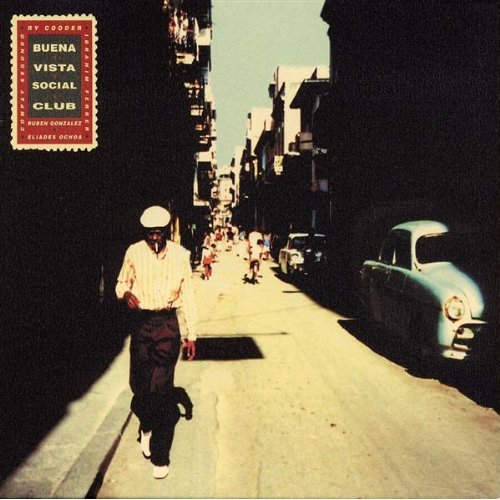
That is, until I saw a documentary on PBS[1]—and that day is about as far away from today as it is from the day I saw the baby crocodile, which is to say that I have identified Cuba with its marvelous music for at least as long as I have identified it with crocodiles, a distinct improvement.  The film touched me on every level—I did not just fall in love with the music, but the sights of Havana, the camaraderie of old musicians, their unpretentious yet assured personalities, their warmth and pride in their homeland[2].  From that time until CDs have gone the way of cassette tapes, I have accumulated a lovely collection of traditional Cuban music.  My meager Spanish is just enough to get the gist of most songs, and that is indeed enough for me.  At some point, the Buena Vista Social Club orchestra came to town during a worldwide tour.  I did not go (something about ticket prices, and I am generally not a concert goer).  While it is tempting to call this the biggest regret of my life, it did not feel so at the time.  The CDs continued to sustain me.

Almost two years ago, Buena Vista Social Club musical showed up off Broadway, but it was December, and I had other plans.  Once again, I made an informed decision to hold out. This time, I was not wrong, for a little over a year later, it finally appeared on The Great White Way, and I was there for it.  Well, to be honest, I was not the first in line.  I was skeptical.  When you love something, you do not want it touched and tinkered with.  You do not want your memories sullied.  This is why I avoid movies based on books I love[3], and generally try to avoid musicals based on movies, which these days is practically an impossibility.  My mother and I planned a trip to NYC, and I was still not convinced, thinking that I will grab the tickets when I get there.  Then Buena Vista was nominated for a Tony, and I figured I better make a move before it becomes a hotter ticket than my limited window of opportunity could support.

I loved the music, but knew nothing about the story, or even cared about it.  On the night of the Tony Awards, I instantly recognized all the characters during the musical number as if they were old friends.  I figured, if nothing else, I will still love the music.  I have seen jukebox musicals, some with better books than others, and in all cases, the music alone has been enough.   

It turned out to be the story I did not know I needed.  The prequel to the events of the documentary, when Omara Portuondo met Ibrahim Ferrer, Compay Segundo, Ruben Gonzalez and others, when they were all making music in the waning days of the Batista regime and the dawning of the revolution, is full of hope, exuberance, and excitement, and sparkles with gentle humor.  The reunion of the former bandmates several decades later, familiar from the documentary, is wistful and burdened with the weight of years gone by, as these things go.  Through it all, the musicians—recipients of the most well-deserved special Tony Award—are simply spellbinding, and the songs are just as gorgeous as ever I heard and loved them.

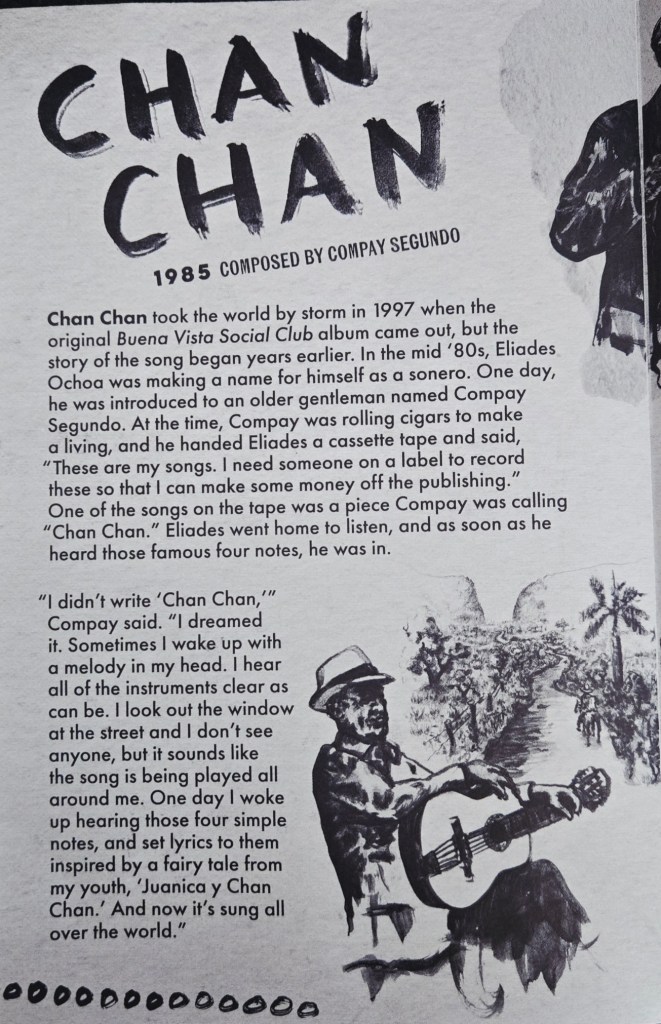
And then there are the Portuondo sisters.  On the eve of the revolution, one leaves for the U.S., in the scene reminiscent of another musical, on seemingly the last plane out of Havana.  The other stays, because someone has to continue to sing the songs of the people, for the people.  The moment when Omara decides not to leave, whether based in truth or in romantic fiction, touched my heart even more than hearing Chan-Chan live.  Some choices we make, some are made for us, some are conscious and based in sacred truth, some are based on the cards we are holding at the time.  Sitting in the Schoenfeld Theatre on a Friday night in July, seeing and hearing this story with all my senses, I both cried for and praised the impossible, life-altering, life-affirming decision[4]. https://buenavistamusical.com/


[1] When we still had PBS…

[2] The Mandela Effect had me believing all these years that Buena Vista Social Club won the Oscar for best documentary.  It did not. The documentary that won that year was “One Day in September”.  Do you remember it?  Me, neither. 

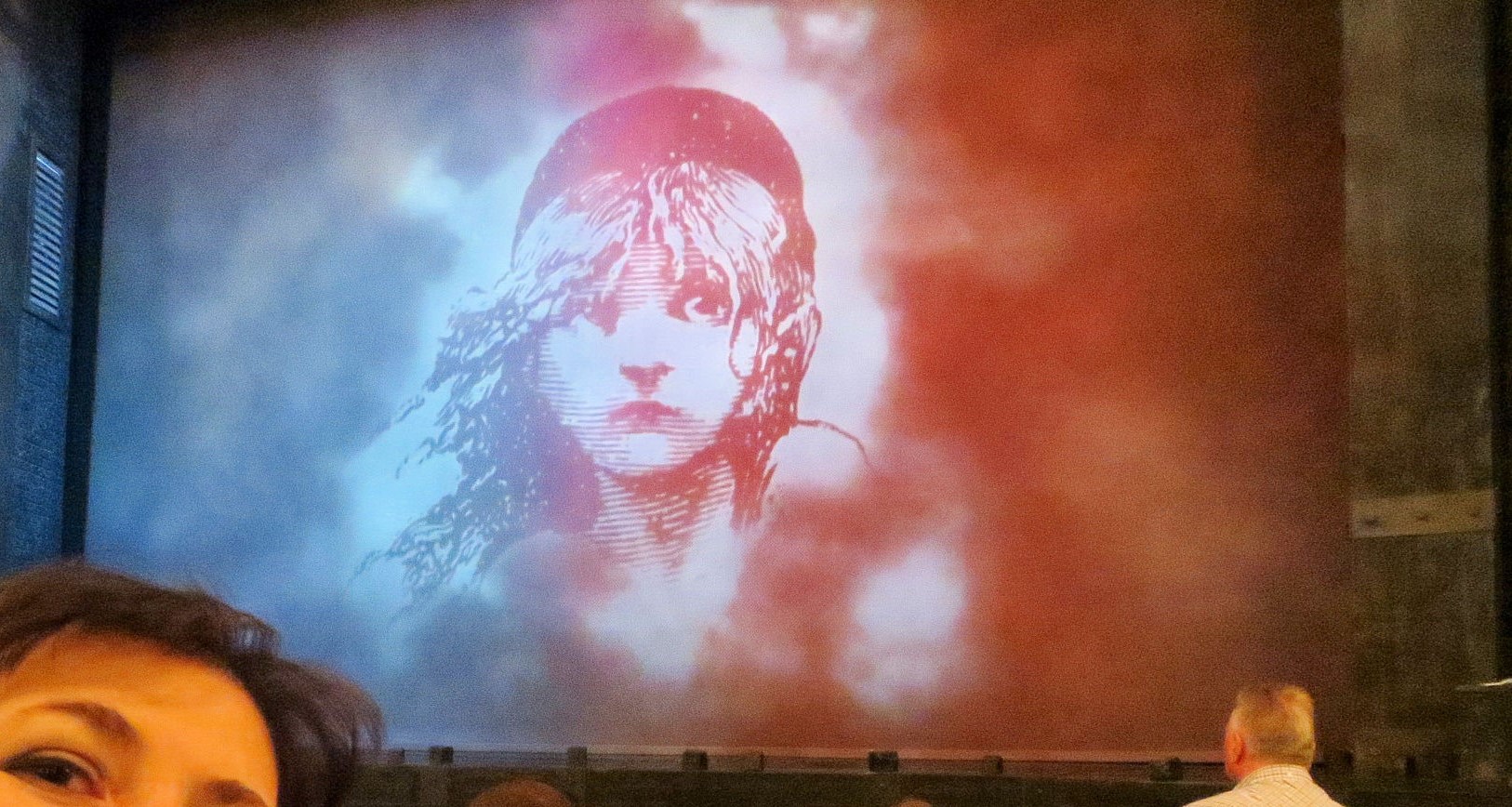
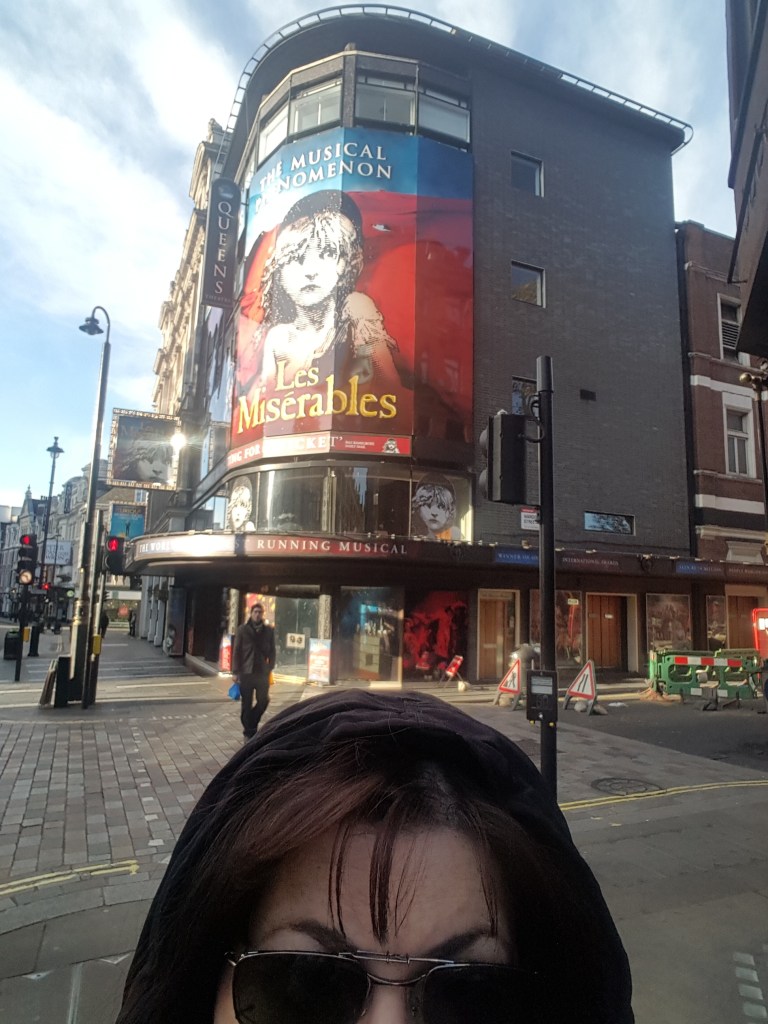
[3] No, Les Miserables does NOT count, because I saw the French TV special first, for those reading [all] along.

[4] I once had a classmate of Cuban heritage.  His father fled to the US during Batista’s rule; his mother, during Castro’s.  He marveled at the idea that had they never left Cuba, they would have never met, being from such different socio-economic background.  The conclusion that I drew from this story, however, was that people flee various regimes for various reasons, not just the ones from which we are taught to believe they do.

Featured

More than Dracula

And then I went to Romania.  It was not on my bingo card in this lifetime.  It was not on my bucket, or any other, list.  In the hierarchy of the Soviet Block, Bulgaria was the most accessible, and there was that personal connection that I already mentioned.  DDR was glamorous and had amazing, coveted toys that sometimes found their way to our stores. Yugoslavia was practically The West.  Poland, Romania, Hungary, and Czechoslovakia were somewhere in the middle, and I never knew anyone who visited these countries. 

The 1980s brought a version of Romania into my own life in the person of my stepfather.  As a teenager going through a trauma that informed her entire life (to which he himself was not a minor contributor), I only listened to his stories on the good days, and those were few and farther between.  He was born when Romania was still a monarchy, and left it for good during the next to last and not even the most brutal decade of Ceauşescu’s reign.

This is what I remember, and there is no one around who can challenge my [faulty] recollections. Like many, his family of well-to-do landowners suffered when the Communists came.  There was a last name change, family separation, exile to a remote village, and the eventual cloak and dagger story of fleeing with his two friends Gheorghe and Mihai (straight out of Romanian central casting) with visas to Hungary which were then altered to get to Austria and with the ultimate goal of defecting to the U.S.  He hated communism with a passion that was matched only by his hatred of everything Russian—and I hope you see the bitter irony in that.  The ‘80s were not great for the Soviet Bloc, and for Romania in particular, though the very end of the decade finally brought the long-awaited relief.  Some of those countries are democracies still…

My BFF of the annual girl trips and I were talking about making the pilgrimage, but somehow it seemed too fanciful.  And then one day, it just didn’t.  I figured, if guided tours were going there, it is no longer the place from which to flee.  I know, I know, it has literally been decades, but those early memories last the longest.   My friend’s grandmother came from Romania, but in a way of turn-of-the-century immigrants, from Transylvania via Ellis Island.  Her childhood impressions of the far away ancestral home were quite different than mine.  What a difference a few decades (and a mad dictator) make!  I am happy to report that she found the Romania of grandma’s stories; I found only a shadow of my stepfather’s.

Arriving in the Western part of the country, I saw not even a hint of the dark and depressing past of the previous regime.  It could be that, on a guided tour full of Americans, we were only shown the best parts, but we had enough free time to see beyond any potential Potemkin villages.  Our lovely, warm, spirited tour manager warned us more than once, with just a hint of apology, that we will see some remnants of the Communist times, such as our hotel in Timisoara which, while the best in town, was ostensibly less luxurious than other hotels on our tour (but as for me, I concluded that all the hotels in which I usually stay are apparently “Communist”, including in places where Communists were not known to have made any inroads!).  If this was the only outward reminder of that era, it was truly nothing at all.  Instead, Romania unfolded as a land full of natural, architectural, and culinary wonders.

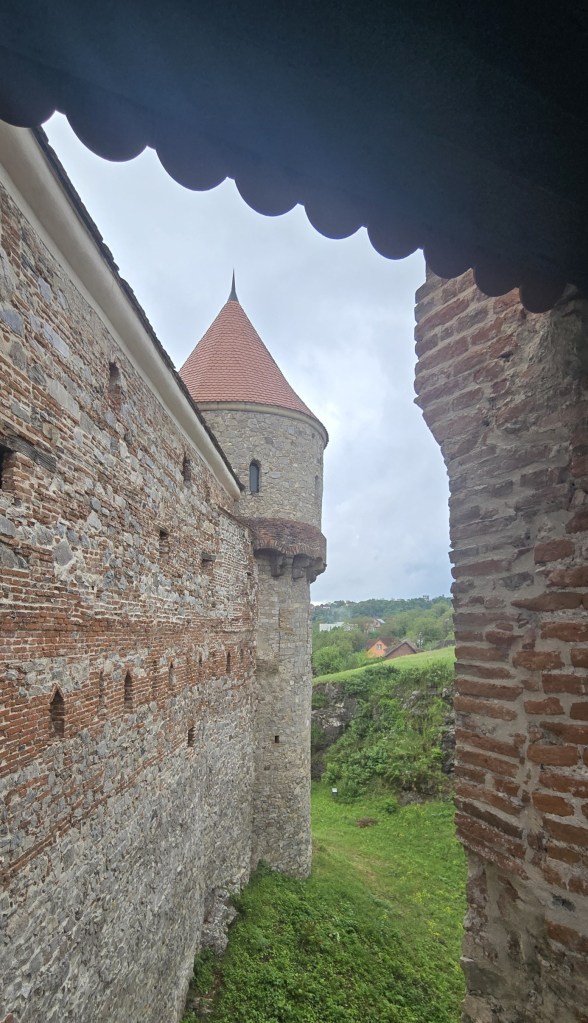
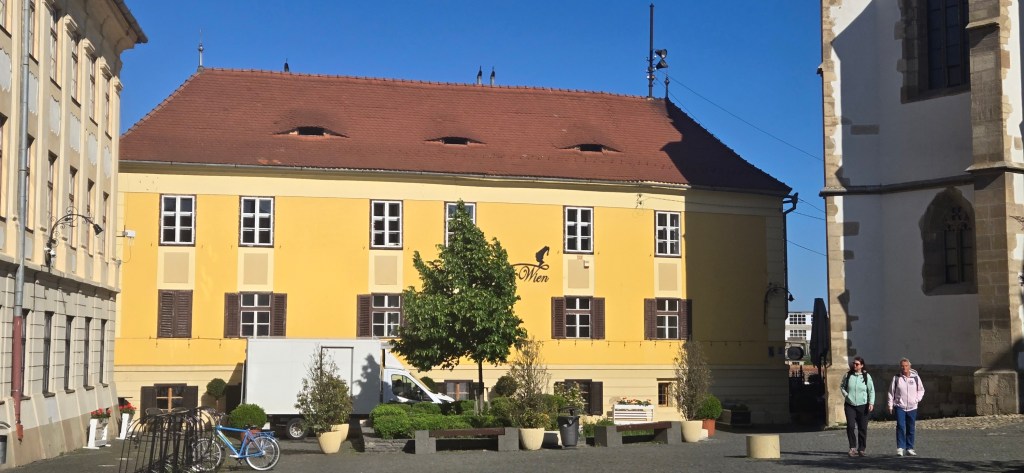
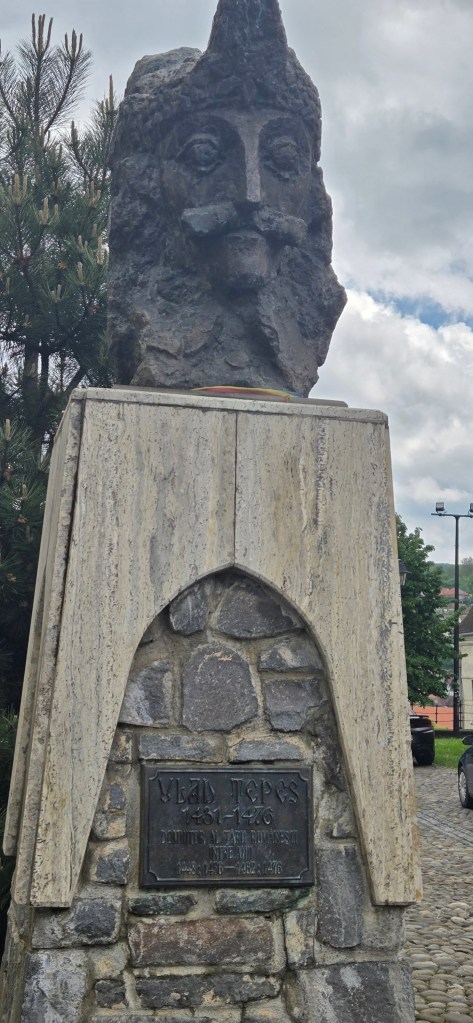
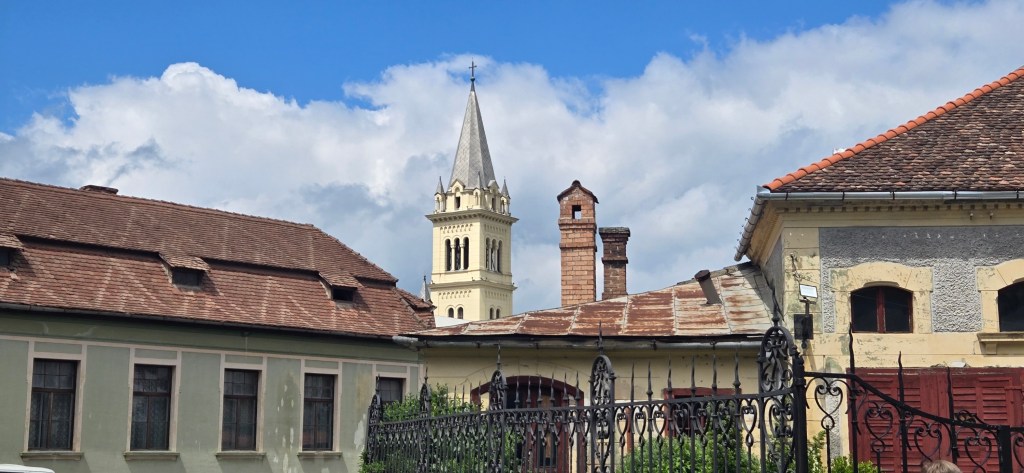
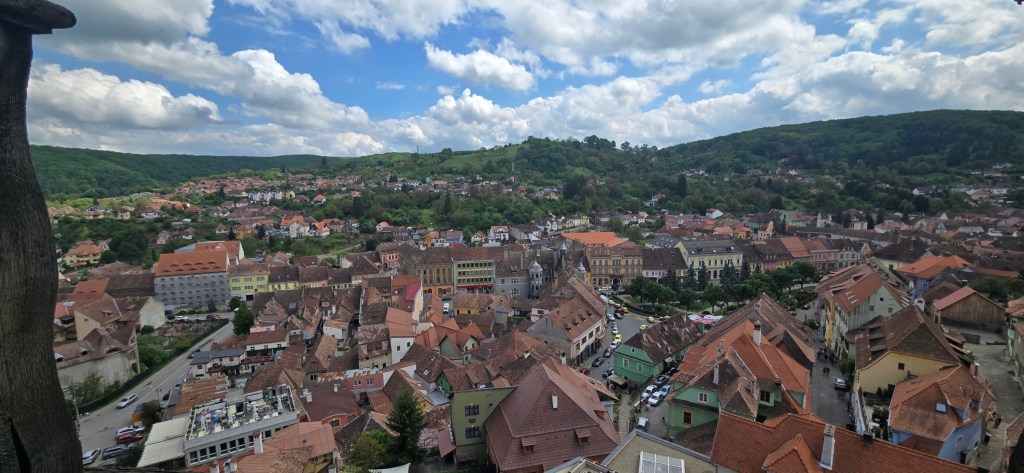
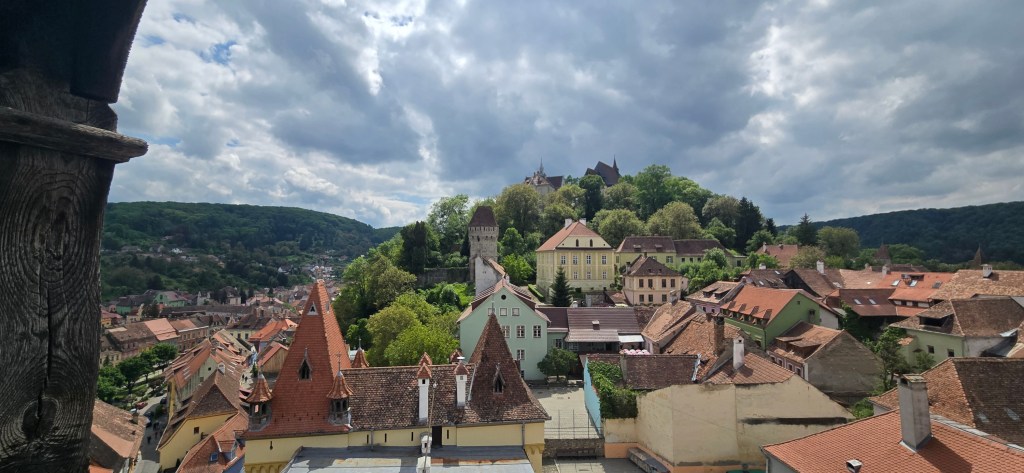
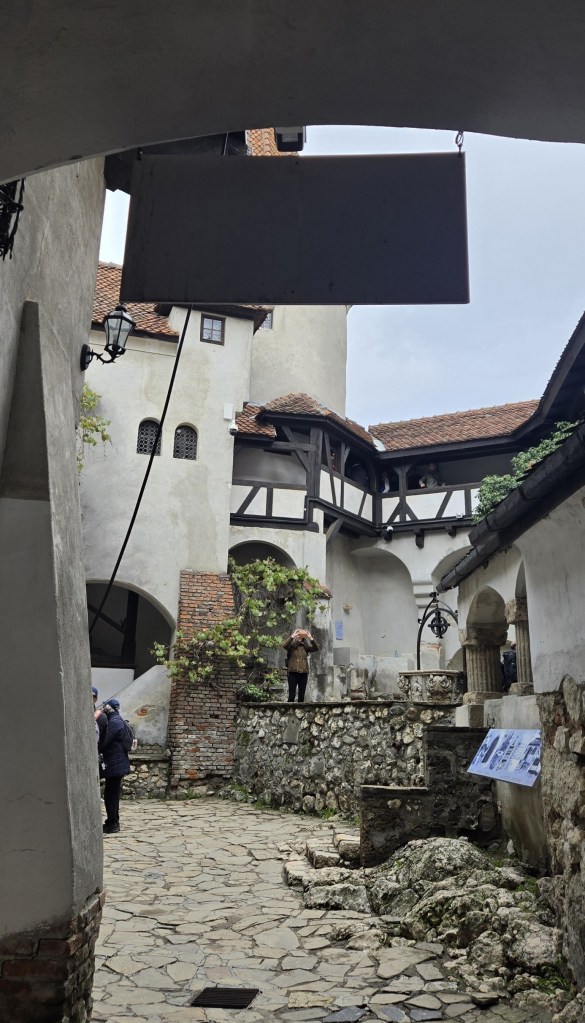
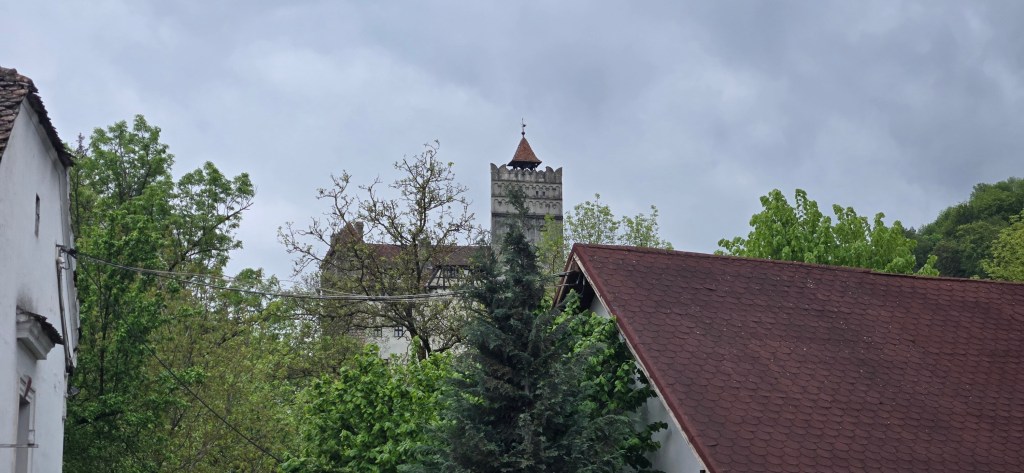
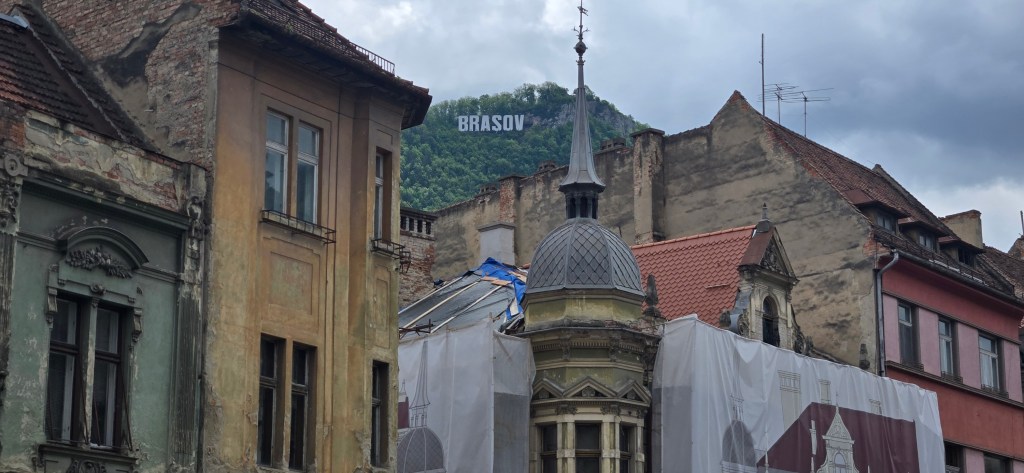
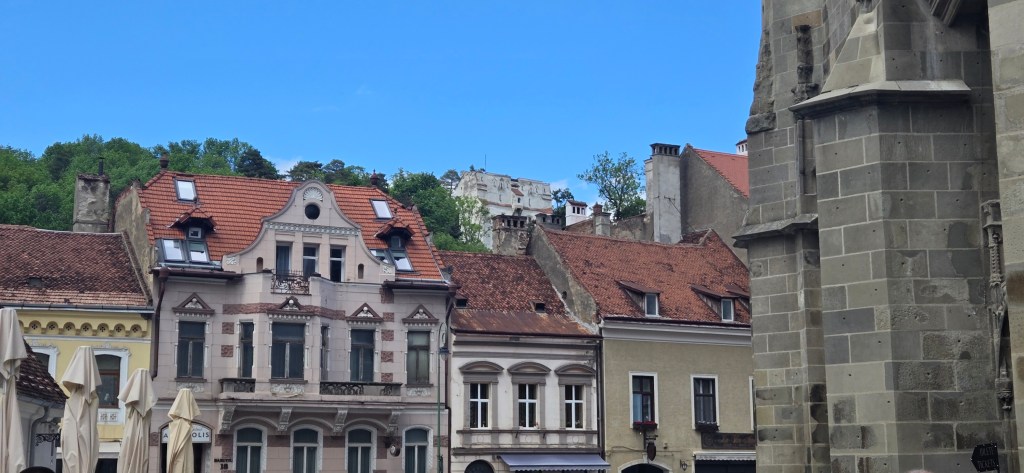
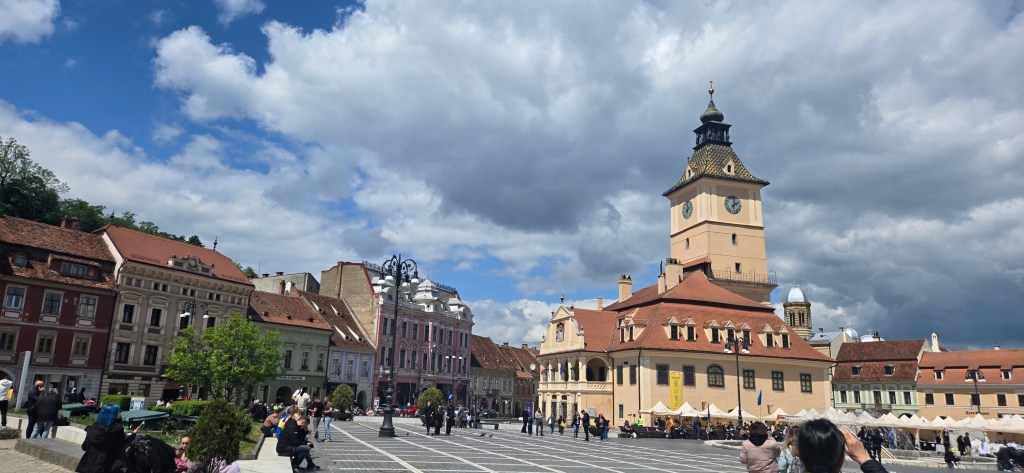
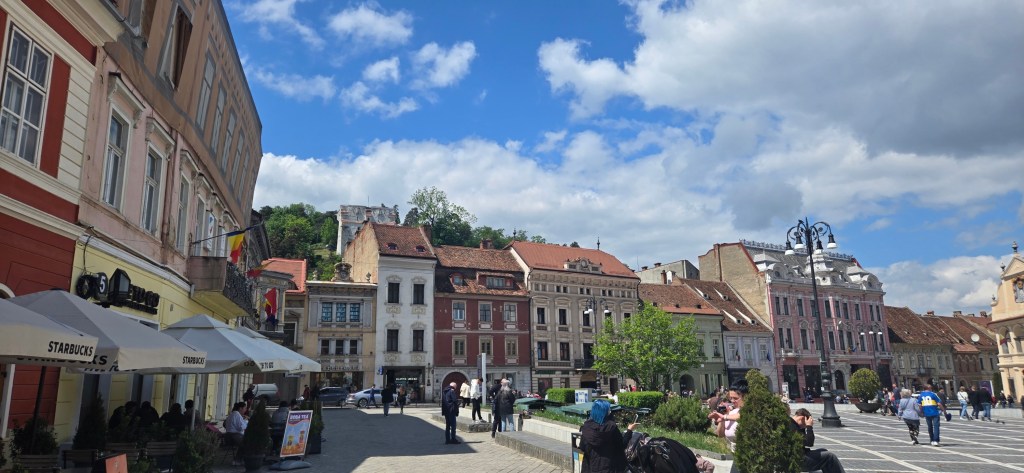
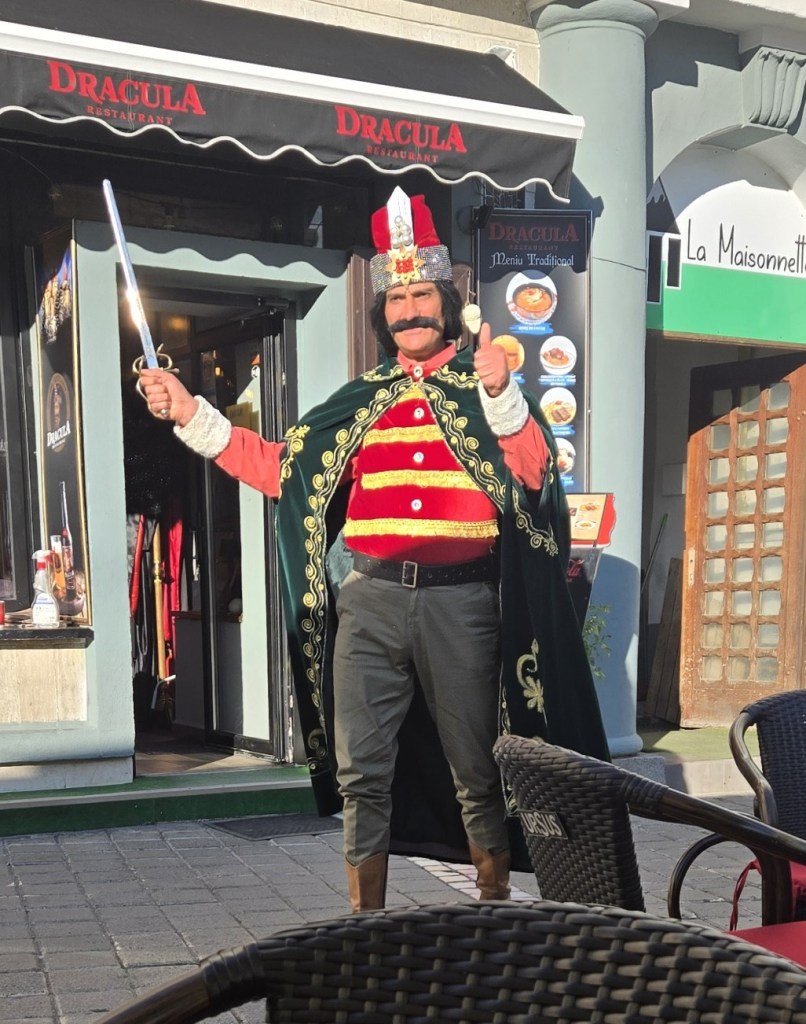
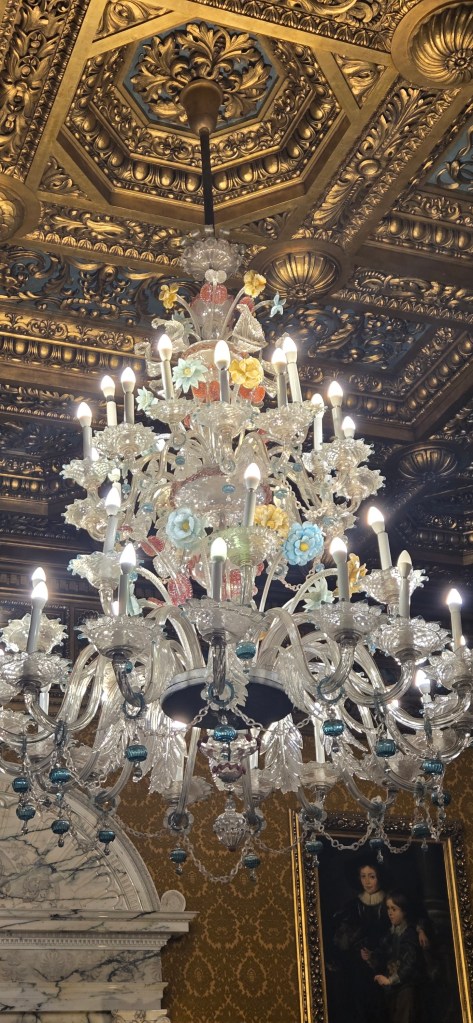
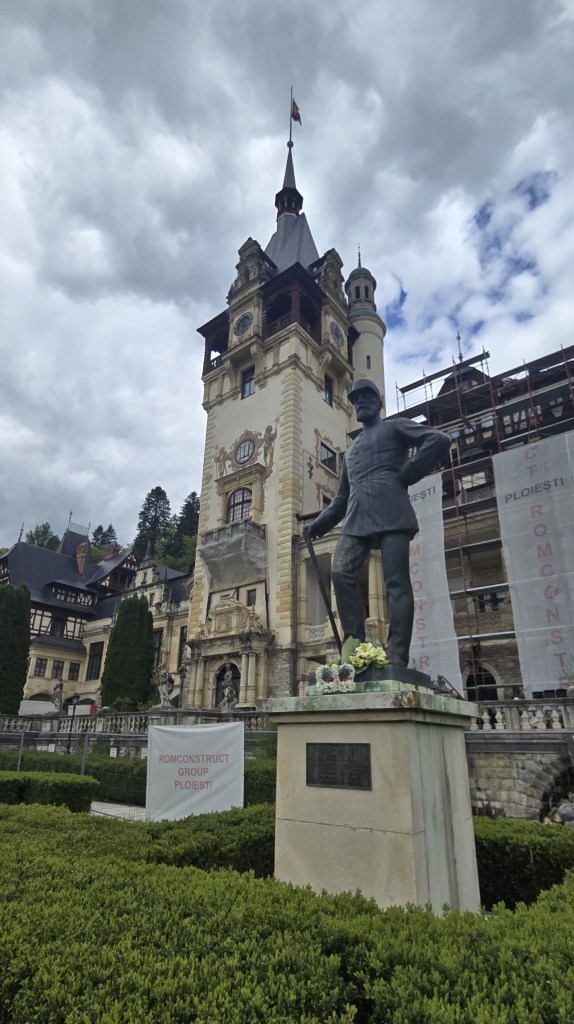
We saw castles: Hunedoara’s Corvin Castle, as intricately feudal as anything France has to offer; Peles, an opulent gem of a palace; Bran, of Dracula fame, both charming and historic and surprisingly unspoiled by its reputation, and towns: Timisoara, where Romania’s present was born, with its three distinct, gorgeous squares; Sibiu, full of small-town European elegance; Sighisoara, with its medieval cobblestone streets and a clocktower with a view that takes one’s breath away; and Brasov, charming and joyous, full of unexpected delights like sampling local wine in a beautiful garden, jubilant Europe Day celebration in a square right below our hotel window, and Dracula himself roaming the streets.  I did not know what to expect, but I did not expect this.  I hate to say “normal”, because what is that, really, but “normal” is the word that kept coming to mind.  After all the suffering, the deaths, the people fleeing into the diaspora, normal would be enough.  But it is more than that.  It’s glorious.  It’s absolutely wonderful.

I did not see the Romania I thought I knew, if vicariously, until we reached Bucharest, and even that took a minute, for we arrived on the weekend, when the central street of the city, Victory Avenue, was closed to traffic for a kind of an extended block party.  People were promenading, music was playing, food was being served everywhere, and it felt like the whole city was out and about, enjoying a warm Sunday night.  The memories flooded the next day, with our walking tour.  Just steps from our hotel was the Revolution Square.  Our guide was telling us about how the dictator would speak from the balcony of the building of the Central Committee of the Communist Party, and my heart just broke.  To the rest of the group, most older than me, these were just words of unfamiliar history, a curiosity.  To the guide, a man younger than me, it was his entire childhood.  We spoke briefly; we understood each other viscerally, survivors of the tangentially shared past.   This country has been through so much, and so recently, and you would not even know it unless you knew for what to look—and listen.  A quarter of a century under a dictatorship, under a cult of personality, all those lives lost or irreparably damaged…  The mind boggles that anyone would choose, or even just flirt with, tyranny as a form of government, but the extra heartbreak is that people do not learn from the lessons and losses suffered by others.

My stepfather and I had a complicated relationship all the way until his death at age 56.  In the grand scheme of things, he died less than a year after Ceauşescu, and never saw this version of Romania that I just did.  And that makes me more than a little sad, for everyone deserves to see their homeland thriving and free.

Featured

Thank You for the Alphabet!

We had a saying back in the day, “Chicken is not a bird, Bulgaria is not abroad” (sounds better in Russian).  It meant no real disrespect; I am certain it came from a place of envy.

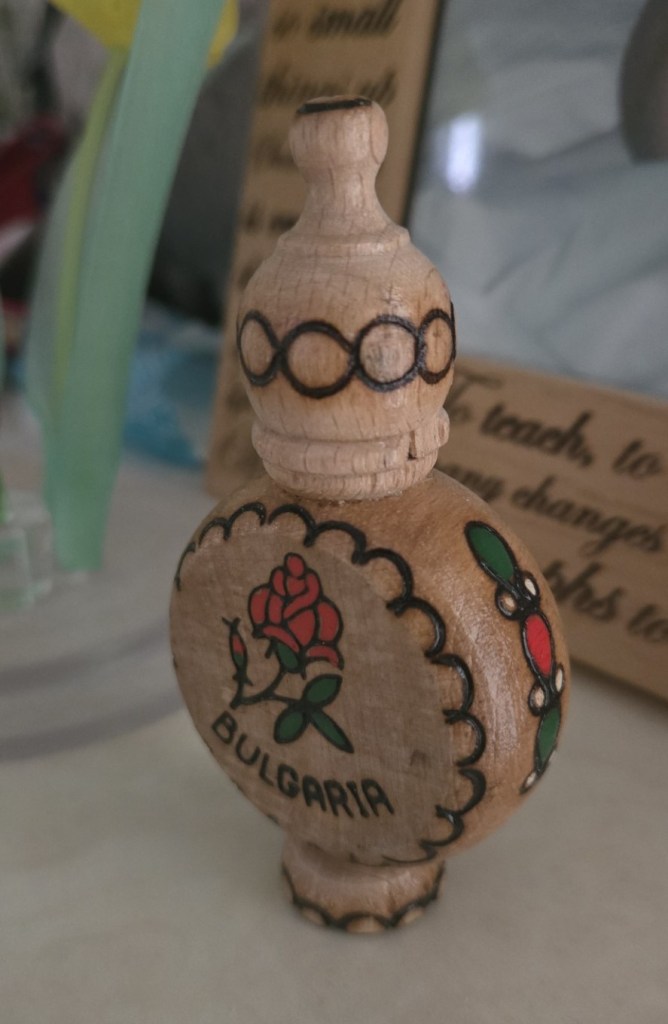
Everyone I knew had one of these little bottles with rose perfume

A close childhood friend of mine lived in Bulgaria with her parents until her father, who was stationed there, died in an accident, and she and her mother returned to our provincial town and our quiet little street.  For years, they would be visited by Bulgarian friends who spoke lightly accented Russian and brought amazing toys and delicacies.  I heard so much about it in my childhood that I felt like I kind of sort of knew it. 

And lokum, this most delectable of desserts!

Bulgaria seemed like us but better.  The people looked, spoke, and dressed a lot like us (though, of course, more fashionably), but were friendlier, less care-worn, just brighter somehow. I imagined their cities were cleaner, and of course the stores were full of treats.  We were supposed to be the biggest, the best, and the most powerful country in the world, but according to numerous accounts from these real people, they had more of everything.  It was a paradox that remained unresolved in my childhood.

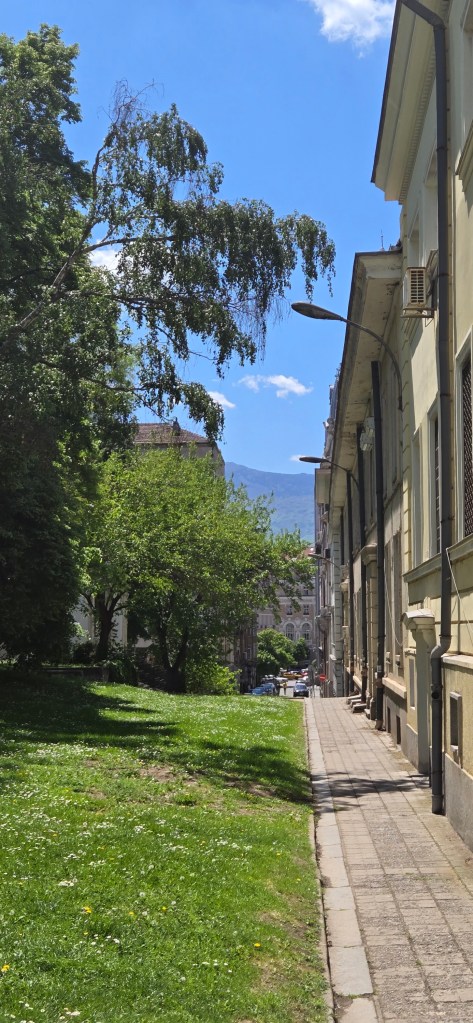
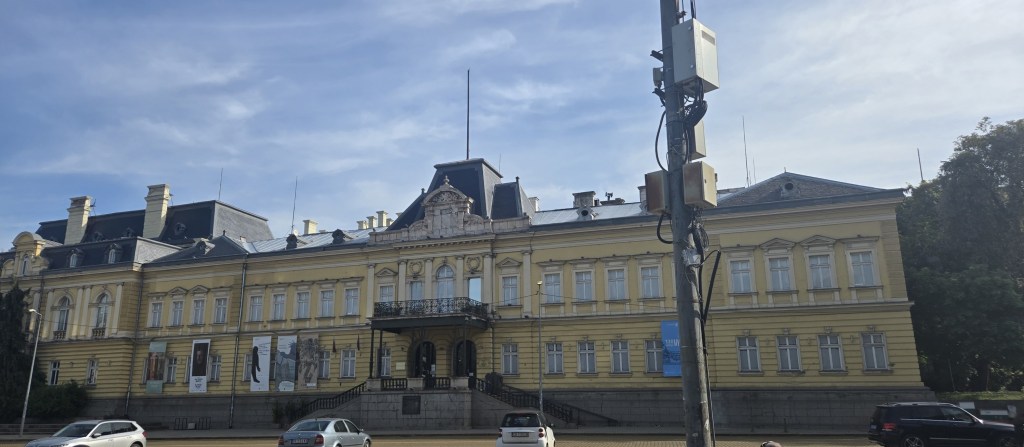
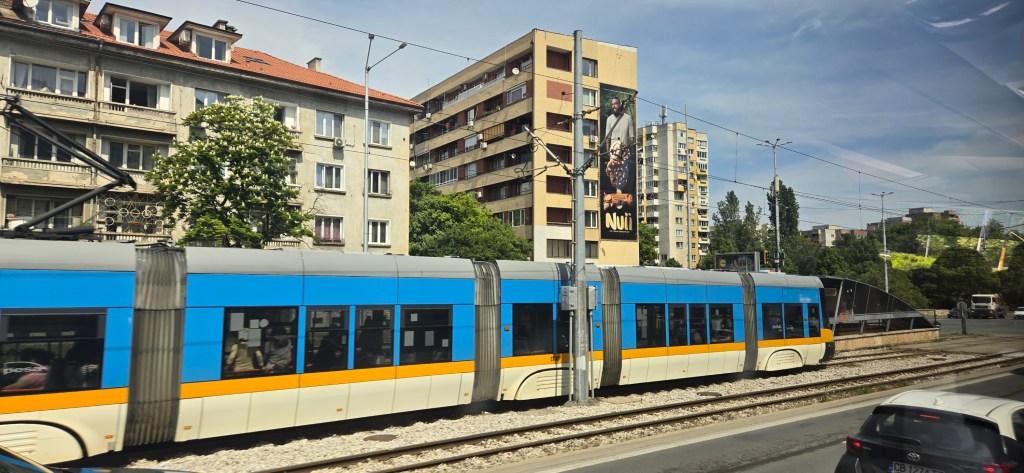
Finally coming to Bulgaria, after imagining it for decades as a fairy tale land of plenty, I found that counterlife I never really lived.  So far away and so long after my childhood, I take the concept of plenty entirely for granted.  Instead of being excited by the exotic otherness that I would have expected to see as a child, I was touched by the occasional glimpses into the past.  The trams and trolley buses.  The tree-lined streets with slightly uneven pavement.  The post-war Soviet-style buildings.  The city parks with benches full of people just hanging out on a warm spring evening.  The onion-domed Orthodox churches.  And everywhere, the signs in Cyrillic. 

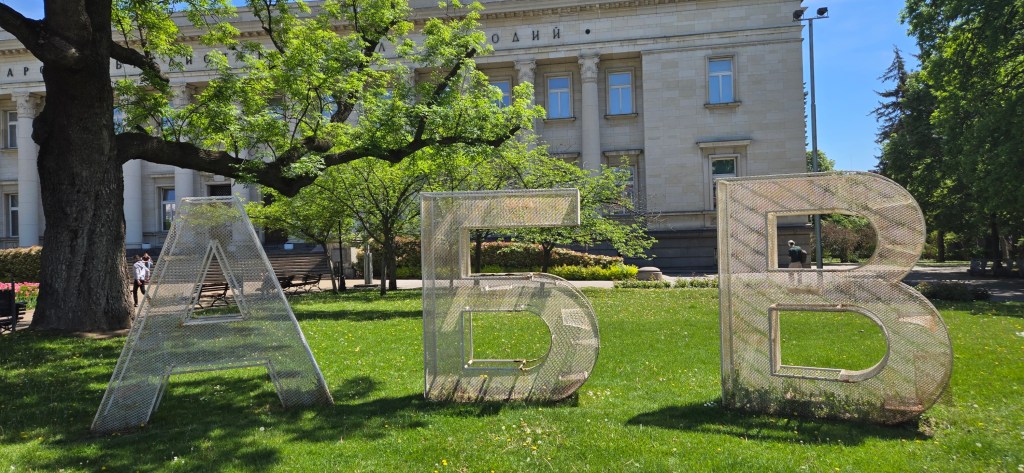
Coincidentally, Sanaz Toossi’s Pulitzer Prize winning play “English” is currently nominated for the Best Play Tony Award.  I saw it performed locally, and sobbed through the whole thing.  One quote stays with me: “When I speak English, I know I will always be a stranger”. I have been a stranger in a strange land for decades.  I speak a foreign language in my home, to my children.  I do not know Bulgarian, but just the cadence of it and the occasional words I could pick out in this native-adjacent language was music to my ears. And seeing familiar letters everywhere, effortlessly reading signs, just absorbing the words, well, that was balm to my eyes—and my soul.  Thank you for the alphabet, Bulgarians Saints Cyril and Methodius!

National Library named after Sts. Cyril and Methodius, naturally

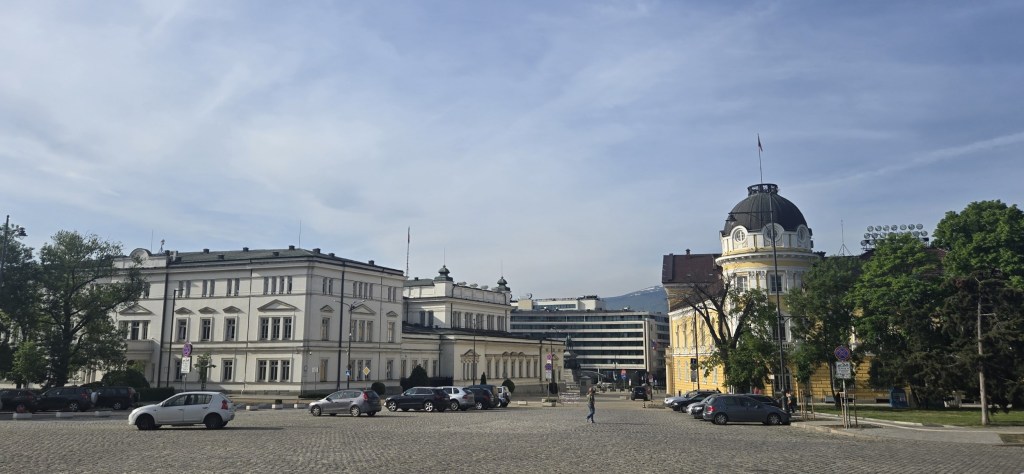
As soon as I arrived in Sofia, I went for a walk that was both purposeful, soaking it all in, and aimless, just wandering the streets and searching for the memories of that parallel childhood.  Walking on the Tsar Osvoboditel Boulevard, taking the slight curve and suddenly seeing the National Assembly building with its tri-color flag, I almost mistook the green stripe for blue.  I could have been in Moscow (had I ever wandered around Moscow on my own—I never have).  It could have been 1972 (if one ignores the modern cars zooming by).  Everything was both larger than my own hometown (for Sofia, after all, is a capital, while I come from provincial backwater), yet small enough to feel familiarly nostalgic. In short, just as I dreamed it would be…

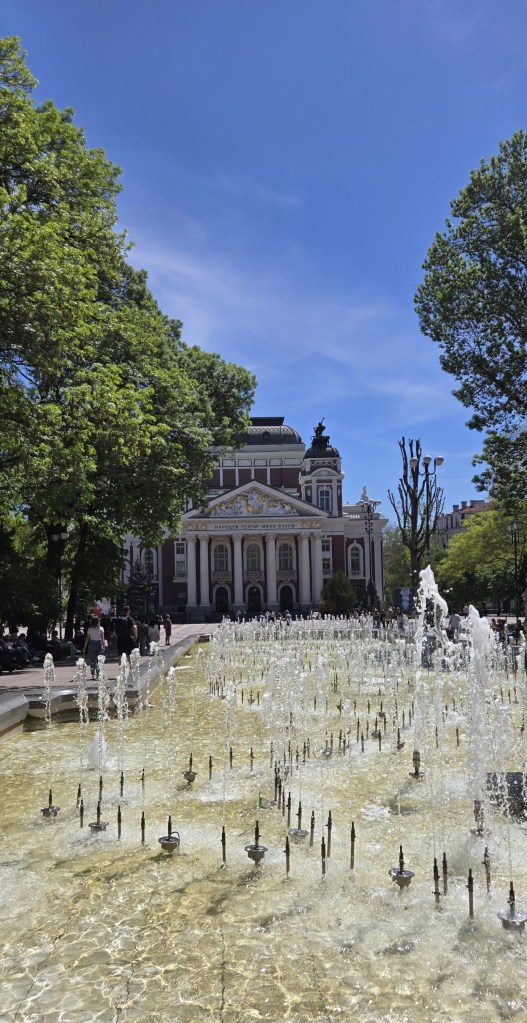
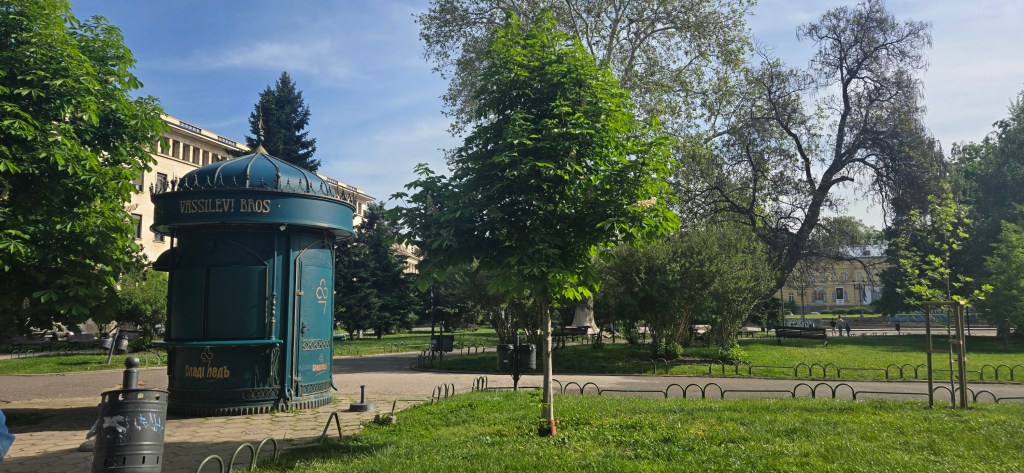
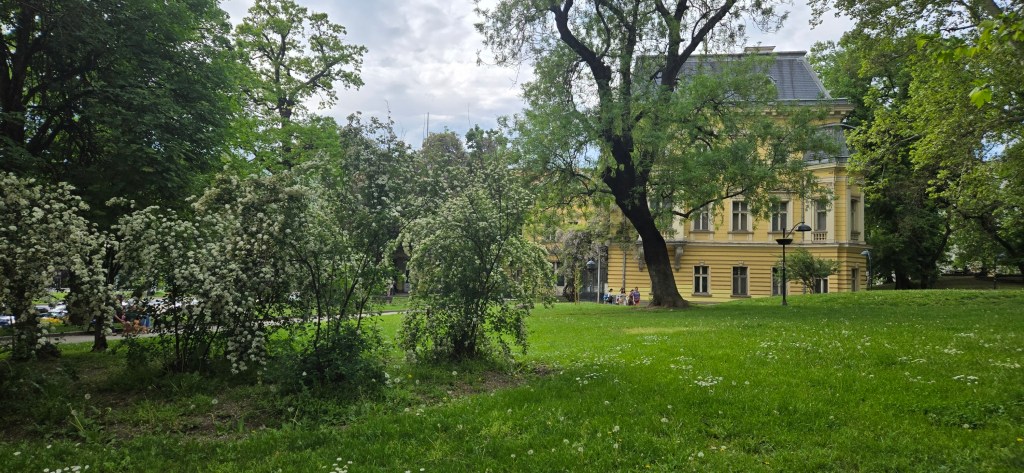
I wandered through the lovely City Garden, and came upon the beautiful neoclassical building of the National Theater named after Ivan Vazov where I saw a poster for the upcoming production of none other than “Rosencrantz and Guildenstern Are Dead”.  How I wish I could have seen it there! 

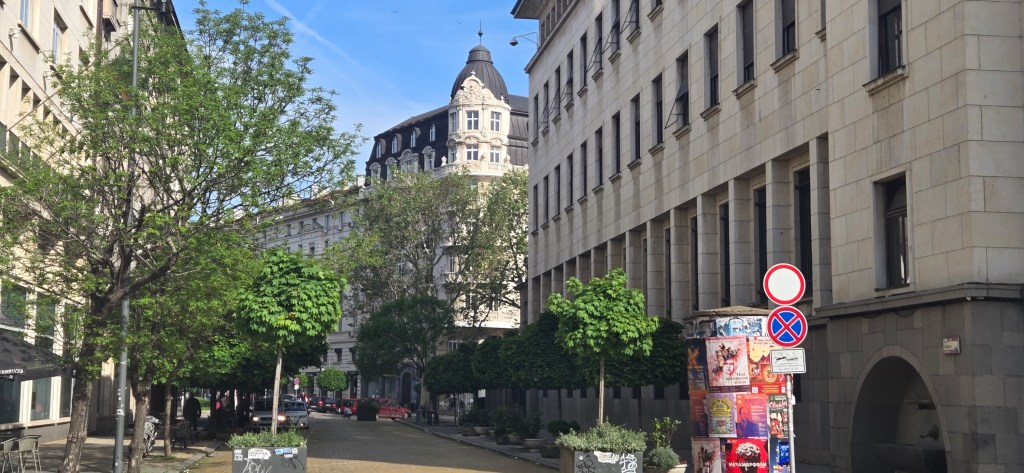
This mix of green spaces, cheerful fountains and colorful flower beds, elegant pre-war buildings on cozy streets and imposing post-war ones on wide avenues, it was all so recognizable from another place and time.  Vitosha Boulevard, the lively pedestrian street with rows of stores and outdoor cafes was the one place that stood out as belonging strictly to the Western, European Union present.  We had nothing like that during the Soviet era.  And even that was heartwarming, a confirmation (as if I needed one) that there is no stagnation, life marches on, and new and wonderful things continue to happen. This is not just an imaginary country of my childhood, but a thriving, vibrant, warm and beautiful land of dynamic present and promising future.

And speaking of Tsar Osvoboditel (Liberator), none other than Alexander II of Russia, who freed Bulgaria from the Ottoman Empire:  my great-great-grandfather fought in his army.  I do not know if he fought in the battles for Bulgarian independence, but I choose to imagine that he did.  I do know that the fact that he was “Alexander’s soldier” decided my family’s destiny, for it enabled him and his descendants, including my beloved maternal grandfather, to live in Russia proper, beyond the Pale of Settlement.  So I have feelings of gratitude to Alexander II that are at least as warm as those that Bulgarians still seem to harbor.   In Russia, he earned his moniker for the emancipation of the serfs, but in Sofia, his impressive monument bears the inscription “To the Tsar-Liberator from grateful Bulgaria”.  He seems to have been the last of the decent ones, as far as Tsars go.

I only spent two days in Sofia, two glorious, beautiful sunny days at the beginning of the longest vacation I have taken in my adult life (10 days).  If I never make it to the land of my actual childhood, I know where to look for a substitute.

Featured

Midsummer Magic

Without any effort—or, indeed, desire—on my part, “A Midsummer Night’s Dream” has recently emerged as the Shakespeare play I have seen most often live on stage.  From some initial encounters ranging from indifferent to downright embarrassing, our relationship has grown and developed into one of admiring understanding.

My favorite among the comedies was always “Twelfth Night”, simply because I saw a televised version of it as a child.  The bumbling duo of Sir Andrew and Sir Toby impressed me the most, and remains my favorite pair of comedic incompetents in the entire canon.  As for “Midsummer”, we did not meet until I was in college. 

I saw several productions over the years, from my beloved Stage West Theatre in Fort Worth to the Stratford Festival in Canada.  Most of them were competently entertaining if not affecting.  Let’s face it, the young lovers’ plight and predictable resolution is not what makes this play so popular; it is Bottom and Co. and the fairies.  And here is where it usually lost me—I have never really enjoyed them as characters on stage.  I have always felt that so much effort goes into the fairies, their costumes, their makeup, their habitat that every else kind of gets lost in the forest, pun intended.  The set is too green, or too blue, there is too much mood lighting, too much gauze/glitter/sparkle/fog/flutter of wings, etc.  I think there is temptation—not entirely surprising—to just get overwhelmed by the external while putting on a play that involves the magic realm.  If I remember nothing else from some of the productions of “A Midsummer Night’s Dream”, I remember a lot of shrubbery and a lot of wings.  I never actively disliked it, but neither did I seek it out. 

Not sure who gets the credit for this photo; it was shared with me by a cast member. Hippolyta/Titania and Theseus/Oberon.

So imagine my surprise when, in a fancy suburb of Chicago which I have distrusted since that fateful day when I visited a client there and could not find my way back. https://oldladywriting.com/2021/08/08/bad-day-in-chicago/  Spoiler alert: Napierville redeemed itself with the most imaginative and heartfelt rendition of “Midsummer” I ever had the privilege of enjoying.

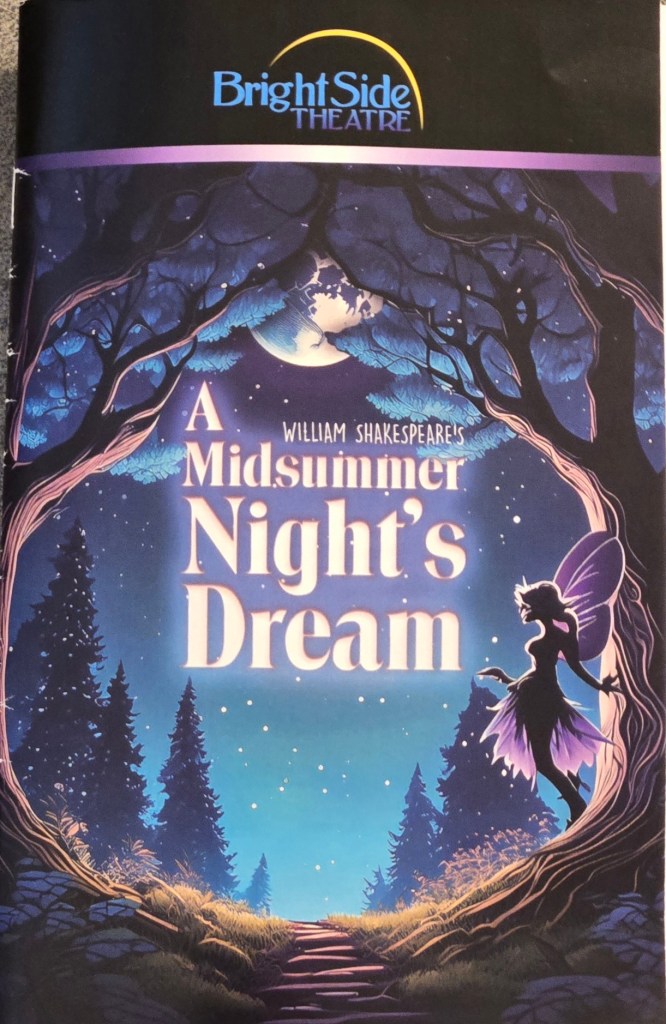
A Midsummer Night’s Dream – BrightSide Theatre

Aside from the quartet of young lovers, who just basically do their thing, the characters in this production are familiar and yet somehow new.  In a smaller theater, with a thrust stage and actors occasionally breaking the proverbial fourth wall, you cannot help but feel part of the story.  But in this version, the relatability is more than a function of proximity.  Theseus of Athens and Hippolyta of the Amazons are played by the same actors as Oberon and Titania, and their attendants in the opening scene also morph into fairies and back again.  Grounded in the corporal world, the fairies are certainly creatures imbued with supernatural powers, but, human-presenting, albeit gorgeously and colorfully costumed, they convey the message that magic is in and all around us.  This double casting, for me, creates a more tightly knit, unified story that is more than just a series of connected plots.  Regal Theseus’ humanity never leaves Oberon, wry elegance of a courtier stays with the mercurial Puck, and Hippolyta is both proud and hopeful as Titania.  So powerful is this bond between the two worlds that I am not sure I ever want to see “Midsummer” again where these roles are *not* played by the same actors.

The play’s funniest scene, when the indomitable troupe of rude mechanicals perform the ill-rehearsed and even worse-written “Pyramus and Thisbe”, is as hilarious as anything I have ever seen.  Peter Quince’s earnestly overwrought introduction, Tom Snout’s exasperated attempts to focus “the wall” on Nick Bottom’s pompous meanderings, Robin Starveling’s laborious attempts to handle two objects at once, and Snug’s brave overcoming of stage fright as the gentlest of lions are all full of humor that never spirals into caricature.  In this production, you root for everyone, even the overly confident yet somehow endearing, wide-eyed Nick Bottom.

I am that pedant who pays attention to and gets distracted by false notes in costuming. This “Midsummer” did what I have seen once before in another play and remembered forever.  It starts in monochrome and gradually becomes more and more colorful.  It is not just that Athenians appear in shades of gray and citizens of the magic realm are in color.  It is not just that Theseus goes from somber black as a ruler of Athens to royal purple as the ruler of the magic kingdom.  The young lovers also gradually transform from gray business professional attire to red and blue silks and lace.  With each exit and entry, I was anticipating the next development of the costumes (and coveted some for myself!).

As for the set, absent are the usual overpowering prop trees and astroturf.  Truly, they just bog down the text and the action (I always knew that).  Instead, there is an abundance of confetti, in all shapes and sizes, and strewn about in every way, including through cannons, which creates an atmosphere of joyful celebration.  And original music written for this production adds another layer of enchantment and lyricism.

Finally, there is *that moment* that transforms everything https://oldladywriting.com/2021/05/25/who-tells-your-story/.  Francis Flute, a mass of nerves as he should be, suddenly loses the high-pitched voice and simpering manner and delivers Thisbe’s farewell speech to the “corpse” of Bottom with the heartfelt pathos of the finest tragic heroes.  I would like to have said that there was not a dry eye in the house, but that would not have been true—still, a hush fell over the audience, and that is no small feat for this play and for this scene.

It never ceases to amaze me how, while staying true to the text and the plot, some productions of Shakespeare’s plays find a truly unique voice.  I give credit to The Bard, of course, for his words are timeless and multilayered.  But I also have to give great credit to the immensely talented team that brought the old story to live in this particular, extraordinary way.  If you are anywhere near Chicago for the next couple of weeks, see this show, before it disappears like so much fairy dust…

Featured

Tartuffe, Impostor, Hypocrite

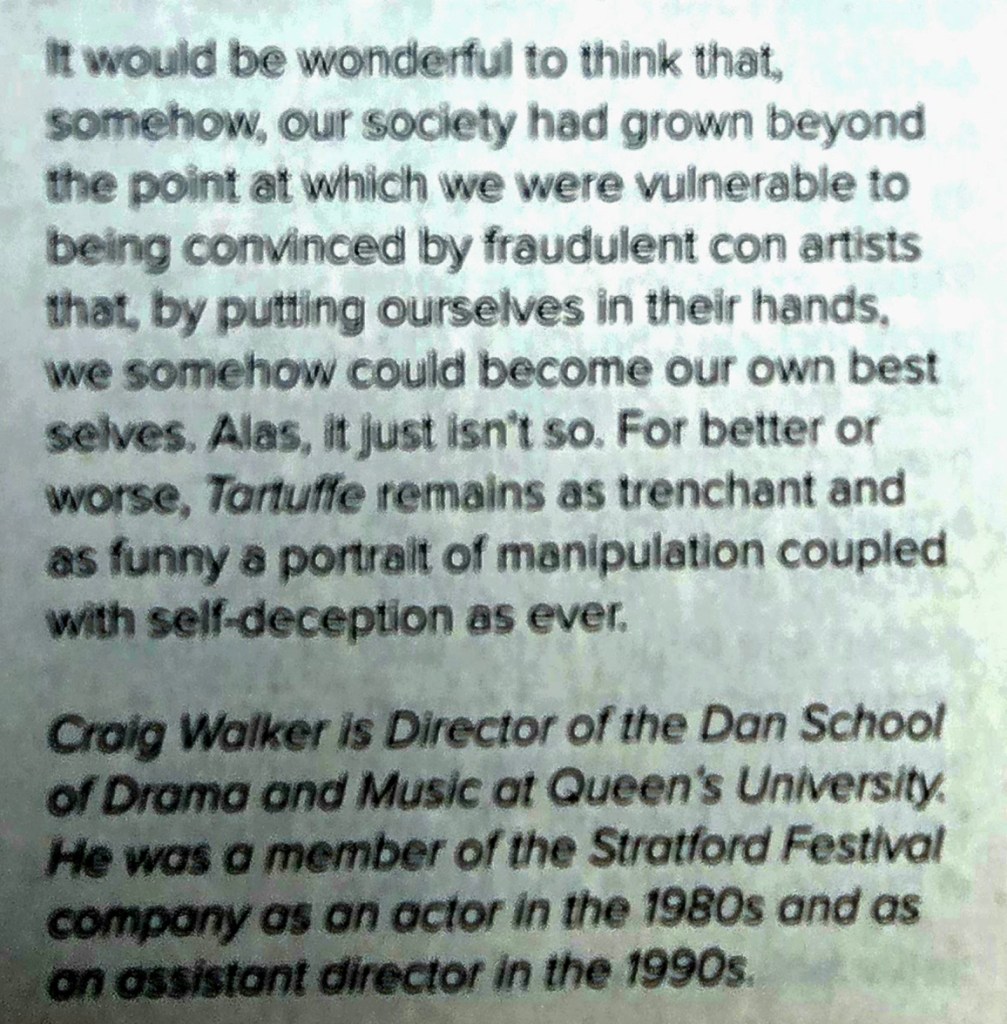
To mention, let alone stage, “Tartuffe” (or “The Impostor”, or “The Hypocrite”) in these turbulent times is almost too obvious.  There is nothing I can say about this brilliant enduring satire that scholars of history and literature have not already said with significantly greater insight.  I will just leave this quote here from the program from the best production of this play that I saw in Stratford in the summer of 2017 (and we thought times were turbulent THEN…):

“Tartuffe” was the first adult play I ever saw live.  It was also the only adult play I saw as a child in the Soviet Union, in our externally beautiful, internally uninspired, historic Volkov Theater [https://oldladywriting.com/2020/07/26/all-my-world-is-a-stage/].  Credit goes only and eternally to Molière (and to the translator, whoever he was[1]) that this experience did not sour me on either live theater or French literature.  That my enduring love of both has shaped my life is something that could not have been anticipated from that first chaotic encounter.

“Tartuffe” came to town when I was maybe 11, and my mother decided that this will make a fine mother/daughter afternoon of culture.  We had fewer such opportunities than one would expect, for reasons that are many, varied, and complicated, ranging from familial to societal.  Everything that pertained to cultural development in my childhood, every museum visit, every book about art, came from my mother.  I cannot bear to think what my early childhood would have been had we spent less time together, but I used to often wonder what it would have been like if we had spent more.  And this is most certainly a story for another time. 

In order to prepare for this momentous event, she decided that we will read the play aloud together.  It was a great idea.  I still remember the first lines spoken by Mme Pernelle to her maid Flipote and Elmire’s response, that opening scene that sets the stage long before the titular character makes his entrance .  To me, they are like the iconic opening bars of a musical.  We took turns reading it aloud, sitting on the stools in my mother’s kitchen.  It was pure joy: the relatable characters with fun names, the dialogue alternately wacky and clever, the ultimate victory of sane minds and loving hearts over liars and cheats.  After “Tartuffe”, I read the rest of the plays in the Molière “greatest hits” collection, and liked them all, but none had a lead character as deplorable and deserving of retribution as this one[2].  It aged extremely well, from the day it was written to the day I read it a little over three centuries later to our tense present. My oh my, plus ça change…

And then came the actual day.  I do not remember the time of year (but choose to set it on a beautiful springtime day) or what I wore (a good sign; I hold enough grudges from my childhood for not being able to choose what to wear on a special occasion).  I remember arriving and heading straight to the theater buffet for a glass of sparkling lemonade and a “basket” pastry.  (For how much I keep mentioning this pastry, I should just make it already—there are recipes online.  Of course, I fear it will not be as amazing as I remember it from childhood.  Nothing ever is.)  My mother cannot be credited with coining the phrase “eat dessert first”, but can definitely be trusted to always do it.  It was a matinee, the buffet was not crowded, and we enjoyed our pre-show treats before proceeding without undue hurry to our seats.  At which point we discovered that we arrived an hour late and missed the entire first act, Mme Pernelle’s opening speech that I memorized being the first, but by far not the only, casualty.

To be honest, I do not recall feeling particular distress at that moment.  I was happy to have enjoyed a pastry, and I did not expect much from the spectacle, for I have been to the Volkov before on school field trips.  Its reputation at the time was consistent with everything else in our stagnant provincial town.  We sat way in the back of the orchestra, under the balcony, a terrible spot in any theater.  Either the acoustics or the actors themselves were lacking, but we had trouble making out what was going on; the words were completely unintelligible (and this was back in the days when my young hearing was very keen, so if I could have heard anything, I would have).  And thus the second act passed in a haze of confusion.

After the second intermission (first for us), my mother, determined to see and/or hear the rest of the play, searched for better seats.  Fortified with more treats from the buffet, I was game.  We spotted an empty opera box and moved in, feeling pretty pleased with ourselves.  We actually started to enjoy the final act when the door behind us opened and two guys in their 20s rolled in, looking and smelling like they partook of something stronger than sparkling lemonade at the buffet.  Checking their tickets with some incredulity, they asked if these were in fact their seats.  My mother barked that the seats were ours, and they meekly retreated, presumably back to the buffet.  We felt triumphant.  It might not seem like much, but it was a perfect coda to a memorable and fun afternoon to which the play was merely an atmospheric backdrop.

I do not expect that I will live to see “Tartuffe” again performed in the language in which I first read and loved it, but I would like to someday experience it in the language in which it was written, the original words I studied in college, in the House That Molière Built, where it is allegedly the most produced play (where so far I only keep running into “Cyrano de Bergerac”). 

P.S.  About translations:  I am of the opinion that French and English are not entirely compatible when it comes to literature.  Established translations, to my ear, do not convey the lightness of the original—yet some modern translations are too colloquial to retain that time and place that is unmistakably Molière.  I have seen some adaptions of his plays that were competent, yet unrecognizable, although for “Tartuffe”, I prefer the crisp, sparkling translation by Ranjit Bolt to Richard Wilbur’s staid and stolid one.  This was the translation used in the 2017 production mentioned above.


[1] In this particular case, it was someone by the name of M. Donskoy.  I give credit where credit is due.

[2] What were the other plays in this collection, you ask? About what you would expect:  “Don Juan”, “L’avare”, “Le Bourgeois gentilhomme”, “Les Fourberies de Scapin”, and “Le Malade imaginaire”.  I saw a televised Moscow theater production of  “Le Bourgeois gentilhomme” as a child, and never forgot the hilarious part where M. Jourdain discovers that he has been speaking in prose his entire life.  Coincidentally, this play remains one of the few on my theater bucket list—I have not seen it live to this day.

Featured

Lyon and Environs

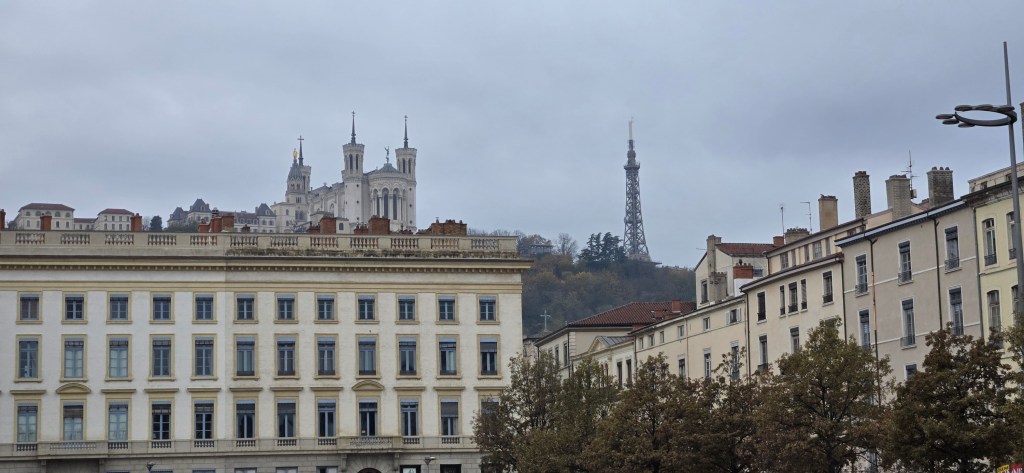
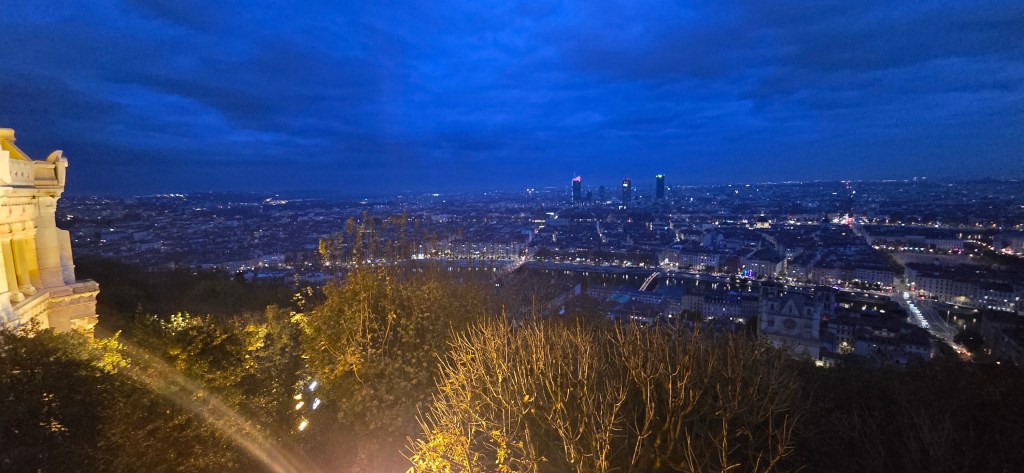
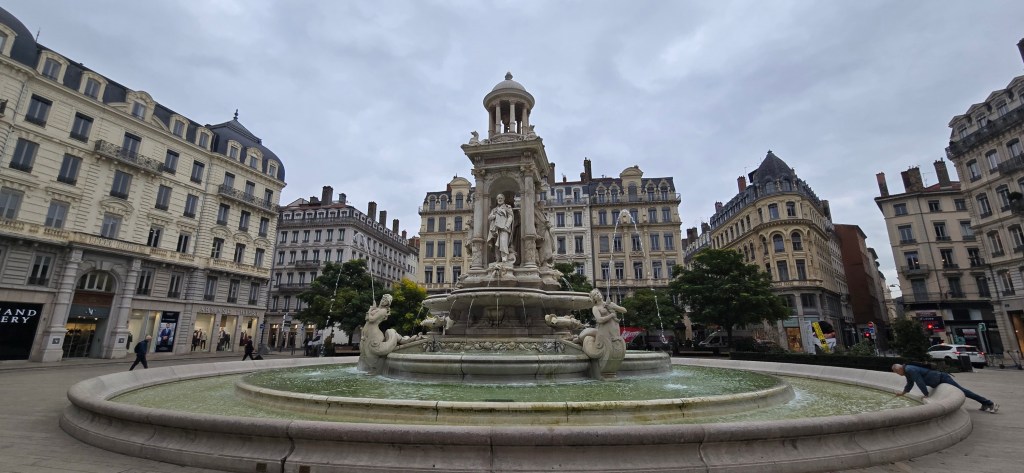
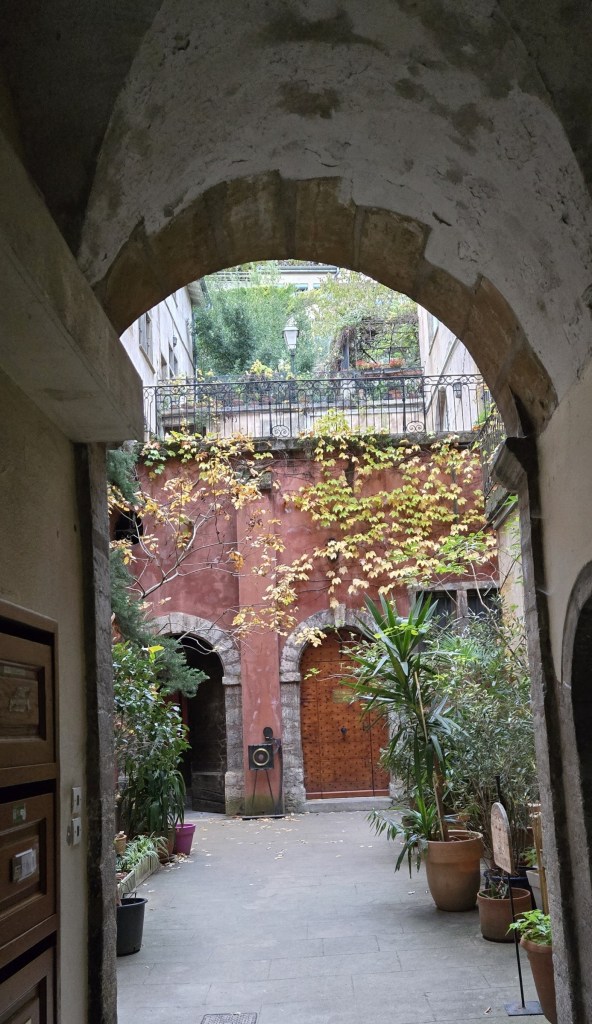
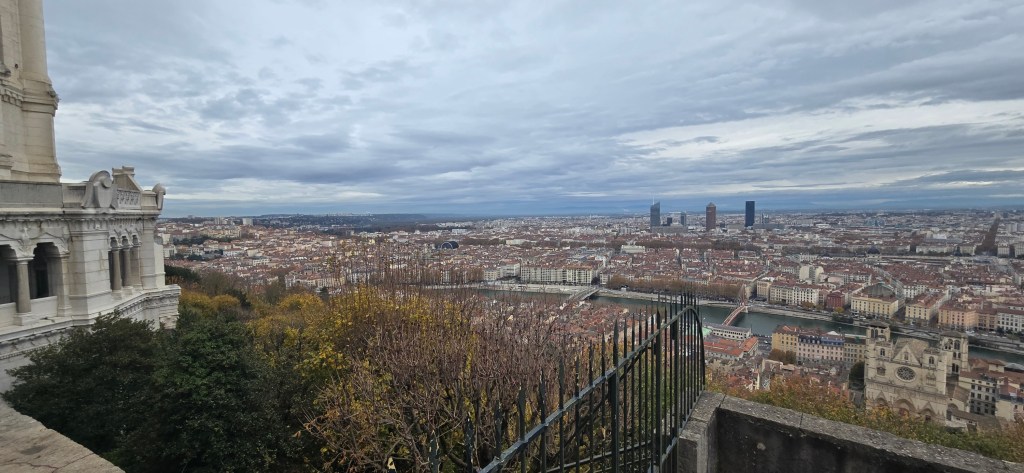
After discovering Beaujolais Nouveau on a trip to France in 2017, followed by some social-distanced celebrations on the Third Thursday of the Eleventh Month during The Plague Years, I decided to add the visit to this annual event, Les Sarmentelles de Beaujeu in the heart of the wine region, to my bucket list.  Spoiler alert:  I was saddened, but not entirely surprised to discover that my wine and charcuterie consumption has a limit.  No, I will not tell you what that limit is, because it is kind of embarrassingly low.  In any case, even before the trip, I correctly guessed that merely drinking copious amounts of wine will not be enough for a European vacation—and decided to add the heretofore unknown to me the city of Lyon to my travels, due to its proximity to the festival.

For reasons that are passing understanding, quick online research resulted in a portrayal of this city as crowded and crime-ridden, with traffic jams for days.  This gave me some measure of anxiety, despite the fact that I (1) drove in Munich on the opening weekend of Oktoberfest, (2) drove in Scotland, (3) drove and lived in New York City, and (4) you know of some of my other more colorful misadventures, including being attacked by monkeys.  I discovered Lyon to be just what I expected (once the sane voices in my head, including that of Rick Steves, prevailed), a lovely French town with rich history and interesting food.  Here are some highlights:

The food.  Lyon certainly has its own gastronomic style. I will try anything once.  Once.

Andouillette sausage: Our very first meal upon arrival was to order sausages, Lyonnais and Andouillette.  I just knew “sausages”, and how bad can they be?  I do not eat them at home, they are gross to me, but I enjoyed them in Germany.  And with all the emotional and historical baggage set aside, I have to admit—Germans do them best.  Lyonnais was covered in mustard, which was fine.  The other one was made of tripe.  I am sure Rick Steves warned me, but I forgot. (Also forgot to take a picture of this delicacy; probably for the best)

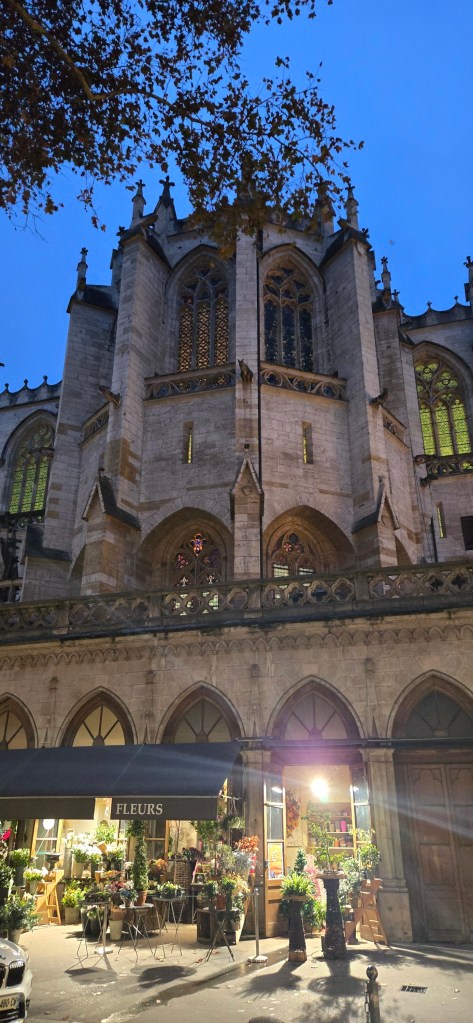
Brioche praline:  I am not a fan pralines.  It is the texture for me.  I was raised by dentists, and have bad Soviet-era teeth, so I am forever conscious when crunchy things come into contact with them (although the biggest villain in my dental saga turned out to be Laffy Taffy—took one of my crowns clean off).  Spouse and I watched people with intriguing colorful packages walk by, and were determined to try whatever extremely popular item they contained.  The actual store turned out to have a line to enter snaking for almost a block.  We demurred, but managed to get in the next day during a slow time.  Having bought the small brioche (which was still quite substantial), we parked ourselves on the nearest bench, in the courtyard of St. John Cathedral, and eagerly unwrapped our package.  It was as expected.  Brioche would have been fine without the pralines.  It would have been better with coffee.  My advice is, get the coffee, and leave this thing alone. 

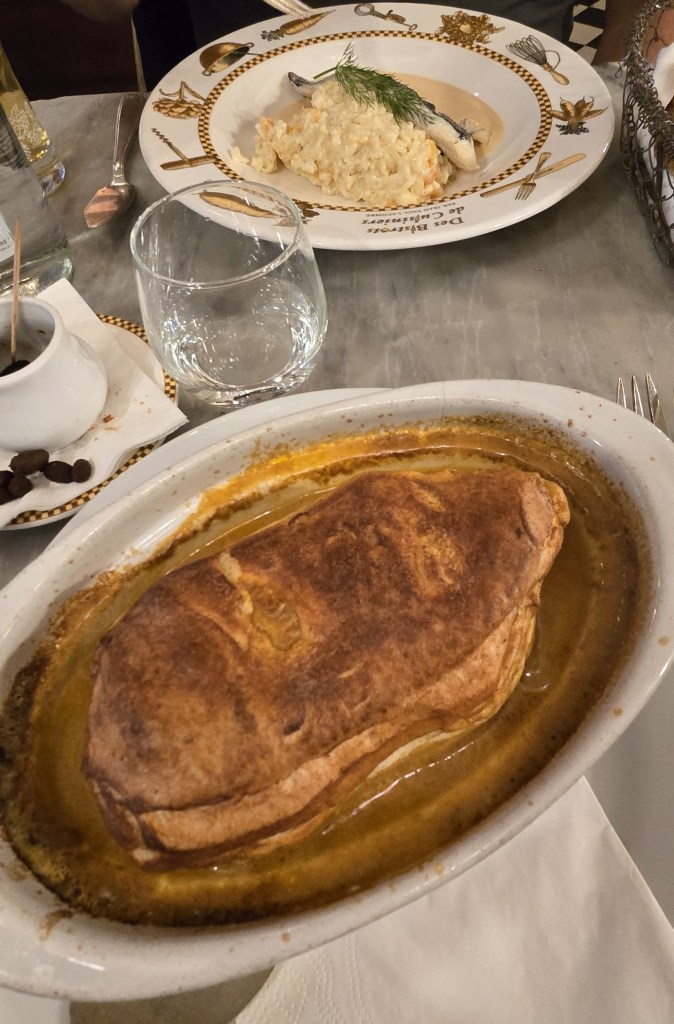
Pike dumpling:  I read that one of the Lyonnais delicacies is dumplings.  I was as game for that as I am for everything else.  I love baos.  I expected a stuffed bun.  I got something completely different.  It took me a bit of time to figure out that the word is not “dumpling” but “soufflé”—confusing, because “soufflé” is literally a French word, so why not use it?  So I basically got a fish soufflé.  It was very airy and delicate and not fishy (and I do not say “fishy” like it’s a bad thing), and I enjoyed.

Cervelle de canut:  It is a creamy cheese spread with herbs and spices, a bit tart courtesy of added vinegar.  To me, it was a less salty, less chunky version of the Austrian Liptauer spread, with which I am more familiar.  Basically, “creamy”, “cheese”, and “spread” are three words that go together in the best possible way. Speaking of three words that do NOT go together, I have not tried Salad Lyonnais.  Bacon, egg, and lettuce together is neither my idea of a good time, nor does it seem interesting enough for a vacation meal. Sorry not sorry.

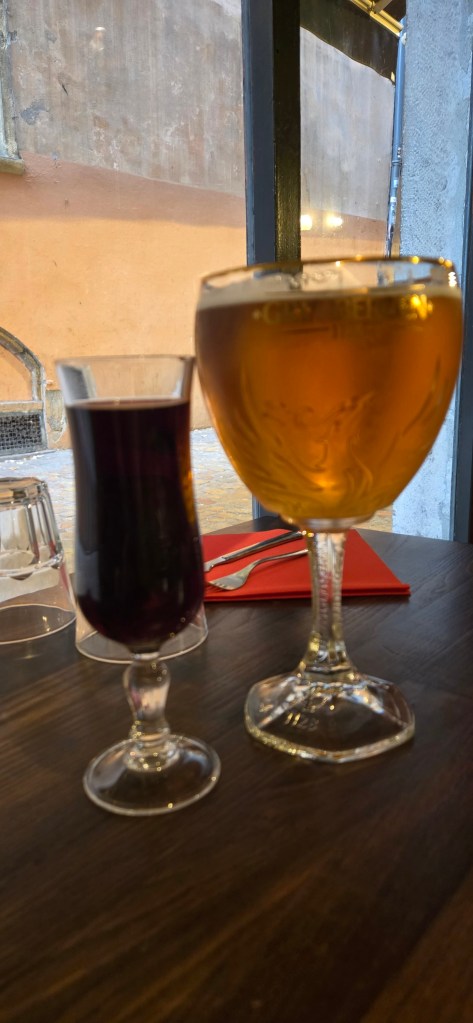
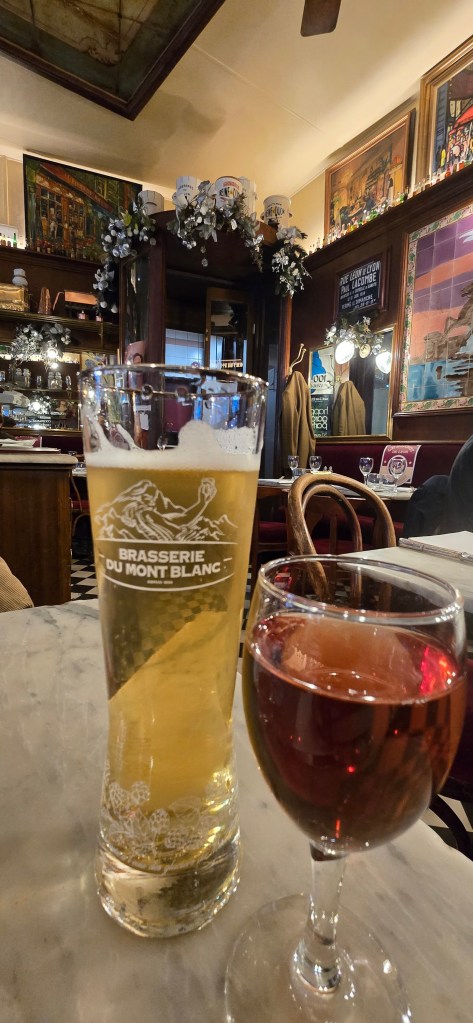
Kir:  It seems that every region in France has its own take on this drink.  I love it in every variation, which is ironic, because I hate black currants.  When I was growing up, I loved the delicate white and red currants, but always found the thick-skinned black ones a bit too aggressive.  Crème de cassis, however, is delicious when diluted with champagne to make Kir Royale.  In Brittany, I discovered Kir Breton, which substitutes apple cider for white wine.  In Lyon, they unironically serve up Communard, with red wine in place of white.  Next time I host a party, I need to offer a flight of Kirs.  I just came up with this idea, and hope I will not forget it.

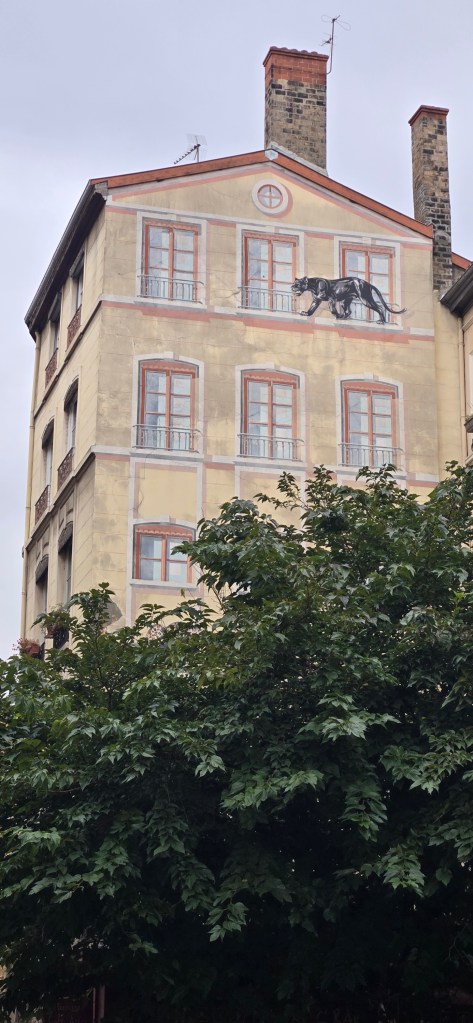
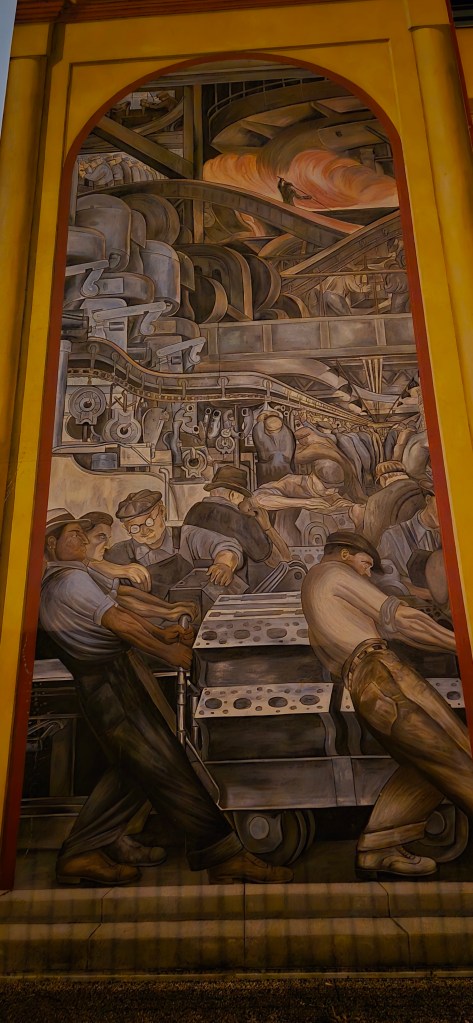
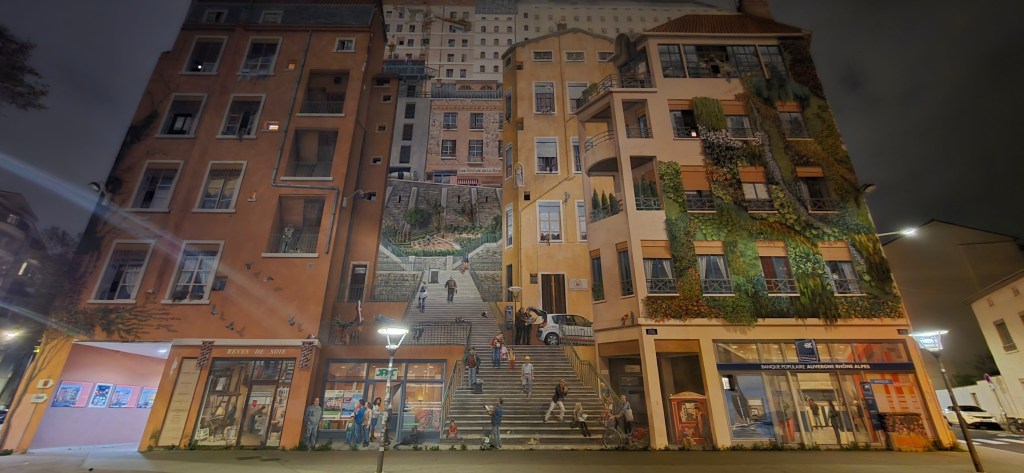
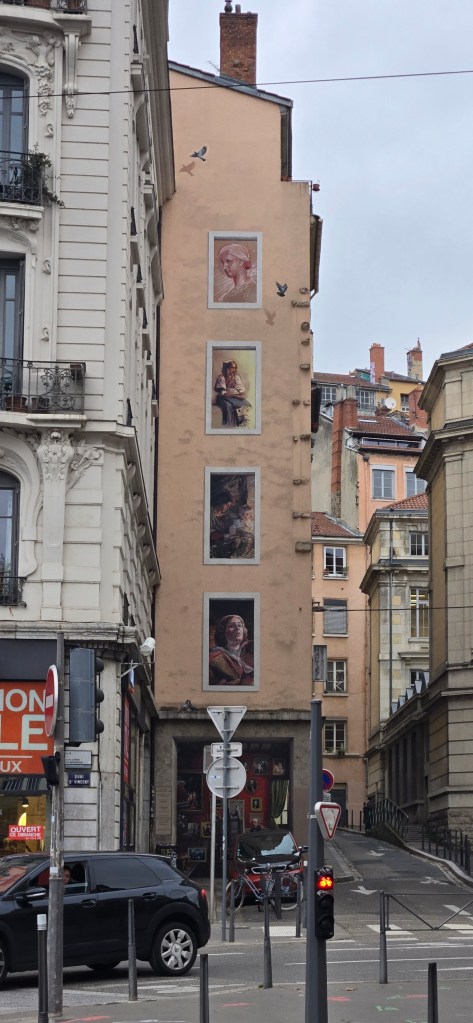
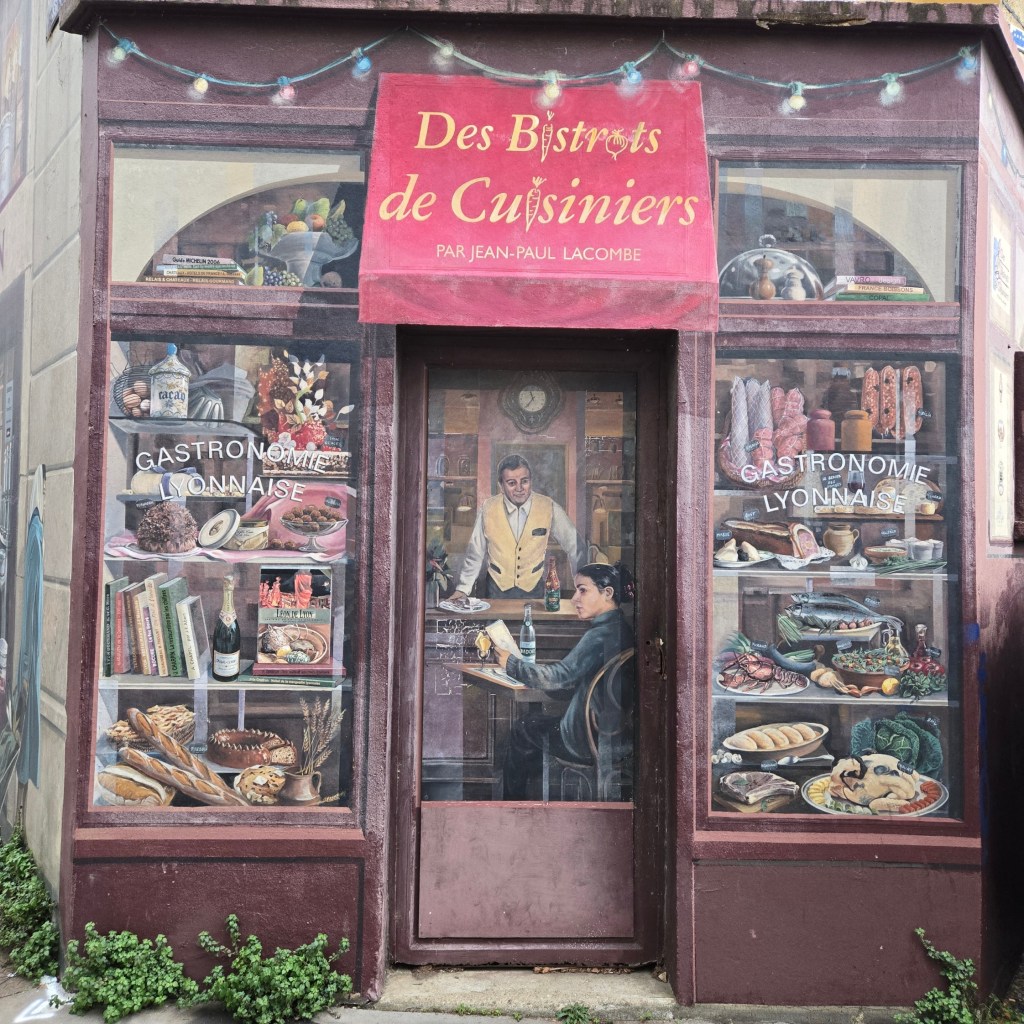
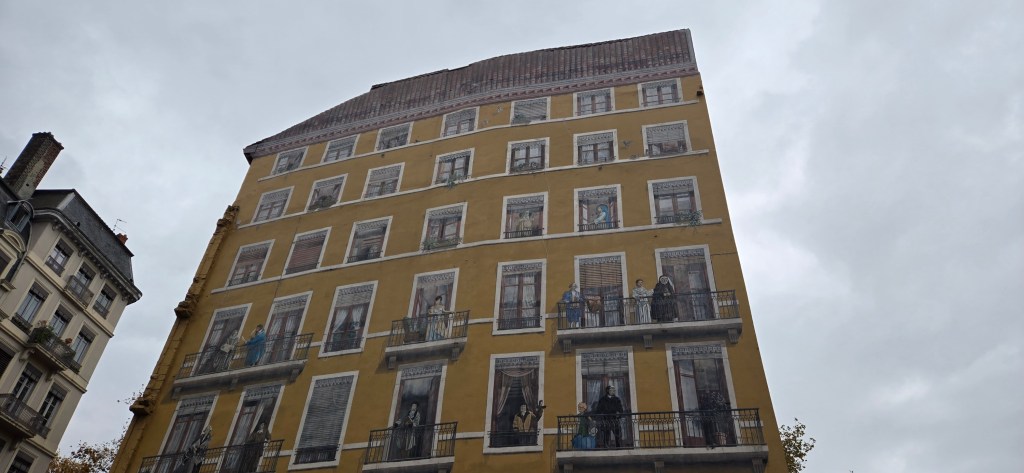
Murals: Lyon has a lot more to offer than just eating and drinking, and one absolutely amazing feature of the city is its murals—specifically, the trompe l’oeil kind.  I was really only looking for that one that is in all the tour books and pops up on social media whenever one sees anything about murals, Le Mur des Canuts (“Wall of the Silk Weavers”, the largest mural in Europe), but the handy paper map that we got at the hotel listed a few more, and so we went on a quest.  The best part of this kind of treasure hunt is that, because they are on outside walls of random buildings, they just sneak up on you.  You walk along, and there is a fake cat on a windowsill, or a fake windowsill, or a fake window.  After a while, you start questioning every door—is it real?  Is it just painted on?  Special mention goes to the Diego Rivera Mural which even has a small part that replicates the magnificent Detroit Industry Murals, as well as a portrait of Vladimir Ilyich Lenin; I sure recognized his familiar face.

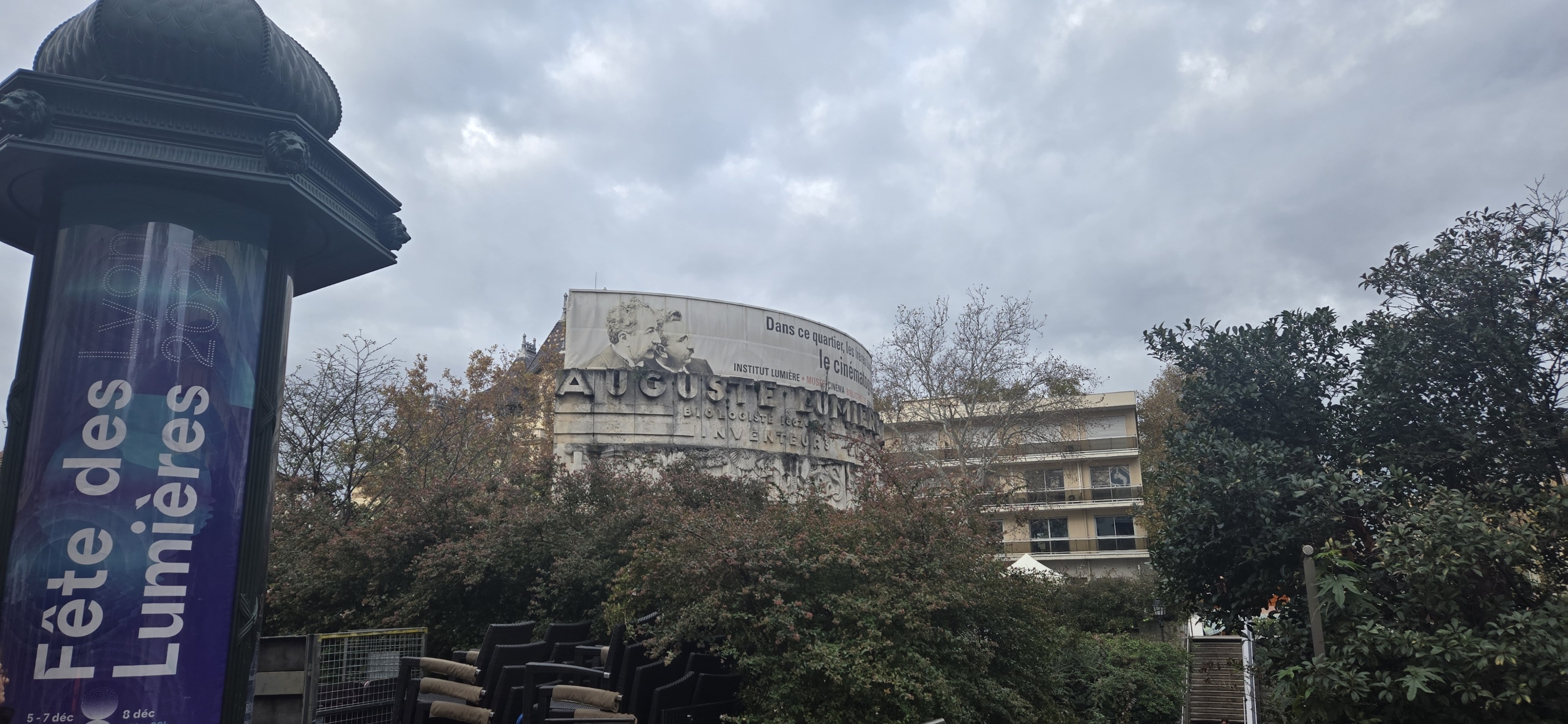
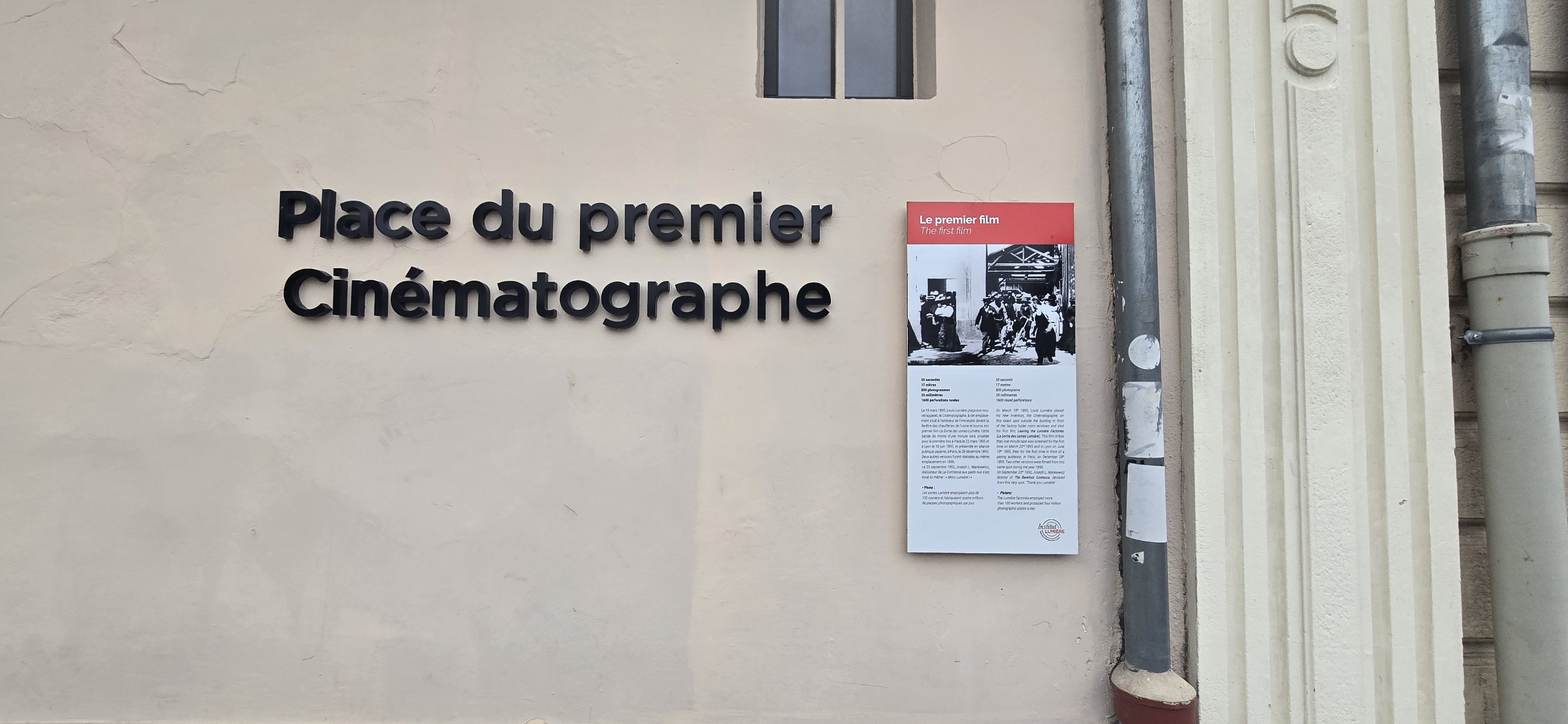
Lumière museum—In college, I took a couple of French cinema classes, including during my very first trip to France for my semester abroad, so the Lumière name was familiar to me.  This is not a French cinema museum (there is one in Paris, also very cool), but specifically, a museum of the Lumière family legacy and the early days after the invention of the cinematograph, in their actual villa.  Auguste and Louis were brilliant scientists, businessmen, and artists, and the world has not been the same since they were in it.

For the rest of the sights, the other museums, cathedrals, etc., check out a reputable tour book and do not trust the keyboard warriors—and I am unanimous in that.

Featured

Another Turkeyless Thanksgiving

I have disliked Thanksgiving before it was politically correct to dislike it.  Well, technically, that is an exaggeration, but the warmest emotion I ever felt toward it was indifference with a tinge of bafflement.  And by “Thanksgiving” I mean the actual celebration and trappings thereof; I always have, and always will, welcome and support the idea of a four-day weekend.  In fact, the four-day weekend is one of my most aspirational career goals.  But I digress.

Of all the big American holidays, Thanksgiving was easy for my mother to embrace during our early immigrant years because of its secular nature and a very specific, mandatory, and exotic (to us) menu.  Paradoxically, these are the very same attributes that eventually turned me off it.

For me, it has been a struggle to celebrate something to which I am not connected emotionally, religiously, or traditionally.  The holidays of my childhood were deeply rooted in the Soviet calendar, the May Day with its first blooms of spring, the Victory Day with its patriotic pride, the October Revolution (celebrated in November during the fall break, so kind of like the long weekend of Thanksgiving).  And then there were the traditional ones, New Year’s Eve conflated with Christmas, a kind of two-for-one complete with Grandpa Frost, gifts under the decorated evergreen tree, but also champagne and a glorious feast at midnight, Cheesefare disguised as Rites of Spring, and some very low-key, irreligious and food-focused Easters and Passovers.

And thus, Thanksgiving did not offer me anything from the very beginning.  When I first watched Macy’s Parade on TV, it seemed chaotic and pointless.  I was used to parades in which you walk, with classmates, with family, with balloons, banners, flowers, and it’s a party.  Watching giant things float is faintly anxiety-inducing to me.  The bland menu as well is almost opposite of comfort food, especially the turkey stuffing, which remains incomprehensible to me.  My spouse enjoys pumpkin pie, and I can make a good one, but making a pie out of pumpkins continues to persist as an alien construct.

My first distinct memory of this holiday is, fittingly, one of attempted avoidance.  My senior year of high school my mother and stepfather went on a cruise, taking advantage of the long weekend—a practice I later wholeheartedly embraced.  I was left home alone, having just turned 17 and anticipating four days in the company of my VHS tapes and Little Debbie snack cakes.  A caring friend was absolutely appalled at the idea of me spending the holiday alone, and took me to a large family gathering at her uncle’s farm.  It was a very nice time, and her kindness stayed with me.  This scenario played out again the following year, with different high school friends.  It was my first year of college, my parents were far away, and being enveloped in the warmth of a family that was not mine, and thus non-judgmental, remains a cherished memory.

For the rest of my time in college, Thanksgiving became a prized homestretch to write the final term papers.  I developed an efficient 24-hour four-day rotation of half hour writing/half hour listening to music while eating Oreos and mixed nuts and drinking black coffee.  Before my mom gifted me a Mac and a dot matrix printer my senior year, Sunday after Thanksgiving was spent in an interminable line at one of the university computing centers, waiting to type up and print my handwritten pages.  I will never forget when a frat boy from one of my Poli Sci classes spotted me sitting on the hallway floor in an unwashed mass of exhausted students and gave me his number that was dozens if not hundreds closer to being called for computer access than mine.  It’s funny, these memories of random acts of kindness…  I have to say that those solitary, but productive days were my second favorite iteration of this strange holiday.

The least favorite, by far, was the actual gatherings with family.  Oh, it is not the family itself, as much as the rituals.  Thanksgiving at my in-laws’, while casual and inoffensive, included the traditional menu I dislike and the obligatory mind-numbing football game that basically concluded with a disorienting midday nap for me.  Thanksgiving at my mom’s was exactly the opposite, extreme formality in dress and elaborate Russianized variations on the dreaded poultry and other dishes, also followed by naps on stiff furniture and a desperate search for the nearest open WalMart as the only available diversion.

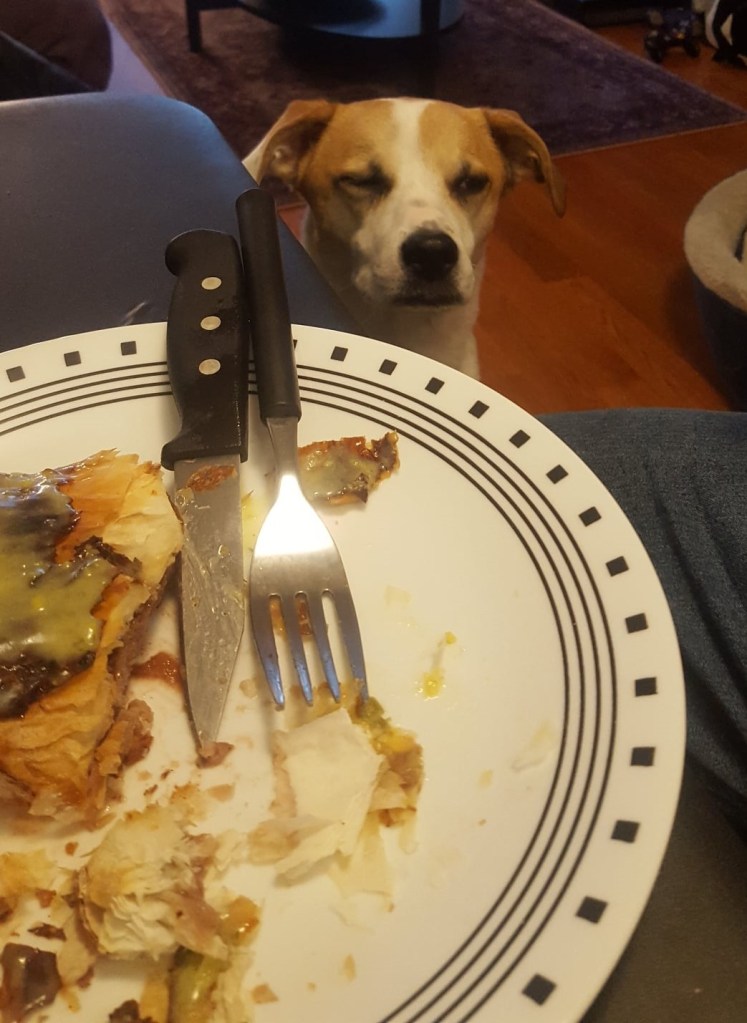
I don’t know who put this thing on my plate. I am sure I did not eat it. (2009)

The truly worst, however, were the Thanksgiving gatherings at my own house.  One time, my mother literally broke her foot when she slipped while running on my newly mopped floor.  Why was she running?  Oh, because as soon as she arrived at my house and saw me manually mashing potatoes, she exclaimed that she brought an electric potato masher to my house in anticipation of just such a clumsy error on my part, and ran for it.  Spouse finished the mashed potatoes and turkey, as I ate Lorna Doone cookies from the emergency room vending machine.  It was a horrible weekend however you look at it, but there is a tiny moral here of letting adult children adult.

Another Thanksgiving saw my son run away from home.  We assumed he was spending the night at a friend’s after one of the typical teenage fights.  It turned out that he was driving all night to none other than my mom’s house.  When he crossed the border into Tennessee on Thanksgiving Day, he realized that he did not know her exact address, and the gig was up.  It was a strange, strange weekend, and the less said about it, the better.

I have to give a nod to a few gatherings in New York.  There was my first year living in Manhattan, when I was wandering Greenwich Village with a friend (we saw “Home Alone” during its first run in a movie theater, and I also saw “L’Atalante”—and how is that for an eclectic mix that only NYC can provide), and because of exams coming after Christmas (creating a nightmare of a different kind), Thanksgiving was truly a four-day urban holiday.  There were also milestone family birthdays that coincided with Thanksgiving, and we gathered in Russian restaurants in Brooklyn with our traditions, including singing, dancing, and the comfort foods such as caviar/herring/tongue/”Olivier” salad and copious amounts of vodka.  Good times! 

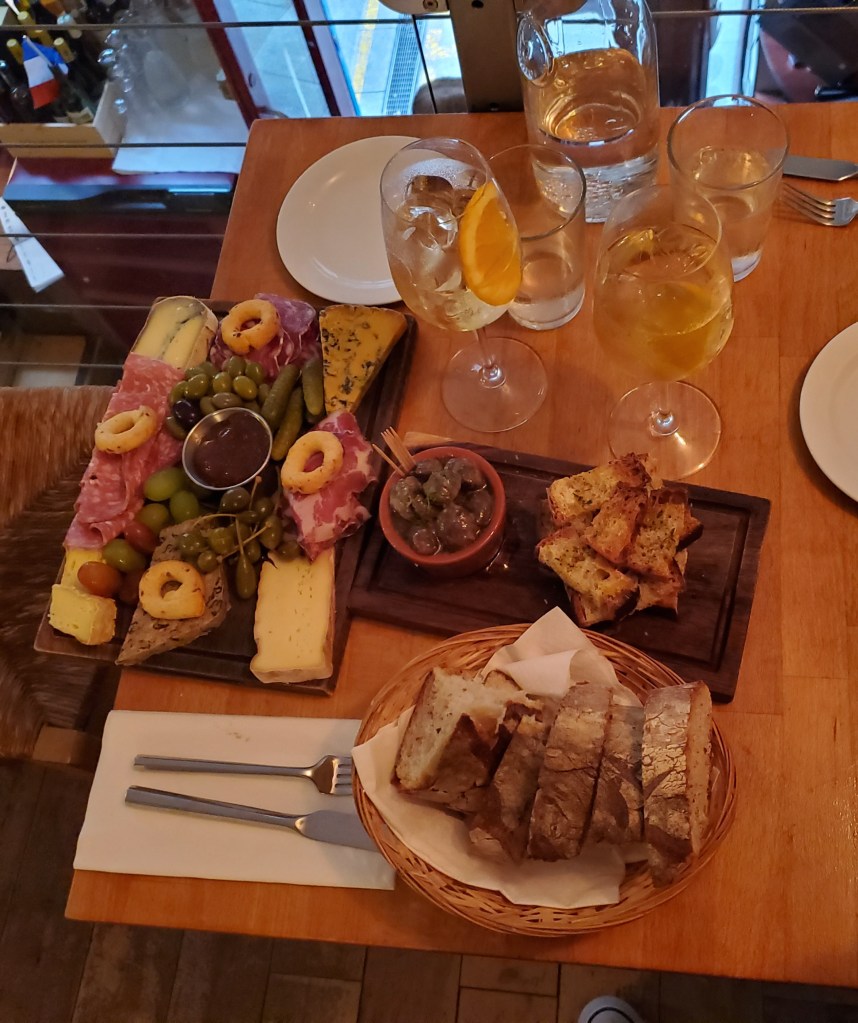
And this brings me to the best Thanksgivings.  They were all non-traditional and European.  There was paella in Spain (2008), rabbit in Malta (2010), Kir Royale at the Deux Magots in Paris (2012), discovery of Guinness in Dublin (2013), fresh turbot in Italy (2014), this incredible smoked orange liqueur in Portugal (2016), discovery of Beaujolais Nouveau on the French Riviera (2017), and the surprising charcuterie in Dublin (2019).

Also whiskey tasting in Dublin. Tealing Distillery. (2019)

Honorary mention goes to Vegas 2015—not quite out of the U.S., but still, Vegas is not your typical Thanksgiving venue—and Chicago 2018, with this failed Beef Wellington.

(2018)

Last year we attempted to have a first firmly post-pandemic family Thanksgiving, albeit in Chicago, and I woke up to a smell of smoke and a wail of sirens.  The building next door caught on fire.  It was a restaurant, so closed for the day.  No one was hurt.  But as I passed the fire trucks on my morning run along the lakeshore, I said to myself, strike three. 

Featured

Fat Ham, or Not Your Father’s Bard

Disclaimer:  I am not a theater critic, nor could I ever be one.  I am excited to share and recommend what I like, but with the wisdom (and empathy) of the years, I do not feel sufficiently invested in discouraging folks from seeing shows I do not enjoy.  I just cancel my season subscription.  Well, of course I will call a couple of my gal pals to warn them, but all of this is to say, we here at #oldladywriting are not panning any shows, especially in our local theater community.  We do not need the negative energy.  And so, here comes another glowing review, well-deserved.

Sometimes I see a show because I know it or about it, and I am excited to experience it.  Occasionally, it is because someone I know is in a show.  And then there are the theaters where I want to see everything, because they are consistently good.  And by “consistently” I mean, sometimes for a quantity of years and depending heavily on the artistic director.  As of this writing, I made a one-year commitment, with an option to renew, to the Detroit Public Theatre.

“Fat Ham” just opened the 10th season at the DPT.  I am not ashamed to admit that I knew nothing about it (because I am also not a literary critic).  I actually vaguely assumed it was a Hamilton parody.  I was completely wrong, as it is actually a modern-day reimagining of Hamlet with a queer Black protagonist.  Shakespeare again—and Hamlet again!  https://oldladywriting.com/2024/04/06/rosencrantz-guildenstern-are/ 

I have seen different Hamlets, cerebral, brooding, vengeful, and eliciting different levels of compassion dependent on the production and its star.  But it is always his story.  We know the end, but it is the mind’s journey to the inevitable conclusion that captivates. “Fat Ham’s” sweet, sensitive protagonist Juicy, a child of no privilege, is a lot less self-centered and a lot more caring than Hamlet has ever been.  How much more relatable is a young man who is not a prince, but just a regular person who is burdened by the world in which parents range from neglectful to abusive, friends are equally beleaguered by the big and small tragedies of everyday existence, and life was never fair to begin with.

Some of the Bard’s iconic plot points are there: the father whose death was engineered by the uncle who then married the mom, the father’s ghost calling the son to avenge his death, the mom whose loyalties and motivations are suspect.  But quite a bit is different, too (spoiler alert):  far fewer people die, even when justice is served, fate takes back seat to positive action, and ultimately, the kids are all right.

I fought the urge to give Juicy a hug and tell him that it will all work out in the end.  I kept thinking of one those rhetorical questions, “what would you say to your younger self”, because I saw a bit of my younger self in Juicy.  Not everything, and obviously not the part of uncle killing father and all that, but just that general feeling of not having agency, of being trapped in a situation with limited means to change.  I wanted to tell him that breaking free from the ties that bind and gag is essential.  Polonius’ famous advice is not quoted in “Fat Ham”, but I have always taken it to heart: “To thine own self be true”.  And say what you will about that old courtier, but as a parent, he is one of the best in the Canon, for he loves his children and tries to do right by them.

And then there is the humor.  “Hamlet” is not particularly funny, other than that scene where Polonius is desperately kissing up to the prince while the two are cloud-gazing.  “Fat Ham”, however, is joyously hilarious, heartfelt and witty, introspective and warm, and rowdy and raucous as life itself.  The acting in this particular production is absolutely effortless.  There is not a single false note in the cast.  I am continuously amazed and impressed by the abundance and caliber of local talent. And also, let us not forget the fun set, an impressively detailed backyard complete with the pig rotating on the spit, kind of like a warped interpretation of “Pleasant Valley Sunday” come to life.  I am thinking that these meticulous lifelike sets are almost a trademark for the Detroit Public.  The last couple of shows I have seen there were equally impressively immersive.

I realize that I have said a lot more about the play itself than about this particular production, but truly, this is because for me, it is almost impossible to separate them now.  So if you are in Metro Detroit over the next few weeks, see “Fat Ham”.  If you are not so fortunate, keep it in mind for future productions.  It is a hopeful message of a glorious triumph of love and self-awareness over toxic masculinity, and that is a beautiful thing.

https://www.detroitpublictheatre.org/season-ten

Featured

On the Train to Crimea

I spent four summers of my life in Crimea, in a resort town called Yevpatoria; it was love at first sight, and the kind of love you never recover from.  Childhood memories burn so bright that some scenes of the movie from that era still play unbidden in my mind’s eye.  We then switched to the Baltics for several reasons, none of which seemed good enough to me: easier to find a room for rent, climate not as oppressively hot, wanting to spend more time with friends and family, or maybe something else entirely.  I mourned Crimea every summer in Estonia.  I mourn it still, and more so as it gets farther and farther from me “through wars, death and despair”[1].  My story is small and long ago, and does not begin to compare with the pain and loss of others, but it is my own.  I wish I could tell the story of my childhood in the magical land which I fear I might never see again, but I do not even know where to start.  Maybe with the annual train trip, which itself was the proverbial journey as wondrous as the destination?

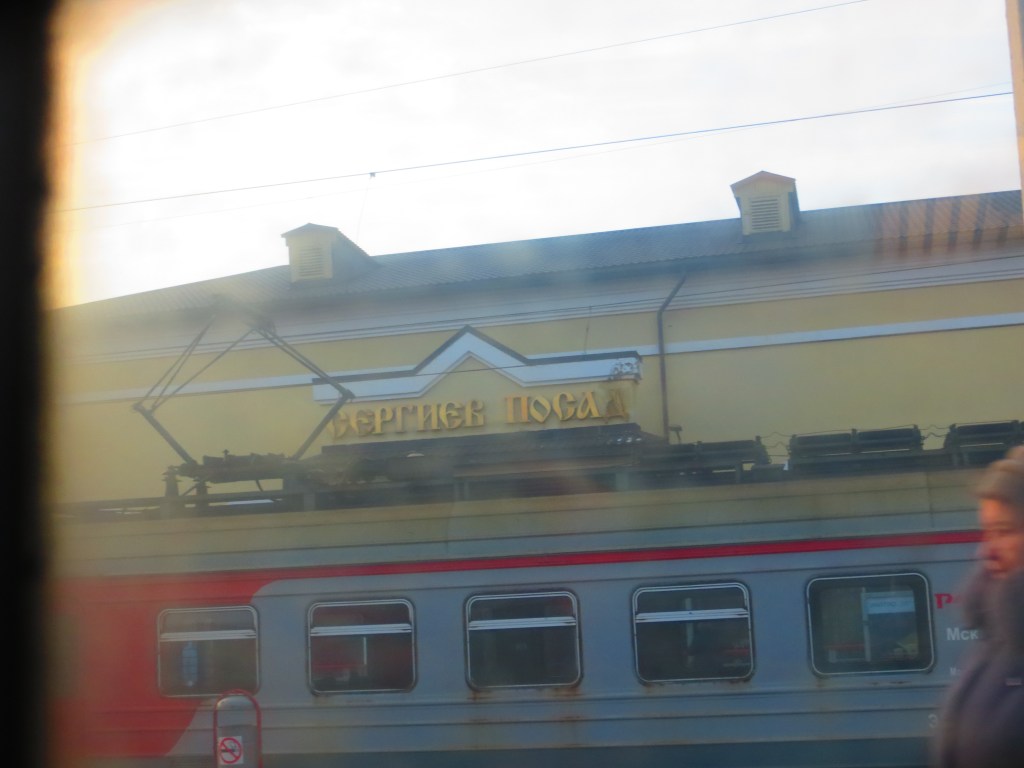
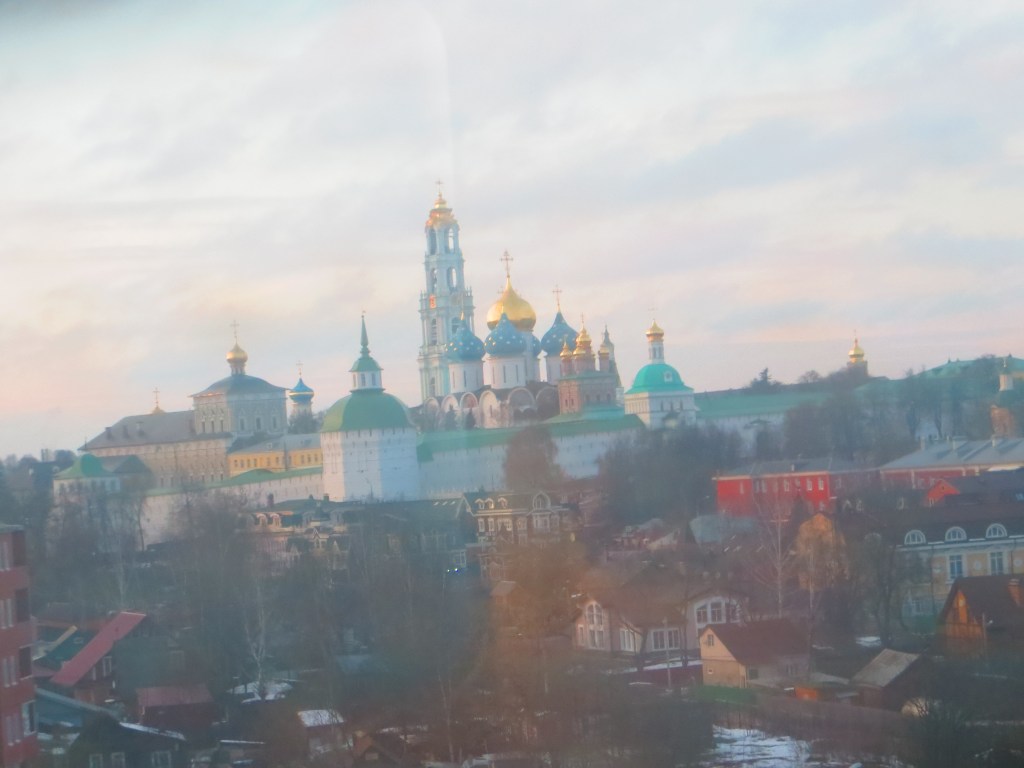
There was no direct train from Yaroslavl, of course, so first there were those four or so hours in a “suburban electric train”[2].  I always found this leg of the voyage excruciatingly boring.  I had the occasion to ride it again a few years ago, and can confirm that there is still something particularly tedious about it.  The big blue faux-leather chairs of old are gone, the new ones are not as spacious as they were when I was a fraction of the size I am now, and the view from the window is just as monotonous (with a tiny exception when the train passes by Sergiyev Posad).

We would arrive at one of Moscow’s nine train stations—Yaroslavsky (of course).  The train to Crimea would take off from another one, Kursky.  It was exciting to be in Moscow, which was huge and terrifying partially because it really is, and partially because my natal family is unusually prone to panic and aimless fuss.  However, while I was always trying to assert my independence and escape from my grandmother’s watchful, and baleful, eye in our provincial town, I would become entirely risk-averse during these long-distance travels.  In addition, Soviet cinematography and literature of the era was replete with fictional accounts of children lost in Moscow.  Although the stories always ended well, for stranger danger was not a thing in a society extolling the virtues of communal living, I found them anxiety-inducing rather than charming.  To this day, Moscow instantly turns me into a country bumpkin.  But I digress.

Yaroslavl Train Station in Moscow. The last time I took the commuter train.

The first year Grandma and I traveled in the regular compartment train which, as time told, was not dramatically different than European trains, with seats converting to bunk beds, four to a compartment. Occasionally, and I suspect it was simply because of availability, we rode in the strange “platzkart” wagon, a uniquely Soviet invention where there were bunks in the corridor as well and thus zero privacy.  Fun fact: there is no word for “privacy” in the Russian language.  I cannot imagine traveling in such a clown car now but, “c’est la vie” say the old folks, “it goes to show you never can tell”[3]. For as a child, I loved the “platzkart” setup, as it was easier to climb to the top bunk, with steps everywhere because of cramming so many people into the wagon, and because it always seemed like such a friendly throng. The only bad memory I have is when the radio in our overstuffed wagon somehow jammed while playing Carmen Suite’s Habanera for a quantity of some interminable hours; I could not hear that piece of music for years without it setting my teeth on edge, and have managed to stealthily avoid the entire opera.

There would have always been a dining car, but of course we never visited such a frivolous establishment.  We brought our own food, like everyone else: canned sprats in oil, black bread, boiled eggs, tomatoes, cucumbers, and salt wrapped in a piece of paper.  The conductor sold tea served in cut glasses with silver holders accompanied by sugar cubes.  Back then, sugar cubes seemed less fashionable than loose sugar, but now the sheen of nostalgia makes those hard blocks seem so retro cool.

It was a day and night’s journey across the land.  Without video stimulation of any kind, the entertainment consisted of eating, playing cards, reading glossy Soviet magazines like “Working Woman” or “Little Flame”, and looking out the window at the landscape gradually changing from north to south.  In the corridor, the windows had these little white curtains that said “Crimea” in light blue cursive letters.  I was always too short to lean on the curtain rod, and eventually too tall to fit under it, but I could stand there and stare out in wonderment for as long as my grandmother would let me. 

We never said “we are going to Crimea”, we said “we are going to the South”.  It was universally understood, same as where I live now, everyone knows the meaning of “Up North”.  Everyone was going on vacation; no one was going home. 

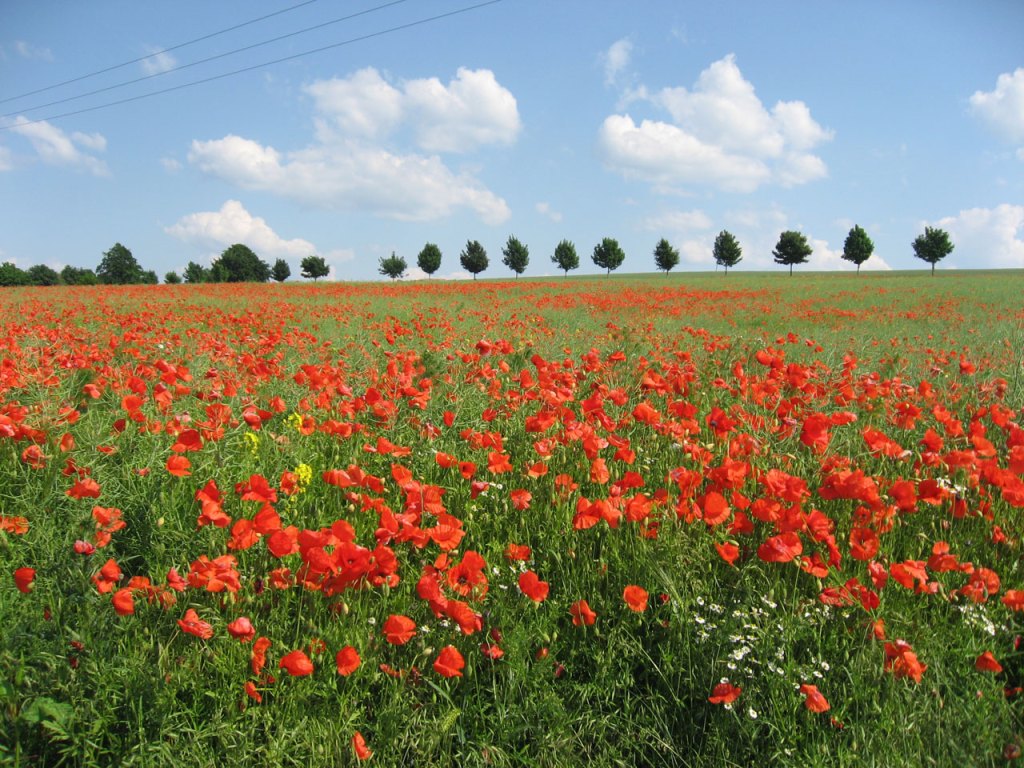
There was a granite plate built into a cliff, proclaiming “Glory to the heroes of Syvash”[4], commemorating events of the Civil War we never studied in school, which just added to the mystery of the land.  I looked for that granite plate every year, because I knew that once I saw it in the morning, I was in a different world.  Waking up in Ukraine, we saw idyllic white daub huts instead of our dark log ones, forests changing into fields, pale bluebells becoming blood-red poppies.  We were coming from the land of asphalt and dusty ash trees, constant strumming of trams, crowded streets.  And then the train just stops, giving the passengers a few enchanting minutes in a field of poppies, imagine that!

The following day would bring Black Sea with its friendly and nonlethal jelly fish, packets of little salty shrimps sold right on the hot sand of the beach, cafeteria “Kolos” with its delicious blintzes filled with sweet cottage cheese or ground beef, Frunze park with its exotic cypresses and statues of fairy tale characters, local history museum with two cannons in the front and a tiny zoo with a monkey in the back.  My grandmother then was younger than I am now, and we were going to the South for an entire summer on the beach.  As an adult, the longest vacation I have ever taken, since age 19, was the trip to, ironically, Russia (11 days).  A summer on the seashore has not been a part of my reality in adulthood.

Curiously enough, I remember nothing at all about the train rides to Estonia in the subsequent summers—not a single thing about the view from the window, people we met along the way, nothing at all.  It was still a summer by the seashore, but no longer the trip of wonders to one of the Seven Seas.

To be continued…


[1] Quoting “Anthem” from “Chess”.

[2] I had to look up the translation.  The Russian word is “elektrichka”.

[3] Quoting Chuck Berry.

[4] Alas, I cannot find any photographic proof of its existence—the plate, not the battle. 

Featured

The War of the Roses

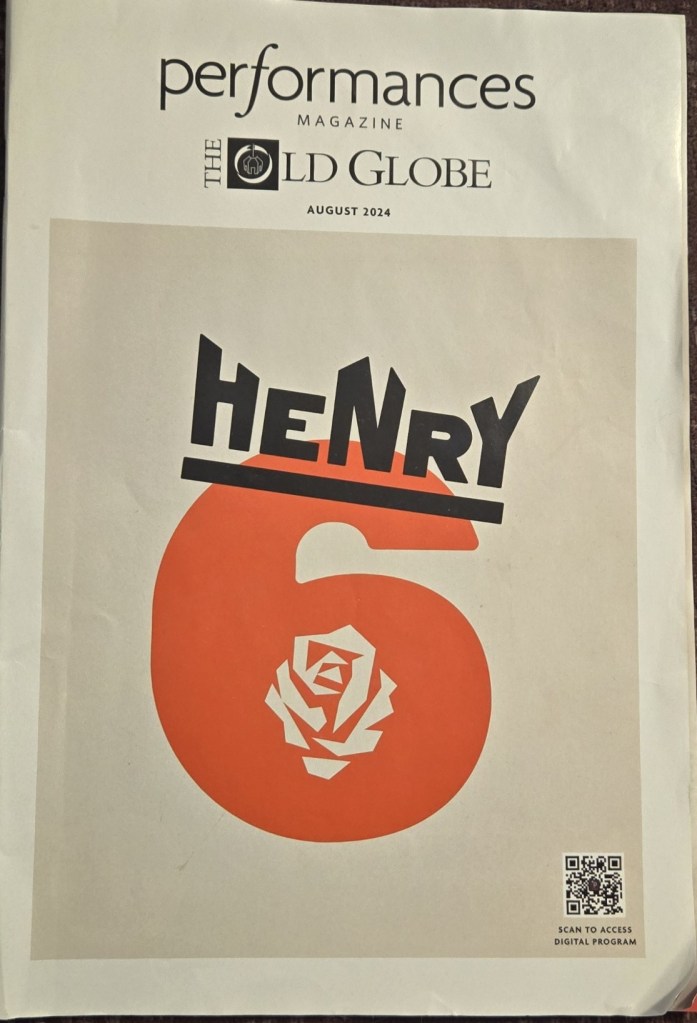
Five years ago, I wrote how in my quest to complete the Shakespeare canon, I was still five plays short.  As of this writing, I only [still?] have two to go (“Troilus and Cressida” and “Two Noble Kinsmen” for those keeping track at home).  “Henry VI” trilogy is done, and how!

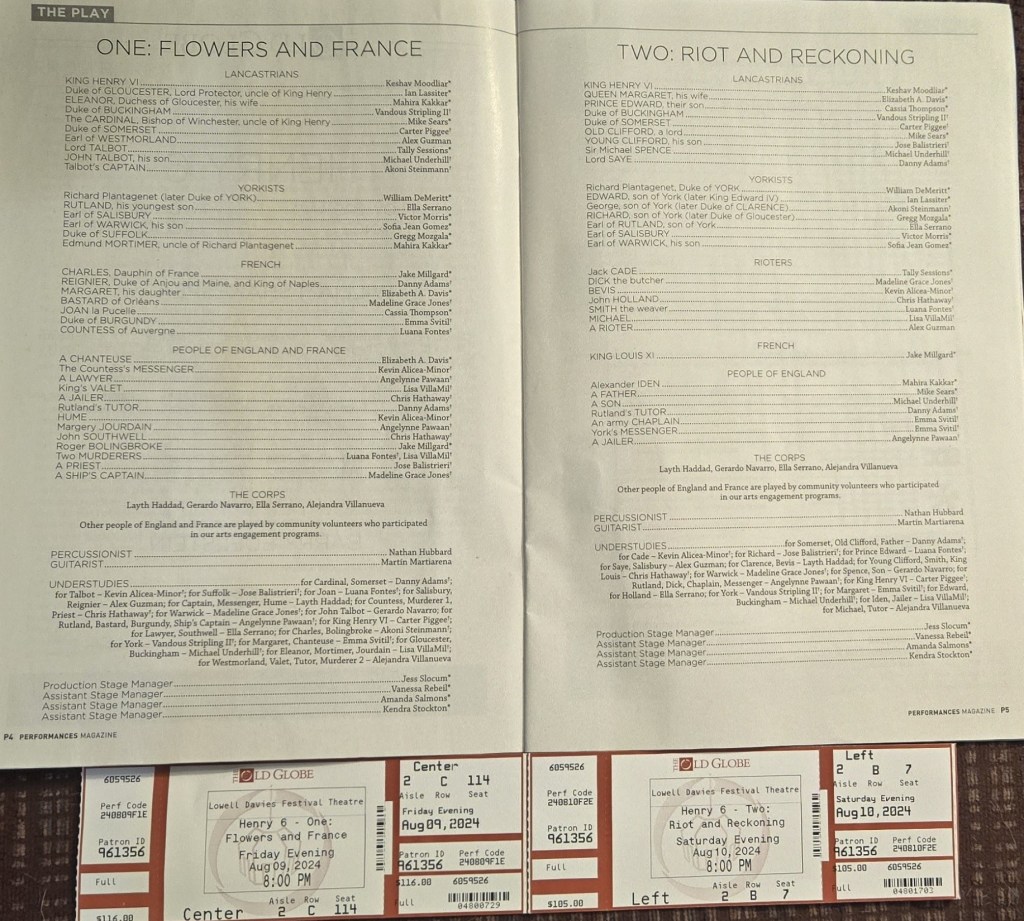
I have to note that it took me fewer attempts to get to Henry (three) than to Vienna (five).  I literally had tickets to see it at the Oregon Shakespeare Festival in the fall of 2020, and we all know how that went.  Michigan Shakespeare Festival was going to produce it this summer but sadly, had to go dark.  I was merely wondering what might be playing at The Old Globe in San Diego during my upcoming trip next spring when I noticed that it is actually doing “Henry VI” this summer.  And so I said to myself, who am I if I am not true to this glorious quest?  I found the perfect weekend when the “Henry VI” Parts 1-3 would play on two successive nights, reserved a hotel room, and spent a couple of months in happy anticipation of a visit to the place of which I warmly think as American Crimea. 

Credit to production designers: Lawrence E. Moten III, Scenic Design; David Israel Reynoso, Costume Design; Mextly Couzin, Lighting Design; Melanie Chen Cole, Sound Design; Caite Hevner, Projection Design.

I have been to The Old Globe several years ago, and loved their production of “Red Velvet”.  However, checking the tickets shortly before the trip, I was slightly dismayed to discover that “Henry” is being staged at an outdoor venue.  I pictured lawn seats, actors scurrying to not be seen behind awkward wooden set pieces, and lots of bugs.  In the Midwest, I have missed more than one outdoor performance and sporting event (yes, I have been known to attend a baseball game, don’t look so shocked!) that have been rained out.  However, I know as well as anyone that it never rains in Southern California, and was willing to put up with the rest of the potential unpleasantries just to cross this elusive trio of plays off my list.  Spoiler alert:  this did not turn out to be your usual Shakespeare in the Park.

Now, much as all I know about French history I learned from the novels of Alexandre Dumas, all I know about English history I learned from Shakespeare.  While I still need to recite the opening lines of “Richard III” to help myself remember who is York and who is Lancaster (and need a mnemonic device I heretofore have not found to identify which rose is red and which is white), I am happy to have finally filled the gap between “Henry V” and “Richard III”. 

It turns out that the gap includes some pretty exciting stuff, such as Joan of Arc’s last stand, epic battles between the English and the French, and intense subsequent plotting and fighting for the crown among the various English heirs and pretenders.  What’s not to like?  Ah, here is what:  my least favorite line in all of Shakespeare, “let’s kill all the lawyers”, makes its annoying appearance.  Even though in the play (and I knew this before seeing it) it is meant as the first step to chaos and political instability and is spoken by a villainous character, it has been misquoted for centuries.  But I am getting ahead of myself.

I have been seeing Shakespeare performed primarily at the Stratford Festival in Canada, which is as good as it gets.  I have seen some fantastic interpretations elsewhere, innovative, beautifully acted, creatively staged, but I have always thought that Stratford’s scale and scope is second to none.  Until now.  And unexpectedly, this “Henry VI”—actually, styled as “Henry 6”—an English Civil War saga 600 years old, filled me with patriotism.  I was all like, look at our American actors being as good as Canadians!

First, the outdoor theater at the Old Globe is basically the same as any other theater but without a roof—and a roof is not critical to a play unless you are dropping a chandelier from the ceiling.  But the way the natural surroundings of the gorgeous Balboa Park worked with the set, however, was both unique and exhilarating.  Every time those giant doors opened to let actors on stage and we saw, instead of the usual backstage darkness, majestic trees lit in the night, it was a spectacle like none I have ever experienced.  The most powerful moment came early on, when Lord Talbot, The Sword of England, first burst on the scene, from the actual forest, backlit and accompanied by stirring rock music.  It was just too cool!

Second, rarely have I seen a Shakespeare production that is so accessible, yet still recognizably classic.  The inventive prologue gave a quick summary of The Henriad (Richard II/Henry IV, Henry V–it was yet unwritten by Shakespeare at the time of the staging of Henry VI) and set the stage for what is to follow.  The costumes, the crowns, the crowds, the chaos—oh, it is history all right, but what gripping history!  Maybe these are earlier plays, but what they lack in familiar soliloquies they more than make up in the absorbing (and true) story that is better than any tragedy (or comedy) from the pen of the same author. 

This production is full of fun anachronisms, including a hilarious presentation by Richard of York to explain his right to the throne with the aid of an overhead projector.  I have to add that, besides the valiant Talbot, Richard was my other favorite character.  Is he supposed to be sympathetic?  I found his sincerity and single-minded focus on the throne endearing.  There was one scene where others are talking, planning, plotting, and he just paces around the stage, literally circumnavigating it, talking to himself.  I caught myself with my mouth literally gaping open, trying to absorb everything that was going on.

I liked the first part more than the second one, for purely subjective reasons—more of the French (Charles the Dauphin bearing hilarious resemblance to King Herod in “Jesus Christ Superstar”), Talbot and the cult of Talbot, and just a lot more humor.  The second part, all about the infighting and plotting for the English throne among the English themselves, is quite a bit darker.  And once that madman Richard III shows up on the scene, events start snowballing, and you know it will end badly.  He gets his own show later; let’s see more of the other people.

Also, Part 2 started right off with the reenactment of the January 6 riot, complete with the QAnon Shaman, albeit with the Union Jack painted on his face—and, obviously, with Shakespeare’s words, which, I imagine, elevated that particular disaster.  It was disturbing and a terrible reminder that we humans never change and learn nothing from history.  We live through these cataclysms and they shock us, but there is nothing new under the sun. Shakespeare already wrote about it…

The thing about Shakespeare is, his words, or even what we take to be his words, are constantly edited and reinterpreted.  Having seen “Henry VI”/”6” for the first time, I do not know if I have fallen in love with the play itself, or with this particular version of it.  But does it really matter?  It was a magical experience that touched my heart, and that is what great theater does.

Featured

Hometown: Ann Arbor

When I started law school, we had this incoming yearbook with everyone’s photos, so that you could get to know your classmates—you were going to be with them for three years.  We had to list our undergraduate institution and hometown.  The first was easy because factual; the second, for me, became unexpectedly convoluted.

At that time, I was not even a decade out of the Old Country, but it was lost to me, irrelevant, and politically incorrect (oh, how the times have not changed!).  I had no home with my mother and stepfather, last and least because they moved states a couple of times since my last sojourn with them.  I was living year round, working, and attending university in Ann Arbor, Michigan, and so it became my hometown, by default and of the moment.    

I lived in the same studio apartment for three years, which was the only place in this lifetime that was all mine, decorated by my teenage self with a combination of my favorite things, including a porcelain mask bought at Middle Earth from when I dreamed of an entire wall of masks (I still have it, the lone holdover; I never bought any others), and a collection of posters of my favorite people and places: best of the Netherlands sent to me by my beloved Dutch host family, the Marx Brothers and the Monkees, Oscar winning movies when there was still a finite number and I knew every one, Mardi Gras by Andrea Mistretta, a field of poppies that reminded me of a train ride from Moscow to Crimea, and an obligatory poster of Moscow (I am most assuredly not from Moscow, but that was the best that was available at Borders). The posters subsequently fell victims to a flood in the basement of my first house, but most of these are still some of my favorite things.

Out there, next to State Theater, is the location of the original Borders bookstore.

And speaking of Borders, I lived a block away from the original bookstore.  This was the Borders before it was a chain, before it was international, before it sold music or had a café, and even before the flagship store moved into the space vacated by Jacobson’s (another sad loss; Jacobson’s was a great store).  Being able to just walk in and browse, after work, between classes, on the weekends—ah, it was heaven!  It was certainly a big part of what made Ann Arbor home.  When I was in high school, coming to Ann Arbor with my mother was a double-edged sword:  she would visit her friends, I was either bored or resentful, but Borders and the nearby movie theater on Fifth that showed foreign and art films that would never make it to our painfully provincial town of Jackson were always worth the trip[1]

Summers in Ann Arbor were magical yet awful.  It was like being in one of those weird stories in which a person wakes up one day and the world is different: there are no adults, or half the population is gone, or the Beatles never existed.  All right, maybe this last one is not strictly relevant.  But basically, you just walked out on the street one day, and all the students were gone, save for the few of us year-round semi-townies.  On the one hand, it was nice to just work and have the predictability of time off.  I craved the stability, but I missed the difference of days and the extra activities that filled the school year.  And, full time job was not twice as boring as a part time job, it was more boring cubed or quadrupled.  It took up so very much time, leaving only the evenings of nothing to do or the weekends of trying to find things to do.  There were no tasks to perform in my free time, but instead, the panic of not having those tasks.  It was the waiting time.  Which is how I sometimes still feel in my adult life.

Eventually, Ann Arbor became too small to contain me and my dreams.  It really is a tiny town, with the downtown you can criss-cross in a quantity of minutes, not hours.  Were it not for the diagonal part of the main campus (obviously nicknamed The Diag), you could look right through it.  I was weary of walking the same half dozen streets.  I needed a change of scenery, and so I went to the biggest city I could find.

Back when there was only one tall building on South University.

I spent another summer in Ann Arbor after that, two years later.  All but one of my friends were gone, and I was living out a Cat Stevens song lyric, “For you will still be here tomorrow, but your dreams may not” and an agonizing “you can’t go home again” adage.  I was a wildly unhappy law student and summer associate in a big firm, terrified by the future not of my own dreaming unfolding in front of me.  It was such a weird time, living in an old familiar place, but on different terms, as a quasi-adult in a college town.  Living in New York, I yearned for Ann Arbor, yet the minute I arrived, the streets started closing in on me again. 

And now, some more decades later, the changes make the town barely recognizable to me.  Gone are all the stores I frequented—yes, literally every single one.  Not one survives, not Borders, not Middle Earth, not Peaceable Kingdom, not Falling Water, not Schoolkids Records.  Some restaurants remain, and there are better ones, including a handful of decent breweries, which would have been irrelevant to the underage me in any case.  But the stores were special because of all the solitary browsing one could do, in a crowd yet apart.  This is a feeling one can cultivate only in an urban environment, walking in, walking around, walking out, invisible.

Ann Arbor is a reminder, a symbol of the time when everything was possible.  Before I started law school, I could have started anything else instead.  The road was chosen, but not yet taken.  I could have taken a gap year (no, I could not have, I had no resources for that, but it is nice to think that I might have had options).  I could have kept working at an office job and used my after work hours to find myself and my path.  I could have… well, that is about it.  I never really had choices.  But there was that one brief shining moment when I thought I did—and that was in Ann Arbor.  And so, this town will always be for me a symbol of possibilities, and that is enough for it to have been called “home”.

[1] “Cinema Ann Arbor: How Campus Rebels Forged a Singular Film Culture” by Frank Uhle is a time-machine trip down memory lane to a time that I just barely glimpsed, but during which I consider myself incredibly fortunate to have lived.

[https://oldladywriting.com/2021/01/30/the-road-not-taken/]


Featured

Memories of The Fourth Sense

I recently had perfume custom made for me.  It sounds fancier than it is, because you basically go on this website[1], pick several scents, and fervently hope that they combine into something that does not make anyone within sniffing vicinity gasp and choke.  Suggestions of complementary scents are available, but I scoffed at those and proceeded to trust my own senses. I was not disappointed!

I knew nothing about fine fragrances growing up—which is no surprise, considering my upbringing.  My no-nonsense grandmother (she of https://oldladywriting.com/2021/08/30/just-boil-water/) did not bother with such frivolities.  She was kind enough to buy me a bottle of children’s eau de cologne one summer in Estonia.  The bottle was shaped like a clown, leaked to the point of extreme transience, and left no olfactory impression on me whatsoever.  She also, in a fit of unprecedented and unrepeated generosity, bought me a tiny bottle of adult perfume, Vecrīga (Old Riga), which miraculously survived to present day and, considerably less miraculously, turned itself into vinegar in the intervening decades without me ever opening it.  I had vague plans to wear it on my wedding day, but forgot and instead dumped half a bottle of Dali on my wrists.  As the latter is currently fetching $800 on EBay while the former is not, I can only say that my marriage was—and is—worth it[2].

In college, the same friend who introduced me to Elton John’s music [https://oldladywriting.com/2019/06/23/rocketman/] also introduced me to quality scents.  She mocked the drugstore-bought Lutece supplied by my mom, who still picks perfume based on the attractiveness of its receptacle, and gave me a bottle of Oscar De La Renta from her personal collection.  Fun fact: today, a half-used bottle of former would set you back the same $90 as the retail-bought bottle of the latter, which just confirms the old adage that there is no accounting for taste, as well as there is no limit to the pull of nostalgia.  But, once I started drenching myself in that designer fragrance, no fewer (and yet no more) than two young men followed the scent straight to my apartment.  In the immortal words of Simon and Garfunkel, “It was a time of innocence”.

When I was in Greece, walking through the Club Med resort on the way to my job as an ouzo drinker [https://oldladywriting.com/2020/07/30/the-wrong-way-to-the-parthenon/ ], a fragrance wafting from some flowers instantly transported me to warm nights on the Black Sea.  I did not expect to smell it again until I discovered Orange Blossoms at Lush.  I do not think oranges grow in Crimea, where I spent the summers of my childhood.  In fact, growing up I was violently allergic to what everyone assumed were oranges, but it was actually the poison with which they were injected to make them ripen or at least appear ripe during their long trek to my North Volga hometown. Logic tells us that this particular scent should not evoke any memories more pleasant than a trip to the children’s hospital—yet it does, and logic is a sword by which I do not want to die.  I am happy to report that Orange Blossoms, after suffering a couple of setbacks, did not permanently join the list of my favorite discontinued things [https://oldladywriting.com/2022/01/29/murder-at-the-marsh/] but has instead become my signature scent.  I also read somewhere that it is the signature scent of French women, so in this case, logic is firmly on my side. 

As for the ones that did join the sad list, there is Yves St. Laurent’s In Love Again.  Like Orange Blossoms, it came, went, came back—but then disappeared for good.  My tenuous connection with YSL was thus severed, and Fragonard took his place as my French perfumer [https://oldladywriting.com/2019/06/09/when-did-the-arc-de-triomphe-start-leaning/].  I owe allegiance to Fragonard for (1) creating not just one but—count them—four scents I love (Belle de Nuit, Emilie, Etoile, and Fragonard itself), (2) not attempting to cancel any of them, and (3) supplying me with its version of Orange Blossoms during the dark period when Lush did not.

Yes, this is a photo of the actual perfumes in my bathroom. All accounted for. Vecrīga is in the middle.

Some years ago, my erstwhile BFF asked what gift I wanted from the homeland; I had trouble coming up with something that I could not get here, and requested a bottle of Red Moscow perfume.  Her cousin finally located it in a Soviet nostalgia shop in actual Moscow, and the two of them could not be dissuaded from the conclusion that this peculiar retro item was meant for my ancient grandmother.  Rumor has it that it existed before the Revolution of 1917 as The Empress’ Favorite Bouquet, and was renamed like so many things during the Soviet era.  I had no idea what it would smell like, and just thought it would be something weird at best, and most likely fetid.  But you know what?  I love it.  It is a very strong floral chypre (there are those orange blossoms again, though I cannot detect them in it) that lasts from morning till night.  There is something symbolic as well as ironic in the existence of a fragrance that survived two ages of empires—and hopefully will outlast a third.

And so what is this custom scent that I chose?  Tulips and mimosa.  Surprised?  Tulips do have a smell, albeit a very subtle and delicate one.  Mimosa—the flower, not the drink—overwhelms in this particular combination, but I am fine with that.  In my childhood, mimosa was the earliest blooming flower of spring, omnipresent on March 8, International Women’s Day.  The smell of this perfume conjures bouquets of those fuzzy yellow balls on the desks of all the girls in class.  One of the big benefits of that egalitarian society was that no one was excluded, unlike the mortifying Valentine Day popularity contests in the U.S.[3]  The homeroom teacher insured that all the boys participated, and all the girls got flowers, and sometimes even perfume, though I do not recall what kind (in any case, it would not have been Red Moscow).  And now Queen’s Bouquet © (see what I did there?) recalls one of the most pure memories of my joyful childhood during these complicated times…[4]


[1] https://scentcrafters.com/ 

[2] I found a lovely write up which made me regret just slightly that I have never really sniffed Vecrīga myself.  But, in my younger days, I would not have appreciated it, and now, I have enough, so all is well. And in any case, I still have never been to Riga. https://www.fragrantica.com/news/Spirit-of-the-City-Riga-in-Dzintars-fragrances-18365.html

[3] Do I even need to mention that the only carnations that I got in high school were from female friends?

[4] The many links to the previous blog posts are for my new subscriber(s) who might have missed them in the past. [insert smiley face]

Featured

Those Two Guys in a Painting in The Hague

I spent a summer in the Netherlands when I was in high school, and still feel that I know it better than anything.  Those youthful impressions are just so much sharper than later ones, when everything sort of starts blending together.  Besides, I kept a diary.  It was the age before digital cameras, let alone camera phones, and a thousand words were cheaper and easier than a picture to be developed.  What led me to the Netherlands in the first place is a longer story that stretches all the way back to my childhood, so will wait to be told another time, but today I am reminiscing about my first independent (meaning, unaccompanied by adults or even Dutch siblings) trip of that summer.  It was to The Hague.  Being the seat of government, home of the Queen *and* the International Court of Justice, as well as the other major museum in the country, it was the natural choice.

I set my alarm for 5 a.m., and once it buzzed, immediately turned it off and slept for three more hours.  By quarter after 8, I was on the bus, and by a minute to 9 on the train heading to The Hague.  I noted in my diary that a roundtrip train ticket from Amersfoort cost 27.80 guilders, which would have been around $9 at the time[1].  In a state of light but persistent confusion, changing trains in Rotterdam, I finally arrived, purchased a map sorely lacking in detail, and after several false starts made my way to Binnenhof and its Ridderzaal, home of the Dutch Parliament and the royal throne.  I could have sworn that I went on a tour, but the diary (present recollection refreshed) denies it and confirms only that I saw an exhibit about the queen (Beatrix at the time) and the Dutch government. (I returned to The Hague a couple of weeks later, just for this, and a good thing, too—I have never seen it since).

I definitely did go to Mauritshuis, which was under restoration, and most of the paintings were displayed in the house of Johan de Witt.  This may or may not explain why I have no recollection of seeing “The Goldfinch” and “The Girl with the Pearl Earring” at that time (books were not written about either one yet), but I was very impressed by Rembrandt’s “The Anatomy Lesson”.  All these guys are hanging on Dr. Tulp’s every word, but then there are two—one a little dazed, probably by the presence of the cadaver, and one who is staring right at the audience, clearly thinking, what the heck am I doing here, at this boring lecture with this gross corpse?  Way to break the fourth wall, Rembrandt[2]!

You see what I mean?

After some more chaos caused by my crap map, I found Panorama Mesdag, the very cool painting of 19th century Scheveningen in the round (the diary says “last century”, but now the diary itself is from the last century, making the panorama from the “century before last”).  And then I made my way to the Peace Palace.  I do remember waiting a bit for an English language excursion, eating ice cream on the grass.  It was a great tour, very informative, and the malachite vases that were the gift of the Russian czar made a particular impression on me.  I even got to sit on the lawyers bench, dreaming of someday.  That particular day never came, but I did have a professor who litigated at the International Court of Justice, so there is that, less than six degrees of separation.

The only photo from my first trip.
What even IS this?!

As the final sight of The Hague, I was determined to see the Queen’s palace, Huis ten Bosch.  It was quite a trek, and a waste of time, because it is literally surrounded by woods.  I walked by the gate several times before I gathered the courage to ask the guard if the Queen lives here. He said yes, but she is currently on vacation.  It was enough of a thrill for me.  I do have to add that my only brush, if we may even call it that, with royalty was when spouse and I glimpsed Juan Carlos I in his limo (or something) pulling out of the royal palace in Madrid as we were coming out of the garden.  We do not talk about that exciting moment when we complain about The First Spanish Trip. https://oldladywriting.com/2020/11/02/the-first-spanish-trip/ But I digress.

The second visit to The Hague[3] was 20 years later, and almost 20 years ago, so there is a slight pattern here.  We went to the Mauritshuis, now fully restored, and infinitely more crowded.  I still missed “The Goldfinch”, for again, the book was not yet written.  We then stumbled onto It Rains Fishes, a restaurant I read about in a guidebook, but did not seek out because I have learned to mistrust guidebooks.  And thus the day was lost, but also gained, because the lunchtime meal in this Indonesian/Malaysian restaurant remains one of my Top Three dining experiences to this day.  I was recently trying to remember the particulars of it, but all we could recall was the tiny green pea puree amuse bouche.  My notes say that spouse had steak and crème brulée, and that I had seafood curry and rum caramel shake.  We spent about $100, which was quite expensive for both the times and time of day, but the elegant décor, lovely music, and superb service made it worth it. 

This year, the Annual Girls Trip took my mother and me to the Netherlands.  We moved at a pace significantly slower than the frenetic speed of my teenage years, and mostly hung around Amsterdam, but could not miss paying homage to the Mauritshuis paintings that have been made more famous by books. 

I have a logical, if not infallible, sense of direction, and a rich collection of memories (as some of these writings demonstrate, I hope).  But The Hague looked entirely unfamiliar from the moment I exited the train station.  I do not mean that it changed, but somehow I could not summon any visions of the city from my previous visits.  My recollections of the gate to Huis ten Bosch and Peace Palace were not tested, Binnenhof was/is disappointingly closed for renovation, and It Rains Fishes closed down permanently.  There was no déjà vu until I saw the staircase within Mauritshuis—I recalled ascending it with spouse on our prior visit.  This time, I paid particular attention to “The Goldfinch”, and was relieved that he was fine after his ordeal[4].  And then I saw that panic-stricken guy desperately plotting his escape from Dr. Tulp’s gruesome anatomy lesson as he has done for almost 400 years, and all was well with the world. 

Ars longa, vita brevis.


[1] It is about three times more now, but I am not sure that it is not a fair increase for four decades.

[2] Fun fact: in the copy which is in Edinburgh and not attributed to Rembrandt, all the observers are staring at Dr. Tulp or the corpse—and this alone makes it inferior.  Don’t bother with it.

[3] Technically, the third, because I visited The Hague twice during that summer in high school.

[4] I know the theft of this painting is a fiction, but I have been mildly anxious about the fate of missing artworks for most of my life.  I am still not entirely convinced that the original portrait of Whistler’s mother does not hang in Mr. Bean’s bedroom, and give the Musée d’Orsay’s version a knowing wink every time I see it.

Featured

Rosencrantz & Guildenstern Are

When I first read “Hamlet” in a high school literature class, Shakespeare’s language was still difficult and unfamiliar, but I immediately and always felt affection for its conflicted [anti]hero.  A family friend told me about “Rosencrantz and Guildenstern Are Dead”, which I also immediately read, intrigued by the concept, and understood nothing.  I have seen some magnificent productions of “Hamlet” over the years, and have been fortunate to ponder and debate its themes with folks much smarter and more astute than myself.  Until now, I have never seen the parallel universe version.

When “Rosencrantz and Guildenstern” rolled into Toronto, with two of the Hobbits, Dominic Monaghan and Billy Boyd, as the leads, I was determined to make the trek.  Now, the Hobbit connection is of no use to me—I slept through all those movies, sitting upright and with my eyes wide open, and actually listened to the book on tape, all 197 hours of it, and retained none of it.  But, I appreciate both the tremendous stage training and presence of the British actors, and the immense talent of Tom Stoppard, one of the greatest—if not THE greatest—living playwrights.  I have come a long way since I first read his words.

Toronto, on occasion, has served as an extension of my theater playground.  It tends to have a slightly different lineup for big Broadway shows through the Mirvish theaters, and some straight plays in addition to the major musicals.  I do not know the city, just how to find my way to the couple of theaters and, obviously, to the Hockey Hall of Fame.  My favorite restaurant, Le Marché, fell victim to the pandemic economy, so the play was truly the only focus of this trip.

I was not disappointed (spoiler alert: far from it!).  But I was surprised.  My memory of this play was so hazy as to be almost nonexistent.  I just knew what is common knowledge: absurdist tragicomedy, similar to “Waiting for Godot”, minor characters from a major play.  All of this is technically true, and none of it is sufficient.  I did not find it absurdist but actually quite heartfelt and authentic—unless life is absurd, and that is a premise that I refuse to countenance.  And as for being minor characters—well, maybe they only passed through “Hamlet”, but they are the heroes of their own story.  I was reminded of how Fredrik Bakman weaves the same cast of characters through several novels, with some front and center in one book but only episodically appearing in another.  Stoppard did it earlier.

These guys were so gentle and genuine.  Rosencrantz in particular was sweet, befuddled, with a hint of Eric Idle-esque wide-eyed mischief.  Guildenstern was a bit more anxious and focused, and also wistful.  There is so much to absorb and contemplate.  They live in a parallel universe and we know how their story will end, but they do not know it.  They are not entirely sure of anything, including the limits of their own power and will. They are floundering, but they are living—as are we all. And that is really the story.  We might think that they do not have agency, but that is only because the title of the play gives it away.   And even despite that, I was waiting for it to unfold differently.  I did not get the sense that they are marching toward an inevitable conclusion.  They are just making some decisions that will affect their lives in dire ways—as do we all.  The Casablanca quote came to my mind, the one about how “the problems of three [let alone two—OLW] little people don’t amount to a hill of beans in this crazy world”.

And there is no predestination, just a series of circumstances and how people make the best, and occasionally the worst, of them, because they are not omniscient.  It is a story of two guys who are not necessarily worse than anyone else.  And in this production, it also helped that Hamlet himself was the worst character in the ensemble:  bearded middle aged man, prone to bulging eyes, with a startlingly booming voice and an utterly charmless manner.  He was manipulative, callous, and revenge-driven.  It was impossible to care, let alone root, for him. Perhaps that was intentional, but I do not know the play—I only know what I felt.  This all goes back to who controls the narrative—“who tells your story”.

And so this experience just confirmed, yet again, my firm belief that plays need to be seen, and the power of live theatre to make one think and feel is unsurpassed.  I wrote before about that one moment for which I wait in each show, and here there was the instance that I realized what is coming, and spouse whispered to me, “This is how they die”.  So invested was I that I forgot the title of show!  And then when Guildenstern said,  “There must have been a moment, at the beginning, where we could have said — no. But somehow we missed it”.  It broke my heart.  And that is really it; “the rest is silence”.

Featured

Tooth Fairy

Last year, I lost my favorite tooth.  I mean, I did not misplace it, nor did it fall out.  It was surgically removed.  This tooth, #6, was my first root canal and my first crown.  My own grandfather put the crown on it, made from a melted down earring, and it lasted for decades.  Eventually, the crown wore out, and then the tooth itself.  There was even another root canal in the mix, so suffice it to say, #6 and I were bonded by hardship.  On the day when #6 and I finally parted ways, the nurse offered me nitrous oxide and oxygen, and how could I say no?  I welcome any option that results in less or no pain for me.

Jubilee Square. Motorbuilders Palace is on the left. The clinic is on the right.

As I was dutifully breathing in and out, an unbidden memory came to me, of me and my classmates trooping down Lenin Avenue to the Jubilee Square (the one with the Motorbuilders Palace [https://oldladywriting.com/2020/08/18/valor-and-glory-of-the-motorbuilders/].  In my mind’s eye, I saw the golden Russian autumn sung by poets, maple leaves everywhere, the only melancholy season of an ever-sunshiny year.  The school year has begun long ago enough to be a bore and a burden, and the time has come for one of the most unpleasant organized events of the Soviet school system—the dental checkup.  It is about a mile from the school to the clinic—the longest mile.  If ever I felt like a lamb to the slaughter, this was most certainly the time.  Usually, I got some kind of exemption, being raised by dentists and being dragged to the children’s dental clinic by my grandmother on my own free time, but that day, I was all out of aces.  It is also possible that this was shortly after my grandmother took me to the clinic and I escaped, bolting out of the torture chair and making it halfway through Jubilee Square before I was captured (traffic in those days was unimpressive, but not nonexistent—I was absolutely in danger of being struck by a bus, a fate still preferable to any dental procedure).  I have to add, individual cabinets are a Western luxury.  In Soviet Russia, an army of Orin Scrivello clones with their whirring drills were leaning over screaming kids in one big room in a fog of ether.  

I have a lot to say about growing up in an apartment where our kitchen doubled as the prosthodontist’s office, but that is another story for another time.  But one thing I know is true, and that is that our home never smelled of ether.  Maybe grandpa had no access to it.  Maybe the smells of grandma’s cooking overwhelmed.  Regardless, the scents of home were not medicinal.  And I know this because had I been immune to these odors, I would not have been so jolted into panic each time I entered a Soviet dental clinic and been positively engulfed by that distinct piercing stench.  A mere whiff was enough to activate the fight-or-flight instinct.  It was always flight, because fighting presumes staying, and there are no fools.  Flee, always flee. 

The unintended consequence of my recurrent, determined, and frantic rejections of the most feared dental procedures was that my grandmother gave up (a precursor of things to come—a scythe came upon a stone, as in, she met her match when it comes to wills of iron), leaving me at the mercy of the school system.  And so began the long march.

The clinic where my grandmother worked. The was not just dentistry here, but other tortures as well. To be continued…

I always think of that BBC commercial, “They say one’s cows are mad, they say one’s dentistry is diabolical” when I think of the dentists of my childhood.  My grandfather did not work with children and was overwhelmingly busy with his relentless stream of patients, and my grandmother—well, I did not trust her.  More specifically, I did not trust in her not taking care to not inflict pain. (Well, that was a lot of “nots”—also emblematic of my childhood). 

That day, which my classmates and I anticipated with varying degree of fear but with unanimous distaste, was the source of much scheming.  While most of them were fairly resigned to this grim fate, I had one accomplice whose fear of the dentist actually exceeded my own.  His name was Max, and he was a freethinker.  I am told he eventually became an alcoholic, a fate not only unsurprising but entirely predictable given both his environment and spirit (no pun intended).  But when I knew him, ages seven to 12, he was a shrewd kid with a profound dislike of conformity and authority.  He was non-confrontational but steadfast in his avoidance of anything extra.  He was the epitome of “quiet quitting” decades ahead of its time. One of his catchphrases was “And the lesson is going on”, whispered to me whenever a teacher would get distracted and go off on a tangent, meaning that while time is getting wasted, no work gets done, and that is its own reward.  Max never got any exemptions from attending mandatory events, and yet he never attended them.  He just did not show up. He was reprimanded, chastised, shamed, and accused of being an “individualist”.  He gave zero you-know-well-whats.  He was, of course, a member of my Link. [https://oldladywriting.com/2023/11/11/scrap-metal-fiasco/]

Max and I conferred and confirmed that we were not going to the dentist, with the class or without.  Ever.  We did not have the audacity to just not show up to school that day—that seemed just too brazen, and we were not hooligans.  We were conscientious objectors.  And so, as the column of the condemned dragged itself along that familiar tree-lined alley, led by our fearsome homeroom teacher, the grammatically and socially challenged instructor of algebra and geometry, the two of us simply ducked into the labyrinth of yards off Lenin Avenue.  Without any regard for consequences, we ran for our lives.  We were not good friends, merely coconspirators.  We quickly went our own way, but for one brief shiny moment, we were bound by the shared taste of complete and utter freedom.

Lenin Ave. We escaped between those yellow buildings on the left. Photo taken in January; alas, I have no autumnal images to share.

And all these many years later, in a dental surgery under the calming influence of gas, it all came back to me, the sepia colors and the smell of fall leaves, the voices of my young comrades, the distinct flavor of childhood of unlimited future and potential, and the feeling of my long ago and far away home deep in my bones.  It never ceases to amaze me how memories can be summoned by the most unlikely agents and at the most unlikely times.  And how joy can be found even in the middle of pain.

Featured

Papa Taught Hebrew in Harbin

My grandmother used to tell me stories about her childhood, in the 1920s, which were both exotic and relatable.  She was only 45 when I was born, which seemed ancient to me, of course, but now I know that the half century mark is prime time for reflection and reminiscing.  We are unreliable narrators of our own lives, and the charm of her mischievous and adventurous early years in the small provincial town on the Volga remains the biggest shared treasure of our fraught relationship. 

Now that I am the age that she was when she was raising me, I realize how memory shifts as time goes by.  In her telling, she was a spirited and inquisitive child that was frequently in trouble with her humorless but loving parents.  The irony that these were the qualities she most deplored in me escaped me then.  I also bought into this portrayal of her parents for the time being, while years later it came to me that perhaps the character trait she most chose to emulate—grim rigidity—was the least praiseworthy attribute of this couple.  They never seemed quite real, just shadows of semi-forgotten ancestors, even though less time separated my childhood from them than from today.

I recently read “People Love Dead Jews” by Dara Horn.  In this book, which had me both nodding in agreement and holding my breath, I came across a chapter about the Jewish community in Harbin in early 20th century.  I do not know if more is written about this place and time in history, but this was the first time I gasped in recognition:  “Papa taught Hebrew in Harbin”.  For among grandmother’s stories was always this nugget: her father spent several years in Harbin, teaching Hebrew to children while his brothers were running a business there.  This has always been just a naked, stand-alone fact, and when I was a child, it always seemed like enough information.  Great-grandfather, whom no one in my world besides grandma and her brother ever met, for he died before The War and before she left her hometown that neither my mom nor I ever even visited, was always described as a stern disciplinarian and seemed sufficiently boring to not merit additional investigation.  But grandma’s own childhood memories of her father speaking Chinese to make the neighborhood kids laugh echoed my own delight when her brother, my beloved great uncle, would pretend to speak Chinese to me.  I knew he was faking it, but he was so delightfully comical!

I finally learned that this interlude in great-grandfather’s life was not random, as I always assumed without additional thought.  Fortunately for me and mine, his ultimate fate was arguably better than that of many of the people he would have known in Harbin—and that is saying a lot, considering that he returned to his hometown of Lyozna, Belarus [1] (at some point before getting engaged to my great-grandmother on June 12, 1919 in Vitebsk[2]), got married and had two children, lived through the darkest years of Stalinism, and died before he was 60 in 1940.

I have been an immigrant since I was a teenager.  I have traveled.  I spent two summers in Europe, and I have been to China on a work trip, to the beautiful and sophisticated Shanghai, which is actually nowhere near Harbin and has a completely different history.  Every day of my professional life, I talk to people who have, at a minimum, spent several years in a foreign country.  Until now, I have not thought of this remote, unknown man’s journey, his years (how many?) in a much colder climate, in a completely different world.  I never imagined that he had his own “stranger in a strange land” journey.

Synagogue in Harbin

As a child I did not know enough about the world to imagine China at the beginning of the 20th century.  I never gave a single thought to how great-grandfather traveled so far—and back—what kind of business these nameless brothers of his had, why and when did he return to Belarus, eventually making his way to and settling in Russia proper. My grandmother was not a person who did not talk about the past, but I do not know how much she knew about that period of her father’s life.  Somewhere along the way, there was some falling out with these uncles that severed the family ties for all eternity (they were not welcome to attend their brother’s funeral).  It might have been related to this business in China, but grandmother’s own mother never told her.  In those days, people did not ask; children did not question their parents.  It is nearly impossible for me to understand the respectful yet reserved, affectionate yet distant relationships of that bygone era.  To the families of these great-uncles, whoever and wherever they are, my family is the missing link, the lost tribe.  Do their descendants remember today that there was another brother, another uncle?  Is this Harbin interlude a part of their family lore?  Sometimes I lament the loss of family memories to family feuds on top of the already precarious and unreliable way history was treated in the Soviet Union.  Other times, I concede that maybe it is only natural that the lives of ordinary people do not survive generational memories.

Dara Horn’s book gave me an unexpected glimpse into my great-grandfather’s unknowable life.  There is a connection that survives time and space, and a memory that is a blessing.

 זיכרונו  לברכה  אַבְרָהָם


[1] The birthplace of Moishe Shagal, aka Marc Chagall.  I wonder if they knew each other?  They would have been contemporaries. 

[2] The only exact date in this narrative, because my great-grandparents’ engagement announcement somehow survived time and distance, and I treasure it.

Featured

Never Not in a Book Club

I have mentioned before how much I love reading [https://oldladywriting.com/2021/04/03/so-many-books-so-little-time/].  It is generally a solitary activity, unless one is in a book club.  The need to share thoughts, ideas, impressions, to laugh and maybe even cry together over a story is so basic and valuable to me that I never not want to be in a book club.  Even the worst book club, in my experience, cannot be all bad because, well, books!

Book clubs, I have been in a few.  Initially, I thought they have to be run by libraries, for that is how I first got into one.  We moved, I found a new library with a new book club, we moved again, and so forth.  I loved the discussions, but eventually tired of the transient nature of those institutional associations.  The last one, at the library in our current town, was a lunchtime affair.  I was the only one who had to make an effort to come from work every month; everyone else was decades older—with the expected outlook on life.  Conversation was decent until the librarian assigned Kevin Boyle’s “Arc of Justice: A Saga of Race, Civil Rights, and Murder in the Jazz Age”.  As other members spent MY lunch hour lamenting the collapse of property values in Detroit thanks to The Great Migration, I fled never to return.

I had a great time forming a book club with a couple of gal pals.  It evolved—or devolved, depending on your viewpoint—almost immediately into an Eating and Drinking Club.  The books were entirely incidental to the social aspect.  At some point, there weren’t even any books.    We clung to the pretense:  Book Club goes to the movies, Book Club gets Thai food, Book Club visits speakeasies, Book Club actually tours a library.  Eventually, the Eating and Drinking Club grew into Weekly Beer Night, and it happily continues as such to this day. 

And yes, you know it’s coming, my tale of being in the worst book club ever–The Rich Ladies’ Book Club.  I was invited by an acquaintance, so in my defense, I did not know that books alone would not provide enough commonality or shelter within the group.  In their defense, I suppose no one expected a working class interloper or was prepared to deal with one.

There were some positives, such as everyone taking a turn selecting the books, and the books were generally wonderful—that is to say, normal book club fare.  The Rich Ladies did not always read them, but I did, and greatly enjoyed.  The overwhelming negative was the steady stream of one-up-woman-ship.  There were endless talks of the cost of kids’ hockey training and travel (while I wondered when did hockey become rich people’s sport and remembered how back in the Old Country any frozen puddle served its purpose) and other sports.  My oldest was already involved in theater, which did not impress anyone; my invitation to a community theater play was met with baffled murmurs. That is your child’s extracurricular activity?  Instead of expensive sport?  How very unusual…

I was always vaguely feeling like I was in a badly scripted parody of “Mean Girls, the Pre-Menopause Years”.  One time, everyone effusively commiserated with one of the Rich Ladies, whose interior designer’s unavailability drove her in desperation to buy a mass-produced lamp at Pottery Barn (while I have been generally satisfied and occasionally thrilled by the offerings at Target).  It was a calamity to be sure, but kudos to the resourceful lady of the house who braved the common throng and saved the day—and one could hardly tell that the item was not bespoke.  Well, as long as one did not examine it closely.

The proverbial pièce de resistance was the time I brought a bottle of wine, which was an expected offering at each meeting.  It was—wait for it—white Zinfandel, and from an unknown label to boot.  It was from a local winery owned by someone I knew, so I thought that was a nice touch.  Gasp!  If there was any doubt before, this misstep immediately outed me as an unwashed mass.  The hostess, a woman with a carefully cultivated stereotypical Gallic aggression I never actually encountered in France, insisted that I can only drink the wine I brought, being that it was not fit for The Rich Ladies’ consumption.  Not wishing to cast their precious nectars before such a swine, they shared their wine bottles; I drank some of mine and took the rest with me (of course the hostess politely but firmly requested that it be removed from her home).  To be fair, this was before I learned that what I really prefer is a robust red.  But you know what?  If I had to do it all over again, I would not only bring white zin—I would bring a box of it! [I am deliberately not posting any photo of wine in a box, because I do not want to shame any wine maker or drinker thereof]  Had I been younger and less secure in my proletarian character, or had The Rich Ladies’ snootiness been less absurdly shallow, I might have felt worse.  But as it was, I just never returned to their exclusive club.  I am sure a sigh of relief was breathed on both sides.

One unexpected blessing of The Plague is my current book club, courtesy of bookclubs app and Zoom technology.  There is a core group of four, with occasional drop-ins.  We are friendly, but do not socialize outside of book club—not the least reason for which is that we live all over the country.  We have spirited and deep (if I do say so myself) conversations about the books we read, and occasionally go off on tangents.  Some months I am reluctant to log in (for I am in charge of technology), because I would rather vegetate on the couch, yet I inevitably emerge refreshed, encouraged, and motivated.  As much as life has taught me that all things come to an end and that change is inevitable, I sure hope this remains a constant for as long as possible, and that I am never not in a book club.

[What follows is the list of books read by my book club that I ranked 5 stars on Goodreads. Among these, I particularly recommend “Detransition, Baby” (no spoilers–but read with an open mind), “The Cider House Rules” (not new, but a modern classic, heartbreaking yet heartwarming), “Station Eleven” (I read it before the plague, and it haunted me until the unimaginable happened, and beyond), “The Midnight Library” (if you ever wondered, like me, where the road not taken might lead), and “The Sign for Home” (one of the most unique, thought-provoking, life-affirming, funny, and touching stories I have ever read–and the author, the wonderful and talented Blair Fell, Zoomed into our meeting and was an absolute joy to meet!)]

Featured

Fortress By the Sea

A few years ago, I updated my Vacation Bucket List.  I am not nearly as adventurous a traveler as people think I am.  I like castles, cathedrals, and art museums.  After I saw Raphael’s Sistine Madonna at the Dresden Gallery, a moment for which I was waiting almost my entire life, I was temporarily adrift.  It was the apex of my dreams.  I even had to ask spouse for suggestions on where we should go next, which is how we ended up at Oktoberfest (worth every crowded, beer-soaked minute, and a story for another time).  I needed to brainstorm.  Many of my travel ideas have been known to come from books, and I have followed the footsteps of some favorite characters.  In my adult life, none touched my heart more than Uhtred of Bebbanburg, the imperfectly perfect hero of Bernard Cornwell’s Saxon Chronicles.

All his life Uhtred was pining for his fortress by the sea.  I have been pining alongside him, from the first book which I read in 2009.  He regained Bebbanburg in the 10th book, and after that, the last three books were superfluous and I do not remember them (although that might be partially because my shorter term memory is declining with age).  But really, much like “The Odyssey”, the quest was the story.  All the other plotlines were just there to support this lifelong journey of Uhtred back home.  From the beginning, I could identify with his longing.  I always felt that I was essentially a female, modern-day version of Uhtred.  There are some subtle differences, mainly related to the sword-wielding, but basically, I am Uhtred.  His feeling of yearning for his lost ancestral home defined him and gave his life purpose, and I identified with that completely.  I spent so much time listening to Uhtred wax nostalgic about his ancestral fortress by the sea, I had to see it for myself.  I had to see the sight of the happy ending.

Bebbanburg, under its modern name of Bamburgh, is in the very north of England, in Northumberland, and is much closer to Edinburgh than London.  Once that simple geographical equation became clear to me, the rest was easy.  I planned a trip to Glasgow, because I have already been to Edinburgh once before, and Glasgow, from where all the rugged and rogue BBC policemen seem to come, was as yet unexplored and still a mere couple of hours from Bamburgh. (Yes, where I come from we measure distance in hours).

An honorable Bucketless mention goes to my valiant effort of driving from Glasgow to Bamburgh.  Even in Europe, trains do not reach every corner of the continent, and one car ride is always simpler than two trains, a bus, and a cab.  I will not lie, anxiety was high, and even as someone to whom driving is as natural as walking, I was by no means sure that either the car or its passengers will emerge unscathed from this trip.

And yet we did.  I never, ever, not in any demented fantasy, pictured myself driving on the wrong side of the road.  But once I did, I realized that the wrong side of the road is not the problem, you just move along (and the helpful “Drive on the left” sticker became a mantra I constantly whispered to myself).  It’s sitting on the wrong side of the car, with all that unaccustomed space on the left where nothing but the door should be, that is the real issue.  It is difficult to stay within the lines and not veer to the left.  If I had a continental car, it would have been a piece of cake.  In any case, no one got hurt, and I never want to do it again in this lifetime—even though I am quite inordinately proud of having done it.  But seriously, it was not enjoyable at all.

Driving up to Bamburgh castle from the road, seeing it just suddenly come into view, imagining what those Vikings must have seen over a millennium ago as they approached this imposing stone bastion—well, all I could do was yell “Foto machen!”at the spouse, as I could not pull over for fear that I would lose my precarious driving momentum.  Is it beautiful?  Of course.  The current owners—not Uhtred’s descendants, alas—do a good job of displaying the history of the area and showcasing the connection to “The Last Kindgom” (not the books, but the TV series, which I, expectedly, found to be a pale shadow of the books).  The castle is majestic, and the views of the North Sea from the ramparts are stunning.  The village at the foot of the fortress is charming and picturesque. 

I have seen a lot of castles in my lifetime, including an exhausting obligatory field trip of the Loire Valley during my semester in France, at the end of which I could not imagine that a time would come when I would voluntarily seek out a chateau if I was not required to write an essay about it.  Oh, the irony!  Last year, I visited Mont St. Michel, another bucket list item, certainly more famous in the world, and arguably more magnificent, in the eye of any beholder.  But, I have never read a book about Mont St. Michel, let alone an epic full of longing for home, a decades-long quest to regain one’s destiny, a story of homesickness and loss that echoed in my heart with every installment of Uhtred’s journey’s many setbacks and heartbreaks.

This is why Bebbanburg.  It is not just a cool castle.  And it is not even just a cool story.  It’s THE story.  Uhtred loses parents and parental figures, siblings, wives, children, and friends.  He lives a life that is not his, a life that was thrust upon him by circumstances and the wills of others.  He goes viking, serves and follows orders of people he hates and who hate him, fights in foreign wars, has adventures, achieves success, fame, and fortune, and makes friends for life.  Yet through it all, he just wants to go home.  Bebbanburg is the reality of his childhood, the dream of his adult life, and ultimately the recaptured reality of his old age.  He went home again, and he stayed home.  It was exhilarating to stand on those ramparts and imagine him there, his life’s goal achieved.  We should all be so blessed to end our journey exactly where we belong.

Featured

Scrap Metal Fiasco

“Nothing that happens to us after we are twelve matters very much.” J.M. Barrie

I must preface the following with a disclaimer.  I have told this story so often that I am pretty certain I have already written it, so if you have already heard or read it, please let me know (and like it anyway). 

I was six years old when I cautioned myself to beware, for I was surrounded by people who were not smarter than me.  It might have been a devastating realization to a child that young.  Instead, it was an inspiration to rally and rely on myself—the old “trust but verify” (which is, in fact, a Russian proverb), minus the trust.  I proceeded to have an eventful childhood full of hijinks, camaraderie, and a singular focus on defying authority.  Almost half a century later, I stand by every shenanigan, and only wish I had made more mischief.  “Forget regret or life is yours to miss”—Jonathan Larson was also right.

In some late years of the seemingly never-ending stagnation of Leonid Brezhnev’s rule, I was a Young Pioneer.  Surrounded by like-minded and like-spirited delinquents-in-training, I vacillated between apathy and active defiance, usually settling on an attitude of passive aggression.  My class of just under thirty pupils[1] was divided into three “links”, similar to a coed Cub Scout den without parents.  In the most disorganized, wild, and irresponsible class, I predictably belonged to the laziest and most undisciplined link.  There were eight of us, if memory serves, which included a core group of restless and adventurous girlfriends, and a couple of unpopular boys.  To snatch defeat out of the jaws of any potential victory was almost a point of honor for me and my young comrades.  To be fair, we usually started out doing what we were supposed to, and proceeded to fail in an epic manner.  None illustrates this better than the one time we collected scrap metal.  So unmitigated was this disaster that our entire school was banned from this time-honored activity for my remaining time back in the USSR.

The day of scrap metal collection, Link One and Three departed post haste in search thereof.  We members of Link Two briefly lingered in class.  Our Link Leader, an earnest, sweet girl who stood alone in our entire class as a follower of the prevailing ideology, made a short motivational speech along the lines of, do not attempt to evade your Young Pioneer duty.  This motivated the rest of us to want to bail on the whole thing, but someone yelled “Construction”, and we rallied.

There used to be a small park next to my school with a couple of see-saws and slides.  I used to come there on field trips with my daycare, and it was still there when I was in first grade.  However, by the start of second grade, the little friendly playground was demolished and taken over by construction of the regional archives.  Five years later, the site of the stalled construction was the school’s perpetual grim neighbor[2].  There was a crane which never seemed to move, and the more daring of us enjoyed crawling through the hole in the fence and all over what looked like the ruins of an old fortress[3].

And so of course construction (and we called it just that, as in “let’s go and find some metal at the construction”) became our first target.  Several of us filed through the habitual hole in the fence, but were dismayed to find that the site was picked over.  The better organized and more ideologically focused Links One and Three already raided it and carried off all the spare metal!  As I say, my little gang was always a day late and a ruble short. We took a couple of abandoned hammers and managed to detach a piece of pipe we determined to be nonessential, but it was not nearly enough.  (Surprisingly, no one thought to cut the fence down for scraps).

My school was located in a residential urban area, surrounded by apartment buildings.  It was an older, more established area of the city, though not quite the prestigious historic center.  Raiding the surrounding courtyards, we added a couple of unattended shovels and rakes to our bounty.  It was a bit of a task to stop the boys from hitting each other with the shovels, but I do not recall any significant injuries during this escapade.

In one of the courtyards, we spotted a child playing with a toy metal wagon and attempted to negotiate surrender, but his vigilant grandma chased us off with a broom.  We also kept losing link members with every encounter, kind of like when Three Musketeers started off for England in search of the queen’s diamonds.  Getting distracted, losing interest, and entirely changing course was typical behavior for me and my friends during any school-sanctioned undertaking.

Still, five intrepid girls persevered, and fortune really smiled on us when we encountered a clearly abandoned metal bed frame in one of the courtyards—with wheels, and even a mattress to boot!  Never questioning why a bed would be parked near an apartment building entrance, we immediately threw off the unnecessary ballast of a mattress, situated our rakes, shovels, and hammers on the springs, and proceeded to move the bed on out.  It was a swift and stealthy getaway, several middle-schoolers in school uniforms[4] earnestly pushing a bed along a lively avenue.  Some passers-by stared, some wondered, none dared to stop the purposeful Young Pioneers.

Not the image of that actual bed. It is surprising how a search for “metal bed with wheels” only comes up with images of hospital beds…

What should have been the long-sought success not just for our merry band of misfits but for the entire class went decidedly pear shaped, for the owners of the all this paraphernalia (neighbors in the process of moving, careless gardeners, construction supervisor) eventually found their way to our school and claimed their belongings.  The worst part was that the bulk of our bounty, the bed and garden tools, was easily returned with apologies because—private property, so a “remnant of the past”, in the ideology of the times.  It was the looting of the construction site—“plunder of state property”—that was the real offense, and our couple of hammers and the piece of nonessential pipe were the least of it.  The more proactive students got there before us and in their zeal carried off everything that was not nailed down, and some things that were, including the nails themselves.  I never got the opportunity to participate in collecting scrap metal again, but I will never forget our glorious entry into the school courtyard, riding on a bed, wielding a rake—Young Pioneer triumphant!


[1] In the Soviet Union, and I believe in today’s Russia as well, you moved from grade 1 to 8 with the same group of 30 or so students, took the same classes, and had the same teachers.  In my school, there were 3 classes to a “parallel”. After grade 8, a third of the students who did not pass the high school entrance exams would go on to trade and vocational schools, and the rest were reshuffled into 2 classes. My school, which housed grades 1 to 10 (and later, the added 11th grade), would graduate about 60 students from high school.

[2] First, not a uniquely Soviet issue.  Second, when I visited in 2018, I saw the unimpressive final product. I did not even take a picture of it. (I found this on GoogleMaps)

[3] If this is not a classic example of “attractive nuisance”, I do not know what is. What we thought we were getting versus what we got (not actual photos).

[4] Brown woolen dresses with black aprons.

Featured

Do You Hear the People Sing?

It has been brought to my attention more than once[1] that all my theater posts have referred only obliquely to my most favorite musical of all time, “Les Miserables”.  And so because I (1) tend to not write timely and (2) am most assuredly not a theater reviewer, here is a tribute more than 30 years in the making.

My first encounter with “Les Miserables” was when the French black and white 1958 miniseries made it to the Soviet television during my childhood.  It seems to be the superior cinematic version because it is French and stars the great Jean Gabin.  At whatever single-digit age I was when I saw it, however, I was incredibly impressed by Gavroche, his pluck, tragic death, and the fact that he lived inside an elephant.  So much did I carry on about this elephant than when we saw the US movie version, the one with Hugh Jackman[2], my kids were besides themselves with the realization that I did not exaggerate this fact.  (I really do not embellish—it’s just that my reality has routinely been stranger than fiction…)

When I moved to New York City in 1990, “Phantom of the Opera” was the hottest ticket in town.  It was not even brand new by then, but the wait for tickets was two years.  Two years, “Hamilton” fans!  In those pre-internet days, I literally had to call the box office and be told that I can get on the wait list.  I planned to be in NYC for at least three years, but I was also 21.   Needless to say, I never got on a wait list, and never saw “Phantom” on Broadway. 

Somehow, word got around that “Les Miserables” not only did not have a decade-long wait for tickets but was offering student discounts to the tune of $14.  Now, this was a very different time with very different pricing structure for live theater.  Full price tickets were $50, which was substantial, especially for poor students.  But, movie ticket prices in NYC were climbing into double digits, so to see a Broadway show for just a few more dollars seemed—and was—extremely reasonable.  Some friends of mine took advantage of this amazing offer and reported that, while the show was good, it was “depressing”.  This was high recommendation, leading me to believe that the story was not Hollywood-ized.  Of course I loved it.  If I knew then what I know now, I would have seen it again.  And again.

In the 1990s and early 2000s, “Les Miz” was touring on a semi-regular basis, and I saw it twice more in Detroit.  The third time, in 2010, my kids were finally old enough to be worth a ticket (for at that point, we were already hundreds of dollars away from the measly $50, let alone $14).  I built it up as the best thing they will ever see live on stage.  The lights came down, and I broke out in cold sweat, because—“There is no ship in Les Miz”!  The Abomination came to town.  For three interminable hours, I watched my beloved show dismantled.  Gone were the revolving stage and the barricades, replaced with CGI images.  Gavroche’s song was cut.  The whole production was just somehow pedestrian, dull, in a word—miserable.  And poor Enjolras, the tragic hero of the doomed uprising, is wheeled away in a cart possibly borrowed from Spamalot (don’t you just expect him to spring up singing “I’m not dead yet”?)  Trevor Nunn, the director of the original production, hated it, asking “why something inferior has been created when something superior could have been created.” [3]  Why indeed? 

I took this musical for granted because it always existed, it always toured, but after seeing the new and worsened version, I was crushingly disappointed.  I took to the internet and discovered that the original version was still playing at the West End.  That was all well and good, but before I even had time to lament this unreachable dream, I learned that I would be going on a business trip to London in the coming months.  If ever I believed in luck and fate, it was at that moment.  But… but, I must have forgotten that life is just a series of turns around which fate is waiting with a stuffed eel skin[4].  Thinking that a musical that is a quarter of a century old is not the hottest ticket in town, I figured that I will just grab a ticket at a half-price booth upon arrival.  However, leisurely perusing West End offerings with the idea to see what else I could see[5], led me to a sudden shocking discovery: there were no tickets for “Les Miserables” during the time of my trip!  Whaaat?!   An increasingly frantic internet search revealed that Alfie Boe[6] was doing a limited run as Jean Valjean.  Furthermore, Matt Lucas was appearing as Thenardier at the same time—and frankly, my money is still on him causing the sellout, because when he said “Paris in the DUST” and chuckled knowingly, the audience just died like when Lin Manuel Miranda first appears on stage and utters “Alexander Hamilton”.

Top of the show, 2011, Queen’s Theatre

So yes, that was a spoiler alert: I got the ticket, from a reseller.  I actually got two tickets, because they were not sold singly, and it was still cheaper than a ticket to a touring production in Detroit, because, well, U.S. theater prices versus the rest of the world.  If you know, you know.  It was all that I remembered and missed, and more, because I knew to never take it for granted again—not just the gorgeous music and the moving story, but Trevor Nunn’s iconic production.  

2015

In the few years that followed, I was extremely fortunate to see the original London production four more times.  The last time was in the spring of 2018.  In 2019, it closed, and was eventually replaced by The Abomination.  On my last visit to London, in November 2021, weeks after Les Miz’ post-pandemic reopening, I walked on by [ https://oldladywriting.com/2021/11/28/west-end-and-beyond/].  I am grateful that the last time I saw Les Miserables, it was in its full glory, revolving stage, barricade coming together and turning, no unnecessary projections and other staging fails too numerous to mention.  Hope dies last, but in any case, the original production of Les Miserables lives in my memory.


[1] Maybe it was only once, but very recently on World Theatre Day.

[2] Hugh is great in many ways, but he is no Jean Gabin.  I said what I said.

[3] https://playbill.com/article/trevor-nunn-speaks-out-on-revised-london-bound-les-miz-mackintosh-responds-com-169704

[4] P.G. Wodehouse

[5] I also saw “Billy Elliott” and “Betty Blue Eyes”; the first one because a colleague chose it and the second one because it looked like something that would never come to the U.S., which, as you know, is how I pick my West End shows.

[6] Alfie Boe is an incredible operatic tenor.  But the best Valjean is Killian Donnelly, who not only sings, but is a fantastic actor.  OK, Jean Gabin is THE best Valjean overall, but Killian Donnelly is the best singing Valjean.  I said what I said.

Featured

Always Nordic, Never Alpine

Pandemic winter is both harder, because there is no place to go, and easier, because there is no compulsion to go places.  I briefly interrupted my hibernation on a Saturday afternoon to engage in some cross-country skiing.  It was more like “cross-yard”—in fact, it was exactly that, because I literally skied out of my backyard and around the subdivision where I live.  Very Old Country.  Driving to a specified and possibly paid location just to ski around seems entirely too bourgeois, unless one is on a holiday.  

This is me, starting out in my actual back yard.

I would not say I was skiing before I was walking, but I certainly do not remember learning to ski.  It was just something children did all winter long, along with sliding down every snow drift and every patch of ice in our path.  All my skis in childhood were the kind that did not require special boots, but the type where you just slide your foot into a rubber band, and another rubber band goes around the heel (and sometimes not even that).  You put your “valenki” onto the rubber piece, because “valenki”, being just felted wool, are very slippery (Although I was always made to wear galoshes over mine.  I come by my indifference to fashionable footwear honestly).  In Russia, I never graduated to the adult skis which came with special boots that attached to the skis with the metal cage-like fastenings that looked complicated and somehow final, leaving no possibility of escape.

Not my actual skis, but a pretty accurate representation.

In my childhood, my main ski route was in the front yard of our house (so that my grandmother could watch me out of our kitchen window).  It was an easy and pleasant morning before going to school during the second shift, until it became less attractive when big garbage bins were installed in my direct path.  Occasionally, I was allowed to ski in the big field behind our house, a site of soccer matches in the summer.  Both of these have since been sacrificed to progress: the field is now home to an auto dealership, and an extremely shocking high rise is getting built right across from the old two- and three-story apartment buildings.  At least the trash bins have disappeared.

These are way fancier than anything we had back in the USSR

Skiing was the gym activity during the 2nd and 3rd quarters of the school year.  As a gym activity, it was terrible for many reasons.  First, the school-provided skis were awful and literally went nowhere, because they were never properly waxed and got stuck in the snow.  Choosing skis in the gym was a predictable pandemonium.  If you were not appropriately aggressive, you could end up with two left skis.  I usually brought my own skis, like some of the children of Soviet privilege, and because my grandmother was convinced that the school skis were unsanitary disease-bearers.  This involved hauling a pair of skis on the crowded trolley #4, an experience similar to riding the NYC subway during rush hour, but with worse smell (some of which was contributed by me, because at one point I had a winter coat with goat fur collar.  Let me tell you, nothing, nothing at all smells worse than goat fur, even after it was aired out AND sprayed with Red Moscow perfume.  This might explain why I have never found goats even remotely adorable).  Guarding my skis against breakage was a nerve-wracking experience for several winters. 

When I was very young, we were not allowed to use poles in school—the temptations of wielding them as swords or trying to poke someone in the eye was too great.  I am ashamed to confess I was not always able to resist either once the pole ban was lifted.

Second, although gym during the ski season was a double lesson to allow us time to change, returning to regular classroom after being outside for an hour and a half, sweaty and soaked, covered in snow, was entirely uninspiring.  In my later school years, I have taken to not returning.  Along with a few pals, we would ski away from the pack on the field where we raced in a long loop, right across the roundabout at October Square (luckily, there were not that many cars in my hometown in those days), grab our backpacks from the school vestibule, and keep going.  Who knows what kind of a delinquent I might have become had we stayed in Russia?  American schools sure scared me straight…

Third, we had to learn downhill skiing.  Now, there are no mountains where I come from.  In my entire life, I have never lived anywhere near a mountain range of any kind.  To me, anything taller than me is a mountain.  If I see an incline, it’s a mountain.  There was not so much as a hill in either our front yard or our back yard.  However, my hometown, like any medieval fortress, is built along a river.  The dramatic and terrifying hill, “Friday Descent” (probably referring to Good Friday, otherwise it is a pretty random name) was the location of our Alpine exercises. 

Although I am not particularly afraid of heights, I am strangely afraid of speed—or, more precisely, of my inability to control myself on runaways skis.  Thus, most my training on Friday Descent ended with practicing safe falling, which is the skill that serves me well to this day whenever I am confronted by any elevation while skiing.  I either fall immediately, or sit on my skis like they are a sled.  Occasionally, tired of rolling over into a snow bank, I would just find an opportune moment while the gym teacher was focused on observing students at the bottom of the hill and ski away on the hilltop, across the roundabout, and you know the rest.

Since I have not attended a gym class since I managed to get an exemption from my last one in the mid-80s, skiing, strictly of the Nordic kind, has been a pleasurable activity. And so, if you see a middle-aged woman gliding across your front yard—or your back yard—one  sunny winter afternoon, it just might be #oldladyskiing.

The Old Country. Front yard: behind the fence on the right is where I used to ski.

Godfather and Me

I had a client once who professed to be a disciple of The Godfather.  He claimed that he read the book daily to gain wisdom.  It was his Bible, or, as they say in Russia (for he was indeed Russian), “table book”—meaning, a book that you keep on your table for daily reference.  He was a product of The Wild 90s—a decade of extreme instability and possibilities back in the Old Country, so no wonder one or both Dons Corleone were his models and ideals.  It was quite a different time in the U.S. in the 90s, where I was focused on building a career and a family in a way that did not involve any bloodshed.  And so, the hopeful young me thought that there were many literary characters much worthier of admiration.

Coming to America (actually, already here, just out and about)

It took me quite a few years to appreciate The Godfather in my own way.  I first saw it as a teenager; my mother must have rented it in her quest to absorb American popular culture (a trend that, at least for her, turned out to be reversible).  I liked it—who wouldn’t—but I did not really “get” it, not completely.  It was certainly a big story, with an iconic score.  At the time of the first viewing, the death of Sonny Corleone touched me the most.  I was no stranger to similar scenes of unflinching and unfair brutality in Soviet cinema.

I am not posting any scenes of murder and mayhem in this family-friendly blog.

Some decades later I caught The Godfather Saga, a spliced chronological combination of the first two movies, when it was once (once!) shown on TV in 2012.  I thoroughly appreciated the sequential flow, and finally jumped on its bandwagon.  Since there were no more movies to be had once I watched the final part of the trilogy, I read the book and all its sequels, including the ones written after Mario Puzo’s death.  Conventional wisdom claims that the film is better than the book.  Nah, it’s just more recognizable.  The book is fine.  However, how that client of mine chose it to be his life primer is still incomprehensible.  What actual life lessons worth emulating did he really learn from it? I always suspected it was so much posturing…

The story and its characters are so ingrained in our culture that I think we just identify with the familiarity of it.  There was even an episode of “Married with Children” literally called “The Godfather”.  I do not remember the plot (nor is it relevant), but there is a moment when Bud, feeling excluded, exclaims that he is not Fredo, it’s Kelly who is Fredo. 

Going through a particularly turbulent time at work, my mind unearthed this memory, and I became mildly fixated on figuring out who I am in the Godfather universe.  Identifying with the hapless Bud Bundy for the purpose of this exercise, and this exercise only, I started suspecting that *I* was Fredo.  Somehow I came to accept the idea of The Godfather as a microcosm of both work and family life where everyone has a cinematic, if not literary, doppelganger.  Surprisingly (Or not?  No, I really was surprised) there are quizzes to tell you what Godfather character you are.  I took several, with the unexpectedly consistent results.  Spoiler alert: I am not Fredo. 

These highly scientific quizzes are based on the movies and not the books.  In the books, Fredo is a thoroughly debauched and deviant womanizer.  He is not, or not just, the stereotypical middle child, overlooked and unable to find his place among the stronger and smarter siblings.  He is simply unsympathetic and unredeemed.  He is most assuredly not an innocent victim—he is basically not a nice guy.  It was tempting to relate to the slightly less harmful, more sad-sack movie version of him for a hot minute while feeling sorry for myself, but fortunately, the feeling passed.

While I certainly do not, not have I ever, identify with Michael Corleone in any of the movies or the books, I quite [over]use the quote “Just when I thought I was out, they pull me back in.”  It has basically become one of my favorite sayings about the state of my career over the past few years.  But it is just one saying.  The rest of his character and destiny resemble mine not at all.

I would have thought I would be Tom Hagen, at least as a professional courtesy, but truth be told, I am no one’s consigliere, no one’s voice of reason, and much more of a perennial ethnic outsider walking along to a funky beat than he would ever want to be.

And so, the big reveal of the quiz is that I got Kay, Michael Corleone’s second wife.  The highly scientific explanation was that I allegedly can be naïve and foolish when it comes to judging others.  That much is true—I have been known to misplace my trust in folks. But who hasn’t?  I protest a lot, but despite my attempts at outward cynicism, I hope for the best—and “hope dies last” is another favorite mantra. 

Kay has always been one of my least favorite characters in The Godfather.  She is just not cool in the romanticized world of the mafia dons.  But, she is also smart, independent, and—this is a big one—not a ruthless killer.  She finds the strength to break with the evil empire and make a new life for herself, and, ultimately, I can relate to that so much more than to anything and anyone else in those movies and books.  It doesn’t change a thing, but even so, I am feeling pretty good about this.  It’s nice to know.

And yet sometimes—sometimes—I cannot help feeling that in the parallel Godfather universe, I am the horse’s head.