
Five years ago, I wrote how in my quest to complete the Shakespeare canon, I was still five plays short. As of this writing, I only [still?] have two to go (“Troilus and Cressida” and “Two Noble Kinsmen” for those keeping track at home). “Henry VI” trilogy is done, and how!
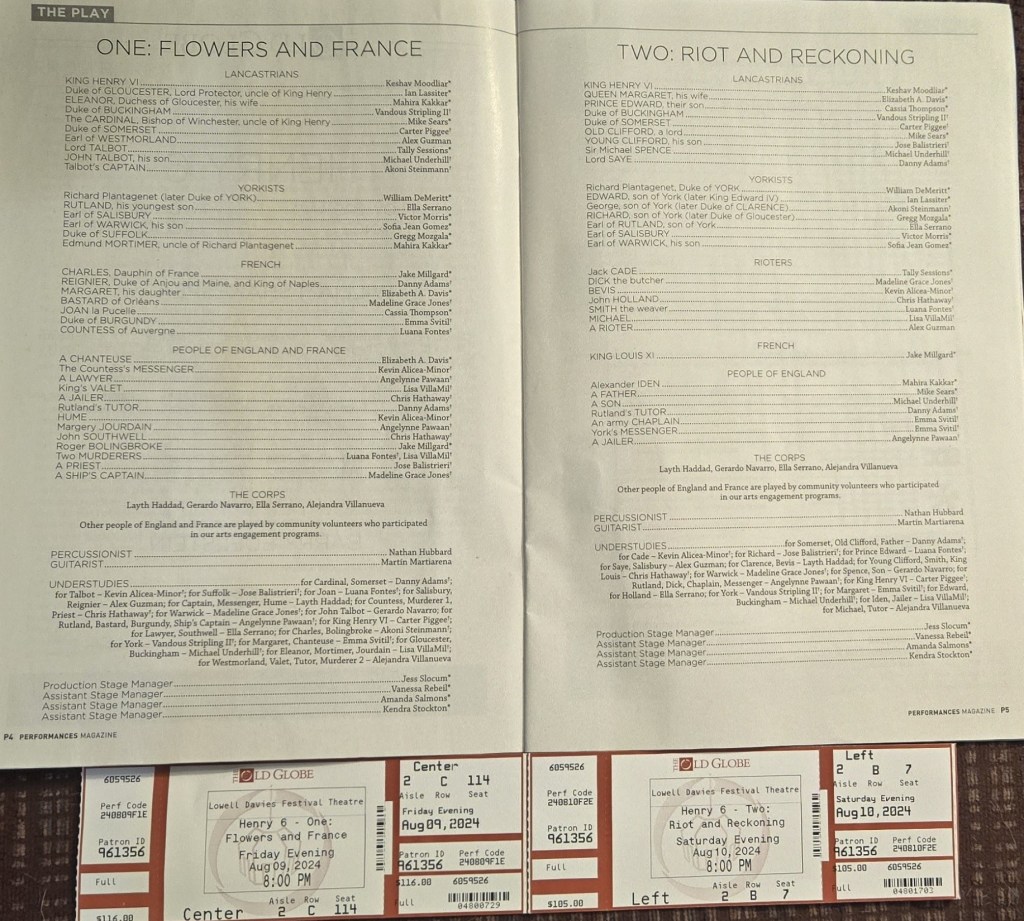
I have to note that it took me fewer attempts to get to Henry (three) than to Vienna (five). I literally had tickets to see it at the Oregon Shakespeare Festival in the fall of 2020, and we all know how that went. Michigan Shakespeare Festival was going to produce it this summer but sadly, had to go dark. I was merely wondering what might be playing at The Old Globe in San Diego during my upcoming trip next spring when I noticed that it is actually doing “Henry VI” this summer. And so I said to myself, who am I if I am not true to this glorious quest? I found the perfect weekend when the “Henry VI” Parts 1-3 would play on two successive nights, reserved a hotel room, and spent a couple of months in happy anticipation of a visit to the place of which I warmly think as American Crimea.

I have been to The Old Globe several years ago, and loved their production of “Red Velvet”. However, checking the tickets shortly before the trip, I was slightly dismayed to discover that “Henry” is being staged at an outdoor venue. I pictured lawn seats, actors scurrying to not be seen behind awkward wooden set pieces, and lots of bugs. In the Midwest, I have missed more than one outdoor performance and sporting event (yes, I have been known to attend a baseball game, don’t look so shocked!) that have been rained out. However, I know as well as anyone that it never rains in Southern California, and was willing to put up with the rest of the potential unpleasantries just to cross this elusive trio of plays off my list. Spoiler alert: this did not turn out to be your usual Shakespeare in the Park.


Now, much as all I know about French history I learned from the novels of Alexandre Dumas, all I know about English history I learned from Shakespeare. While I still need to recite the opening lines of “Richard III” to help myself remember who is York and who is Lancaster (and need a mnemonic device I heretofore have not found to identify which rose is red and which is white), I am happy to have finally filled the gap between “Henry V” and “Richard III”.
It turns out that the gap includes some pretty exciting stuff, such as Joan of Arc’s last stand, epic battles between the English and the French, and intense subsequent plotting and fighting for the crown among the various English heirs and pretenders. What’s not to like? Ah, here is what: my least favorite line in all of Shakespeare, “let’s kill all the lawyers”, makes its annoying appearance. Even though in the play (and I knew this before seeing it) it is meant as the first step to chaos and political instability and is spoken by a villainous character, it has been misquoted for centuries. But I am getting ahead of myself.
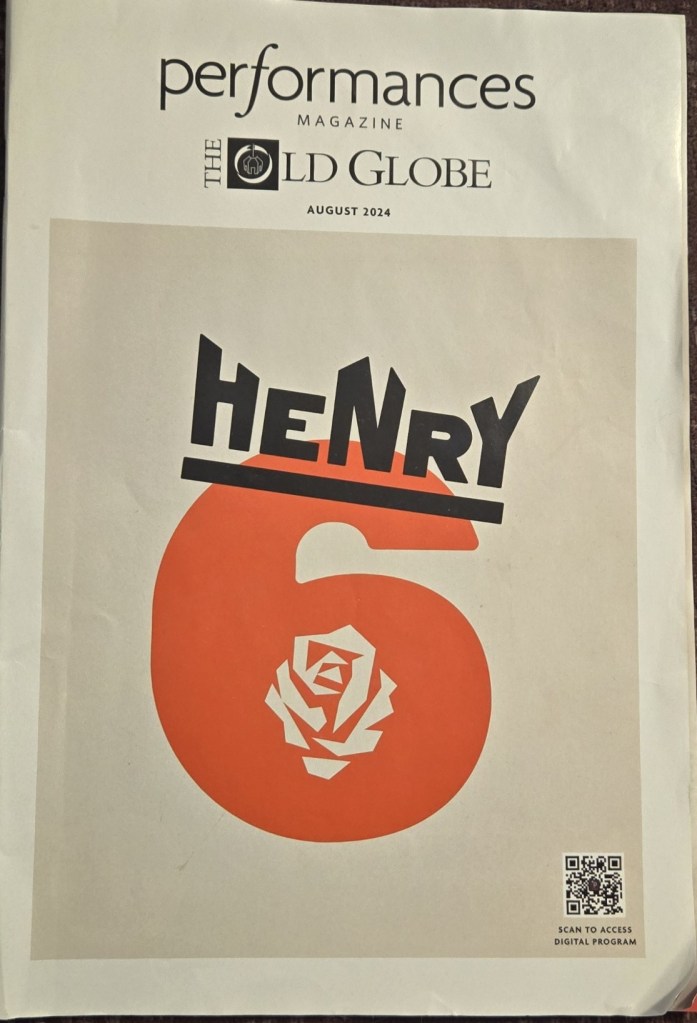
I have been seeing Shakespeare performed primarily at the Stratford Festival in Canada, which is as good as it gets. I have seen some fantastic interpretations elsewhere, innovative, beautifully acted, creatively staged, but I have always thought that Stratford’s scale and scope is second to none. Until now. And unexpectedly, this “Henry VI”—actually, styled as “Henry 6”—an English Civil War saga 600 years old, filled me with patriotism. I was all like, look at our American actors being as good as Canadians!

First, the outdoor theater at the Old Globe is basically the same as any other theater but without a roof—and a roof is not critical to a play unless you are dropping a chandelier from the ceiling. But the way the natural surroundings of the gorgeous Balboa Park worked with the set, however, was both unique and exhilarating. Every time those giant doors opened to let actors on stage and we saw, instead of the usual backstage darkness, majestic trees lit in the night, it was a spectacle like none I have ever experienced. The most powerful moment came early on, when Lord Talbot, The Sword of England, first burst on the scene, from the actual forest, backlit and accompanied by stirring rock music. It was just too cool!
Second, rarely have I seen a Shakespeare production that is so accessible, yet still recognizably classic. The inventive prologue gave a quick summary of The Henriad (Richard II/Henry IV, Henry V–it was yet unwritten by Shakespeare at the time of the staging of Henry VI) and set the stage for what is to follow. The costumes, the crowns, the crowds, the chaos—oh, it is history all right, but what gripping history! Maybe these are earlier plays, but what they lack in familiar soliloquies they more than make up in the absorbing (and true) story that is better than any tragedy (or comedy) from the pen of the same author.
This production is full of fun anachronisms, including a hilarious presentation by Richard of York to explain his right to the throne with the aid of an overhead projector. I have to add that, besides the valiant Talbot, Richard was my other favorite character. Is he supposed to be sympathetic? I found his sincerity and single-minded focus on the throne endearing. There was one scene where others are talking, planning, plotting, and he just paces around the stage, literally circumnavigating it, talking to himself. I caught myself with my mouth literally gaping open, trying to absorb everything that was going on.
I liked the first part more than the second one, for purely subjective reasons—more of the French (Charles the Dauphin bearing hilarious resemblance to King Herod in “Jesus Christ Superstar”), Talbot and the cult of Talbot, and just a lot more humor. The second part, all about the infighting and plotting for the English throne among the English themselves, is quite a bit darker. And once that madman Richard III shows up on the scene, events start snowballing, and you know it will end badly. He gets his own show later; let’s see more of the other people.
Also, Part 2 started right off with the reenactment of the January 6 riot, complete with the QAnon Shaman, albeit with the Union Jack painted on his face—and, obviously, with Shakespeare’s words, which, I imagine, elevated that particular disaster. It was disturbing and a terrible reminder that we humans never change and learn nothing from history. We live through these cataclysms and they shock us, but there is nothing new under the sun. Shakespeare already wrote about it…
The thing about Shakespeare is, his words, or even what we take to be his words, are constantly edited and reinterpreted. Having seen “Henry VI”/”6” for the first time, I do not know if I have fallen in love with the play itself, or with this particular version of it. But does it really matter? It was a magical experience that touched my heart, and that is what great theater does.

 Old Lady Writing
Wow! I think you need to send it to the theater! It’s a fantastic tribute!
LikeLike