Featured

Time Shelter: Reminiscence, not Review

“The past is not just that which happened to you.  Sometimes it is that which you just imagined”*. 

The older I get, the more disappointed—and, frankly, disbelieving—I am that we cannot travel back in time.  The more years pass, the farther I get from certain cherished moments, the harder it is to accept the permanence of their departure.  Watching Doctor Who, the ultimate wanderer in time and space, I get a vague sense of unease from the episodes set in the future.  What is the far future to me?  I will not see it, so I am not curious about it and not invested in it.  But the past, well, it is full of second guesses disguised as second chances.  It is full of the comfort of nostalgia. “It’s been written that the past is a foreign country.  Nonsense.  The past is my home country.  The future is a foreign country, full of strange faces, I won’t set foot there”*.

In “Time Shelter”, Bulgarian writer Georgi Gospodinov creates the perfect scenario for which my soul has been yearning.  Gospodinov is Bulgarian, and we are exactly the same age.  I feel his story almost instinctively, beyond the words, for he writes not just about the decades he experienced, but as only an Eastern Block Gen-Xer experienced them.  It is rare that I hear the echoes of the voices in my head in print.

His first person narrator meets Gaustine, a mysterious psychiatrist who opens a “clinic for the past”.  It is meant to evoke recognizable memories for Alzheimer’s patients by reproducing the surroundings of their comforting past lives, but the concept takes off and everyone wants to starts seeking shelter from the relentless passage of time by stepping into the past. “Everything happens years after it has happened”*.

Like Gaustine’s patients, I am not even interested in the historical past, someone else’s past.  I do not want to meet Shakespeare (whoever he really was) or see dinosaurs or anything like that. (OK, maybe I want to meet D’Artagnan in his natural habitat, but that is all).  And fine, I don’t even want to change anything.  I saw “Sliding Doors”.  I read “Midnight Library”.  I am no longer sure which parts of my life I would want to erase if there is no guarantee that this would not have a detrimental effect.  I can no longer fathom what my life would look like today if I had made different decisions at some critical junctures.  I might have been spared some pain, but what unanticipated and ultimately avoided sorrows were waiting in the wings?   The decisions that I made, I stand by them.  The decisions that were made for me trouble me still with the passage of years but regret is useless. And it all basically worked out.

The pool would have been beyond that fence on the right

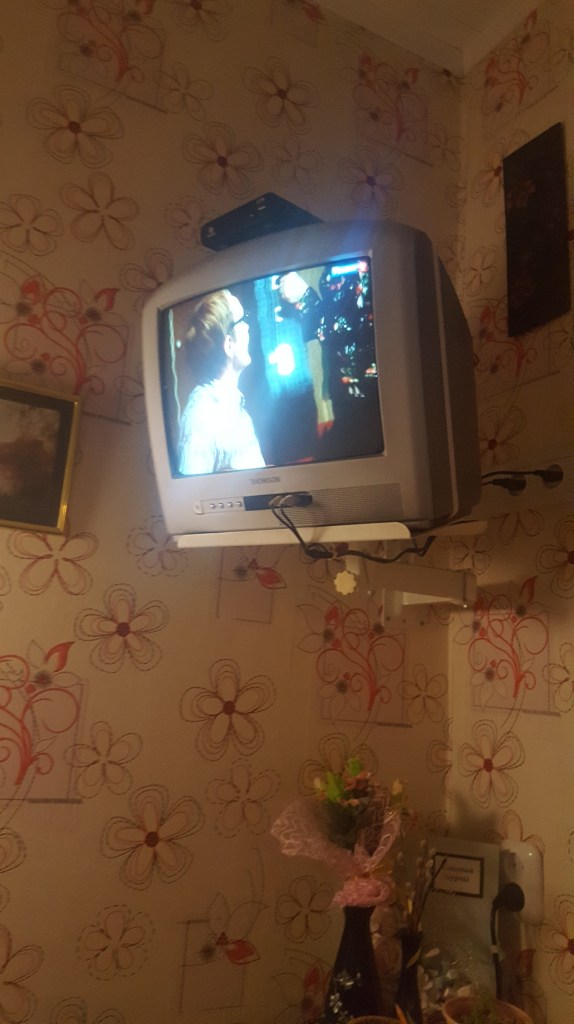
It is just that the melancholy longings come unbidden in the twilight, and that is when I sometimes wish I could revisit my past.  I want to see the sun rise over the roofs from the balcony of my mother’s apartment, for every occasion on which I visited her there seemed special and wonderful.  I want to sit in my childhood apartment’s dark room lit only by the lights of the Christmas tree, the only year my grandparents had a real tree and could finally hang up the one ornament that was too heavy for our little artificial tree—an orange, the size and weight of the actual fruit.  I do not want to forget either that orange that always stayed in the ornament box in the entresol except for that one brief appearance or my favorite ornament, wild strawberry with a human face.  I want to go to the grocery store on the first floor of our apartment building and buy birch juice by the glass and a hard block of coffee with milk, meant to be dissolved in boiling water and not gnawed like I did as a kid.  I want to watch my collection of film strips in the hallway of our apartment on the coldest winter days.  I want to marvel at the hollyhock mallow plants in our neighbors’ garden in the summer.  I want to see again that inground public pool that was filled in when I was just a toddler, leaving behind a weed-covered wasteland—was my memory of this thing even real, a random outdoor pool on our quiet little street?  And I want to sit on our old couch and read the books of my childhood.  There is so much from that era of gentle stagnation which seems positively utopian in comparison to our present cataclysmic times.  “Warning, history in the rearview mirror is always closer than it appears”*.

My favorite part of this mesmerizing novel, which I had to read twice in a row (and even that was not quite enough to fully take it all in; I am yearning to read it again), is when time shelters become so popular that European countries actually vote on returning to their respective favorite past eras.  The clinics of the past are no longer enough; entire countries become engulfed in nostalgia.  It is fascinating to read what decade each country chooses as representative of the glory of its people, yet still recognizable and not entirely devoid of modern comforts.  Some decades of the last century are obviously fraught; 30s and 40s have their devotees, but Gospodinov is not going there.  The story is not about that.  So many countries choose the 1970s or the early ‘80s (including most of the [former] Eastern Bloc—the whiff of freedom in the air, before reality bit), with only Italy choosing the ‘60s.  Bulgaria’s choice is not mentioned, but there is a hint.  “What decade would you choose?  “I’d like to be twelve years old in each of them.” * That would be my answer, too.

*All the quotes are from Georgi Gospodinov, “Time Shelter”, English translation by Angela Rodel
https://georgigospodinov.com/

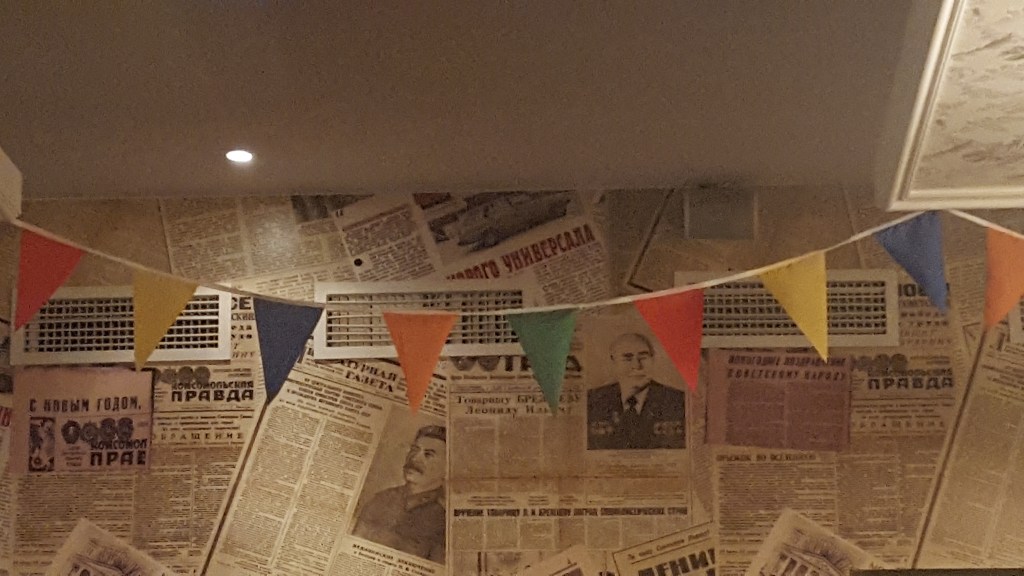
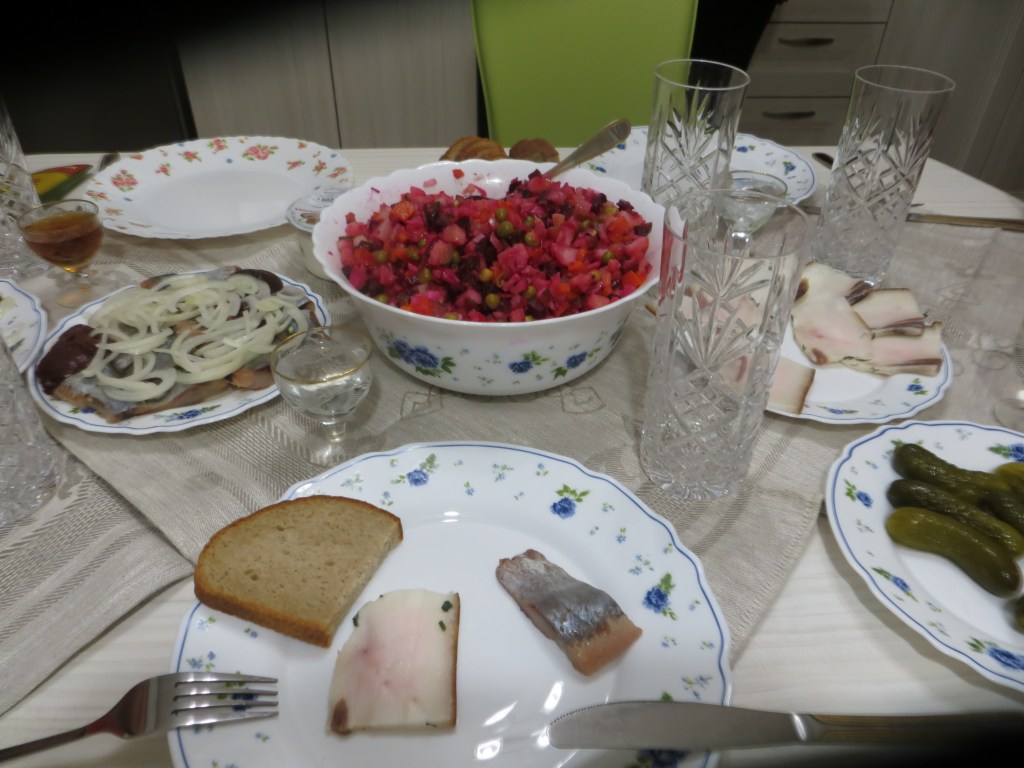
[Caption: my time shelter, for better or worse]

Featured

Never Not in a Book Club

I have mentioned before how much I love reading [https://oldladywriting.com/2021/04/03/so-many-books-so-little-time/].  It is generally a solitary activity, unless one is in a book club.  The need to share thoughts, ideas, impressions, to laugh and maybe even cry together over a story is so basic and valuable to me that I never not want to be in a book club.  Even the worst book club, in my experience, cannot be all bad because, well, books!

Book clubs, I have been in a few.  Initially, I thought they have to be run by libraries, for that is how I first got into one.  We moved, I found a new library with a new book club, we moved again, and so forth.  I loved the discussions, but eventually tired of the transient nature of those institutional associations.  The last one, at the library in our current town, was a lunchtime affair.  I was the only one who had to make an effort to come from work every month; everyone else was decades older—with the expected outlook on life.  Conversation was decent until the librarian assigned Kevin Boyle’s “Arc of Justice: A Saga of Race, Civil Rights, and Murder in the Jazz Age”.  As other members spent MY lunch hour lamenting the collapse of property values in Detroit thanks to The Great Migration, I fled never to return.

I had a great time forming a book club with a couple of gal pals.  It evolved—or devolved, depending on your viewpoint—almost immediately into an Eating and Drinking Club.  The books were entirely incidental to the social aspect.  At some point, there weren’t even any books.    We clung to the pretense:  Book Club goes to the movies, Book Club gets Thai food, Book Club visits speakeasies, Book Club actually tours a library.  Eventually, the Eating and Drinking Club grew into Weekly Beer Night, and it happily continues as such to this day. 

And yes, you know it’s coming, my tale of being in the worst book club ever–The Rich Ladies’ Book Club.  I was invited by an acquaintance, so in my defense, I did not know that books alone would not provide enough commonality or shelter within the group.  In their defense, I suppose no one expected a working class interloper or was prepared to deal with one.

There were some positives, such as everyone taking a turn selecting the books, and the books were generally wonderful—that is to say, normal book club fare.  The Rich Ladies did not always read them, but I did, and greatly enjoyed.  The overwhelming negative was the steady stream of one-up-woman-ship.  There were endless talks of the cost of kids’ hockey training and travel (while I wondered when did hockey become rich people’s sport and remembered how back in the Old Country any frozen puddle served its purpose) and other sports.  My oldest was already involved in theater, which did not impress anyone; my invitation to a community theater play was met with baffled murmurs. That is your child’s extracurricular activity?  Instead of expensive sport?  How very unusual…

I was always vaguely feeling like I was in a badly scripted parody of “Mean Girls, the Pre-Menopause Years”.  One time, everyone effusively commiserated with one of the Rich Ladies, whose interior designer’s unavailability drove her in desperation to buy a mass-produced lamp at Pottery Barn (while I have been generally satisfied and occasionally thrilled by the offerings at Target).  It was a calamity to be sure, but kudos to the resourceful lady of the house who braved the common throng and saved the day—and one could hardly tell that the item was not bespoke.  Well, as long as one did not examine it closely.

The proverbial pièce de resistance was the time I brought a bottle of wine, which was an expected offering at each meeting.  It was—wait for it—white Zinfandel, and from an unknown label to boot.  It was from a local winery owned by someone I knew, so I thought that was a nice touch.  Gasp!  If there was any doubt before, this misstep immediately outed me as an unwashed mass.  The hostess, a woman with a carefully cultivated stereotypical Gallic aggression I never actually encountered in France, insisted that I can only drink the wine I brought, being that it was not fit for The Rich Ladies’ consumption.  Not wishing to cast their precious nectars before such a swine, they shared their wine bottles; I drank some of mine and took the rest with me (of course the hostess politely but firmly requested that it be removed from her home).  To be fair, this was before I learned that what I really prefer is a robust red.  But you know what?  If I had to do it all over again, I would not only bring white zin—I would bring a box of it! [I am deliberately not posting any photo of wine in a box, because I do not want to shame any wine maker or drinker thereof]  Had I been younger and less secure in my proletarian character, or had The Rich Ladies’ snootiness been less absurdly shallow, I might have felt worse.  But as it was, I just never returned to their exclusive club.  I am sure a sigh of relief was breathed on both sides.

One unexpected blessing of The Plague is my current book club, courtesy of bookclubs app and Zoom technology.  There is a core group of four, with occasional drop-ins.  We are friendly, but do not socialize outside of book club—not the least reason for which is that we live all over the country.  We have spirited and deep (if I do say so myself) conversations about the books we read, and occasionally go off on tangents.  Some months I am reluctant to log in (for I am in charge of technology), because I would rather vegetate on the couch, yet I inevitably emerge refreshed, encouraged, and motivated.  As much as life has taught me that all things come to an end and that change is inevitable, I sure hope this remains a constant for as long as possible, and that I am never not in a book club.

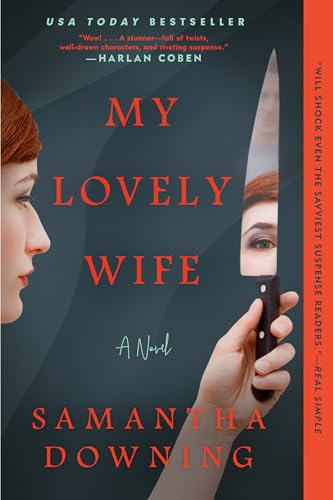
[What follows is the list of books read by my book club that I ranked 5 stars on Goodreads. Among these, I particularly recommend “Detransition, Baby” (no spoilers–but read with an open mind), “The Cider House Rules” (not new, but a modern classic, heartbreaking yet heartwarming), “Station Eleven” (I read it before the plague, and it haunted me until the unimaginable happened, and beyond), “The Midnight Library” (if you ever wondered, like me, where the road not taken might lead), and “The Sign for Home” (one of the most unique, thought-provoking, life-affirming, funny, and touching stories I have ever read–and the author, the wonderful and talented Blair Fell, Zoomed into our meeting and was an absolute joy to meet!)]