Who Tells Your Story?

Although I love theater, I am almost never at the forefront of seeing something before it becomes popular.  A lot of it is because I do not live near where shows start—although I am given to understand that “Fiddler on the Roof” premiered at Detroit’s Fisher Theatre in 1964, that was literally before my time.  The odds of me finding myself, during my travels, near a Broadway or West End show that is not yet big but will be are pretty slim.  While it has happened more than once that I saw a show that I thought was destined for greatness which later went nowhere[1], the opposite never happens.  Probably the biggest missed opportunity, not counting all the shows I regret missing in Stratford over the years, was during a 2015 visit to New York. 

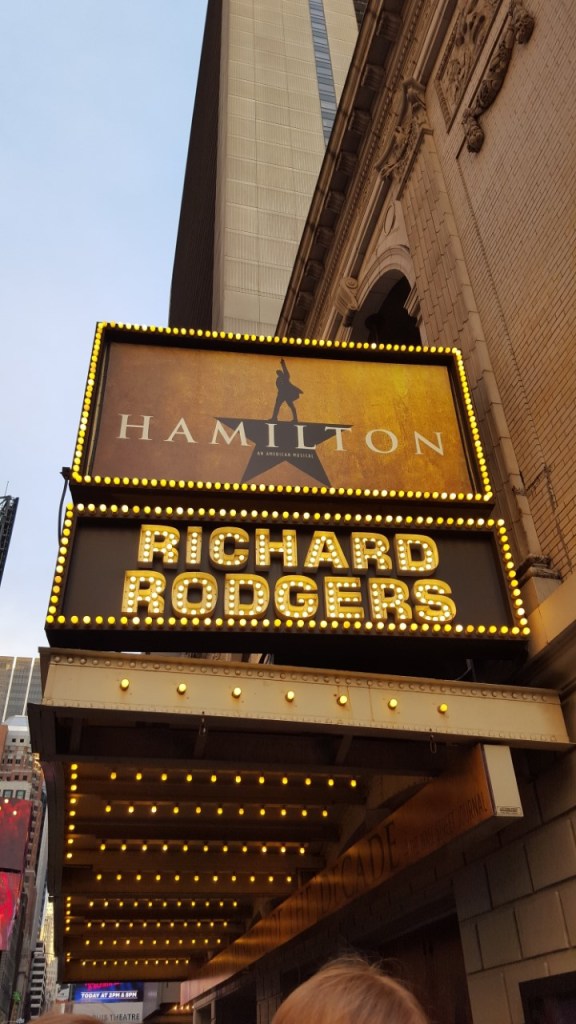
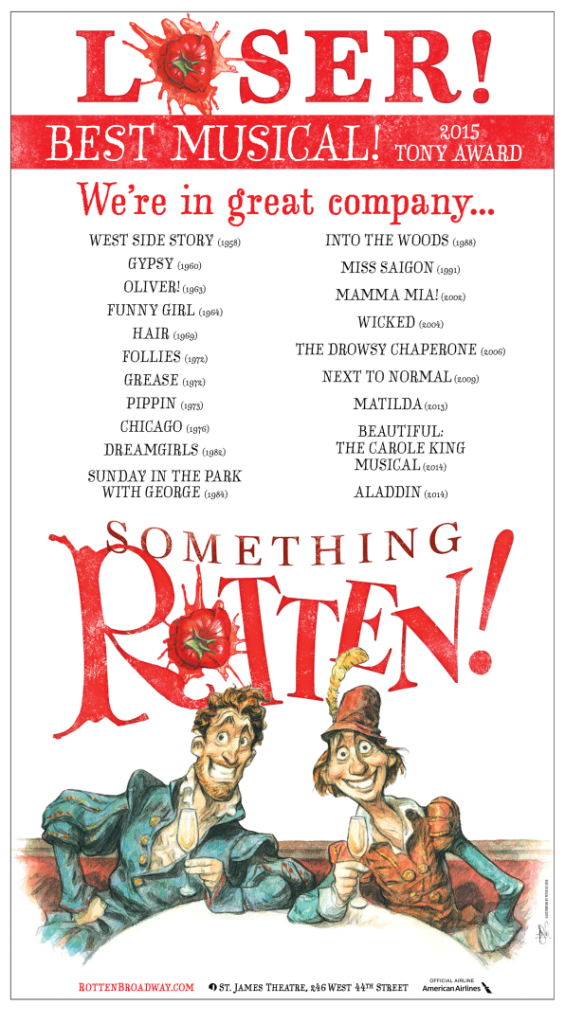
My actor son was living in Brooklyn and about to leave on tour with “Aladdin”[2].  The family was visiting him, and naturally, decided to see a Broadway musical.  Walking past the Richard Rodgers Theatre, I noticed the not-yet-familiar black silhouettes on gold background. 

“What is this all about?” inquired I. 

“It’s a new rap musical about Alexander Hamilton”, replied son, dismissively.

“Hmm, that sounds really stupid”, opined I, disdainfully.

“It does indeed”[3], agreed son, and we moved on, chuckling to ourselves.  This was too much even for this theater-appreciating family.  Spouse, in his low-key way, was noting that “Something Rotten!” “looks good”.  When this man says that something “looks good”, it means that he is super-excited and jumping up and down inside with the mad desire to see whatever this is.  We bought tickets to “Something Rotten!” and enjoyed it immensely, witnessing a standing ovation in the middle of Act I—which, of course, is an incredibly rare occurrence, and a sure indication of potential long-term success[4]

I did not give “Hamilton” another thought until, on a Christmas flight to London, I saw the soundtrack as one of the offerings of Delta in-flight entertainment.  I tried to listen, and it was nice enough, but the flight is an overnight one.  I sleep on overnight flights.  I fell asleep.

And then I woke up with a jolt, because something terrible happened to the Hamilton family (OK, they also turned the lights on and started serving breakfast)!  I am neither proud nor ashamed to say that my knowledge of American history is limited to two years of high school—and the first year, my English was not good enough to fully grasp the goings on.  Alexander Hamilton was covered that year, and I remembered that he was shot in a duel by Aaron Burr, but who knew that his son was also killed?  It was sad!  It was like “Les Miz”!

I landed in London a “Hamilton” fan, and decided to travel to New York in the foreseeable future and see this musical in person.  I mean, how much could it cost, if we fly with miles and grab a hotel room with points?  Couple of hundred bucks for tickets? 

Not so fast, newly-minted-fans!  This brought back memories of “Phantom” in the ‘90s [https://oldladywriting.com/2020/04/25/team-phantom/]—but, times have surely changed, and in the classical dilemma of time versus money, I had a little bit less of the former and a tiny bit more of the latter.  Tickets were procured, and their extortionate cost was somewhat balanced out by the fact that we flew to New York on Spirit Airlines, and with no more than a handbag per person.

Was it worth it?  Yes, yes it was—although spouse did say, after it was all over, “It was great, but not like the first time I saw “Les Miz”.  I will not dispute that, because “Les Misérables” holds an extra-special place in my heart.  I also will not do a review of “Hamilton”, because I doubt that anything is left unwritten about it.  But this is what it means to me.

In theater productions, I live for that one moment when everything shifts and you remember it forever, either because it’s the funniest thing you’ve ever heard:

            “A handbag?!” in “The Important of Being Earnest”

            “The whole staff was slaughtered” exchange in “Hothouse”

or it breaks your heart:

            “Could you ask as much from any other man?” in “Jesus Christ Superstar” (because you know what happens to him…)

            As soon as the miners appear in “Billy Elliott” and sing “The Stars Look Down” (because you know what happens to them…)

or, in some cases, the entire play is brilliant:  “Art”; “August Osage County”

I will not call it an “aha” moment, because it is not a moment of cerebral discovery, but it is more of an “oh”—or “aww”?—moment, which is purely emotional in nature.  It is the “wait for it” or “catharsis” moment.  It is what live theater does best, that moment of unity of hearts and souls between the characters on stage and the audience.

“Hamilton” both starts and ends on that moment.  The opening number is so big, so smart, so creative, so instantly recognizable, and when we heard, “What’s your name, man?”, and there was that little pause, and Lin-Manuel Miranda appeared and said “Alexander Hamilton”—well, the entire audience of 1,300+ lost their collective minds!  Not to take away from “Something Rotten!”’s standing ovation in Act I, but that was a rock star-caliber moment.  Lin-Manuel Miranda’s presence is electric, and his charisma and enthusiasm on stage cannot be overemphasized.  I would say that I knew, once again, that I was in the presence of greatness [https://oldladywriting.com/2020/07/26/all-my-world-is-a-stage/]—except that by the time I got to see “Hamilton”, live and with the still original cast, that would have been a major understatement. 

And then there is that closing number, “Who Lives, Who Dies, Who Tells Your Story”.  I love a good ending.  I mean, who doesn’t, but I really, *really* love a good ending.  A good ending is worth the price of admission even more than a good beginning, because it stays with you, even after the curtain falls.  “Hamilton” ends like it begins, with the satisfying big number, but with more poignancy.  It’s the combination of “Anatevka”, “Impossible Dream”, and “Do You Hear the People Sing?”, these other great finales, because it is both tragic and hopeful, tender and confident, wistful in the loss of a promising life cut short, yet satisfying in the summary of its legacy.  It earns my inarticulate but sincere praise of “I cried and cried”. 

Who tells your story?  Little by little, I am trying to tell mine…


[1] My spouse still laments “Martin Guerre” by Claude-Michel Schönberg and Alain Boublil, the creators of “Les Miserables” and “Miss Saigon” fame.  You haven’t seen that version of “Martin Guerre”?  No one has.

[2] Small print--not THAT “Aladdin”.

[3] This is why my writing career is still fledgling.  I cannot write dialogue.

[4] This was after “The Musical”, which I still think is one of the most fun and clever numbers of the genre, basically an entire “Forbidden Broadway” in several minutes and on a major stage.  And to be fair, Christian Borle did get a Tony for his part in this, not to mention eight other nominations for the show itself!

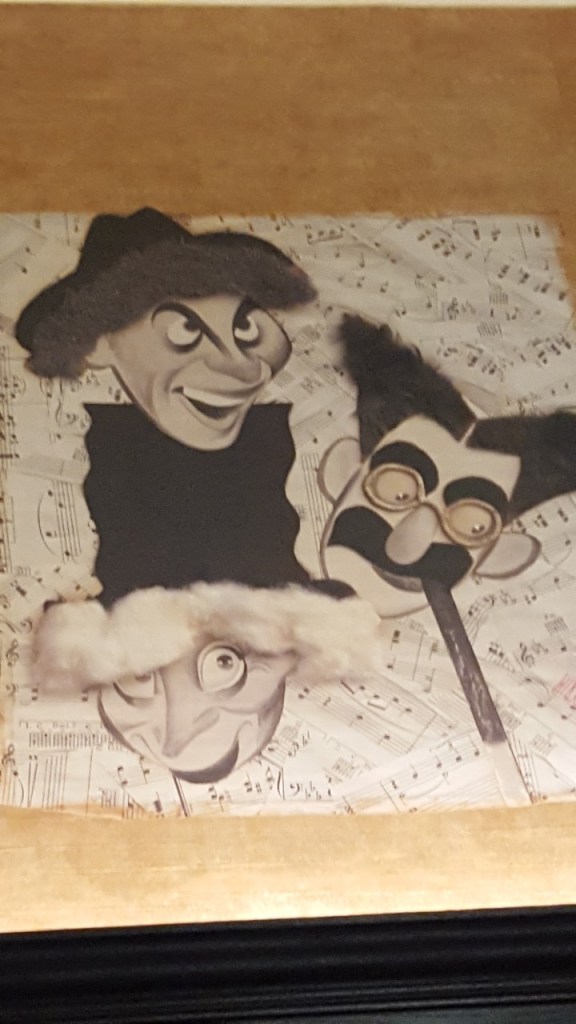
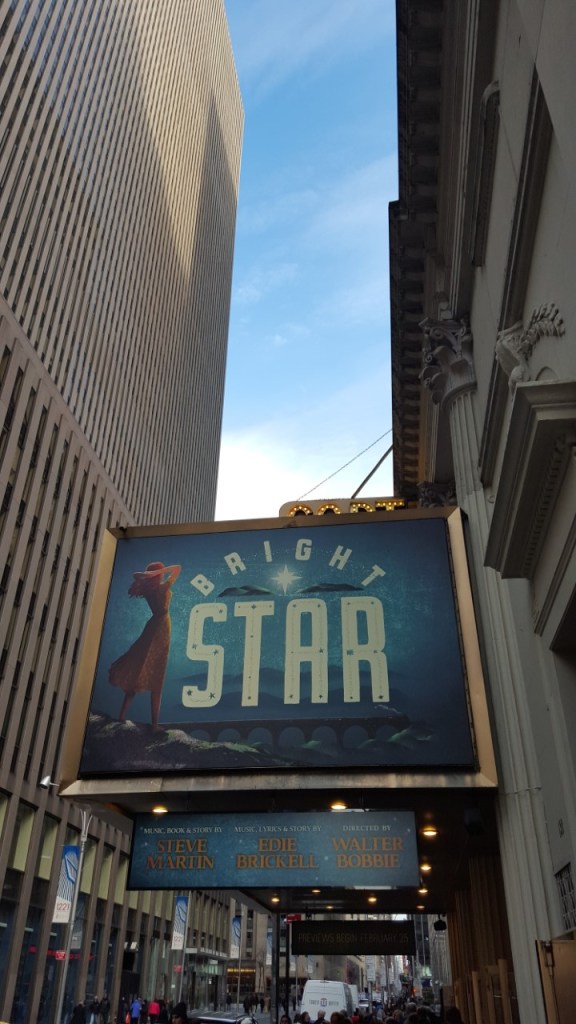
It was a magical weekend overall. We also saw “Bright Star”, starring the wonderful Paul Nolan, who deserves an award for every role which he graces with his talent, and stayed at the Algonquin, Harpo Marx’ old stomping ground.  Those are stories for another day!]

Meet Me in Sistine Chapel or Rome, Second Try

My second trip to Rome was in 1988, during that much-mentioned European summer in college.  There were endless discussions about where everyone will travel after classes end.  I wanted to go to Scandinavia.  Almost everyone wanted to go to Italy.  I went to Scandinavia, by myself—but not before I went to Italy with my roommate Kathy.

This looks like something out of “Rocco and His Brothers”. Milo in 1988

But at the outset, I have to acknowledge that I made a small, but vital error in my first Roman reminiscence when I wrote that I never entered Pensione Milo since 1981. Roman Holiday – Old Lady Writing Apparently I did, during this second visit, and not only that, but Kathy and I even went up to the lobby and loitered there for a bit.  There are photos from this second visit—but, due to lack of funds and related constraints of a 35mm camera, the careful rationing of available resources resulted in zero images of the pensione’s interior.  And then three decades passed, and I completely forgot this ever-critical fact—until I conferred with the old diary.  And there it was.  Never let it be said that I do not acknowledge my mistakes.

As a teenager, I wrote about my life in great detail, which I desperately envy now.  I envy my younger self’s complete and utter self-absorption—but, that is certainly the prerogative of youth.  I would love to recapture that focus in my Third Thirty, and preferably a little before.

And thus present recollection refreshed informs us that on Thursday, July 7, 1988, Kathy, Naomi, and I were the second group to depart the Travelers Hotel in Nimes (the town I missed revisiting due to the plague last year, Pont du Gard and the Plague – Old Lady Writing) on a night train to Paris.  While waiting on the platform, we were rewarded by being kissed by sailors from a Marseille-bound train that stopped in Nimes for a literal minute.  It was a kinder, gentler time.  No judgment.

In my diary, I wrote in puzzling detail about traversing Paris with Naomi from Gare de Lyon to Gare du Nord with my hateful, incredibly heavy orange Soviet-edition suitcase.  Wheeled suitcases were already a thing then, but out of about 35 people in the group, I was the only one without one.  Being an immigrant, and of the refugee kind to boot, I spent the decade trying, yet never quite succeeding, to fit in.  I would like to think that the orange suitcase was the last vestige of that difficult passage to America. 

In any case, it was a complicated plan in which Kathy (who stored her suitcase at Gare Montparnasse—a detail that never becomes important again in this narrative) and I, after parting ways with Naomi, first headed to the Netherlands, where I left the detested luggage with my erstwhile host family, and then traveled all the way down to Rome, after which we efficiently worked our way back up via North of Italy, Switzerland, Belgium, Luxembourg, Belgium again, Switzerland again, to finally tearfully part back in Paris.  She mentioned once that she will probably not return to Europe, as she was looking forward to getting married and living the good life in the U.S.  I was instantly shocked, as I envisioned that summer as the beginning of many adventures to come.  We were both right.  And she is still the best roommate I’ve had (present spouses excluded, of course).

But the very first day—after the luggage was sorted and after we spent about two days sitting on various trains (for sleeping wagons are only covered by the Eurail Pass if there is literally no other mode of transportation) and missing various trains (for the Italian rail schedule was an unsolvable mystery in the ‘80s) was Rome.

The hostel where we stayed was either worse than Milo, or I came to expect more.  No, it was clearly the former—as a college student of extremely limited means, my expectations would not rise for at least another decade (remember the First Spanish trip? The First Spanish Trip – Old Lady Writing)  We arrived exhausted and bedraggled at Roma Termini, looking forward to a shower before bed.  I do not recall who went in first—but whoever it was, discovered that only cold water was available (I would guess it had to be me, because had Kathy told me that there was no hot water, why would I have gotten in?  She would have—I would have stayed filthy).  We sat on our respective beds, felt sorry for ourselves, and had a good cry.  I had a fleeting thought that Rome and I just aren’t meant to be.

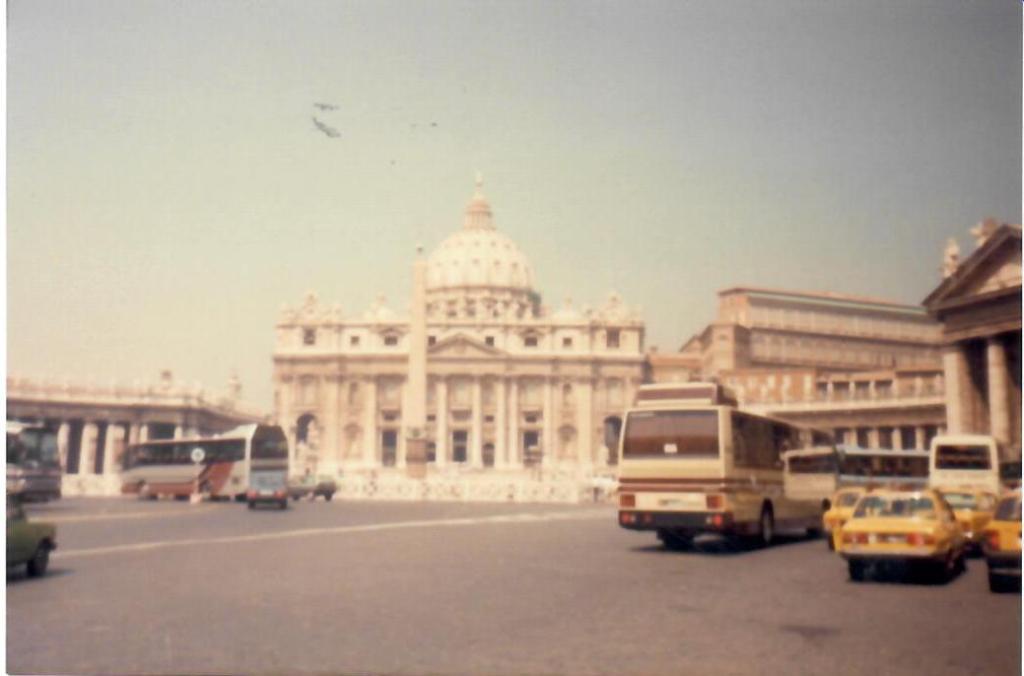
Our one day in Rome was action-overpacked.  We met several friends from our group—inside the Sistine Chapel, no less, because in those pre-cell phone days you had to pick a landmark, a time, and hope that everyone made it.  It was kind of like a student/buddy moment of Sleepless in Seattle.  Kathy and I walked all the way from the hostel near Termini to the Vatican.  We already know now that it is less than 5k Roman Holiday – Old Lady Writing, but after a long train ride, a traumatic first evening, and on a sweltering, tourist-packed August day it seemed like a manifestation of all the confusion and disorder that I remembered from my previous Rome stay. 

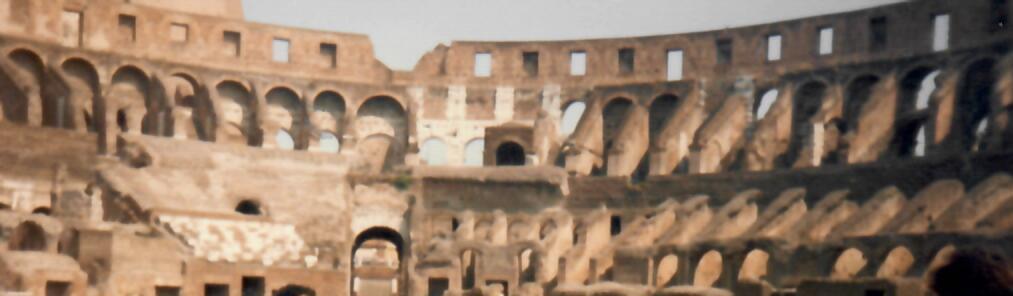
So, I finally saw the Sistine Chapel, and then the Colosseum.  We ate some terrible pasta at a cheap restaurant nearby, cementing my poor opinion of Italian food for the next few decades.  We visited the catacombs.  It was exciting to finally be out and about as a paying, albeit a decidedly not flush, tourist.  But Rome was still overwhelming, in its size, its sights, its sounds, its infinite variety.  If the first trip was one prolonged anxiety attack, the second trip was an assault on the senses.  To be fair, it was only a day, and short on time and money, we made the best of it.  Third time turned out to be the charm.

So Many Books, So Little Time

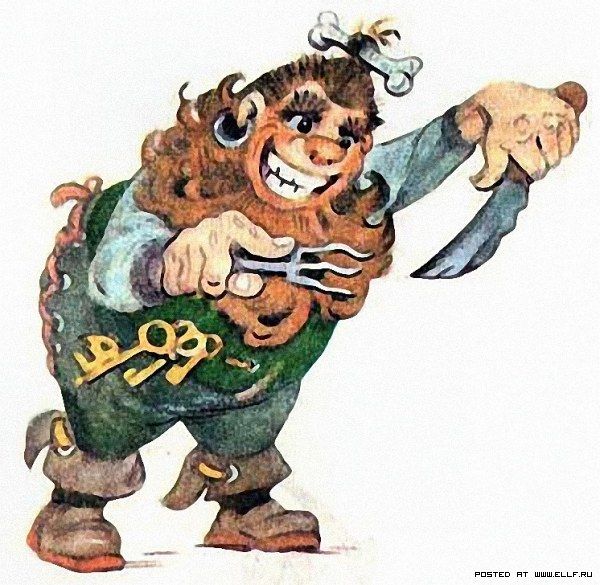
I read a lot.  I have always read a lot.  It started one warm sunny summer afternoon when I was five.  My grandmother was reading “The Wizard of the Emerald City” to me (Russian version of “The Wizard of Oz”), but had to set it down because, as usual, household chores beckoned (this was some years before she started enlisting me and came to the swift conclusion that my lack of floor scrubbing and chicken plucking skills will never land me a husband.)  She put the book on a piano stool (a piano in that time and place was mandatory; I was not encouraged to touch it).  I circled it for a bit, unsure of how much trouble I will earn myself for touching a library book, but simply dying to know what happened when Ellie, Totoshka, and the gang encountered the savage сannibal.  I picked up the book and managed to put enough letters together to get through the rest of the chapter.  In my mind’s eye, I still see how the setting sun was streaming through the windows (we had northern exposure in our one room). 

Not a good moment to stop this book

And my most enduring, most comforting, most enriching, most faithful, most influential past time was born.  I have never stopped reading, not through years of university, child-rearing, long hours at work.  Backpacking through Europe at 19, I would go without a meal to spend what seemed like an extraordinary amount of money on English-language paperbacks in non-English speaking countries to read on trains (added bonus—lost weight).  I would choose the most pages for the money, which was not always the best literary value, alas.

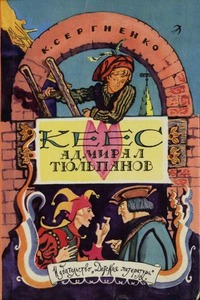
My reading practices, however, changed over the decades.  As a child, if I liked a book, I would read and reread it.  I would go back, flip through pages, land on a random passage, read from that point, look for favorite passages, reread those, and so on.  This might explain why occasional quotes from “The Three Musketeers” or “Twelve Chairs” or even Chekhov’s short stories still come to me unbidden, but a book I read a month ago is so thoroughly forgotten that I might not recall either the title, the author, or the plot today (I mean you, “Where the Crawdads Sing”.  No offense).

My actual much-depleted pandemic stash

At some point, quality fell somewhat of a victim to quantity.  You know those Goodreads challenges, to read 50 books a year?  (Well, that’s the challenge I set for myself every year—doesn’t everyone?  A book a week, with a couple of weeks off for binge-watching Netflix seems very reasonable.) But why such a rush?  Is it because a friend said once, “I haven’t even read 1,000 books!” in a self-horrified manner?  But, that was probably about 20 years ago, so I have hit the quasi-magic number by now.  Or is it just because there is an embarrassment of riches out there?  I do not want to miss out on something great, and so gulp books down like Lindor truffles.

But I miss the reflection.  And what I really, really miss is the change in my relationship with books.

When I was a child, I read like a child.  The literary characters were my friends.  They lived in my imagination, and they were my counterlife[1].  I lived in their world, and they lived in mine. 

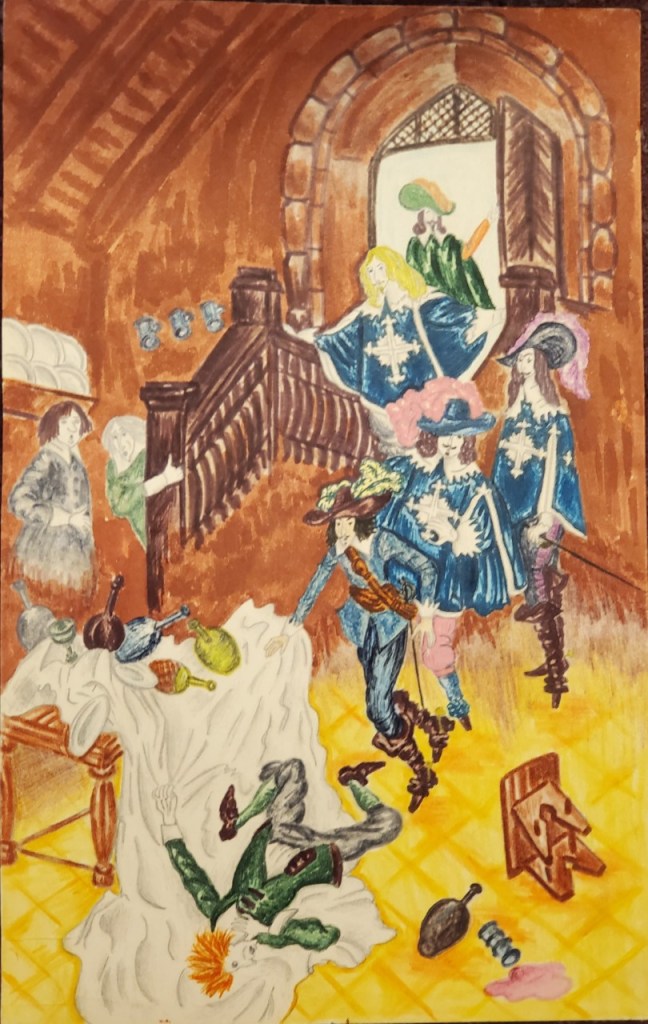
In my childhood, the counterlife was galloping through the vaguely unimaginable streets of Paris with the musketeers.  It was pure fantasy, as I never expected to walk the streets of Paris any more than I expected to walk on the surface of the moon[2]When Did the Arc de Triomphe Start Leaning? – Old Lady Writing
At some point, and I do not know when exactly that border into adulthood was crossed—and the crossing was, I imagine, inevitable—book characters stopped appearing in my reality.  Or, more accurately, I stopped going into theirs.  A certain detachment occurred where, while I remain entertained, enlightened, educated, and generally touched (and occasionally irritated and even bored) by what I read for pleasure, it is no longer my alternate reality.  It is just that—entertainment, education, etc.  It is enough—of course it is enough, there are so many great books that I have read and have yet to read—but I sometimes miss that untamed fantasyland of my childhood, where every story was examined through the lens of how it could play out in counterlife, and where I tried every character on for size as a potential friend or alter ego. 

It is unavoidable and logical, but it is occasionally sad when I stop and think about it.  That wild inventiveness would be very helpful right now, as the global pandemic still rages, theaters are still closed, and non-fictional friends are still remote.  This might be a good time to work on breathing new life into the counterlife… 


[1] Thank you for introducing this term in “The Glass Hotel”, Emily St. John Mandel.  I have always said “parallel universe”, but that implies, I think, something more impossible rather than improbable.

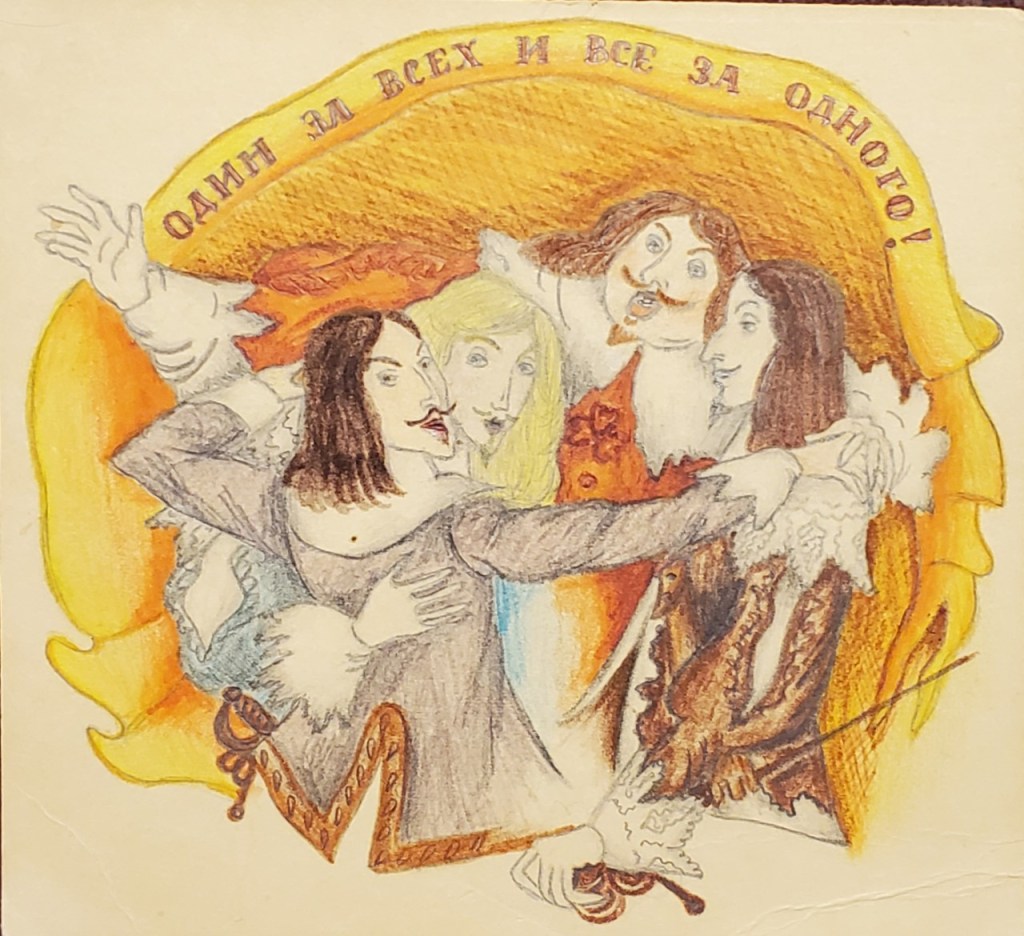
[2] I might add that the vast majority of my childhood literary heroes were male.  I am of the generation and culture that was not bothered by that.  In the childhood reenactments that I held with my girlfriends, we WERE the musketeers. I even won the top prize at a school New Year’s party, dressed as a musketeer in a costume made by my mom, wielding a plastic rapier, and performing the famous “Song about the sword”. What did I win? Probably an orange. Valor and Glory of the Motorbuilders – Old Lady Writing

“One for All and All for One!” Again, by the author.

London Calling

With my love of travel, my love of Gilbert and Sullivan, and my love of “Chariots of Fire”, there is one important location that has not yet been mentioned.  It Is a Glorious Thing – Old Lady Writing Did you guess London?  If so, you guessed correctly.  If not, I cannot fathom what you are thinking. 

London was slightly elusive in my younger days.  During my college summer in Europe, the Chunnel train was not yet in existence.  While the British rail system was covered by the Eurail Pass, the passage from the continent to Albion was not.  There was no way I was going if there was an extra charge.

The Royal Family in the “good old days” (At Madame Tussaud’s in London. I love wax museums, and never miss one!)

Around the time of my last college spring break, my mother gifted me with enough free, rapidly expiring airline miles for two tickets to Europe.  I could bring a companion.  No catch.  In what can only be described as a fit of temporary insanity, I invited Grandma.  No, really, I was twenty one years old, and I went to London with my Grandma.  I am expecting to be rewarded for this in my next life…

And so, I flew to New York, and Grandma and I set out on a cross-continental flight together.  Our troubles started immediately when she set off a metal detector.  The year was 1990, a kinder, gentler time when everyone could walk on to the departure gates, and TSA was only a vague concept—except in a case of an elderly, five feet tall woman who was  bringing not only an apple for her long flight, but an accompanying knife wrapped in a handkerchief.  Bizarrely, the TSA agent who confiscated Grandma’s best paring knife agreed to mail it back to her home address in Brooklyn.  The potential loss of the knife caused Grandma considerable distress during our vacation, until we were informed by triumphant Grandpa, upon being picked up from our return flight, that the knife arrived safe and sound.  No “How was your trip? How is London?  Welcome home!”, but “Those bastards did not steal our knife after all!”

The flight itself was an unmitigated nightmare.  Grandma, immeasurably energized by full access to me for the upcoming week, decided to start early on what we call “educating” me, but really the better term is “nagging”.  I was treated to a seven-hour lecture about the various deficiencies of my character, my appearance, my behavior, my friends both male and female, and my overall prognosis for a productive life.  As a graduating university senior heading to an Ivy League law school and holding down two jobs, I naively thought I might have had a right to feel sort of OK about myself.  However, I was also overweight and single, two of the most cardinal of mortal sins in The World According to Grandma.

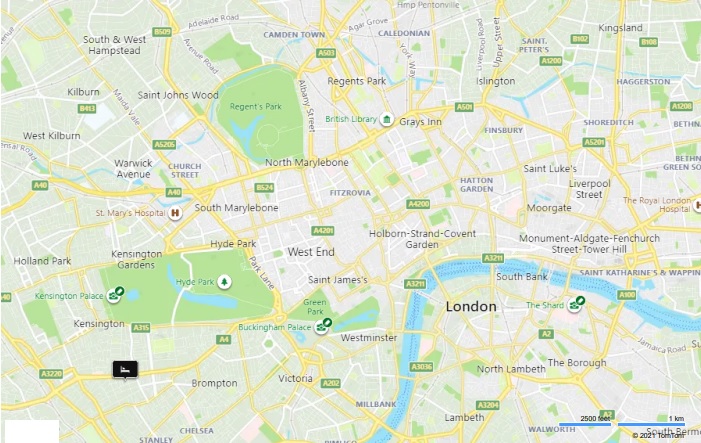
Holiday Inn London – Kensington Forum Hotel |Best Price Guaranteed |Kensington London Hotel (hikensingtonforumhotel.co.uk)

We were staying at the Forum Hotel, now Holiday Inn Kensington Forum.  This is important, because this hotel is huge—900+ rooms and 27 stories. Upon arrival, after a sleepless night of “education”, I determined that I lost interest in my travel companion.  We had a brief discussion and decided that, in order for each of us to preserve our own mental, emotional, and physical well-being, we will tour the city separately and only share sleeping quarters.  I lived in a dorm—I could do it!  Grandma was married for 45 years at that point—she could definitely do it!  We each had our own money, room key, basics of the English language (some better than others), and I generously gave her one of my maps of London (this was when giant folding paper maps were all the rage).  She stormed off.  I breathed a sigh of relief.

Here is what I did next: (1) Called my mom as I still do during all important times, or really any time at all. She was supportive, as she generally tends to be.  (2) Unpacked my suitcase and staked out my bed.  (3) Took a shower, washed and blow-dried my hair, and changed clothes, because I needed a pick me up.  (4) Opened the minibar and daringly consumed an adult beverage, because I needed a pick me up.  (5) Ate a bar of chocolate, also from the minibar, because, well, isn’t it obvious? (6) Unfolded my giant paper map and determined that the first stop on my tour that day will be Harrod’s, which was the closest landmark to this hotel, and also made the most sense, given how the trip started.

The reason for these boring details is because I want to convey that I was only ready to depart the hotel quite a fair bit of time after Grandma.  I mean, all of these activities took a while.  I am not sure exactly how much, but long enough that when I heard a tentative knock at the door, I logically assumed that the day’s cleaning crew was arriving.  Since this was my first time staying at a place fancy enough to be cleaned (and with a mini-bar—did I mention the minibar?), I grabbed my coat and rushed to the door, on my way toward my adventure in London, yelling encouragingly to whoever was behind the door that I am leaving and they can get down to business.

Behind the door was Grandma.  All this time, she was trying to find her way out of the huge hotel, rode the elevator, stumbled on the underground garage, gift shop, and every other floor, but regrettably, never the lobby.  She was exhausted, defeated, and ready to make peace.

Thus began my love affair with the West End… [The photo is not mine]

The rest of the week actually went reasonably well, all things considered.  We walked a lot (some of it was because Grandma was always a tireless walker her entire life, never having learned how to drive), saw all the main sites, including a day trip to Windsor Castle (where Grandma concluded that the tiny medieval royal beds are far inferior to her Italianate suite back in Brooklyn), and experienced our first (but far from my last) West End musical (“Me and My Girl” at the Adelphi theater).  In those days, London was still boasting its terrible cuisine, though to be fair, the two of us, a college student and a Soviet retiree, were decidedly not “foodies”.  We ate at McDonald’s and were excited.  Once we had pastries at a cafe and felt rather sophisticated.  I bought six decks of cards for my collection. I took only twice as many photos.  Every night, after Grandma fell asleep, I watched British TV and treated myself to a beverage and chocolate from the mini bar. 

It was not my best trip to London, but it was a decent first encounter with an exciting city which I came to know well in subsequent decades.  Later, there came many laughs, many discoveries, and many unforgettable theater experiences.  This was the slightly inauspicious start.

One of the twelve photos I took. Seriously? What is it even?

Always Nordic, Never Alpine

Pandemic winter is both harder, because there is no place to go, and easier, because there is no compulsion to go places.  I briefly interrupted my hibernation on a Saturday afternoon to engage in some cross-country skiing.  It was more like “cross-yard”—in fact, it was exactly that, because I literally skied out of my backyard and around the subdivision where I live.  Very Old Country.  Driving to a specified and possibly paid location just to ski around seems entirely too bourgeois, unless one is on a holiday.  

This is me, starting out in my actual back yard.

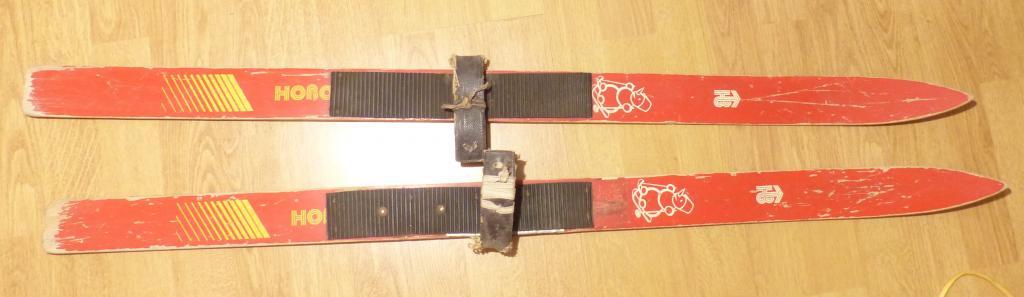
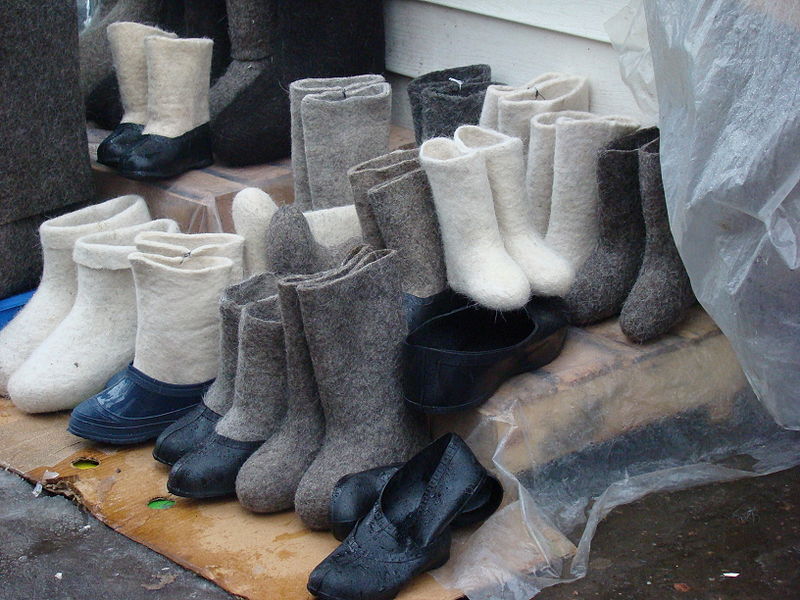
I would not say I was skiing before I was walking, but I certainly do not remember learning to ski.  It was just something children did all winter long, along with sliding down every snow drift and every patch of ice in our path.  All my skis in childhood were the kind that did not require special boots, but the type where you just slide your foot into a rubber band, and another rubber band goes around the heel (and sometimes not even that).  You put your “valenki” onto the rubber piece, because “valenki”, being just felted wool, are very slippery (Although I was always made to wear galoshes over mine.  I come by my indifference to fashionable footwear honestly).  In Russia, I never graduated to the adult skis which came with special boots that attached to the skis with the metal cage-like fastenings that looked complicated and somehow final, leaving no possibility of escape.

Not my actual skis, but a pretty accurate representation.

In my childhood, my main ski route was in the front yard of our house (so that my grandmother could watch me out of our kitchen window).  It was an easy and pleasant morning before going to school during the second shift, until it became less attractive when big garbage bins were installed in my direct path.  Occasionally, I was allowed to ski in the big field behind our house, a site of soccer matches in the summer.  Both of these have since been sacrificed to progress: the field is now home to an auto dealership, and an extremely shocking high rise is getting built right across from the old two- and three-story apartment buildings.  At least the trash bins have disappeared.

These are way fancier than anything we had back in the USSR

Skiing was the gym activity during the 2nd and 3rd quarters of the school year.  As a gym activity, it was terrible for many reasons.  First, the school-provided skis were awful and literally went nowhere, because they were never properly waxed and got stuck in the snow.  Choosing skis in the gym was a predictable pandemonium.  If you were not appropriately aggressive, you could end up with two left skis.  I usually brought my own skis, like some of the children of Soviet privilege, and because my grandmother was convinced that the school skis were unsanitary disease-bearers.  This involved hauling a pair of skis on the crowded trolley #4, an experience similar to riding the NYC subway during rush hour, but with worse smell (some of which was contributed by me, because at one point I had a winter coat with goat fur collar.  Let me tell you, nothing, nothing at all smells worse than goat fur, even after it was aired out AND sprayed with Red Moscow perfume.  This might explain why I have never found goats even remotely adorable).  Guarding my skis against breakage was a nerve-wracking experience for several winters. 

When I was very young, we were not allowed to use poles in school—the temptations of wielding them as swords or trying to poke someone in the eye was too great.  I am ashamed to confess I was not always able to resist either once the pole ban was lifted.

Second, although gym during the ski season was a double lesson to allow us time to change, returning to regular classroom after being outside for an hour and a half, sweaty and soaked, covered in snow, was entirely uninspiring.  In my later school years, I have taken to not returning.  Along with a few pals, we would ski away from the pack on the field where we raced in a long loop, right across the roundabout at October Square (luckily, there were not that many cars in my hometown in those days), grab our backpacks from the school vestibule, and keep going.  Who knows what kind of a delinquent I might have become had we stayed in Russia?  American schools sure scared me straight…

Third, we had to learn downhill skiing.  Now, there are no mountains where I come from.  In my entire life, I have never lived anywhere near a mountain range of any kind.  To me, anything taller than me is a mountain.  If I see an incline, it’s a mountain.  There was not so much as a hill in either our front yard or our back yard.  However, my hometown, like any medieval fortress, is built along a river.  The dramatic and terrifying hill, “Friday Descent” (probably referring to Good Friday, otherwise it is a pretty random name) was the location of our Alpine exercises. 

Although I am not particularly afraid of heights, I am strangely afraid of speed—or, more precisely, of my inability to control myself on runaways skis.  Thus, most my training on Friday Descent ended with practicing safe falling, which is the skill that serves me well to this day whenever I am confronted by any elevation while skiing.  I either fall immediately, or sit on my skis like they are a sled.  Occasionally, tired of rolling over into a snow bank, I would just find an opportune moment while the gym teacher was focused on observing students at the bottom of the hill and ski away on the hilltop, across the roundabout, and you know the rest.

Since I have not attended a gym class since I managed to get an exemption from my last one in the mid-80s, skiing, strictly of the Nordic kind, has been a pleasurable activity. And so, if you see a middle-aged woman gliding across your front yard—or your back yard—one  sunny winter afternoon, it just might be #oldladyskiing.

The Old Country. Front yard: behind the fence on the right is where I used to ski.

Roman Holiday

It took me three visits and over three decades to make peace with the Eternal City. Yes, Rome and I are friends now.  We have finally met as equals.  And frankly, I have fallen in love with it.  Any place seems better when you are (1) not a refugee there and (2) not focusing all your energy on leaving.

There are no photos in existence from that time, but I do have several postcards, depicting the sights I saw live only decades later.

I will never forget the first exciting view of Roma Termini in December of 1980.  In my first outing from the USSR, where train stations were bare, marbled, vaulted, and meant exclusively for tormented and interminable waiting, the bright vitrines of Termini were just spectacular.  There were these display cases the size of small windows, basically shadow boxes, full of various souvenir items and toys, shiny, exotic, and oh-so-Western-European.  They were mesmerizing! 

I have seen many more train stations since then, and they no longer interest me.  Although in Rome things tend to stick around for millennia, the shadow boxes seem to have gone the way of all memories.  Everything else is recognizable, but Termini’s luster has faded.  In contrast, the rest of the city is much improved.  But what a conundrum—in 1980, Rome meant nothing to me beyond the glamorous train station.  I saw so pitifully little of it!  Thirty five years later, the rest of Rome transformed itself into a glorious, romantic, sight- and taste-filled adventure—albeit with a lackluster train station.  What a sleight of hand!

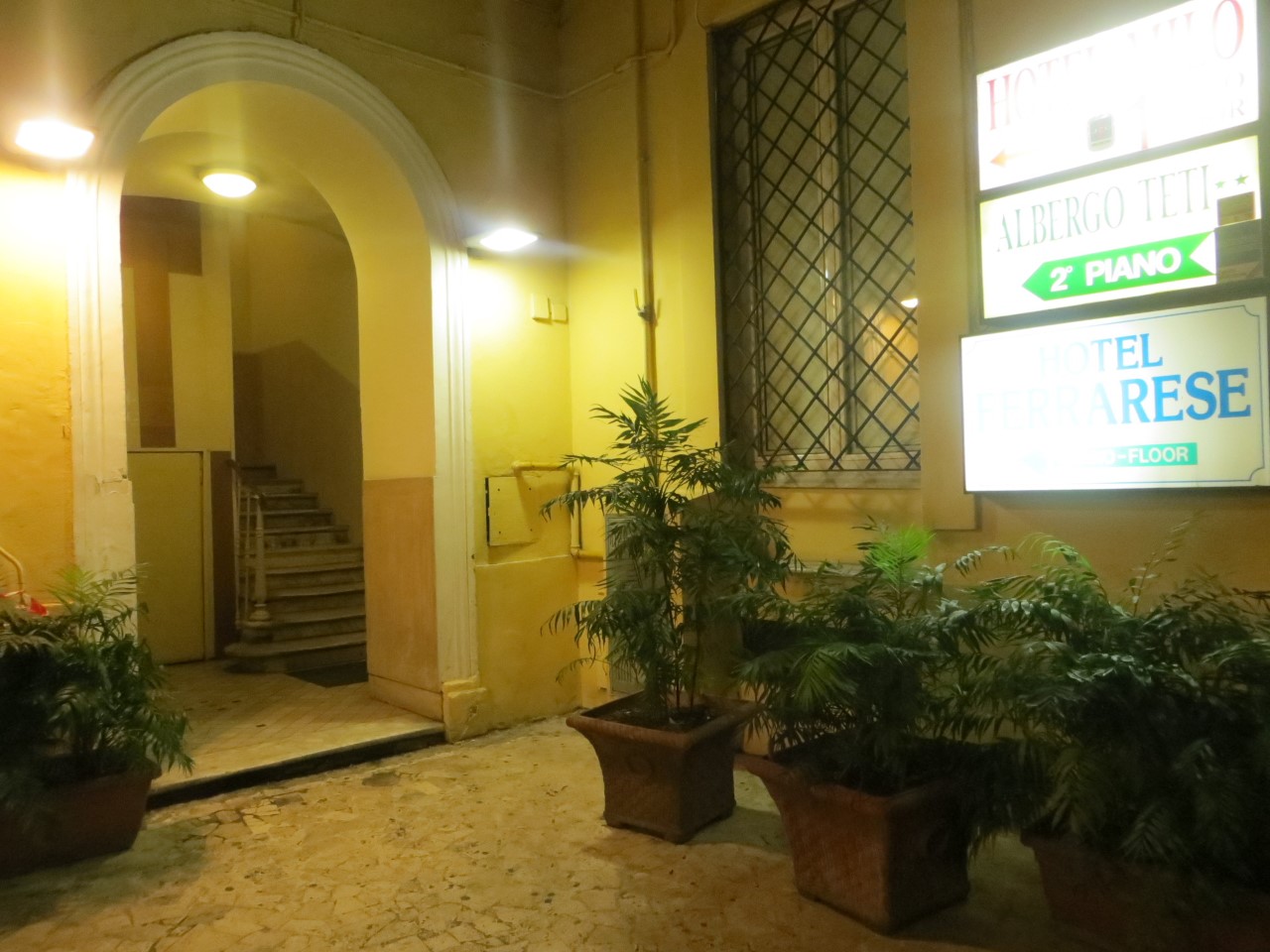
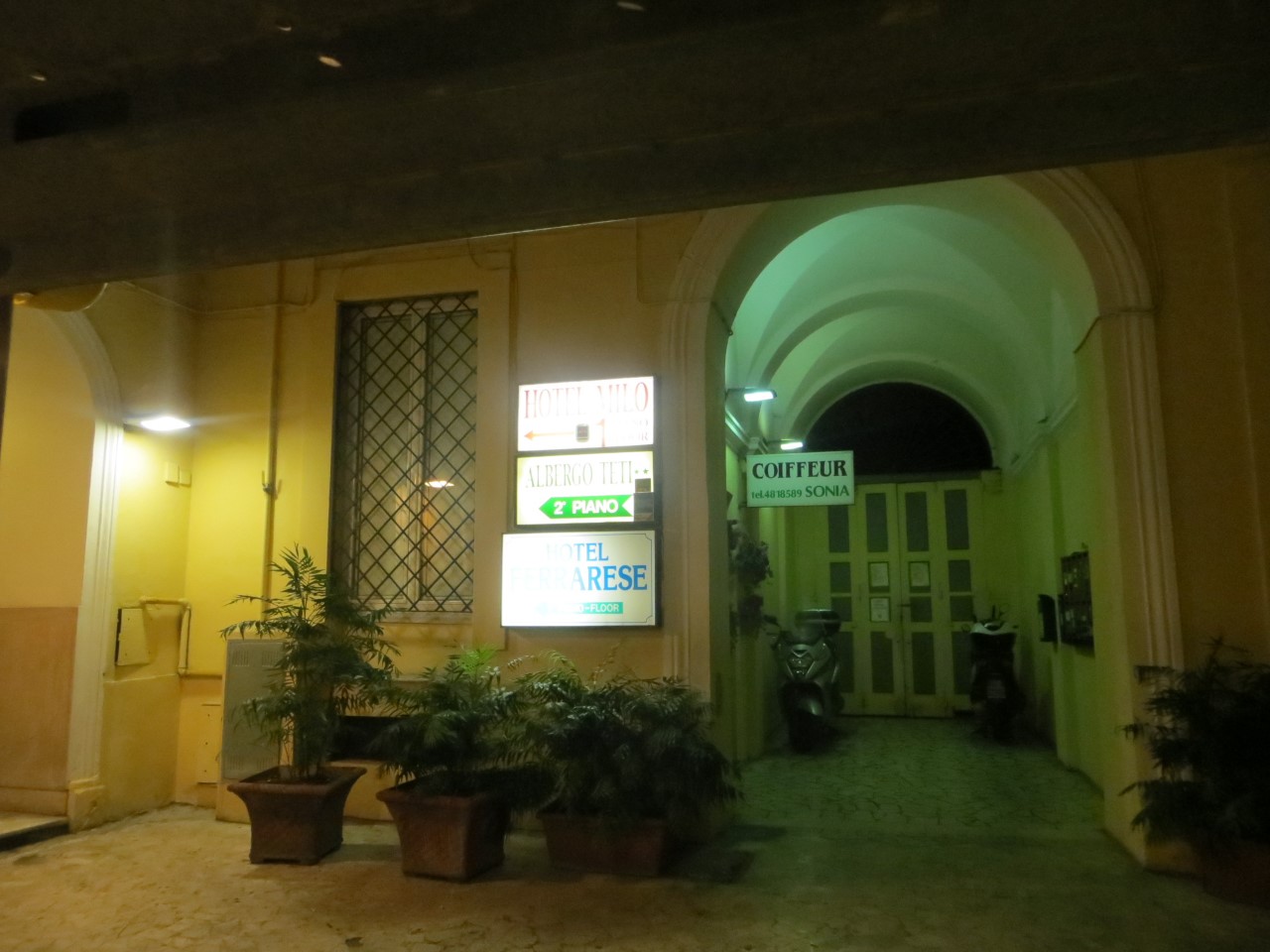
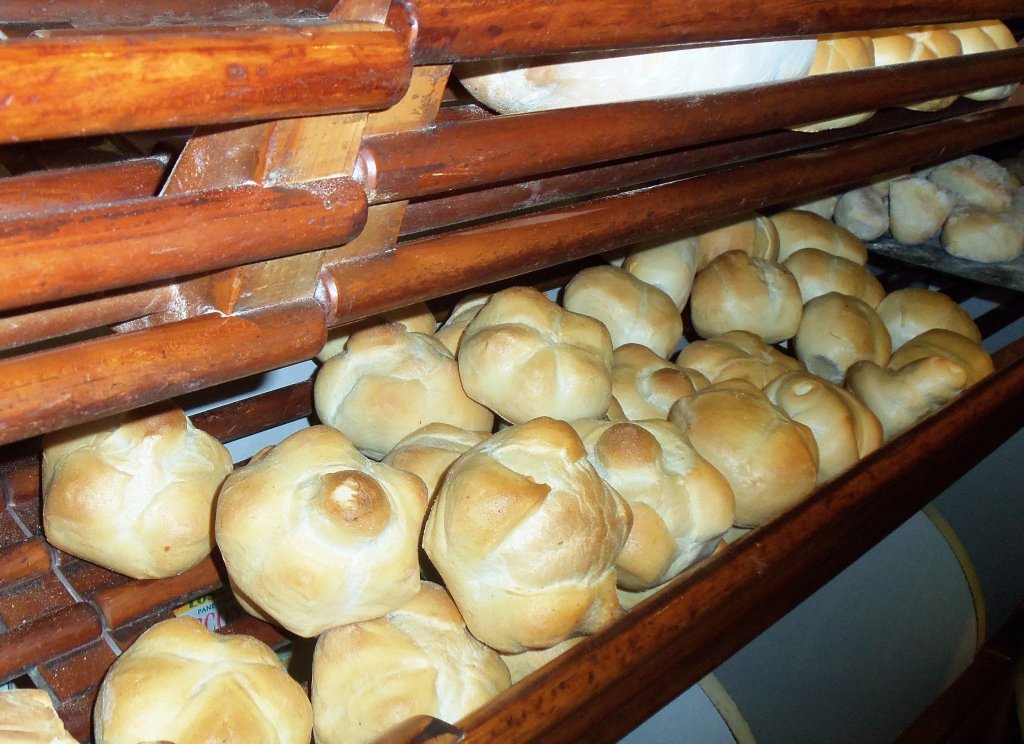
Pensione Milo, which housed many of us former Soviet citizens on our first and one-way trip out of the country of our birth (still united at that time), is now a hotel.  If I live long enough to get back to Rome yet again, I would like to try to dare myself to stay there–provided the scars of memory heal by then.  It is near the Termini, so that makes it convenient.  On my two subsequent visits, I stayed nearby because that was all I knew, but it is actually a fairly charming area.  Milo seems to have been all renovated and fancy, with private bathrooms, no less (according to their website; I have not yet had the nerve to enter).  Well, not exactly fancy, but it is a hotel, no longer a boarding house for refugees.  There must not have been much call for that after a certain point in time.  Back in the day, we had two rooms, because we were two families.  I was made to share with my grandmother, and my mom with my grandfather, because grandma and I caught some terrible illness and were quarantined together.  It was the brighter room, on a lower floor, and it had a sink.  A sink of our own!  The other room was upstairs, with peeling wallpaper, sloping ceiling, and no sink. Occasionally fellow refugee neighbors would use our sink to brush their teeth, as it was such an unexpectedly luxurious feature.    There was a communal dorm-style bathroom and a dining room.  The meals, which included bread rolls of the type that they still serve in Roman hotels for breakfasts, and all manner of pasta dishes with weak tomato sauce, and occasionally tomato pasta soup, were served by a guy named Franco.  I can now pretty much assume that Franco was his name.  At the time, the foreignness of it could have only meant that it was Italian for “waiter”. 

So, for years I thought that Italian food was terrible (both the gobs of boiled spaghetti of the refugee cuisine, and equally the monstrous portions of over-cheesed baked American variety).  It did not compare to the culinary delights of the Austrian prison, where we stayed prior to being transported to Rome.  There was no Italian equivalent of Manner wafers.  But we were free.  Free to do almost nothing but fret about our future. We were pretty confident, I think, that we would be allowed to enter the United States—but when? And what exactly waited for us on the receiving end?  And how do you occupy your time with anything more than survival when you have no money and no language skills?  It is not the lack of money or language.  It is the not belonging.  You are not a tourist, not a guest, not on a business trip.  You are just in a limbo of existence, and you are waiting for your paused life to restart. 

As refugees, we spent most of our time in Rome indoors.  This might have been the only time in my life that my grandmother did not insist that I go outside to play.  What did we even do?  How did we pass the days?  (And how many days were we actually there?  It felt like months, but the calendar does not bear that out).   It seems so strange and unlikely now that we would not have taken the opportunity to explore the city.  I asked my mother about it not long ago, and she really had no answer.  There were plausible explanations—no map, no language, no money—but none of that makes sense if you have the time.  We ate our meals and constantly conferred with the other exiles (“Where are you going, Tevye?” “New York. And you, Lazar Wolf?” “Chicago.” “Good, we will be neighbors”).  This was our version of the last days in Anatevka. 

We stayed within a short walking distance from the Colosseum, which I never saw on that trip.  I walked the entire distance from the near-Termini area to the Vatican on several later occasions.  It is less than a 5k, a distance that I cover on autopilot during my training runs.  Could a merry little band of refugees have walked out of Pensione Milo on Via Principe Amedeo and kept walking?  Not stopping to drink prosecco, not walking into churches, not sitting down to a plate of seafood, but just strolling and staring?  We did at least once, because I remember a group of us, led by one especially fierce female of the species, who kept accosting passers-by with frantic cries of “Dove la posta centrale?”  I remember the terrifying bulk of the Vittorio Emanuele II monument, but not whether we ever reached our destination.

We met the New Year in the lobby of the pensione. One of the dads was presented as an unexpectedly believable Grandpa Frost, with cheeks rouged by someone’s lipstick, and gave out gifts to the kids.  Everyone contributed what they could.  I got a chocolate bunny, which was literally the best gift ever.  In our secular Soviet life, chocolate bunnies had no connection to Easter (nor should they ever or anywhere, in my humble opinion), but were an anytime special treat.  I was thrilled.  No one could afford to buy Italian chocolates, but this was a familiar treasure that someone brought from home and donated.  I have kept the foil wrapper for 40 years.

They say that how you meet the New Year is how it will turn out to be.  “They” are decidedly wrong as often as they are right.  But, that New Year’s Eve set the tone not just for the coming Worst Year of My Life So Far (and I just lived through the pandemic of 2020!), but for my Least Favorite Decade So Far, the 1980s.  It might have been a festive Roman celebration outside, but inside, my small world was bracing for the strange, scary new life on another continent. 

Wanting All the Cards

I got to play “Two truths and a lie” on a Zoom call at work.  Of course I loved it.  In fact, I think everyone did, because we are lawyers.  And of course I obsessed about it for a couple of weeks leading up to the big day, because I like to think that many interesting and unlikely things happened to me over the years.  I was just a trifle annoyed that most of my colleagues had similarly outrageous and improbable experiences, though somewhat mollified when, after I announced my three “facts”, someone muttered that “they are all lies”[1]

This got me thinking about what, among the many weird, yet non-traumatic, particulars of my life remain obscure, yet interesting?  And I keep coming back to my playing card collection.

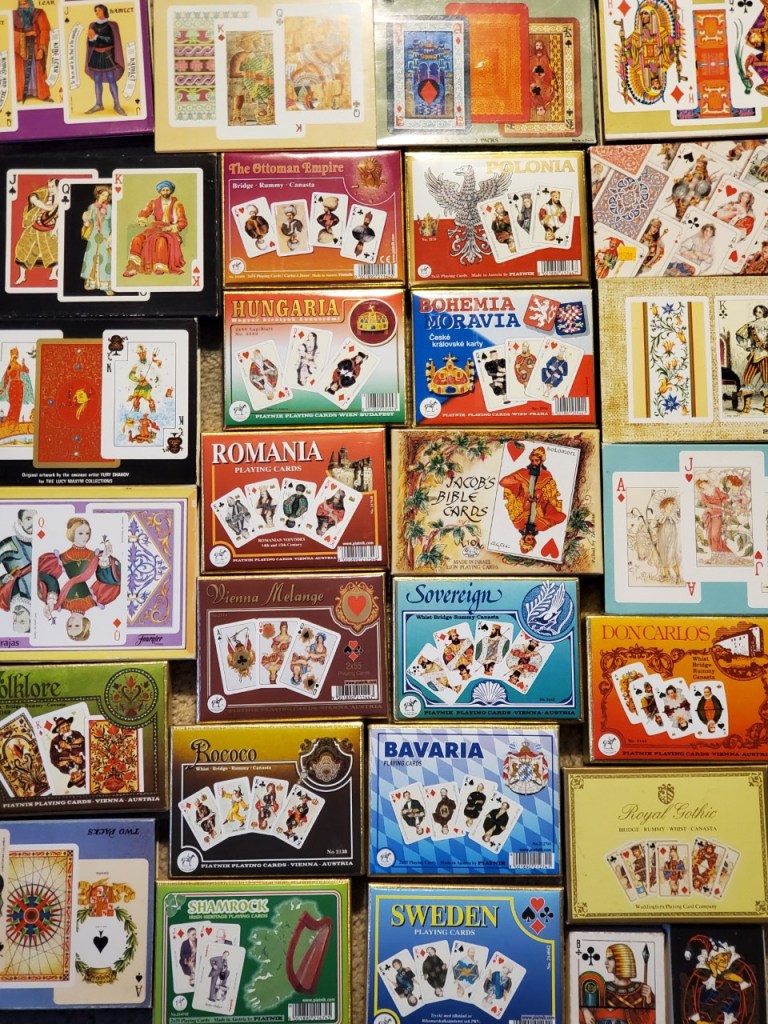
Just a small and random sample

For a large part of my life, I have loved playing cards and wanted to possess them.  By this I mean, I do not necessarily love playing card games, but love the cards themselves. It has been a deep and abiding love, a bearer of much joy, a literary and artistic inspiration, and #42 on my list of Favorite Things [A Few of [Whose] Favorite Things – Old Lady Writing][2].

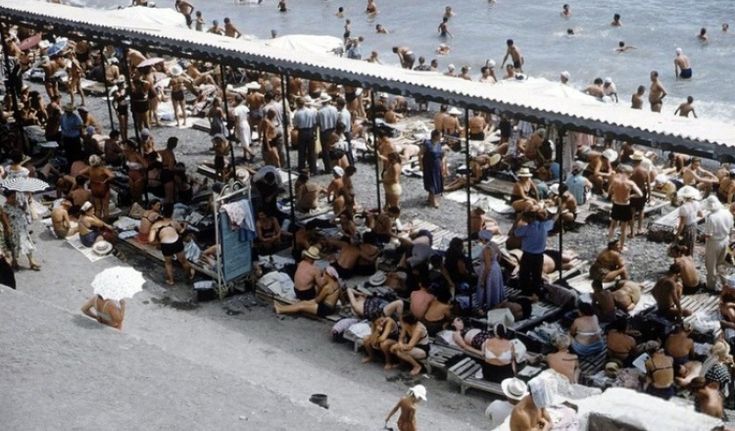
Sadly, this is not my photo, but this is exactly how it was.

I trace the beginnings of this beautiful friendship to the early summers of my life leisurely spent on the Crimean beaches, playing a rousing game of Fool with whatever friends I made hanging out on the wooden sunbeds[3] between dips in the sea.  We also played Witch (Old Maid) and Drunkard (War), but Fool, the most popular Russian card game, was the only one that required some skill[4].

Clockwise from top left, Stella, Ophelia, Violette, Sylvia, and Sylvester. This is the deck she drew from memory.

When I was six, my grandmother, with whom I spent all my summers at the beach, and I were joined by acquaintances from our hometown, a couple of sisters around her age, one of whom had a 10 year old daughter, Irina.  For reasons that are lost to time, there was a joint refusal by the aged relatives to purchase a deck of cards for us, and so Irina simply drew one.  Although no record remains of that deck, I remember it as the crowning achievement of Pre-Raphaelite art.  We even gave the queens the fanciest names we knew, and attempted to name the jacks, but could only come up with one (look, we were just little girls in the USSR).  We so much wanted a real deck of cards! At some point, Irina’s mother relented and bought her one [5].  Searching for a facsimile of that deck became a goal in my adult life. 

Of course I found it!

Arriving in the US, I was absolutely stunned and disappointed to discover that playing cards here are not beautiful, and the face cards in all the decks are the same.  Of all the easy wins, playing cards were such a letdown!  And then, for American Christmas ’84, my mother presented me with a deck surprisingly purchased at Jacobson’s.  Baroque by Piatnik, which started my collection, is still the most beautiful deck I own.

The rules of the collection are simple:  face cards have to be distinct, human, and beautiful.  That means no animals, no cartoons, and no decks that have a weird theme like politicians, posters, quotes, or whatever.  They have to have traditional suits (French is preferred, because that is what I am used to) and traditional court cards.  I include stripped decks, because again, that is what was popular in Russia in my day. The backs are irrelevant.

According to Wikipedia, the largest card collection is over 11,000 decks.  Mine is about 100 times smaller, not counting double decks, but I love [almost] each and every one.  About a third of them are by Piatnik [Piatnik – Company], the greatest and largest card manufacturer in the world.  As a teenager, I vaguely dreamed of working for Piatnik, but literally could not imagine what skills I possess and into what job they would translate. 

My collection was enlarged by stopping in all stores that might carry these “artistic”, for lack of a better word, European-style cards.  In the US, that primarily included fancy stores that might carry gambling paraphernalia (and surprisingly, the store inside Cinderella Castle in Disneyworld, as well as my beloved and dearly missed quirky Peaceable Kingdom in Ann Arbor).  In Europe, it was pretty much any stationery or souvenir store, as well as big department stores like Harrod’s.  My mother has been a very enthusiastic contributor since the beginning, always traveling with the hard copy list of my decks. I stopped collecting almost a decade ago, because Piatnik seems to have run out of ideas, and ordering on the internet is no fun.  I have a very slight and vague regret of not buying a new deck in Dublin last year, but this gives me a reason to return[6].

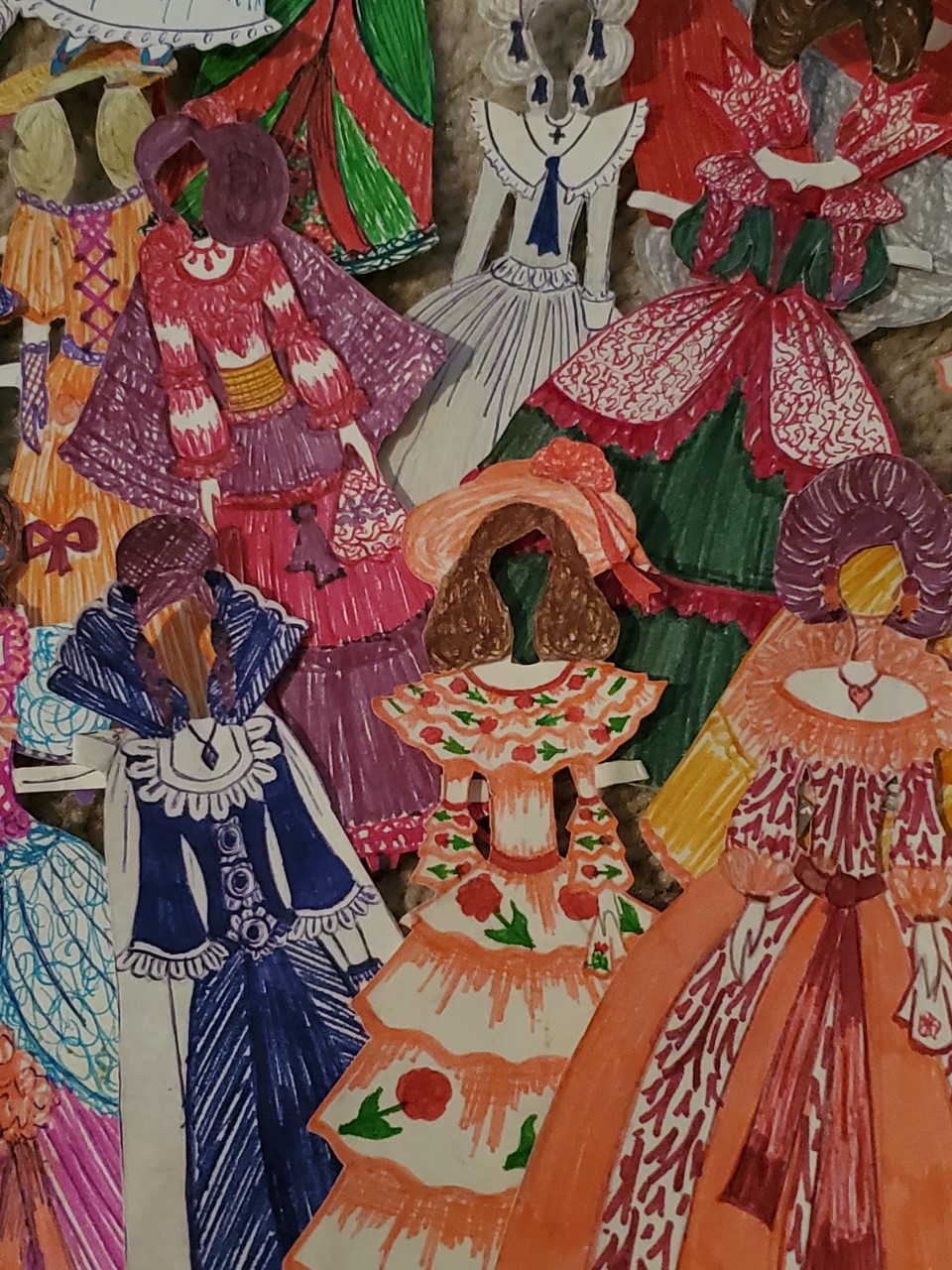
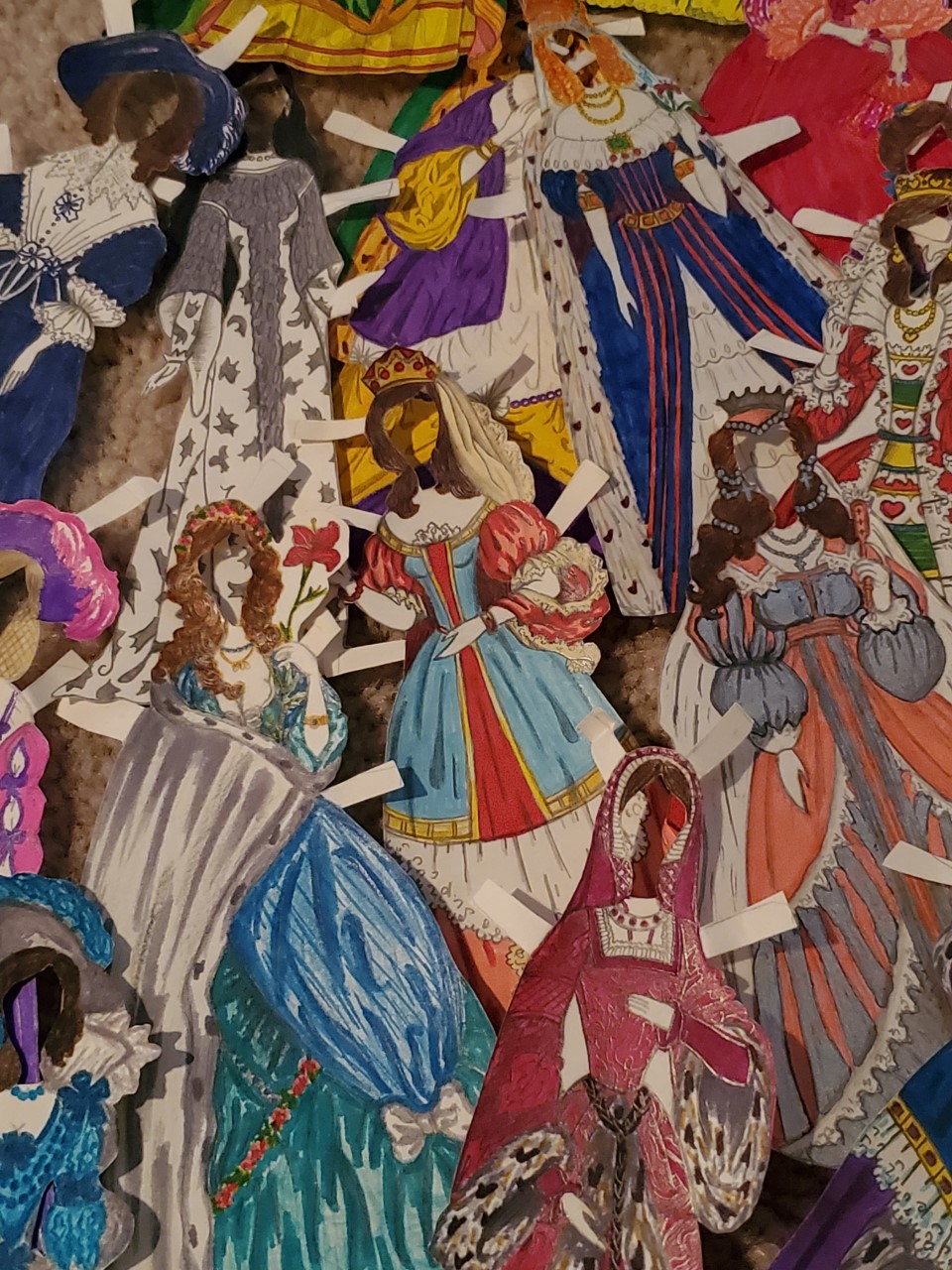
A word about artistic inspiration.  As a refugee child in Rome with no toys but an extravagant set of markers which my family somehow managed to afford for Christmas, I drew a paper doll and, over the years, a mass of elaborate period dresses, inspired by my own imagination combined with dolls in Italian toy store windows and later, playing cards.  Since queens on playing cards are only portrayed from the waist up, all the skirts are mine.

(Just a few of the dresses; the last one was left unfinished around 30 years ago.)


[1] My big lie was the monkey story from The First Spanish Trip.  The truths were crashing a circus rehearsal (stay tuned!) and being chased by someone wielding a can opener (a singularly unpleasant event not worth retelling).

[2] I specifically did not mention it then, because I knew it will someday deserve its own full entry.

[3] English language fails me here.  The word that we actually use translates as “trestle bed”, but that seems to mean nothing to anyone.  I literally have spent no time on the beach in my English-speaking life, after an entire childhood of sun-drenched salt-water summers.

[4] In later years, during summers at the Baltic Sea, Nines replaced Fool as the rousing card game of choice. My grandfather subsequently demonstrated himself as the most charming cheat in the game of Nines.

[5] Eventually, the seven of clubs was lost, and we drew a card on nothing better than a piece of green blotter paper.  Needless to say, the seven of clubs was extremely conspicuous.

[6] And I never found Piatnik’s King Arthur deck.  I probably could now, but I prefer to leave this slight gap in the collection.  “Nothing in life has any business being perfect”.

The First Spanish Trip

It was not *my* first trip to Spain, but third.  Unlike my relationship with Paris [https://oldladywriting.com/2019/06/09/when-did-the-arc-de-triomphe-start-leaning/], my relationship with Spain devolved over the years, and what we call “The First Spanish Trip” has a lot to do with it.

It started out on a very auspicious note.  I was young (though not as young as I was when I first went to Paris) and poor (though, again, not as poor).  I had not travelled in several years by that point, if you do not count visiting family in Brooklyn (arduous drive-through-the-night weekend car trips) and Tennessee (same).  Why weekends only?  Because I live in a country where you have no expectation of paid time off.  God bless America!

Somehow, a point was reached where a week’s vacation became an attainable goal, and a travel agent was contacted.  Her involvement also seemed promising at first, as she mentioned that the roundtrip flights to Europe, particularly to either London or Madrid, were reasonably priced–$300, to be exact, which even a quarter of a century ago was very affordable.

I vaguely remember sitting in my office and calling my spouse to check if he would prefer London or Madrid.  He had never been to Europe except purportedly some bizarre flight to Germany on a military plane for literally one day.  The story is long on holes and short on details, and is not likely to merit another mention in print.  I have previously been to both London AND Madrid.  He fatefully asked, which one has better food?  Even now, a quarter of a century later, having had many a glorious adventure in London, I would wholeheartedly cheer for Madrid for a superior culinary experience.  Back then, it was a rhetorical question.

And then, in a strange twist of fate, I acquired a week of timeshare.  There are probably more timeshares in Costa del Sol than anywhere else in the world.  They are pretty fabulous resorts, even if you are not young and poor and have not taken a vacation in several years.  Looking at the map, the drive from Madrid to Malaga’s environs is a lot shorter than the above-mentioned ones—in fact, about half the distance.  On paper, it made perfect sense to rent a car and drive South, enjoying both the capital and the coast.  A lot of things make sense on paper…

Again, because this is not a travelogue, I will only mention the mistakes that were made on this, my first adult vacation.  To this day, my spouse has not recovered from some of these.  The Second Spanish Trip, despite having been a perfectly lovely and fulfilling voyage which included many of the things we missed the first time, is largely ignored and forgotten, so large looms the shadow of The First.  We may never pass this way again…

  1. Renting a car.  I actually rented a car twice in Europe within the past year, and drove through Bavaria and Gascony, both possessing of narrow winding rounds through hilly terrain.  But you know why this is no longer a problem?  Because of technology.  It is a lot easier to drive with the GPS telling you where to turn and automatically recalculating for road construction than it is when you are trying to read a many-paged Spanish-language atlas you bought at Borders (but I still miss Borders).  Spouse was driving, since he is the only one who can drive a stick (a terrible European practice that, thankfully, has also gone away.  No need to make life more difficult).  I was frantically flipping through the giant map atlas.  Everyone was screaming.  A couple of peculiarities about Spanish highways: (1) When you see the “exit” sign, you literally have a second to swerve and exit.  There is no 1 mile (or 1.6 km) warning, there are no multiple signs leading up to the exit.  It’s just the exit, and there it went, and you are still driving.  And if you think you can just exit at the next one and return—seriously, you think you can do that in Spain?  Cute.  (2) Sometimes, the highway entrance ramps are closed.  Again, no warning, no construction signs, no yellow tape, just a barrier that someone put up to stop you from getting on the highway—so you need to very carefully reverse back down ramp.  There was a lot of reversing done on that trip.  (This sign would have been very helpful at the time) (3) If there is a detour, there are—you guessed it—no signs guiding you on an alternate path.  If you are driving from Madrid to the coast, and the only road that you can see on the map is out of commission, you might end up going up a mountain and then down the other side to get back on track.  The view was breathtaking, not the least because there are no barriers, not even the flimsy ones, between the narrow road and the side of the mountain, but I have never felt so close to death (except later on this trip; see below).  We did drive through a town called Lanjaron—elevation 2,162 ft—where they make bottled water.  Whenever I saw the bottles thereafter, I shuddered.  And this is how a hypothetical five hour drive became a day-long, white-knuckled affair that pretty much set the tone for the entire vacation.
  2. Flea Market.  I hate flea markets, which is a holdover from the days I spent with my grandparents in Brooklyn.  South of Spain was filled with them.  Maybe it still is, I do not know.  Everyone seemed very keen on recommending them to us, and we put some effort into avoiding them.  Imagine our surprise when we actually encountered one at an amusement park.  Yes, right next to the swinging pirate ship in Tivoli World in Benalmadena Costa, various vendors spread their wares on the ground.  I bought a calculator to help me with currency conversion, and it broke before the end of the vacation.  And by the way, Tivoli World is lame, cannot recommend.  Of course, I live within driving distance of “America’s Roller Coast”, but even so, and even without the flea market all over itself, Tivoli World was not worth visiting. (It might be nicer now)
  3. Clamps.  Parking can be a challenge in Europe, especially if you cannot afford it.  On my last two trips that involved a car, which consequently involved parking, I occasionally paid for it.  Ah, the privilege of middle age—being able to afford to drive your car into a public garage!  It is not even grossly overpriced—you can pay less for an entire day of parking during Oktoberfest in Munich than you would for an hour in Chicago’s Loop, true story!  But back then, either parking was unaffordable, or it simply was not there, or both.  Our most confusing day was in Gibraltar, where we congratulated ourselves on finding a great free spot for our rented Opel Kadett under an innocuous sign “clamps”.  OK, clamps, whatever, and we walked away.  And then we saw it:  all the cars similarly parked had fluorescent orange boots on one wheel.  “Clamps” is literally what we did not think it was—it clamps onto your car to prevent it from moving, because it is in a *no parking* spot!  We ran back so fast (I could still run at that point on vacation—keep reading), and rescued the car from imminent clamping.  Gibraltar is English territory.  Why not just say “no parking”?  A mystery, but one we solved in the nick of time. (This detailed sign and illustration would have been very helpful)
  4. Driving up The Rock.  Again, being poor, but in possession of a car, we could not afford the funicular, and decided to drive up to The Rock of Gibraltar.  The road we took was clearly one way, because it was narrow enough for just one European-sized car, although we were puzzled at the lack of indicators which was the one way heading.  We assumed we missed the direction sign, because going the way we were just felt right—until we turned a sharp corner and were confronted by a bus barreling toward us at what seemed like the speed of light.  It was the one time in my life I was certain I was going to die.  It was, to this day, the scariest thing that has ever happened to me.  We screeched to a stop.  The bus screeched to a stop.  Spouse apologized for going the wrong way on a one-way street. The bus driver replied, nonchalantly, “It is a two-way system, but you are going the wrong way to the rock”.  Apparently, no panic is warranted.  If someone is coming your way, you pull over—onto the sidewalk, hopefully not running over pedestrians—and let them pass.  But this was just not the right street for us.  So we retraced our steps and took another, similarly terrifying, route.
  5. Monkeys.  Gibraltar is home to the only free-roaming monkeys in Europe.  They are cute, but they are not domesticated.  This is their home.  We are mildly unwelcome visitors.  Unless you have something they want.  Some years later, they attacked my grandmother because she pulled out a packet of airline peanuts from her pocket (back when airlines served peanuts)[1].  That day, they mostly entertained themselves by getting into some carelessly unlocked cars, preening in rearview mirrors, and pooping on the seats.  The only thing we did right was lock our car with the windows up.  And then a monkey stole spouse’s glasses, and I painfully twisted my ankle while chasing it.  I managed to get the glasses back, but at great personal cost.  My ankle hurt, the rest of the trip’s itinerary had to be scrapped because I could not walk very much and had to stay close to the resort, but thank God for socialized medicine—at least I got some amazing painkillers for free from the infirmary at the resort[2].(Actual photos I took)
  6. Bat.  Our trip combined the Riviera and Madrid, where we finally parted with the car and thought we might breathe easier for a few days.  That was not to be.  The very first evening out promenading in the city, we were encountered by a protest.  We had no idea what it was about, but it was alarming both because of our reluctance to be a part of an international incident and because its shouting, marching, flag-waving demonstration was led by a bat.  Yes, a real flying creature of the night charged ahead of the humans and toward us.  We ran and hid.  I mean, what else was there to do? 
  7. Hostel.  In Madrid, we stayed in a hostel.  This was before hotels.com, let alone Airbnb.  I literally sent a fax in my very basic [two years of high school] Spanish from the U.S. to reserve a hostel.  It might not have been so bad, even without a TV or any amenities but with a shower, had we not just stayed at a fabulous timeshare.  This was when I said to myself, no more hostels for me.  Never again.  And then…
  8. We missed the flight.  Yes, it happened, and I still do not know who is to blame for this.  We arrived at the airport two hours before the designated flight time, and were told that we were two hours too late.  Apparently, this particular flight has been leaving at a different hour for quite some time.  Our tickets were handwritten by the travel agent—who remembers that crazy practice?—who later claimed that the flight time must have been changed after the tickets were issued.  We had no international calling capabilities, and it was long before the flight apps.  The stressed TWA agents, whose employer was going through one of its final bankruptcies, initially just shrugged, but once I became mildly hysterical, offered to rebook us on the next flight out free of charge.  Of course, that flight was not leaving until the next day—22 hours later, at the correct time.  They booked us into—what else?—a hostel[3] in Barajas, a tiny and unpleasant airport town.  By the time we made it to the hostel, the entire town was closed for a five-hour afternoon siesta.  No matter, we were out of money anyway (this was, of course, before credit cards were widely in use and/or accepted in Europe).  At some point, the town’s only eatery opened for a couple of hours, so we scraped together our remaining pesetas and spent them on an American-style burger (that’s all they had, really!) and a pitcher of sangria.  The next morning, we put on the clothes we hastily previously washed in the hostel sink and dried outside.  And thus ended our first and worst adult and European vacation. [4]

Not my photo, but this is about as exciting as I remember Barajas.

[1] Do not feel bad for grandma.  She was, and is, fine.  It takes more than a pack of wild monkeys to take her down.

[2] I have been telling this story for all these years, but it is a fiction—some might say, a lie, but that is such an ugly word.  What actually happened is that I twisted my ankle in the excitement of getting to the bargain basement of Marks & Spencer’s.  Which is a stupid thing that I do not like to mention, but now you know.

[3] Hostal Viky is still in existence.  I am not going to give it a review, either here or anywhere else, because it may very well be a fine establishment of its kind, but as the final indignity at the end of a comedy of errors, it did not impress.

[4] But you know what was NOT bad about The First Spanish Trip?  My footwear!  [https://oldladywriting.com/2020/07/30/the-wrong-way-to-the-parthenon/] In the photos, I am wearing tennis shoes.  How American!  It was the last time I wore tennis shoes to Europe.  That is also something that has changed over the past quarter of a century, but now I am old, and my running shoes are for running.

All to the Polls!

One of my most favorite childhood memories is when I served as Honor Guard at an election.  I have forgotten a lot of the particulars about what, how, why, and even when.  Frankly, I do not want to ask for corroboration, because I am almost afraid that my friends’ memories are not as glorious as mine. 

“I’m no expert, but I remember reading somewhere, every time you retrieve a memory, that act of retrieval, it corrupts the memory a little bit.  Maybe changes it a little”[1].  Well, this particular memory has probably been retrieved to the point beyond recognition, for the joy brought by the factual experience of it as well as for the sheer uniqueness of the experience.  Observing an election in the Soviet Union, a state that officially only existed for 70 years (75 if you count from the Revolution)!  From the inside!  Had I known how soon it was going to end, for me AND the country, I would have tried to remember more and better.  But how?

And so, in the year I cannot name with any certainty other than it was in the late ‘70s, our classroom teacher, a particularly unpleasant personage who ostensibly taught us, badly, algebra and geometry, announced that our class was chosen to serve as Honor Guard at an election.  Participation, in the way of the Soviet regime, was mandatory—but we did get to miss class, which was as desirable in that time and place as it has been for schoolchildren since the beginning of time.  The fact that I was excited to be formally excused from class indicates that it must have been before I became a brazen truant, so probably fourth grade.

” A deputy is a servant of the people”–no argument here.

What election could it have been?  Probably for the delegates to the local soviet (which just means “council”—there is really nothing more sinister to this word; it is also the word for “advice”).  Periodically there were leaflets promoting various candidates, with their names and photos and nothing else because (1) their party affiliation was obvious and (2) so were their campaign promises.

The polling place was a school, but not ours–#57, which was in my home district (I went to a school of choice, #37.  It included some children of the intelligentsia, but otherwise had very little to recommend it in the general landscape of the most stagnant decade of the country’s history).  It was my first and last time inside the building past which I frequently walked on my way to and from my school (the shortcut to #37 past #57 lay past wastelands and garages, which is more than symbolic; the long way, predictably, was via Lenin Avenue).

We were supposed to do our civic duty in shifts, and in groups of four.  It was a happy accident of fate that my BFF and I were the last two girls in class in alphabetical order.  We were told to arrive for our shift wearing our Young Pioneers uniform.  We actually had three types of uniform:  brown dress and black apron for everyday, parade uniform of brown dress and white apron (which you are technically not supposed to wear as a Young Pioneer, but occasionally someone screwed up and forgot and showed up at an important event in the wrong uniform, immediately giving rise to speculation that they were kicked out of the Pioneers), and the Pioneer uniform, white shirt and navy skirt.  Of course, denim skirts were not allowed—and of course, my mother sewed a super-cool denim skirt for me.  The odious math teacher would sidle up to me and admonish me for wearing denim, and I would assure her that next time I would wear plain navy wool.  It was our own little détente.

But that day, we were ready to represent, and I am sure that my skirt was wool, my red tie had no soup stains, and there was a giant white bow in my hair.  The entire class was extremely nervous leading up to the big event, because a rumor was floating that we might have to stand stock still and hold the Pioneer salute for the entire time.  Not only did that rumor turn out to be false, but we also were fed on breaks during our 2-4 hour shift: sparkling lemonade and the ever-popular “basket” cakes, though not the really delicious ones from the Volkov Theater. 

This image has an empty alt attribute; its file name is pirozhnoe-korzinochka4-360x240-1-1.jpg

https://oldladywriting.com/2020/07/26/all-my-world-is-a-stage/ Despite the fact that one of the two boys in our merry quartet was mine and my BFF’s sworn enemy whom we regularly fought on an off school grounds (in our egalitarian regime, boys and girls regularly engaged in physical combat), we had a grand time during a grand occasion.

The four of us basically just stood in a line on a dais in the school auditorium, trying to convey the motto “Pioneer is always ready” with our eager and helpful demeanors.  We felt like we were entrusted with tremendous responsibility when an old woman approached us and asked for clarification on how to check off the one box on the ballot, and where to put the ballot.  It could not have been her first time voting, but she either needed help because, well, age leads you there, or she wanted to make the young feel included.  She was performing her civic duty.  We were there to help.  We felt the weight of the moment.

Not us, but a fairly accurate representation.

There was a big ballot box sitting in the middle of the room.  There was also one of those polling booths with privacy curtains.  One or two people used it during our shift—but why?  Each ballot had only one candidate’s name on it.  I asked my mother about it afterwards, and she said that it is possible to vote against the one candidate, but then you might have some explaining to do.  Apparently, you also could not abstain from voting—shirking your civic duty was frowned upon, probably earning a reprimand at work from the Soviet HR equivalent.

It is easy now to say that an election with just one candidate is a sham (although I have voted in many a Western Democracy’s election where a candidate also ran unopposed).  It is easy to sneer at a high voter turnout by attributing it to coercion (although if the day of election is a day off work and school ANS you get to eat and sing songs—who wouldn’t? And how is exercising your most important civic duty not a cause for celebration?).    

This memory is my own, and is not an endorsement of any particular political system.  I never voted in that system.  I was an observer, for one brief shining moment, and it left me with a feeling of responsibility that has not left me to this day.  I have seen democracy in action, and I have seen democracy fail.  I remain hopeful—but only just…

“Women enjoy the right to vote and be elected on an equal basis with men.
Long live women, who have equal rights in the USSR!”

[1] Emily St. John Mandel, “The Glass Hotel”.

Valor and Glory of the Motorbuilders

The municipal autonomous institution of the city of Yaroslavl, Palace of Culture named after A.M. Dobrynin, formerly Palace of Culture of the Motorbuilders, just celebrated its 55th birthday.  In a surprising twist, my first short story (amazingly still unpublished), about a visit to A.M. Dobrynin’s “dacha”, just celebrated its 36th birthday.  Apparently, despite August being a heavy month [https://oldladywriting.com/2019/10/13/sorrow-floats/], it has seen some good times.

This is the best photo of the Palace of Culture of the Motorbuilders, because it is not only from my era, but includes the now defunct “Salut” (firework)–the lamppost much maligned as an eyesore

In the course of my career, I have worked closely with some of the biggest automotive manufacturers in the world, as well as the biggest automotive suppliers.  This is possibly the most boring sentence I have ever written that was not work related.  It is not even a brag.  Everyone who lives in the metropolitan Detroit area is involved in the automotive industry in some way.  So is everyone who lives in Yaroslavl. 

Anatoly Mikhailovich Dobrynin was the General Director of the Yaroslavl Motor Plant from 1961 until 1982, the only one in my lifetime there, and had the longest tenure of any director to date.  I was going to say he was like a Russian Lee Iacocca, but I truly have no idea if there is any comparison. Frankly, Lee Iacocca should have been so lucky.  Comrade Dobrynin was a Hero of Socialist Labor, recipient of Lenin and State Prizes of the USSR, and many other labor medals, prizes, and honors.  And because his entire career and life (the two ended pretty much simultaneously) fit into the several decades of the Soviet Union’s existence, he got to lead an enterprise which, besides its manufacturing prowess, was also a giant benefactor to the city’s workers.  Basically, the big plants subsidized various affiliated ventures.  For example, the Motor Plant contributed to the creation of the Motorbuilders’ Palace of Culture, Motorbuilders’ Park, movie theaters, stadiums, etc.

The interior of this Palace of Culture is a bit elusive for me.  I had few occasions to enter it.  I did not attend any of the children’s classes there.  Despite it being significantly closer to our house than the Young Pioneers Palace, where I spent four tortured years at an art studio [https://oldladywriting.com/2019/06/04/run-your-own-race/], I only entered the Palace of the Motorbuilders for the movie theater (which was, again despite its convenient location, somewhat unpopular among the youthful moviegoers, and is now defunct) or to attend the exclusive New Year’s parties.   I strongly suspect that, given that the Motorbuilders were so superior to all the other organizations in our city, I could not possibly qualify for any of their children’s clubs and afterschool activities.  I could only hope to be admitted to the events at the Young Pioneers’, which had to take all young pioneers (and had vastly inferior New Year’s parties), or at the Giant Club, which was loosely affiliated with the other major plant in my town, the Tire Plant.  The Tire Plant was uncool, and its director was entirely unknown.  Giant, however, had a better movie theater—and, I was accepted into the Young Pioneers on the Giant stage.  But I digress.

Not the actual photo of the slide at the Culture Palace.

A word about the New Year’s parties.  They were basically Christmas parties, complete with a Christmas tree (called, naturally, New Year’s tree), Santa Claus (Grandpa Frost), and gifts for all the kids. At the Motorbuilders’, the gift package would include a tangerine.  Tangerines were not as exclusive as bananas, but one did not simply encounter a tangerine in the middle of a Russian winter in the seventies.  The parties would include various activities such as some kind of a fairy tale staging, loud yelling at the tree to “light up”, and presentation of the gifts to the children.  Because the Motorbuilders’ Palace was huge, they also had slides.  I have no idea where they would come from and to where they would retire after the holiday season, but the slides were possibly even more exciting than the tangerines.  Life just does not get better than when hundreds of children are pushing and shoving to go down a giant slide at a Palace of Culture before New Year’s.  As we used to say, thank you for our happy childhood, beloved Motherland.   

Right behind the Palace of Culture was the Motorbuilders’ Park.  Apparently it is officially named the Anniversary Park, as it was created for the town’s 950th anniversary in 1960, but no one calls it that.  The colloquially known Motor Park, Yaroslavl’s answer to Paris’ Luxembourg Gardens and Madrid’s Parque del Buen Retiro, was lush, green, and huge.  When I visited it two years ago, it somehow became small, weird, and scruffy.  I strongly suspect it was because my BFF kind of rushed me through it so that we could go home and eat, and I did not get the full effect.  But, in the glorious 70s the park was home not just to gorgeous alleys for promenading and a very impressive round fountain in the middle as befits European capitals, but also to many exciting rides such as “boats” (those big swings that you see at Renaissance faires), “runner” (a strange contraption of several wheels that lifted kids in attached seats up and down as it also moved in a circle, and was out of commission much more often than it was functioning—to find the “runner” actually running was like finding a unicorn in a Soviet zoo.  I kid; we had no zoo), and “autotrain” (A train that ran through the park. Why auto?  Because it was not on rails).

Actual footage at the park in 1974.  I am not there, but could have been.  Look for the rarely functioning ”runner” at 1:50, a very clear view of the back of the Palace at 3:36, followed by “boats”, and then some “adult” rides, such as the “Devil’s (Ferris)” wheel, which for some reason did not allow children.

Last but not least, the Motor Plant owned a resort, officially known as a “recreation center” (the word “resort” was much too bourgeois), named Forest.  Forest was literally in the forest on the banks of the Volga.  If you worked for the Motor Plant, you could get a “voucher” to spend a summer week at the Forest.  My times at the Forest deserve their own story, if ever one can be written to give full justice to the joys of Soviet childhood on the Volga—and I mean that without even a hint of sarcasm.  It was basically an all inclusive resort, and for its time and place it was just perfect. 

The main building at the Forest. It does not do the place justice.

But wait, it gets better.  Deep in the actual forest that surrounded the Forest, there was one more building—the “dacha” (country house, summer cottage, chalet) of the director of the Motor Plant, Comrade Dobrynin.  It so happened that my grandfather’s friend, Uncle Sasha, was the director of the Forest, which somehow resulted in us being invited, on several incredible occasions, to stay at the Dobrynin dacha.  Of course, we never referred to him as Dobrynin, Comrade Dobrynin, or especially Anatoliy Mikhailovich.  He was “Director”.  Not that we ever met him—I mean, Uncle Sasha must have, but no one in my family has, as far as I know.  It goes without saying that we only stayed at the dacha when Director was not in residence.  And when I say “dacha”, I do not mean the cabins that all of our friends had “za Volgoi” (on the other bank of the Volga, beyond the city walls), without electricity, indoor plumbing, or even water (as a child, I found gathering water from a well very charming).  No, Director’s dacha was a literal mansion.  I mean, it was not even a regular person’s house.  I remember two things most distinctly: a billiard room (which I blame for my lifelong burning desire to possess a pool table.  Which I’ve had for almost 20 years now, and have probably used six times within the first year of getting it and none since) and a dining room which I seem to recall looking exactly like that dining room in the first Batman movie, the one with Michael Keaton (THE Batman).  That movie came out over a decade after we ate pea soup in the Director’s mansion, by the way.  Food for thought.

Why pea soup, you ask?  Well, there was one touch-and-go trip when Uncle Sasha called my grandparents and another couple, the Osipovs, good friends and fellow adventurers, and invited them to the dacha as Director was not going to be in[1].  The five of us started gathering, but I recall some hesitance on someone’s part until Uncle Sasha’s wife, Aunt Lida, enticed us with a promise of delicious pea soup prepared by the Director’s cook, Mrs. Patmore[2]

It was exactly like this.

Somewhere along the way, we got the command to retreat, as Director was coming after all.  But how?  This was before cell phones.  It was barely after regular phones, because, Soviet Russia.  The cavalcade must have been intercepted while the Osipovs’ orange car was picking us up.  We dispersed.  And then—false alarm.  Director was not coming after all.  We were going to taste the pea soup!  He didn’t, and we did.  In the Batman dining room.  It was magnificent.  And I thought to myself, people live like this in the West.  And I was wrong, because no one I know lives like this in the West, because I do not get personally invited to the mansions of the automotive companies’ CEOs.

Rare unpublished manuscript

But the experiences at the Director’s dacha made such an impression on me that when I wrote my first short story, in 1984, it was about one such visit.  I exercised poetic license by replacing grandparents and their friends with a fun gang of kids my own age, who cause mischief and wreak havoc, and they actually get to meet the Director, who turns out to be charming and not intimidating.  Perhaps that is how Comrade Dobrynin really was.  I would not know.  And then everyone eats pea soup.  The end.


The modern day branding of the Palace of Culture.

For more information, current events at the Palace, fun videos, and an occasional retro photo: https://www.facebook.com/groups/dkdobrynina1965/

[1] I lived with my grandparents, so wherever they went, I went.  They were in their mid-fifties then, so like older parents.  Almost all of their friends were at least a few years younger, so this is not a feeble elder crowd, just so you know.

[2] I lie.  No one called her that.  It was Comrade Patmore.