Wanting All the Cards

I got to play “Two truths and a lie” on a Zoom call at work.  Of course I loved it.  In fact, I think everyone did, because we are lawyers.  And of course I obsessed about it for a couple of weeks leading up to the big day, because I like to think that many interesting and unlikely things happened to me over the years.  I was just a trifle annoyed that most of my colleagues had similarly outrageous and improbable experiences, though somewhat mollified when, after I announced my three “facts”, someone muttered that “they are all lies”[1]

This got me thinking about what, among the many weird, yet non-traumatic, particulars of my life remain obscure, yet interesting?  And I keep coming back to my playing card collection.
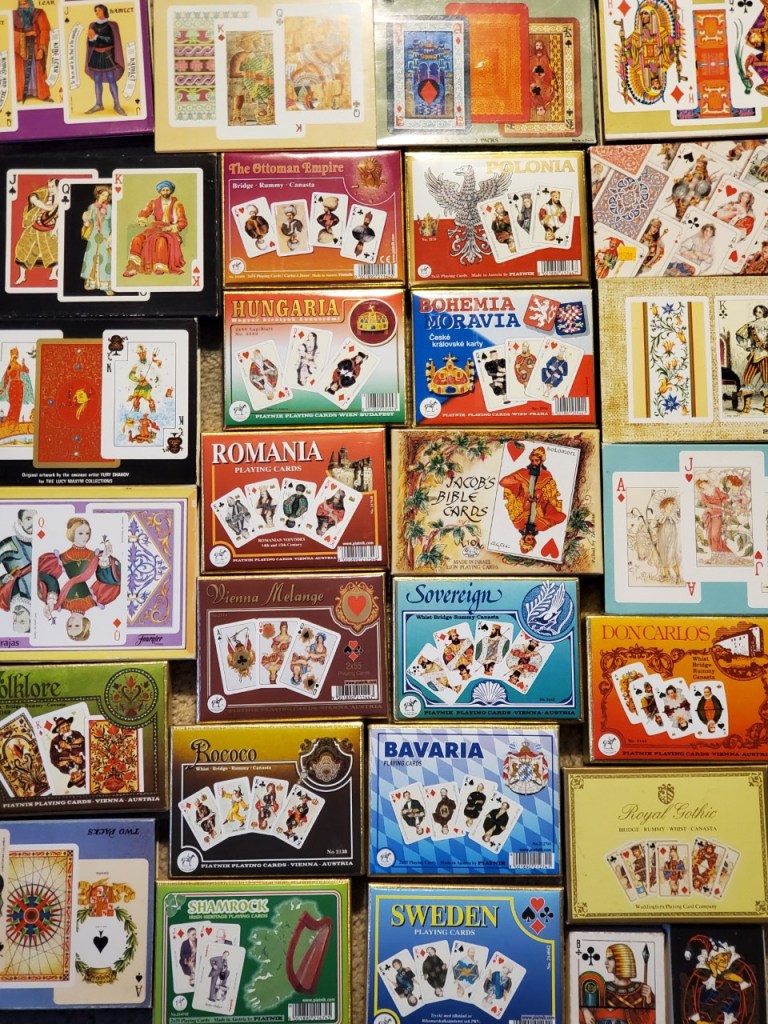
Just a small and random sample

For a large part of my life, I have loved playing cards and wanted to possess them.  By this I mean, I do not necessarily love playing card games, but love the cards themselves. It has been a deep and abiding love, a bearer of much joy, a literary and artistic inspiration, and #42 on my list of Favorite Things [A Few of [Whose] Favorite Things – Old Lady Writing][2].
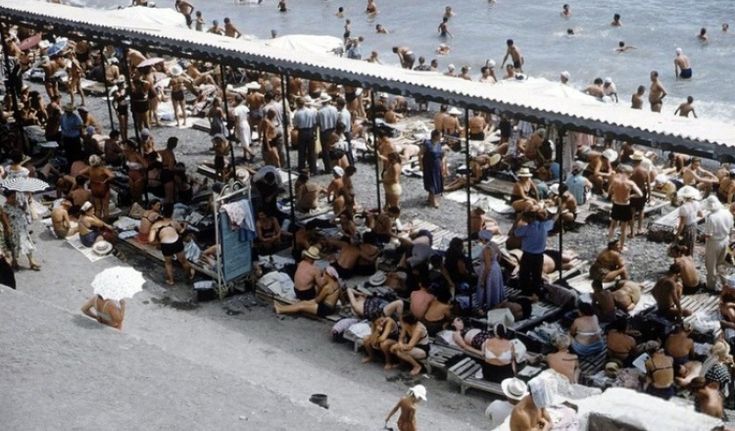
Sadly, this is not my photo, but this is exactly how it was.

I trace the beginnings of this beautiful friendship to the early summers of my life leisurely spent on the Crimean beaches, playing a rousing game of Fool with whatever friends I made hanging out on the wooden sunbeds[3] between dips in the sea.  We also played Witch (Old Maid) and Drunkard (War), but Fool, the most popular Russian card game, was the only one that required some skill[4].

Clockwise from top left, Stella, Ophelia, Violette, Sylvia, and Sylvester. This is the deck she drew from memory.

When I was six, my grandmother, with whom I spent all my summers at the beach, and I were joined by acquaintances from our hometown, a couple of sisters around her age, one of whom had a 10 year old daughter, Irina.  For reasons that are lost to time, there was a joint refusal by the aged relatives to purchase a deck of cards for us, and so Irina simply drew one.  Although no record remains of that deck, I remember it as the crowning achievement of Pre-Raphaelite art.  We even gave the queens the fanciest names we knew, and attempted to name the jacks, but could only come up with one (look, we were just little girls in the USSR).  We so much wanted a real deck of cards! At some point, Irina’s mother relented and bought her one [5].  Searching for a facsimile of that deck became a goal in my adult life. 

Of course I found it!

Arriving in the US, I was absolutely stunned and disappointed to discover that playing cards here are not beautiful, and the face cards in all the decks are the same.  Of all the easy wins, playing cards were such a letdown!  And then, for American Christmas ’84, my mother presented me with a deck surprisingly purchased at Jacobson’s.  Baroque by Piatnik, which started my collection, is still the most beautiful deck I own.

The rules of the collection are simple:  face cards have to be distinct, human, and beautiful.  That means no animals, no cartoons, and no decks that have a weird theme like politicians, posters, quotes, or whatever.  They have to have traditional suits (French is preferred, because that is what I am used to) and traditional court cards.  I include stripped decks, because again, that is what was popular in Russia in my day. The backs are irrelevant.

According to Wikipedia, the largest card collection is over 11,000 decks.  Mine is about 100 times smaller, not counting double decks, but I love [almost] each and every one.  About a third of them are by Piatnik [Piatnik – Company], the greatest and largest card manufacturer in the world.  As a teenager, I vaguely dreamed of working for Piatnik, but literally could not imagine what skills I possess and into what job they would translate. 

My collection was enlarged by stopping in all stores that might carry these “artistic”, for lack of a better word, European-style cards.  In the US, that primarily included fancy stores that might carry gambling paraphernalia (and surprisingly, the store inside Cinderella Castle in Disneyworld, as well as my beloved and dearly missed quirky Peaceable Kingdom in Ann Arbor).  In Europe, it was pretty much any stationery or souvenir store, as well as big department stores like Harrod’s.  My mother has been a very enthusiastic contributor since the beginning, always traveling with the hard copy list of my decks. I stopped collecting almost a decade ago, because Piatnik seems to have run out of ideas, and ordering on the internet is no fun.  I have a very slight and vague regret of not buying a new deck in Dublin last year, but this gives me a reason to return[6].

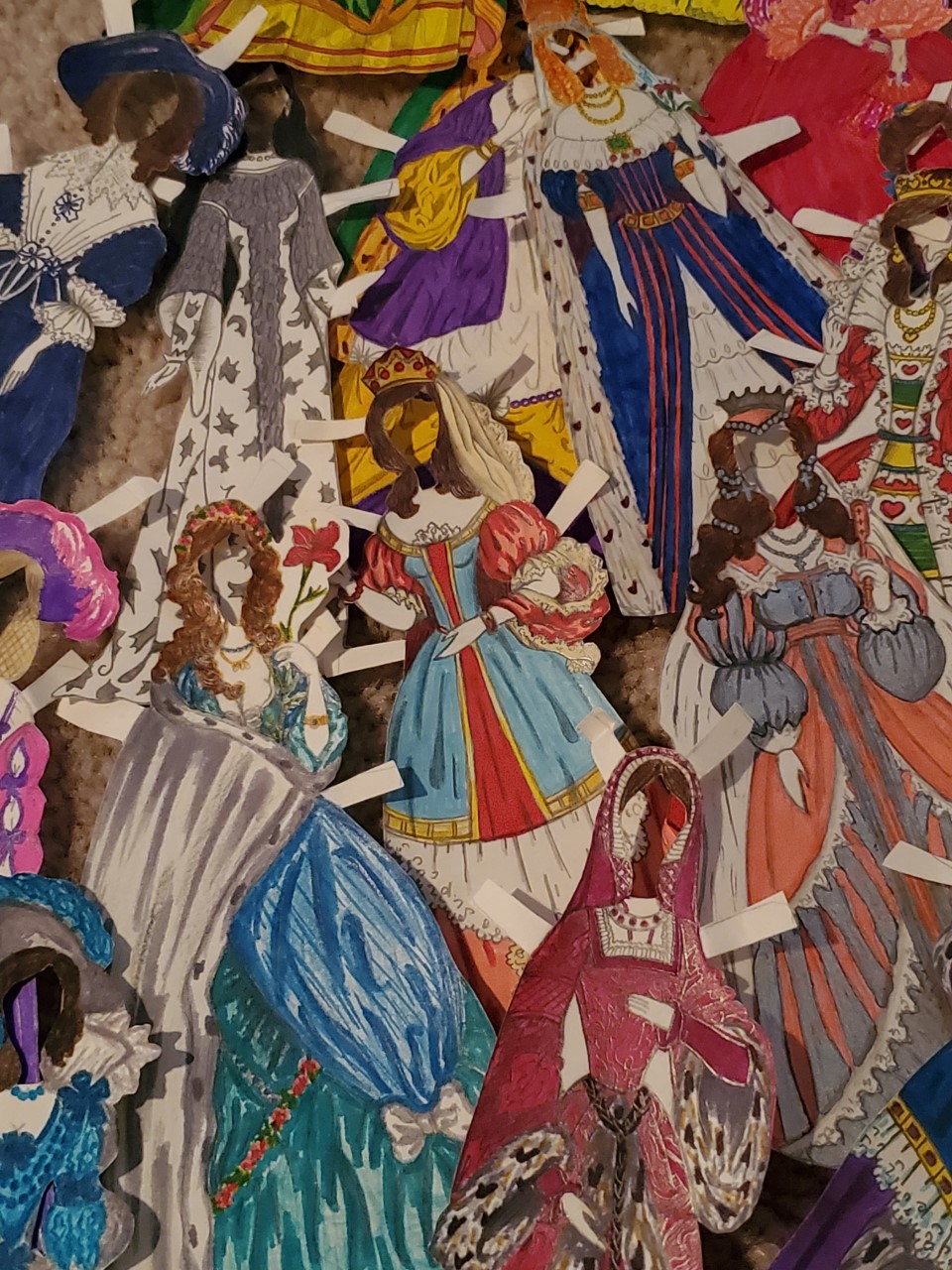
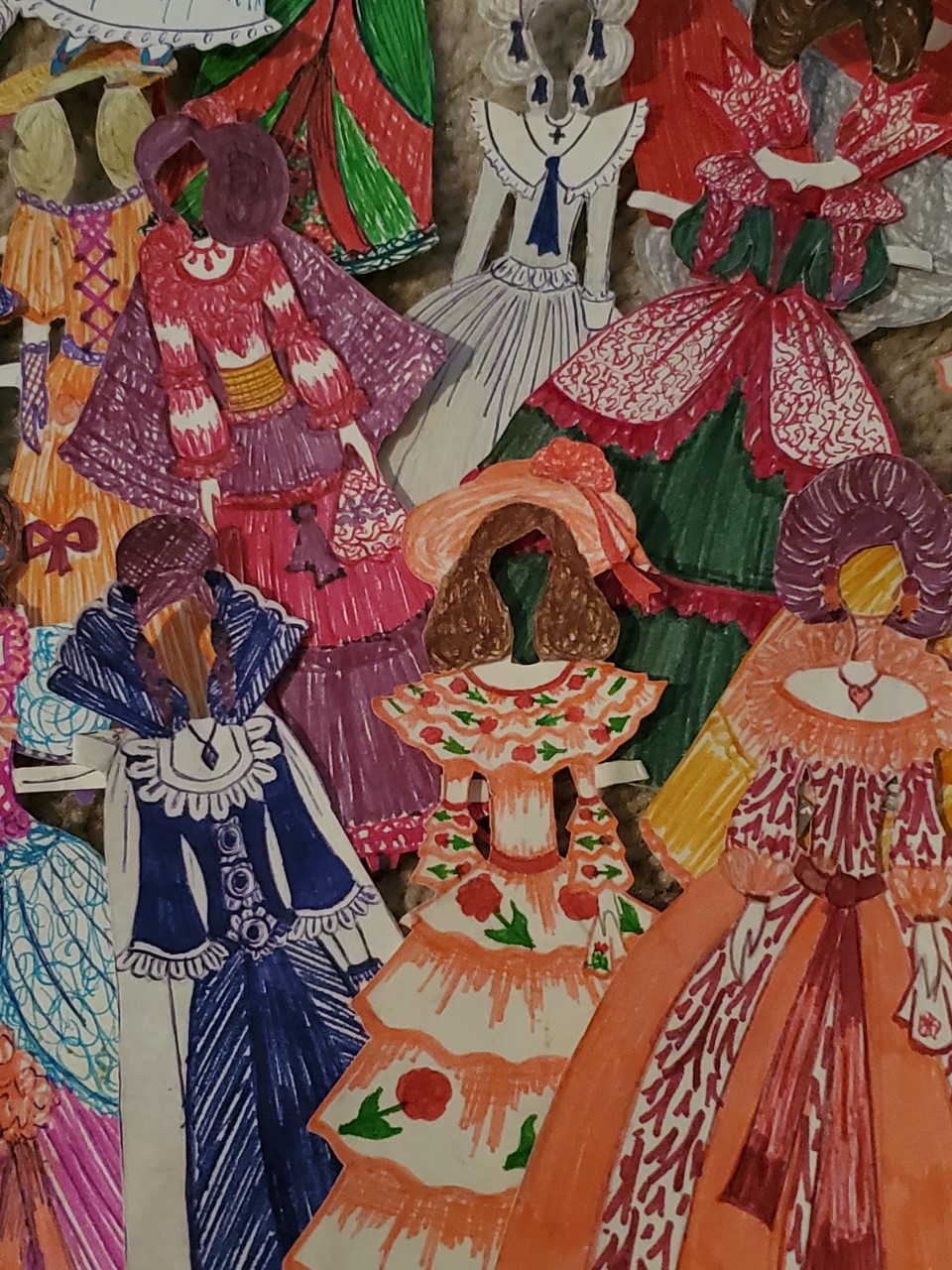
A word about artistic inspiration.  As a refugee child in Rome with no toys but an extravagant set of markers which my family somehow managed to afford for Christmas, I drew a paper doll and, over the years, a mass of elaborate period dresses, inspired by my own imagination combined with dolls in Italian toy store windows and later, playing cards.  Since queens on playing cards are only portrayed from the waist up, all the skirts are mine.

(Just a few of the dresses; the last one was left unfinished around 30 years ago.)

[1] My big lie was the monkey story from The First Spanish Trip.  The truths were crashing a circus rehearsal (stay tuned!) and being chased by someone wielding a can opener (a singularly unpleasant event not worth retelling).

[2] I specifically did not mention it then, because I knew it will someday deserve its own full entry.

[3] English language fails me here.  The word that we actually use translates as “trestle bed”, but that seems to mean nothing to anyone.  I literally have spent no time on the beach in my English-speaking life, after an entire childhood of sun-drenched salt-water summers.

[4] In later years, during summers at the Baltic Sea, Nines replaced Fool as the rousing card game of choice. My grandfather subsequently demonstrated himself as the most charming cheat in the game of Nines.

[5] Eventually, the seven of clubs was lost, and we drew a card on nothing better than a piece of green blotter paper.  Needless to say, the seven of clubs was extremely conspicuous.

[6] And I never found Piatnik’s King Arthur deck.  I probably could now, but I prefer to leave this slight gap in the collection.  “Nothing in life has any business being perfect”.
All to the Polls!

One of my most favorite childhood memories is when I served as Honor Guard at an election.  I have forgotten a lot of the particulars about what, how, why, and even when.  Frankly, I do not want to ask for corroboration, because I am almost afraid that my friends’ memories are not as glorious as mine. 

“I’m no expert, but I remember reading somewhere, every time you retrieve a memory, that act of retrieval, it corrupts the memory a little bit.  Maybe changes it a little”[1].  Well, this particular memory has probably been retrieved to the point beyond recognition, for the joy brought by the factual experience of it as well as for the sheer uniqueness of the experience.  Observing an election in the Soviet Union, a state that officially only existed for 70 years (75 if you count from the Revolution)!  From the inside!  Had I known how soon it was going to end, for me AND the country, I would have tried to remember more and better.  But how?

And so, in the year I cannot name with any certainty other than it was in the late ‘70s, our classroom teacher, a particularly unpleasant personage who ostensibly taught us, badly, algebra and geometry, announced that our class was chosen to serve as Honor Guard at an election.  Participation, in the way of the Soviet regime, was mandatory—but we did get to miss class, which was as desirable in that time and place as it has been for schoolchildren since the beginning of time.  The fact that I was excited to be formally excused from class indicates that it must have been before I became a brazen truant, so probably fourth grade.

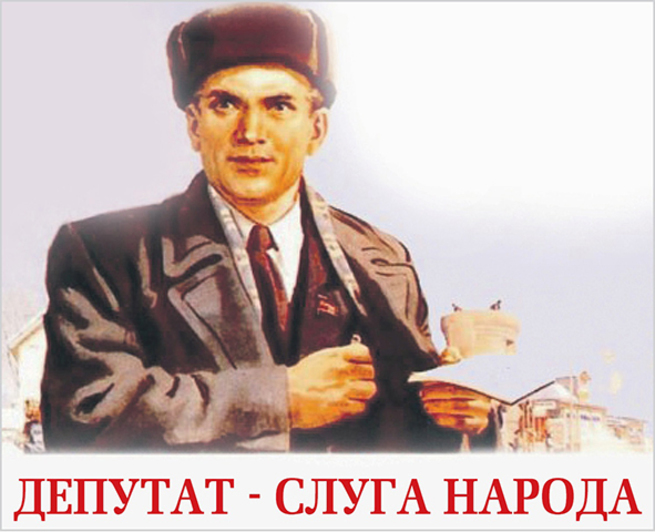
” A deputy is a servant of the people”–no argument here.

What election could it have been?  Probably for the delegates to the local soviet (which just means “council”—there is really nothing more sinister to this word; it is also the word for “advice”).  Periodically there were leaflets promoting various candidates, with their names and photos and nothing else because (1) their party affiliation was obvious and (2) so were their campaign promises.

The polling place was a school, but not ours–#57, which was in my home district (I went to a school of choice, #37.  It included some children of the intelligentsia, but otherwise had very little to recommend it in the general landscape of the most stagnant decade of the country’s history).  It was my first and last time inside the building past which I frequently walked on my way to and from my school (the shortcut to #37 past #57 lay past wastelands and garages, which is more than symbolic; the long way, predictably, was via Lenin Avenue).

We were supposed to do our civic duty in shifts, and in groups of four.  It was a happy accident of fate that my BFF and I were the last two girls in class in alphabetical order.  We were told to arrive for our shift wearing our Young Pioneers uniform.  We actually had three types of uniform:  brown dress and black apron for everyday, parade uniform of brown dress and white apron (which you are technically not supposed to wear as a Young Pioneer, but occasionally someone screwed up and forgot and showed up at an important event in the wrong uniform, immediately giving rise to speculation that they were kicked out of the Pioneers), and the Pioneer uniform, white shirt and navy skirt.  Of course, denim skirts were not allowed—and of course, my mother sewed a super-cool denim skirt for me.  The odious math teacher would sidle up to me and admonish me for wearing denim, and I would assure her that next time I would wear plain navy wool.  It was our own little détente.

But that day, we were ready to represent, and I am sure that my skirt was wool, my red tie had no soup stains, and there was a giant white bow in my hair.  The entire class was extremely nervous leading up to the big event, because a rumor was floating that we might have to stand stock still and hold the Pioneer salute for the entire time.  Not only did that rumor turn out to be false, but we also were fed on breaks during our 2-4 hour shift: sparkling lemonade and the ever-popular “basket” cakes, though not the really delicious ones from the Volkov Theater. 

This image has an empty alt attribute; its file name is pirozhnoe-korzinochka4-360x240-1-1.jpg

https://oldladywriting.com/2020/07/26/all-my-world-is-a-stage/ Despite the fact that one of the two boys in our merry quartet was mine and my BFF’s sworn enemy whom we regularly fought on an off school grounds (in our egalitarian regime, boys and girls regularly engaged in physical combat), we had a grand time during a grand occasion.

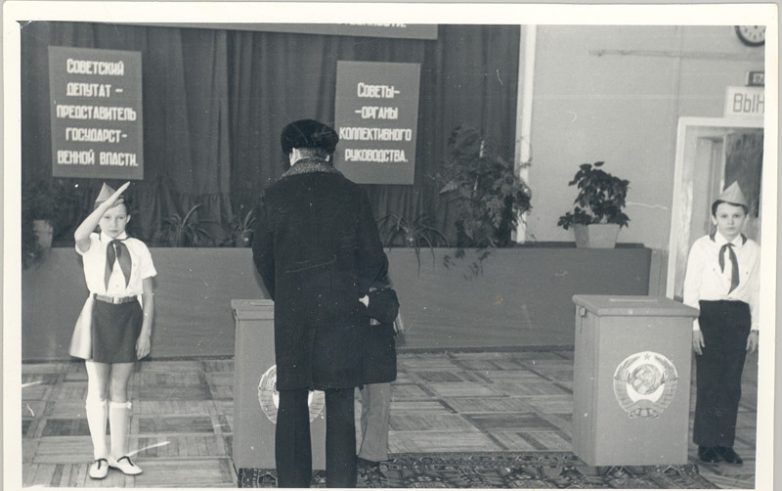
The four of us basically just stood in a line on a dais in the school auditorium, trying to convey the motto “Pioneer is always ready” with our eager and helpful demeanors.  We felt like we were entrusted with tremendous responsibility when an old woman approached us and asked for clarification on how to check off the one box on the ballot, and where to put the ballot.  It could not have been her first time voting, but she either needed help because, well, age leads you there, or she wanted to make the young feel included.  She was performing her civic duty.  We were there to help.  We felt the weight of the moment.

Not us, but a fairly accurate representation.

There was a big ballot box sitting in the middle of the room.  There was also one of those polling booths with privacy curtains.  One or two people used it during our shift—but why?  Each ballot had only one candidate’s name on it.  I asked my mother about it afterwards, and she said that it is possible to vote against the one candidate, but then you might have some explaining to do.  Apparently, you also could not abstain from voting—shirking your civic duty was frowned upon, probably earning a reprimand at work from the Soviet HR equivalent.

It is easy now to say that an election with just one candidate is a sham (although I have voted in many a Western Democracy’s election where a candidate also ran unopposed).  It is easy to sneer at a high voter turnout by attributing it to coercion (although if the day of election is a day off work and school ANS you get to eat and sing songs—who wouldn’t? And how is exercising your most important civic duty not a cause for celebration?).    

This memory is my own, and is not an endorsement of any particular political system.  I never voted in that system.  I was an observer, for one brief shining moment, and it left me with a feeling of responsibility that has not left me to this day.  I have seen democracy in action, and I have seen democracy fail.  I remain hopeful—but only just…

“Women enjoy the right to vote and be elected on an equal basis with men.
Long live women, who have equal rights in the USSR!”

[1] Emily St. John Mandel, “The Glass Hotel”.

Valor and Glory of the Motorbuilders

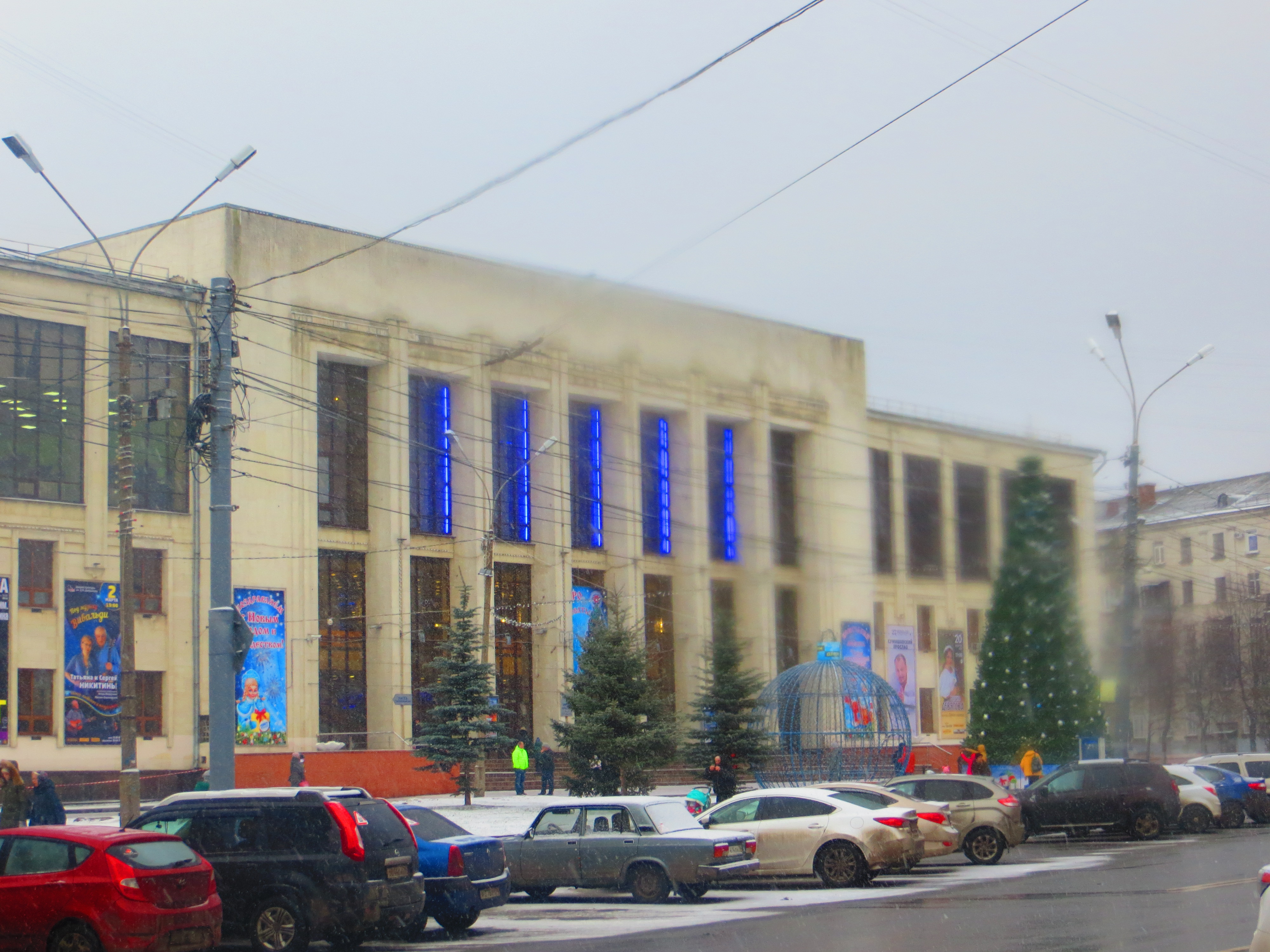
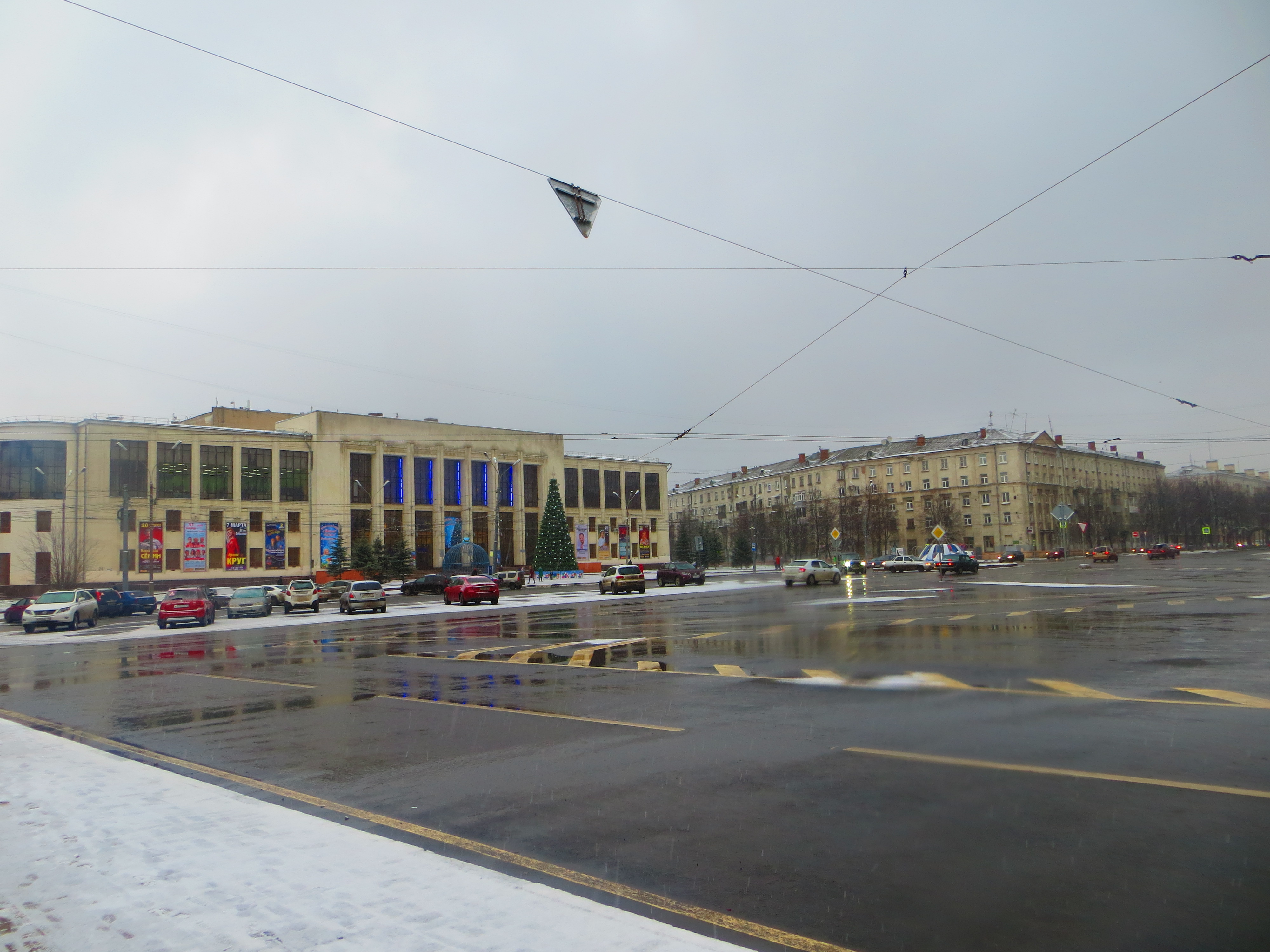
The municipal autonomous institution of the city of Yaroslavl, Palace of Culture named after A.M. Dobrynin, formerly Palace of Culture of the Motorbuilders, just celebrated its 55th birthday.  In a surprising twist, my first short story (amazingly still unpublished), about a visit to A.M. Dobrynin’s “dacha”, just celebrated its 36th birthday.  Apparently, despite August being a heavy month [https://oldladywriting.com/2019/10/13/sorrow-floats/], it has seen some good times.

This is the best photo of the Palace of Culture of the Motorbuilders, because it is not only from my era, but includes the now defunct “Salut” (firework)–the lamppost much maligned as an eyesore

In the course of my career, I have worked closely with some of the biggest automotive manufacturers in the world, as well as the biggest automotive suppliers.  This is possibly the most boring sentence I have ever written that was not work related.  It is not even a brag.  Everyone who lives in the metropolitan Detroit area is involved in the automotive industry in some way.  So is everyone who lives in Yaroslavl. 

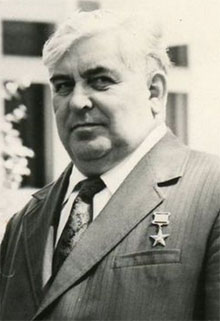
Anatoly Mikhailovich Dobrynin was the General Director of the Yaroslavl Motor Plant from 1961 until 1982, the only one in my lifetime there, and had the longest tenure of any director to date.  I was going to say he was like a Russian Lee Iacocca, but I truly have no idea if there is any comparison. Frankly, Lee Iacocca should have been so lucky.  Comrade Dobrynin was a Hero of Socialist Labor, recipient of Lenin and State Prizes of the USSR, and many other labor medals, prizes, and honors.  And because his entire career and life (the two ended pretty much simultaneously) fit into the several decades of the Soviet Union’s existence, he got to lead an enterprise which, besides its manufacturing prowess, was also a giant benefactor to the city’s workers.  Basically, the big plants subsidized various affiliated ventures.  For example, the Motor Plant contributed to the creation of the Motorbuilders’ Palace of Culture, Motorbuilders’ Park, movie theaters, stadiums, etc.

The interior of this Palace of Culture is a bit elusive for me.  I had few occasions to enter it.  I did not attend any of the children’s classes there.  Despite it being significantly closer to our house than the Young Pioneers Palace, where I spent four tortured years at an art studio [https://oldladywriting.com/2019/06/04/run-your-own-race/], I only entered the Palace of the Motorbuilders for the movie theater (which was, again despite its convenient location, somewhat unpopular among the youthful moviegoers, and is now defunct) or to attend the exclusive New Year’s parties.   I strongly suspect that, given that the Motorbuilders were so superior to all the other organizations in our city, I could not possibly qualify for any of their children’s clubs and afterschool activities.  I could only hope to be admitted to the events at the Young Pioneers’, which had to take all young pioneers (and had vastly inferior New Year’s parties), or at the Giant Club, which was loosely affiliated with the other major plant in my town, the Tire Plant.  The Tire Plant was uncool, and its director was entirely unknown.  Giant, however, had a better movie theater—and, I was accepted into the Young Pioneers on the Giant stage.  But I digress.

Not the actual photo of the slide at the Culture Palace.

A word about the New Year’s parties.  They were basically Christmas parties, complete with a Christmas tree (called, naturally, New Year’s tree), Santa Claus (Grandpa Frost), and gifts for all the kids. At the Motorbuilders’, the gift package would include a tangerine.  Tangerines were not as exclusive as bananas, but one did not simply encounter a tangerine in the middle of a Russian winter in the seventies.  The parties would include various activities such as some kind of a fairy tale staging, loud yelling at the tree to “light up”, and presentation of the gifts to the children.  Because the Motorbuilders’ Palace was huge, they also had slides.  I have no idea where they would come from and to where they would retire after the holiday season, but the slides were possibly even more exciting than the tangerines.  Life just does not get better than when hundreds of children are pushing and shoving to go down a giant slide at a Palace of Culture before New Year’s.  As we used to say, thank you for our happy childhood, beloved Motherland.   

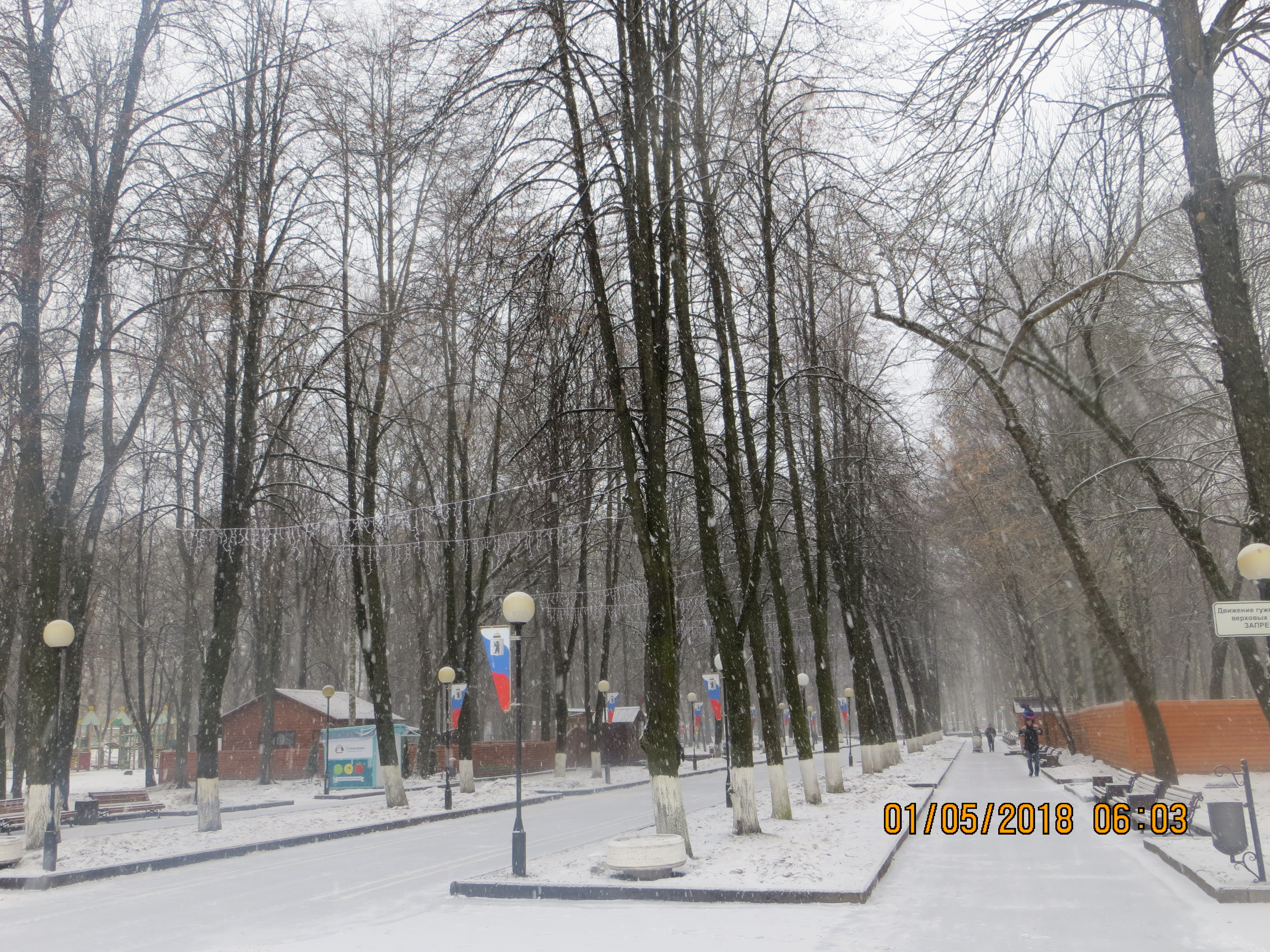
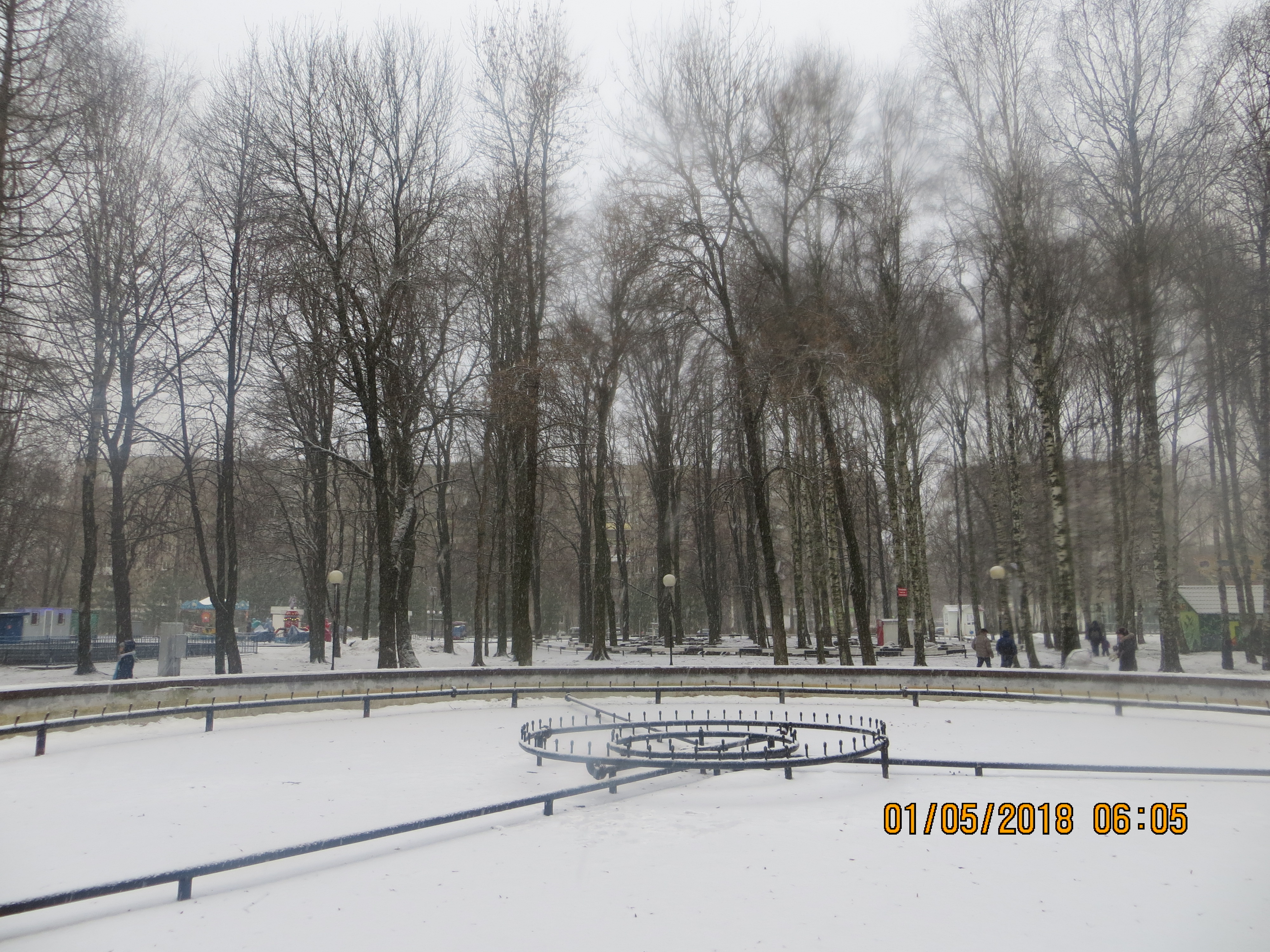
Right behind the Palace of Culture was the Motorbuilders’ Park.  Apparently it is officially named the Anniversary Park, as it was created for the town’s 950th anniversary in 1960, but no one calls it that.  The colloquially known Motor Park, Yaroslavl’s answer to Paris’ Luxembourg Gardens and Madrid’s Parque del Buen Retiro, was lush, green, and huge.  When I visited it two years ago, it somehow became small, weird, and scruffy.  I strongly suspect it was because my BFF kind of rushed me through it so that we could go home and eat, and I did not get the full effect.  But, in the glorious 70s the park was home not just to gorgeous alleys for promenading and a very impressive round fountain in the middle as befits European capitals, but also to many exciting rides such as “boats” (those big swings that you see at Renaissance faires), “runner” (a strange contraption of several wheels that lifted kids in attached seats up and down as it also moved in a circle, and was out of commission much more often than it was functioning—to find the “runner” actually running was like finding a unicorn in a Soviet zoo.  I kid; we had no zoo), and “autotrain” (A train that ran through the park. Why auto?  Because it was not on rails).

Actual footage at the park in 1974.  I am not there, but could have been.  Look for the rarely functioning ”runner” at 1:50, a very clear view of the back of the Palace at 3:36, followed by “boats”, and then some “adult” rides, such as the “Devil’s (Ferris)” wheel, which for some reason did not allow children.

Last but not least, the Motor Plant owned a resort, officially known as a “recreation center” (the word “resort” was much too bourgeois), named Forest.  Forest was literally in the forest on the banks of the Volga.  If you worked for the Motor Plant, you could get a “voucher” to spend a summer week at the Forest.  My times at the Forest deserve their own story, if ever one can be written to give full justice to the joys of Soviet childhood on the Volga—and I mean that without even a hint of sarcasm.  It was basically an all inclusive resort, and for its time and place it was just perfect. 

The main building at the Forest. It does not do the place justice.

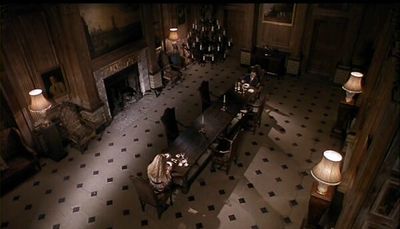
But wait, it gets better.  Deep in the actual forest that surrounded the Forest, there was one more building—the “dacha” (country house, summer cottage, chalet) of the director of the Motor Plant, Comrade Dobrynin.  It so happened that my grandfather’s friend, Uncle Sasha, was the director of the Forest, which somehow resulted in us being invited, on several incredible occasions, to stay at the Dobrynin dacha.  Of course, we never referred to him as Dobrynin, Comrade Dobrynin, or especially Anatoliy Mikhailovich.  He was “Director”.  Not that we ever met him—I mean, Uncle Sasha must have, but no one in my family has, as far as I know.  It goes without saying that we only stayed at the dacha when Director was not in residence.  And when I say “dacha”, I do not mean the cabins that all of our friends had “za Volgoi” (on the other bank of the Volga, beyond the city walls), without electricity, indoor plumbing, or even water (as a child, I found gathering water from a well very charming).  No, Director’s dacha was a literal mansion.  I mean, it was not even a regular person’s house.  I remember two things most distinctly: a billiard room (which I blame for my lifelong burning desire to possess a pool table.  Which I’ve had for almost 20 years now, and have probably used six times within the first year of getting it and none since) and a dining room which I seem to recall looking exactly like that dining room in the first Batman movie, the one with Michael Keaton (THE Batman).  That movie came out over a decade after we ate pea soup in the Director’s mansion, by the way.  Food for thought.

Why pea soup, you ask?  Well, there was one touch-and-go trip when Uncle Sasha called my grandparents and another couple, the Osipovs, good friends and fellow adventurers, and invited them to the dacha as Director was not going to be in[1].  The five of us started gathering, but I recall some hesitance on someone’s part until Uncle Sasha’s wife, Aunt Lida, enticed us with a promise of delicious pea soup prepared by the Director’s cook, Mrs. Patmore[2]

It was exactly like this.

Somewhere along the way, we got the command to retreat, as Director was coming after all.  But how?  This was before cell phones.  It was barely after regular phones, because, Soviet Russia.  The cavalcade must have been intercepted while the Osipovs’ orange car was picking us up.  We dispersed.  And then—false alarm.  Director was not coming after all.  We were going to taste the pea soup!  He didn’t, and we did.  In the Batman dining room.  It was magnificent.  And I thought to myself, people live like this in the West.  And I was wrong, because no one I know lives like this in the West, because I do not get personally invited to the mansions of the automotive companies’ CEOs.

Rare unpublished manuscript

But the experiences at the Director’s dacha made such an impression on me that when I wrote my first short story, in 1984, it was about one such visit.  I exercised poetic license by replacing grandparents and their friends with a fun gang of kids my own age, who cause mischief and wreak havoc, and they actually get to meet the Director, who turns out to be charming and not intimidating.  Perhaps that is how Comrade Dobrynin really was.  I would not know.  And then everyone eats pea soup.  The end.


The modern day branding of the Palace of Culture.

For more information, current events at the Palace, fun videos, and an occasional retro photo: https://www.facebook.com/groups/dkdobrynina1965/

[1] I lived with my grandparents, so wherever they went, I went.  They were in their mid-fifties then, so like older parents.  Almost all of their friends were at least a few years younger, so this is not a feeble elder crowd, just so you know.

[2] I lie.  No one called her that.  It was Comrade Patmore.

Personal Best

The unthinkable and the entirely unexpected happened—I won a running award that was not just for showing up!  I actually placed second in my age category in a masked, socially distanced race. And though I have always joked that the only way I will place is if only three women run, I always secretly hoped for just such an eventuality.  Frankly, I thought I might have to wait a couple more decades for the ranks to start thinning.  Turns out I just had to wait for the pandemic that would turn most races virtual.  The point in my favor was that with no more than 100 runners, the competition was not that stiff.  However, I have to clarify that there were seven (7) women that showed up in my age category.  And I still placed second (2nd).  There were five (5) entire women slower than me, which is an amazing improvement since gym class[1]. https://oldladywriting.com/2019/06/04/run-your-own-race/

The race itself was actually pretty brutal, and not something in which I would participate under normal circumstances.  I mean, I did not know how crazy it would be because as always, I carefully read the directions about where to park, where to stand to socially isolate at the start, and when to wear the mask.  I blithely overlooked the facts that the race was (1) at night, and (2) in the woods.  Words like “moonlit”, “9 pm”, “trail”, and “forest” did not cause any alarms to go off, so excited I was to just run in an actual race.  And so, I literally stumbled through the dark jungle, leaping (and I use the term loosely) over tree roots, trying not to slip in the mud (as it rained shortly beforehand), alternately praying and swearing.  It was also extremely hilly.  Pure adrenaline moved me forward, based on a desperate desire to not perish in the woods.  This was easily the most exciting thing that happened to me since the plague came to town.

Picture this logo on everything that money can buy in the USSR in 1980. It is more than you would expect.

The real twist in all of this is that this past weekend marked the 40th anniversary of the Moscow Olympics.  I tend to see symbolism and omens in everything.  For me, it seemed auspicious to run—and “medal”!—on such an august (see what I did there?) occasion.


The year 1980 was one of the best, if not THE best, year of my life.  It was the last year of my childhood, and my childhood was pretty wonderful.  The Olympics lent the entire year the aura of magic, camaraderie, and celebration.  These were the first Games to come to Eastern Bloc, and are the only Summer Games that took place there to this day.  They were a tremendous big deal for The Soviet Machine.  We all know now how that worked out, sadly, and from then on[2]. But for those of us in close proximity to the Big Event, it was a truly exciting time.

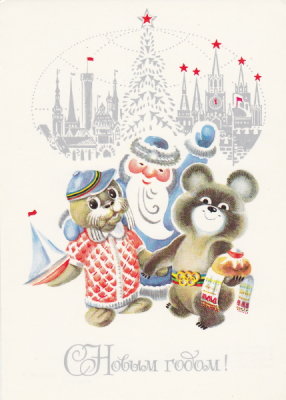
This New Year’s card also lives in my basement.

There were several things that made it so.  First, the merch.  You literally could not buy anything that did not have the Olympic logo on it.  And everything that had the logo cost more, even if it was just a few kopeks. It was a cunning plan to raise money, I suppose.  We normally call such a scheme a “load”, but during that glorious year, people were eager to buy even dinner plates that had the discreet stylized image of the Kremlin with the five rings under it.  I myself was a proud owner of a messenger bad with the logo.  I mean, everyone had one, but I was not usually cool enough to have anything that other kids had.  Yet that year, I did!  And of course, Misha the Olympic Bear was the best mascot, because bears are awesome, and he was the cuddliest of bears.  I dreamed of owning a stuffed toy, but that was an unattainable dream.  I did get a rubbery squeezable one, which we duly brought to the US among our very limited possessions, and which is still lurking somewhere in my house, not having been properly appreciated by my kids.  Fun fact:  the mascot of the sailing regatta, held in Tallinn, was Vigri the Seal.  Since my grandmother and I spent part of the pre-game summer in Tallinn, I am a proud owner of a small wooden Vigri.  He also crossed the Atlantic and lives in my basement.

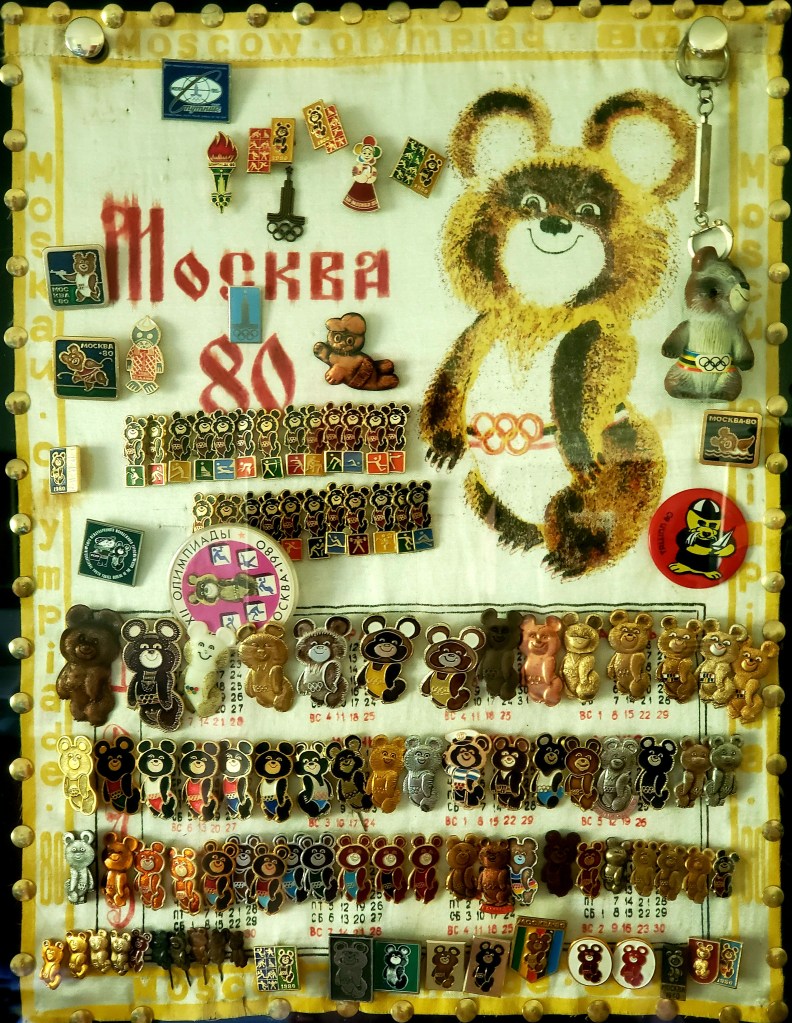
My mom and I diligently collected every Misha–and some Vigri–pin we could find. Seriously, how cool is this?!
NOT the same brand that we had

Second, the food.  Because of my hometown’s close proximity to Moscow, https://oldladywriting.com/2019/06/28/the-three-monuments/ we were getting food.  Not the regular food like meat and potatoes and apples, but tiny portions of packaged food like butter and jam, as well as juice boxes.  These were intended for the athletes, but were siphoned off to the periphery both before their arrival and after their non-arrival.  These were items that you would see outside the Soviet Union in an average, non-fancy diner at breakfast.  To us, they were ambrosia.  I was under strict orders from my grandmother to not tell my friends that we had a supply of this amazing stuff, else we would have an infestation of neighborhood kids in search of mythical juice boxes.  (I received the same orders when we bought a color TV and a car, and whenever we had bananas in the house).

NOT the same brand that we had. There is no image of the incredible juice boxes that I could find. One of the flavors was pineapple–like we even knew what that tasted like!

I still think of Moscow Olympics every time I open a tiny jam container when I have breakfast at a diner.  And I still think of that glorious summer of plenty and exhilaration when I think of the Olympic Games.  And I still say, whenever anyone Russian asks me when I left the Motherland, “After the Olympics”.  And everyone understands.


[1] The plague took my friend who was slower than me in gym class.  I mourn her more than anyone will ever know, and for reasons that have nothing to do with anything that has yet been written…

[2] Five countries have been represented at all Summer Olympic Games – Greece, Great Britain, France, Switzerland, and Australia, but only Greece has participated under its own flag in all modern summer Olympic Games.  Good for Greece, rising above the fray! https://oldladywriting.com/2020/07/30/the-wrong-way-to-the-parthenon/

The cool blue bottle is for winners only!

All My World Is a Stage

In my pre-plague life, I never had a spare weekend.  I [used to] see a lot of live theater.  Over the past couple of decades, most other hobbies fell by the wayside as this one escalated.

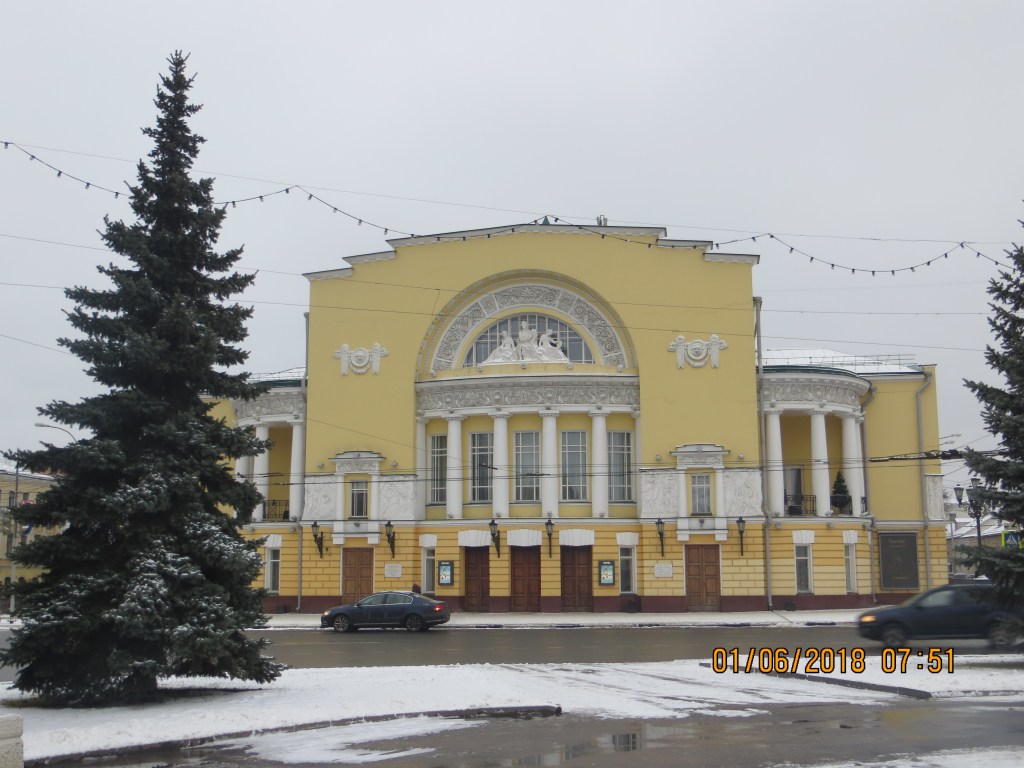
A few people asked me about the origins of this love.  One was Geraint Wyn Davies[1].  He was just being polite and making small talk, but I launched into some inane monologue of sharing a birthplace with the first professional theater in Russia, the Volkov, named after its founder, Fedor Volkov.  This is factually true, but really, in my day the Volkov was a disaster.  It is a gorgeous classical building of pale yellow, with white columns and ornate façade, second in appearance only to the Bolshoi.  Many famous theaters are so nondescript from the outside.  The House that Moliere Built is simply stunning in its unimpressiveness, despite being home to the largest and deepest stage I have ever seen.  But the Volkov is beautiful, and sits in a strategic location, facing the large round Volkov square containing the statue of Fedor Volkov himself (no surprise),

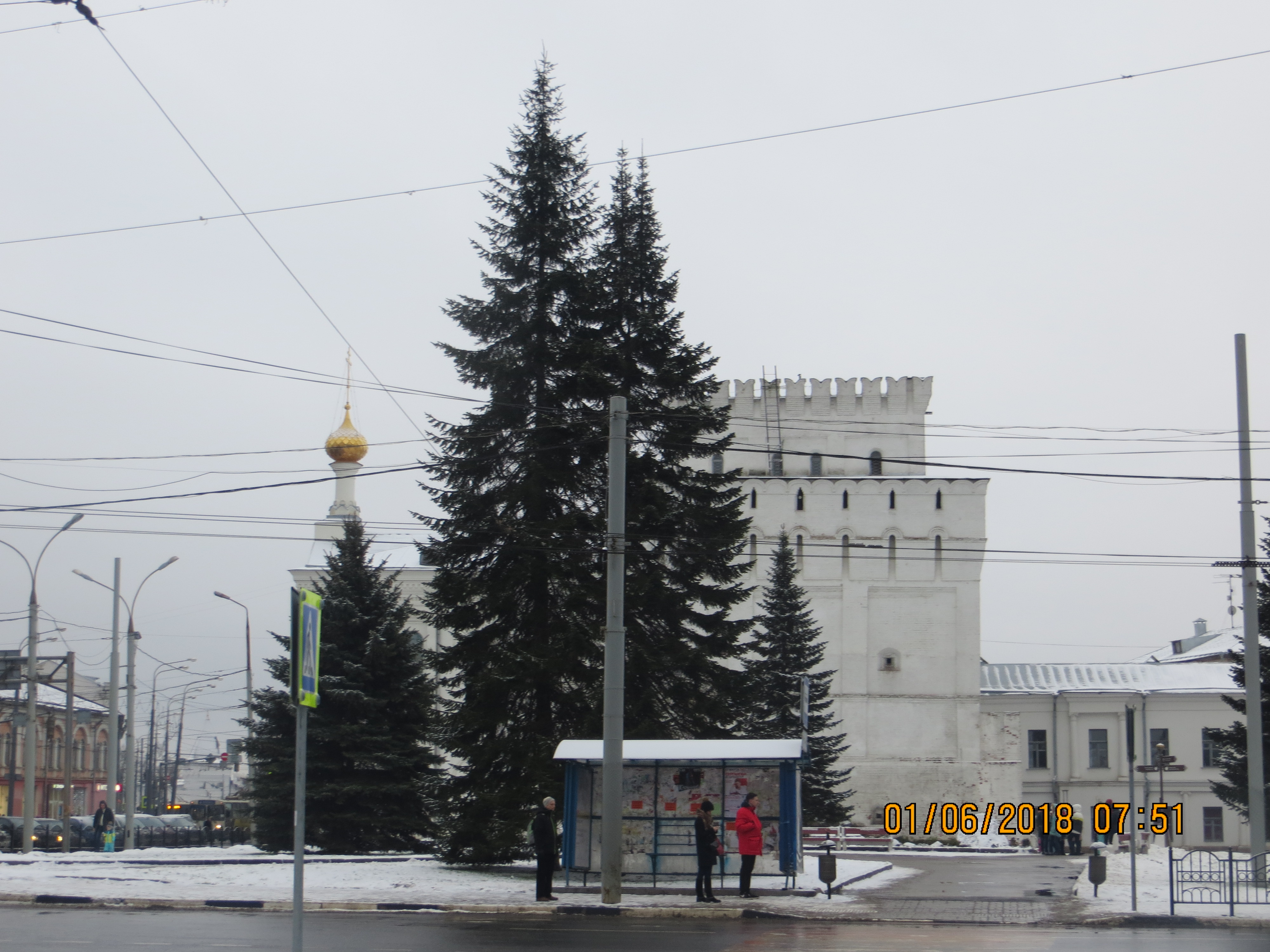
and one of the oldest historic monuments in town, the 17th century Banner (Znamenskaya) Tower.  It is a spectacle—but a spectacle that used to be entirely external. 

Oh, to be sure, it is also magnificent inside—with its marble red-carpeted stairs, frescoed walls, sculpted ceiling, velvet curtains, and a buffet serving delectable pastries.  Unfortunately, what used to happen on stage in the ‘70s was either stale plays by Ostrovsky (in all fairness, I have never seen or read any of them), stock Communist plays (I have certainly never seen those either), Nutcracker (with substandard local or traveling cast), and an occasional Moliere or other permissible Western classic (performed in a standard static declamatory style).  Before the Young Viewer’s Theater was built (after my time), my class would occasionally troop over to the Volkov on a field trip to see a morality play about the Young Pioneers. 

The pastries were always excellent!

Right before we left the Soviet Union forever, my grandmother and I spent a few days in Moscow.  The family friend with whom we stayed knew someone who worked at the Satire Theatre, and managed to get us in to see “Pippi Longstocking”.  If one was to have such luck as to get into the Satire, or really any Moscow theater in those days, one would be hard pressed to find anything less exciting than “Pippi Longstocking”.  Nonetheless, as proverbial beggars cannot be choosers, it was still thrilling.  There were a couple of actors whom I knew from TV, and that was enough.  I still recall one tune from the musical, for that is indeed what it was, and that is no small measure of an impression it made on me almost 40 years ago.  I never heard this tune again except in my head.  Those were the days when memories were made.

In the US, we were astonished to learn, theater tickets were distributed on a sort of first come, first served basis to those who had the means to pay, rather than on a complicated favoritism scale as a part of a behind the scenes black market economy.  That was an incredible concept, although I did not know the actors and did not want to see them.  Whenever my mother and I found ourselves in New York at the same time, she dragged me to Times Square to stand in line for half price tickets.  The first Broadway play I saw was “Foxfire”, with Jessica Tandy, Hume Cronyn[2], and Keith Carradine.  We must have already been living in the US for a bit, because I knew who Keith Carradine was[3].  I understood almost nothing, as my English was so poor and certainly not theater-ready at the time, but I did understand that I was in the presence of greatness.  I held on to the memory and still cherish.  I wish I had kept the program…

We saw a few great shows over the years when I was in high school: several G&S productions https://oldladywriting.com/2020/03/29/it-is-a-glorious-thing/, and an amazing production of “As You Like It” in Jackson before Michigan Shakespeare Festival settled there. https://www.michiganshakespearefestival.com/   It is still the gold standard for that play for me.  Each act was done in a different setting.  The city was all shades of gray and furs and muffs, the forest was all pastels, and the rest I do not remember.  Nonetheless, for what was my first encounter with Shakespeare in the language I was still learning, it certainly left a lasting impression.  But the real theater life started in Fort Worth.

When I was in college and my parents (I use the term loosely when it includes my late stepfather) lived in Fort Worth, they discovered a small regional theater called Stage West. https://stagewest.org/  In a tiny space of about 100 seats, they used to put on a fantastic variety of plays—and still do.  My first exposure was to a dysfunctional comedy at Christmas called “Seasons Greetings”—we still laugh about “Pig number one, pig number two”, although I have never seen it performed since.  From then on, every time I visited my parents, we would go to Stage West.  It was always a delight, with an underlying feeling of uncomfortable incredulity about how a troop of local actors in some shed on a rough dockyard-like street would do a better artistic job than the permanent staff of the oldest professional theater in all of Russia, working in a gorgeous building with delicious pastries.

As an aside, I had the great fortune of revisiting Stage West a few years ago during a work conference in Dallas.  My mother joined me, and we saw Stoppard’s “The Real Thing”.  As a purportedly more sophisticated theater goer after the passage of almost three decades, I was still astonished.  It was a world-class production.  And one of those moments when I said to myself, I am the luckiest girl in the world.  Gosh, I just live for those moments!

And then there came Stratford.  https://www.stratfordfestival.ca/  This is a story that has been told often, and at almost every Stratford social event.  It is just a conversation starter—how long have you been coming, what was your first experience?  In my young married life, theater was not a factor, as we had neither time nor money, and never both at the same time.  One fine day in 1996, my college friend suggested a girlfriends’ day to see a play.  So the three of us drove three hours, arrived on a rain-soaked Saturday in August, ate some weird concoction prepared by one of us (not me!) for lunch in the car, and entered the Festival Theatre to behold the great William Hutt as King Lear.  It was unquestionably one of the defining moments of my life. I wish I had kept the program…

Initially it was an annual trip.  Initially it was just Shakespeare.  Then we added other shows that sounded interesting, and once a season became not enough.  Then some years later my friend lost interest and was replaced by my spouse.  Then my kids started coming, and several other friends came along, and I even went by myself once when I could not sell anyone on “Fuenteovejuna”[4].

Along the way, I started to go to the theater everywhere I have traveled for work or leisure, and then planning trips with seeing plays as the goal.  It became my identity— “I go to the theater”.  It is what I do and who I am.  For the time being, I do not and I am not.  It feels like an intermission of my life.  With theaters closed for the foreseeable future, I no longer know who I am and what to do with my after-work life.  As I see it, I have two options:  (1) reinvent and find some new interests, or (2) hunker down with my memories and wait it out.  Or maybe both?  Stay tuned…

The new Tom Patterson theater–as of this writing, it has not yet opened…

[1] I am just name dropping here. J

[2] Is it a coincidence that Hume Cronyn is Canadian?  I think not.

[3] I saw Keith Carradine on a BroadwayCon panel a few years ago, and he actually mentioned “Foxfire” with fondness.  What a full circle!

[4] Anyone who has not seen this Stratford production should be living with regrets.  I am just saying.

Father’s Day Part II

I meant to add this as a follow up to Part I.  Like for Rose Tyler, it is certainly an unexamined subject for me.  I never had a father.  Well, strictly, it is not true.  He has always existed in the ether, and walks the Earth today. 

Here is how we first met.  Back in the pre-Afghan invasion days, before the Soviet Union reinstituted the draft, young men were only conscripted if they were not in college.  Those pursuing a higher education were exempt from the brute service.  My father failed out of college and was immediately snapped up.    One fine day during my fifth summer, I was told that my father was coming home.  I was made to wear a hideous sleeveless blue dress with pink trim, and have not forgiven my mother for it to this day.  It was made in Egypt, and had a head of Nefertiti on the inside tag.  It freaked me out, and I hated the dress because of it.  I also hated how my bangs were pulled back in a bow.  It seemed a lousy first impression to make on my father.

He arrived with a bouquet of flowers for my mother, and I recall turning away from a hug.  He was a stranger, and it was all completely embarrassing.  I lived with my grandparents, and young men were scarce in my world.  He was probably about 25 at the time.

I think my parents were only together for that one summer.  Several memories I have of that time are as follows:

Living with my other grandparents.  They had a two bedroom apartment. It was a standard and familiar layout of the times. I remember they had a vase on the floor with cattails. I must have had the urge to pick at them.  I probably did.  My other grandmother, who, as my father later confirmed, disliked my mother and her family (and me, I certainly felt so), was ironing a beige dress with white lace that I had and ironed out a crease on the front.  It was the design of the dress, and I protested, because “my” grandmother would not do such a thing.  She responded that she was also a grandmother of mine.  Whatevs, lady.  I never believed her, and she never really was.  I addressed her with the polite “vy” instead of the familiar “ty”, which irritated her.  I do not even have a photo of her. I would not know her in this life or the next.  She died just a few years ago. 

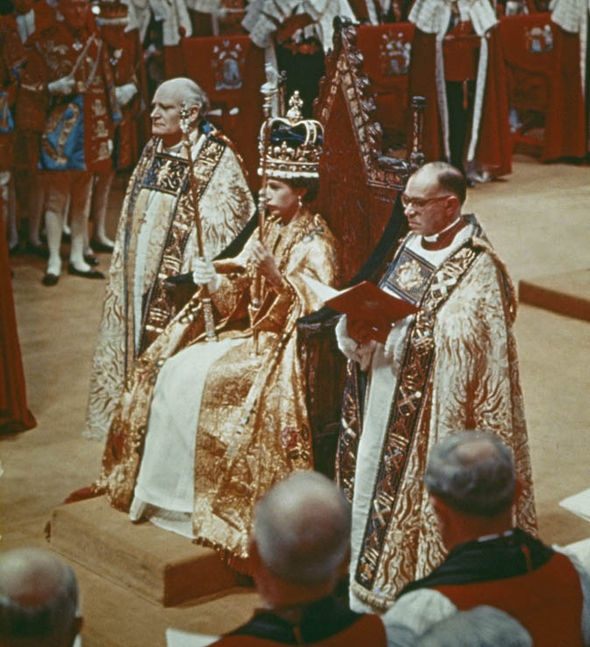
Toys. My other grandparents presented me with some cool toys.  There was a set of amazing dollhouse furniture, which I regrettably did not treasure.  Of course, it would have never made it to America anyway.  What did was an old Viewmaster which my father must have had as a child when his parents lived in India.  It had some amazing Western shows, such as a three-disk set of “Bambi”, “Three Little Pigs”, “Little Black Sambo” (it was a long time ago…), coronation of Queen Elizabeth II, lots of brightly colored parrots and one monkey (there is always one monkey), and incredible views of faraway Asian lands, particularly Mount Fuji and the Taj Mahal.  I brought it frequently to show and tell in my Russian school.  The collection made it to America but not past high school. When I went away to college, I neglected to supervise, and my mother, predictably, lost it.  It is a damn shame.  Damn shame.

Aunt.  My mother is an only child.  My father has a younger sister.  They seems to have retained a close relationship to this day.  She was a college student at the time, and he encouraged me to shake a fist at her and yell, “We will show you, students!”  Only recently did I learn that this was because of the famous Shurik the Student movie, “Operation Y”.  My father must have been a fan.  My aunt Tanya seemed a benign, but nondescript, presence.  I remember almost nothing about her.  My father was allowed to name his newborn baby sister Tatiana, which is apparently his favorite name.  He suggested it as a name for me, but of course my mother had to step in without something less “common”.  It appears that my father did not get a vote.  He managed to prevail with my sister, who has a different mother. 

Car.  My other grandfather had a car.  It was huge and green and white, but maybe it wasn’t either.  My father must have known how to drive, because I recall sitting in the front, which is quite illegal for very young children, Soviet Union being no exception, and he admonished me to slide under the dashboard if we saw the road patrol out in the country.  Great parenting right there! 

Not my other grandparents’ actual dacha

Dacha.  My family never had a dacha, a “beyond the Volga” country home, because my grandfather worked all the time.  It was not that my grandparents could not afford it, but more that they did not want to be bothered with working the land.  Besides, pretty much everyone we knew had a dacha.  My other grandparents’ dacha was a two story construction, which was very exciting.  The second story was some kind of a loft where my parents slept.  I wonder if that is what caused my affinity and longing for lofts.  I have never lived in one.  My father’s paternal grandmother was still alive at the time.  She seemed ancient.  She was dressed all in black and sat on the steps of the dacha and yelled at me whenever I ran in or out of the house.  I have no recollection of her being elsewhere, just on the steps of the dacha. 

And then there were the pranks.  Tall, handsome, fair, young, my father was not really a parent, but a fun older brother type.  One time we came to pick my mother up from work (he was not working—not then, not later).  My mother worked at the Synthetic Rubber Plant.  There was a mean old Soviet woman guarding the exit.  It was a secure facility, and those without authorization could not enter.  I saw my mother walk toward us down a long hallway.  Father urged me to run to her, past the mean woman—and I did.  It was, of course, unimaginable, but it was fun!

Another time we were waiting for my mother to come home.  My father came up with a basic, but ballsy, plan of cutting out eyes in a sheet, putting me on his shoulders, and scaring my mother as soon as she entered the apartment.  It was hilarious.  He was so much fun!

I never had any grievances against my father.  He was—and, I am afraid, remains—a stranger, but the memories are mine and lovely…

The Three Monuments

The Three Monuments

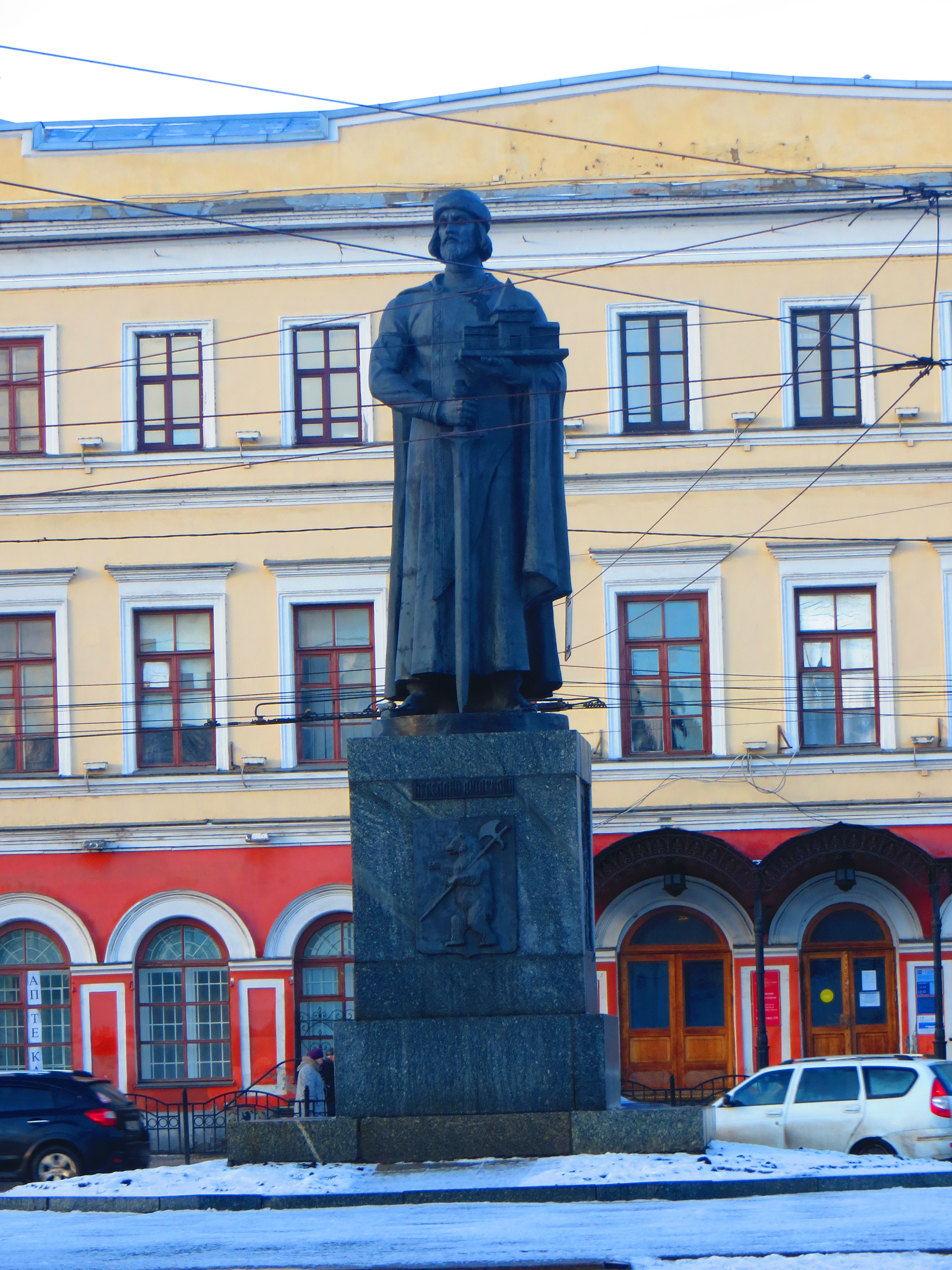
~Yaroslavl, capital of the Golden Ring of Russia and the oldest of the Volga towns, was founded in 1010 by Yaroslav the Wise, a prince of Kievan Rus.  Legend has it that Yaroslav went North and found a friendly spot by the Volga on which he would built a city.  A bear came out of the woods and charged at him. Yaroslav killed the bear with an ax. Almost a decade later, he became the Grand Duke of Kiev. He ruled wisely and well, despite his one known act of cruelty to bears.  He built the famous Cathedral of St. Sophia (which houses his tomb and the incredible fresco portraits of his family) and the Golden Gate of Kiev (cue Musorgsky’s “Pictures at an Exhibition”), and established the first Russian law code, Russian Justice.  Still, the town on the  Volga is his greatest achievement.  Memory eternal!

Yaroslavl on top, bear on bottom. But notice who is holding the ax…

In Yaroslavl, time did not quite stand still, in terms of keeping up with internet and other modern conveniences, such as resplendently stocked grocery store shelves.  However, the general character and look of the town did not change.  One very comforting feature is the profound lack of attention to the destruction of the relics of the past—whether the long past, or *our* past.  Just as the name of the town never changed during the Communist era, but continued to evoke the long ago Grand Duke of Kiev who famously conquered a bear with his ax, so did the Lenin and October Prospects remain thusly named in the Yaroslavl of the Russian Federation.  And just as the 17th century churches were not detonated during the three quarters of the 20th century that comprised the entire history of the now defunct country of my birth, but merely consigned to store potatoes, so do the imposing monuments of that country remain as the scattered guideposts of the city today.  There are two Lenins; there always were the two Lenins.  One is standing on the Red Square (many Russian towns have a Red Square) and with his upraised arm shows the way to our bright future.  Meet you *by the arm*. 

By the arm

The other one is sitting and writing in his notebook upon a crossed knee, facing his namesake Prospect, with his back to Mother Volga, with the Soviet Street crossing in front of him.  I remember laying flowers at the base of this sculpture, as it was conveniently located near my school.  Kids were sworn into the Young Pioneers next to this Lenin every year on his birthday on April 22.  Meet you *by the leg*. 

By the leg

And then there is Karl Marx, my favorite monument ever.  I am emotionally attached to it because I remember when it was unveiled.  The year was 1972, if memory serves, and we were going to spend the summer “za Volgoi”, literally “beyond the Volga”, or simply, on the other bank of the Volga.  On the other bank is the countryside, and when I was really small, my grandmother rented a room in a hut in a village called Yakovlevskoye (Jacob’s).  Actually, we had two landladies, one after another, but this is so long ago that I barely remember the first one, Olga something or other. To be fair, I was 2 or 3 years old.  I remember only a very high bed with lace pillowcases, and trying to drown Vanechka, a doll to which I have taken a dislike, in my potty.  My grandmother seemed to have persisted that the doll’s demise was meant to be an accident, but I, in turn, persisted in trying to destroy it.  I do not recall who finally won, but, experience would suggest—not I.   

The second landlady was Anna Loginovna, and I can still see her low ceilinged house with the traditional wood burning stove, and our room with pictures of ladies from the fashion magazines tacked to the walls.  Anna Loginovna’s daughter died tragically during one of the summers we were living with her, when a drunk truck driver plowed through a window of a store in which she was shopping. I remember seeing photos of her in a coffin, stitches on her face, and her orphaned children, a girl and a boy older than me, maybe a teenager and a preteen, sitting forlornly at their grandma’s rough wooden table.  I do not recall, if I ever knew, if Anna Loginovna had other children, or what happened to the two kids, who ultimately took responsibility for them.  But I remember sitting at that table, in that house, almost half a century ago.  But I digress…

We were traveling to beyond the Volga in a bus, the #50.  I was looking out the window, and saw a dreadful and fearsome sight of a block of gray marble with a burlap sack at the top at the intersection of Lenin and October Prospects.  I did not know it then, and had no basis for comparison, but if I extract this memory now, I would compare it to a prisoner about to be beheaded.  The sight so alarmed me that I never forgot it.  Someone (logically, the responsibility would have fallen to my grandmother) explained to me that it is a new monument which will be shortly unveiled.  The ceremony happened during our summer sojourn on the other bank of the Volga.  I was immensely relieved to see that the bag was off his head and it was now an imposing gray torso with a familiar bearded head on what became (or maybe already was) Karl Marx Square.  The clemency shown to the prisoner made me feel proprietary and affectionate toward him.  Meet you *by the beard*.

This image has an empty alt attribute; its file name is img_5430.jpg
By the beard