
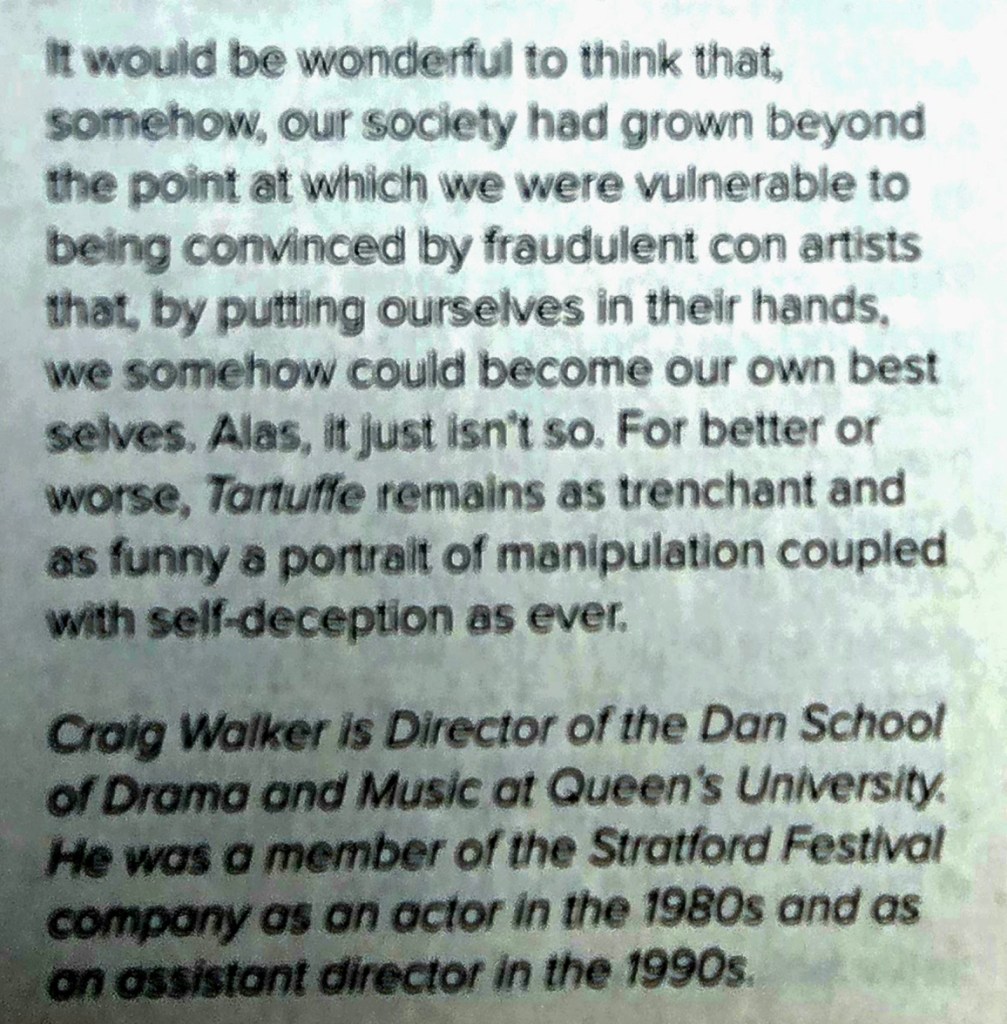
To mention, let alone stage, “Tartuffe” (or “The Impostor”, or “The Hypocrite”) in these turbulent times is almost too obvious. There is nothing I can say about this brilliant enduring satire that scholars of history and literature have not already said with significantly greater insight. I will just leave this quote here from the program from the best production of this play that I saw in Stratford in the summer of 2017 (and we thought times were turbulent THEN…):
“Tartuffe” was the first adult play I ever saw live. It was also the only adult play I saw as a child in the Soviet Union, in our externally beautiful, internally uninspired, historic Volkov Theater [https://oldladywriting.com/2020/07/26/all-my-world-is-a-stage/]. Credit goes only and eternally to Molière (and to the translator, whoever he was[1]) that this experience did not sour me on either live theater or French literature. That my enduring love of both has shaped my life is something that could not have been anticipated from that first chaotic encounter.

“Tartuffe” came to town when I was maybe 11, and my mother decided that this will make a fine mother/daughter afternoon of culture. We had fewer such opportunities than one would expect, for reasons that are many, varied, and complicated, ranging from familial to societal. Everything that pertained to cultural development in my childhood, every museum visit, every book about art, came from my mother. I cannot bear to think what my early childhood would have been had we spent less time together, but I used to often wonder what it would have been like if we had spent more. And this is most certainly a story for another time.
In order to prepare for this momentous event, she decided that we will read the play aloud together. It was a great idea. I still remember the first lines spoken by Mme Pernelle to her maid Flipote and Elmire’s response, that opening scene that sets the stage long before the titular character makes his entrance . To me, they are like the iconic opening bars of a musical. We took turns reading it aloud, sitting on the stools in my mother’s kitchen. It was pure joy: the relatable characters with fun names, the dialogue alternately wacky and clever, the ultimate victory of sane minds and loving hearts over liars and cheats. After “Tartuffe”, I read the rest of the plays in the Molière “greatest hits” collection, and liked them all, but none had a lead character as deplorable and deserving of retribution as this one[2]. It aged extremely well, from the day it was written to the day I read it a little over three centuries later to our tense present. My oh my, plus ça change…

And then came the actual day. I do not remember the time of year (but choose to set it on a beautiful springtime day) or what I wore (a good sign; I hold enough grudges from my childhood for not being able to choose what to wear on a special occasion). I remember arriving and heading straight to the theater buffet for a glass of sparkling lemonade and a “basket” pastry. (For how much I keep mentioning this pastry, I should just make it already—there are recipes online. Of course, I fear it will not be as amazing as I remember it from childhood. Nothing ever is.) My mother cannot be credited with coining the phrase “eat dessert first”, but can definitely be trusted to always do it. It was a matinee, the buffet was not crowded, and we enjoyed our pre-show treats before proceeding without undue hurry to our seats. At which point we discovered that we arrived an hour late and missed the entire first act, Mme Pernelle’s opening speech that I memorized being the first, but by far not the only, casualty.


To be honest, I do not recall feeling particular distress at that moment. I was happy to have enjoyed a pastry, and I did not expect much from the spectacle, for I have been to the Volkov before on school field trips. Its reputation at the time was consistent with everything else in our stagnant provincial town. We sat way in the back of the orchestra, under the balcony, a terrible spot in any theater. Either the acoustics or the actors themselves were lacking, but we had trouble making out what was going on; the words were completely unintelligible (and this was back in the days when my young hearing was very keen, so if I could have heard anything, I would have). And thus the second act passed in a haze of confusion.
After the second intermission (first for us), my mother, determined to see and/or hear the rest of the play, searched for better seats. Fortified with more treats from the buffet, I was game. We spotted an empty opera box and moved in, feeling pretty pleased with ourselves. We actually started to enjoy the final act when the door behind us opened and two guys in their 20s rolled in, looking and smelling like they partook of something stronger than sparkling lemonade at the buffet. Checking their tickets with some incredulity, they asked if these were in fact their seats. My mother barked that the seats were ours, and they meekly retreated, presumably back to the buffet. We felt triumphant. It might not seem like much, but it was a perfect coda to a memorable and fun afternoon to which the play was merely an atmospheric backdrop.
I do not expect that I will live to see “Tartuffe” again performed in the language in which I first read and loved it, but I would like to someday experience it in the language in which it was written, the original words I studied in college, in the House That Molière Built, where it is allegedly the most produced play (where so far I only keep running into “Cyrano de Bergerac”).


P.S. About translations: I am of the opinion that French and English are not entirely compatible when it comes to literature. Established translations, to my ear, do not convey the lightness of the original—yet some modern translations are too colloquial to retain that time and place that is unmistakably Molière. I have seen some adaptions of his plays that were competent, yet unrecognizable, although for “Tartuffe”, I prefer the crisp, sparkling translation by Ranjit Bolt to Richard Wilbur’s staid and stolid one. This was the translation used in the 2017 production mentioned above.
[1] In this particular case, it was someone by the name of M. Donskoy. I give credit where credit is due.
[2] What were the other plays in this collection, you ask? About what you would expect: “Don Juan”, “L’avare”, “Le Bourgeois gentilhomme”, “Les Fourberies de Scapin”, and “Le Malade imaginaire”. I saw a televised Moscow theater production of “Le Bourgeois gentilhomme” as a child, and never forgot the hilarious part where M. Jourdain discovers that he has been speaking in prose his entire life. Coincidentally, this play remains one of the few on my theater bucket list—I have not seen it live to this day.




 (Judging by how hard it was to locate a picture of it, I would guess no…)
 Old Lady Writing