…and Bratislava

I always assumed that if I made it to Vienna, I would have to add a day for Bratislava.  Fun fact:  Vienna and Bratislava are two closest European capitals in terms of distance, so I understand that it is a common side trip, but that was never my reasoning.  I generally do not like to “gallop through Europe”, as the saying goes.  I learned to not overplan from experience (although my consequential plunge into underplanning has resulted in some unintended and occasionally hilarious jams—but that is another story for another time).  I like to take in the sights and go at my own pace, and I dislike leaving a place without exploring it fully.  So short story long, if I am going somewhere, I am not also going somewhere else.  However, what led me to Bratislava was not its proximity to Vienna, but that Trip That Never Happened 42 years ago.

To be fair, Bratislava was never going to be more than a train connection on our original journey.  We always knew that we were not going to see the town.  It was an almost unimaginably different world back then. Europe was still divided into East and West, and getting from East to West was complicated even with a passport.  A moot point, in any case, because we had no passports.  We no longer had passports because we no longer had citizenship of any country, none at all.  We were put on a train heading out of the USSR, and the first stop was Bratislava.  Czechoslovakia was still united, and Bratislava was not a national capital of anything. 

NOT what I remembered

We disembarked in Bratislava and waited for the train to take us into the *real* West, to Vienna.  On that cold and lonely platform in December of 1980, I do not remember any other passengers.  It was just the four of us, my mom and grandparents and I, and we stood there with our two suitcases per person for what seemed like hours.  This might be an invented memory, but I remember going into the train station itself and seeing chewing gum for sale (if you ever heard how prized it was in the Soviet Union—it’s all true!).  Could we have just walked into the city?  Were there any guards who would have stopped us?  It is impossible to know now, because the only tangible goal was to get on that train heading to Vienna.  These days, the hour-long trip between the two cities is almost akin to a suburban commuter ride.  Back then, one travelled from the Eastern Block to the Capitalist West in a fancy sleeper compartment, and I remember it taking hours—probably because of border control.  My mother remembers red velvet upholstery; I do not.
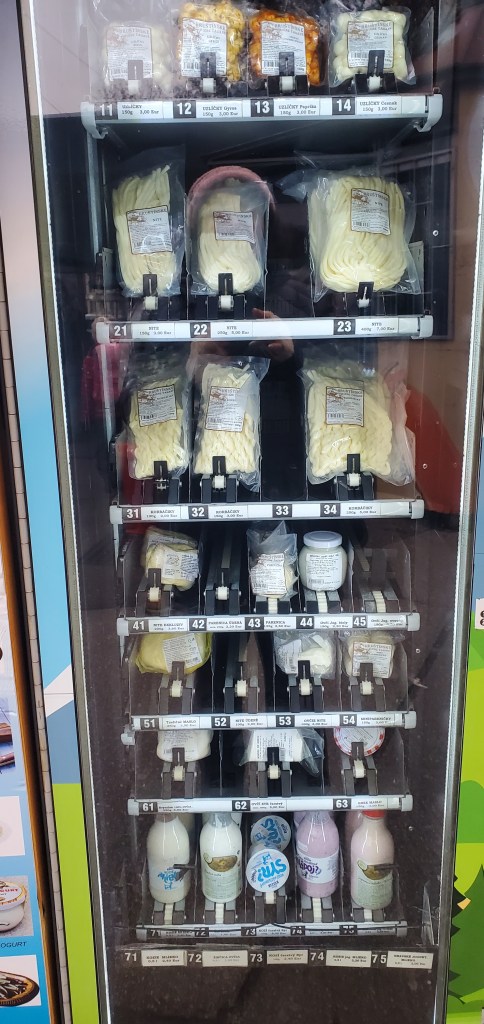
But there IS a vending machine selling dairy products

And so Bratislava remained something I never even pictured, just a footnote to a trip to Vienna.  The only part of a this visit I could envision was arriving at that train station and walking past that kiosk selling gum and sundries out into an unimaginable town.  Medieval? Baroque? Modern? The important part was the station, the kiosk, the sunlit town square.  None of them turned out to be real in 2022.

My persistence in going to Bratislava in the face of my mother’s mild opposition; my brisk realization that in this century, trains to and from Vienna connect to Bratislava via a suburban station and not the main one, preventing the recreation of that long ago voyage; brief panic about having to also get on a bus to get to city center—none of these are worth recounting.  Well, maybe the briefest of mentions—repeatedly seeing the words “Bratislava Petrzalka” instead of “Bratislava Central” or “Bratislava Hlavna” led this sophisticated traveler and polyglot to feverishly search the interwebs for a route into the city (get on the bus in this area, alarmingly advised the web, never take the taxi).  Otherwise, we would be walking out of the train station into a somewhat grim peripheral disappointment and then right back to Vienna, as per tradition. 

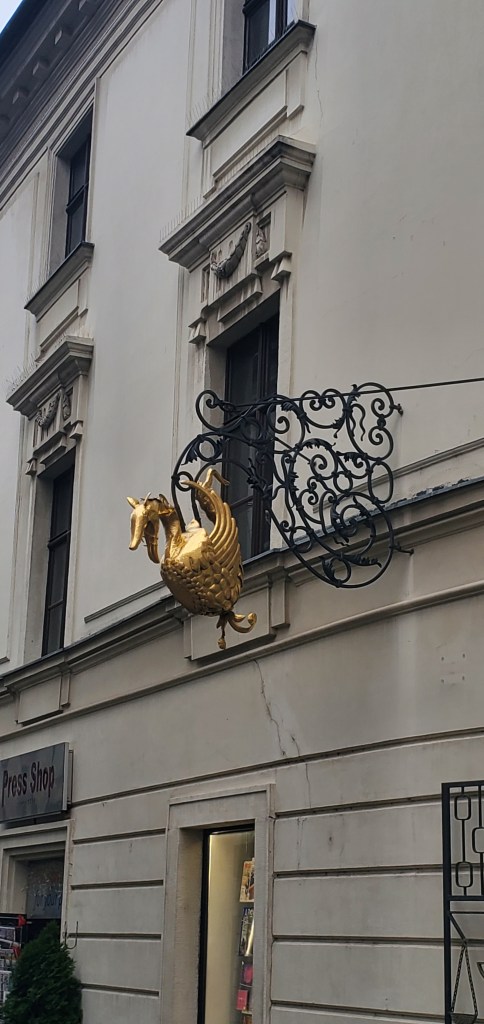
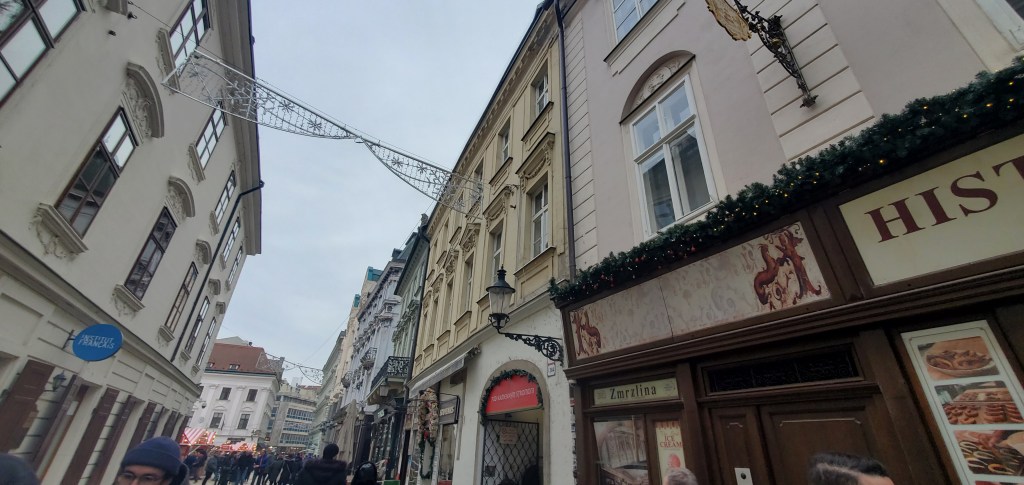
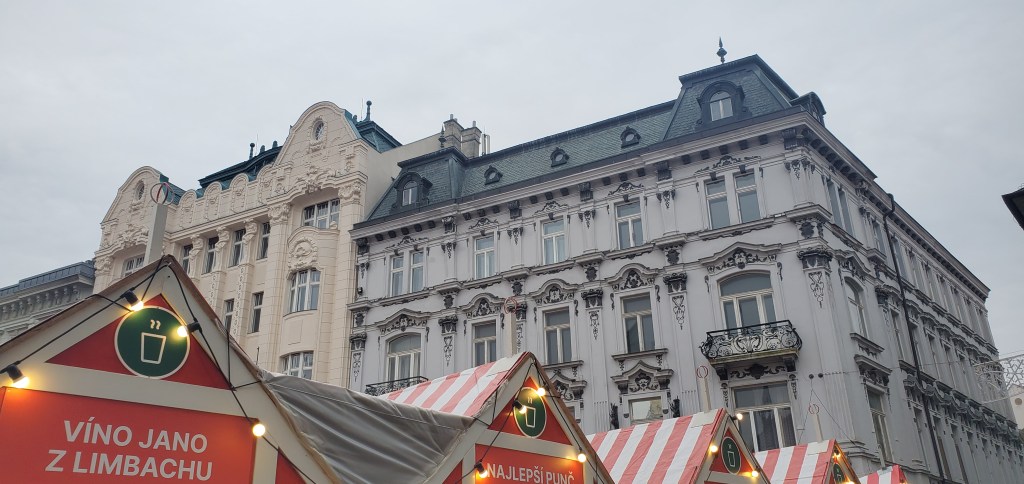
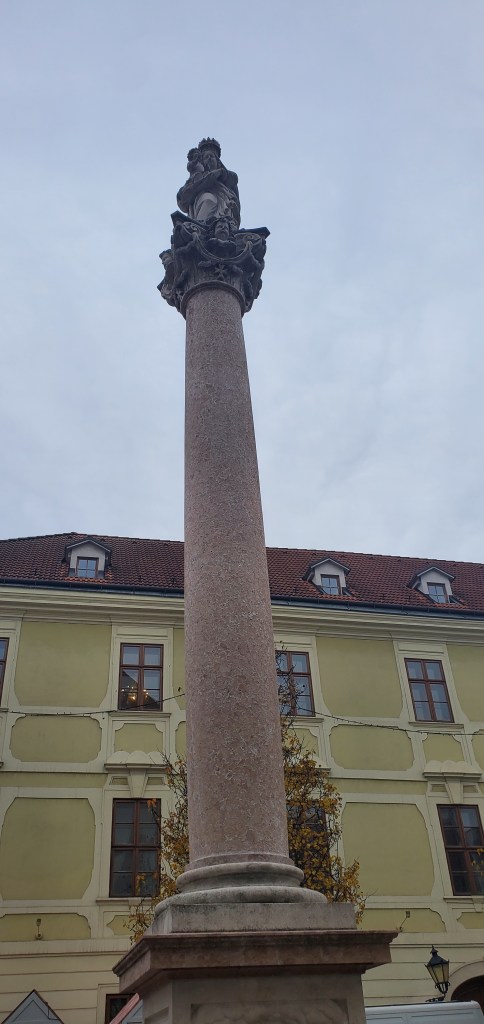
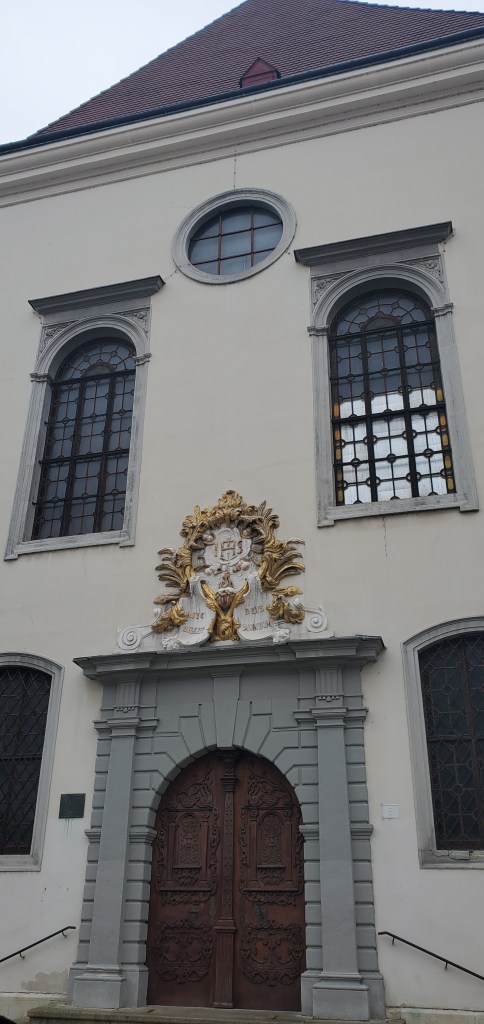
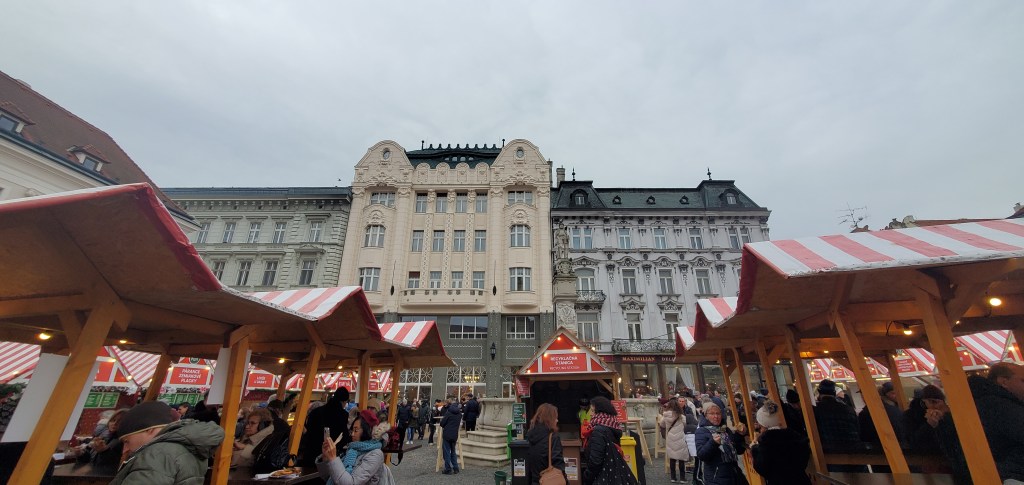
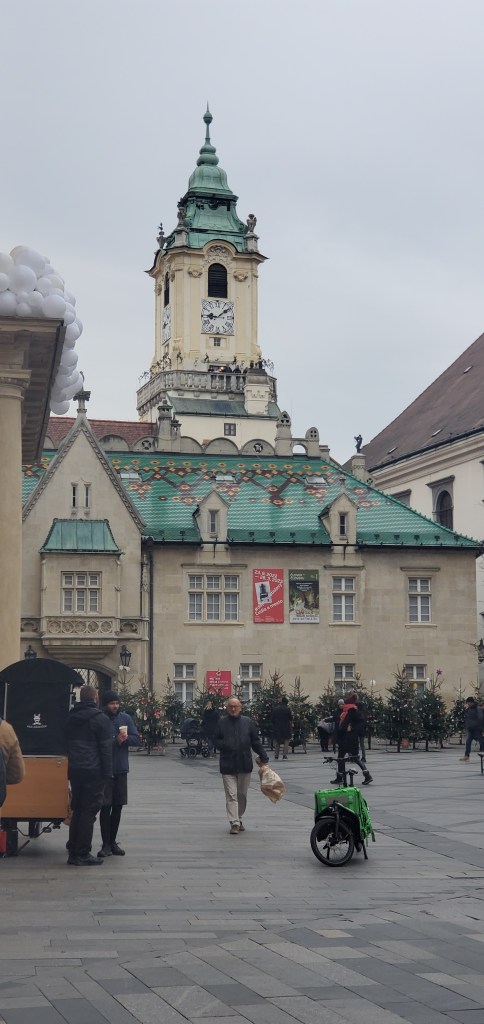
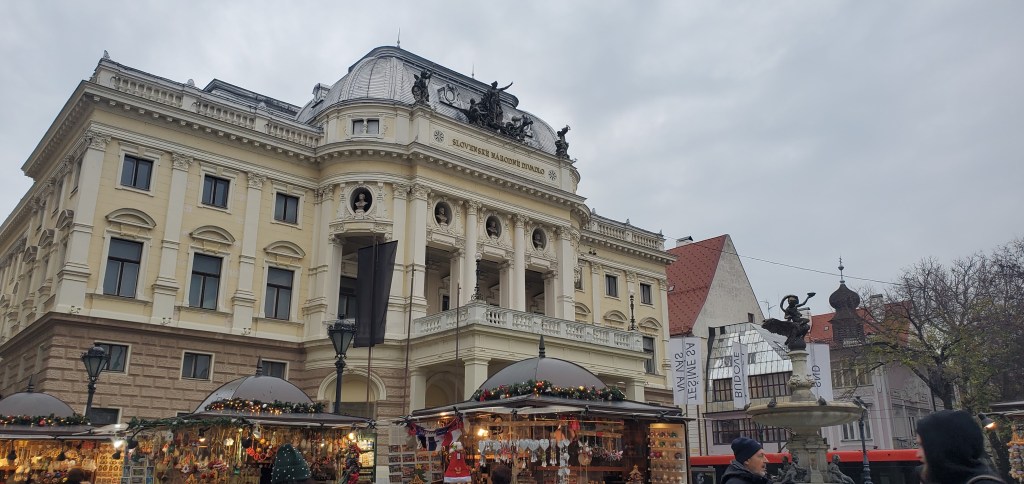
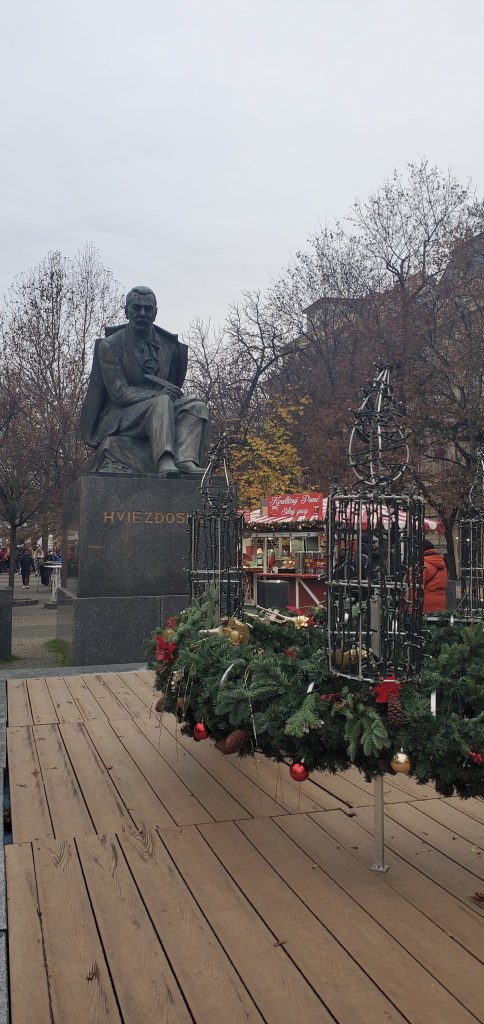
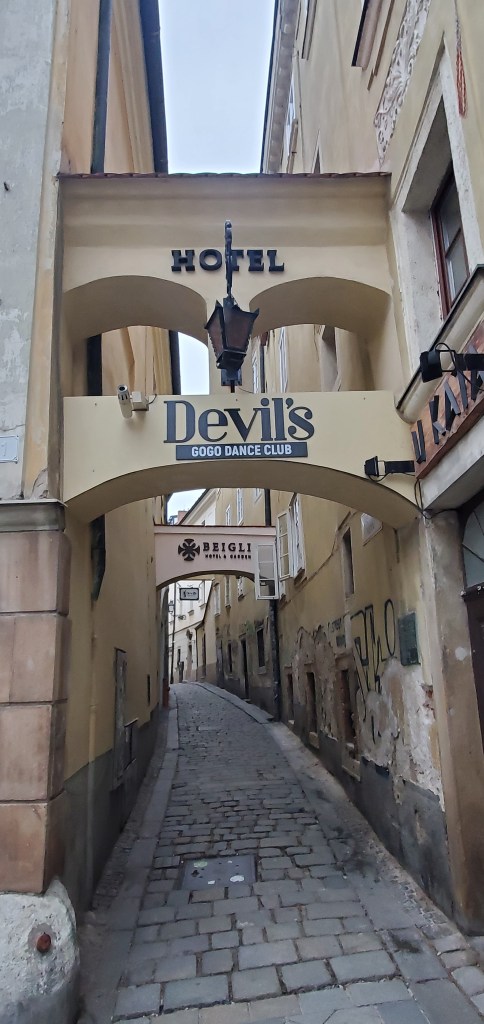
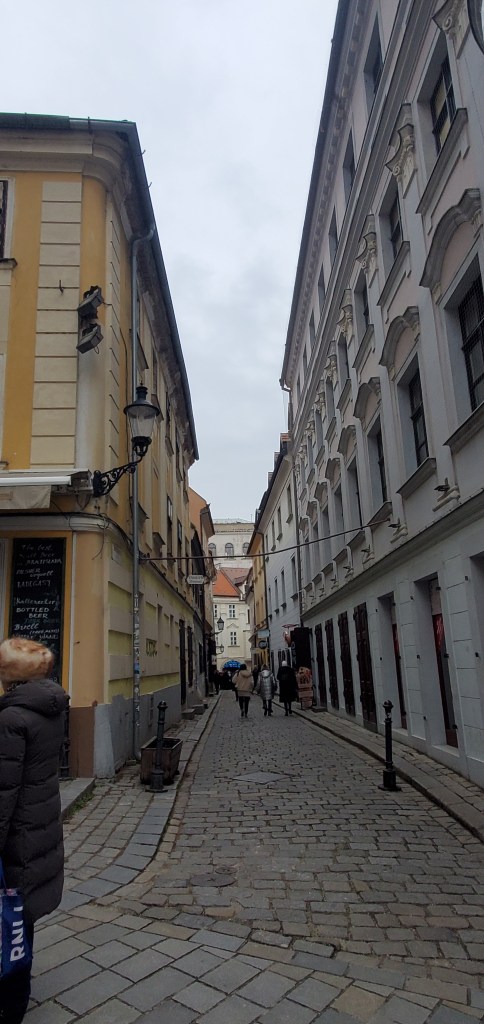
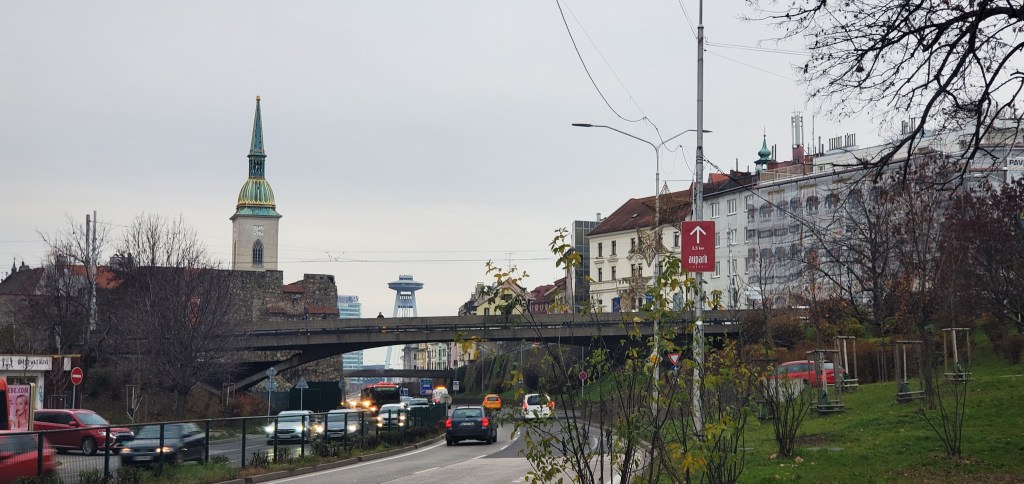
Ultimately, I feel like I gave Bratislava a short shrift.  We walked around a bit, enjoyed the most lavish meat feast I could ever imagine (allegedly for two people, but there were six meat servings), encountered another Christmas market (again, mostly meat), saw some charming medieval sites, and hightailed it back to Vienna before dark.  But I think Bratislava deserves more than just a couple of hours.  It seemed like a lovely town I would like to get to know better.  I would have liked to visit its castle high above the city, its churches and museums, taste the local wine at a very cool cellar by which I walked, and learn more about the effect the decoupling from Czechia had on Slovakia.  I could have researched and planned prior to going, but I think the existence of this town was simply too fantastic to contemplate.  Now that I know that it is real, we need to be properly introduced.

Just Boil Water

Shortly after our arrival in New York, the refugee resettlement organization—it must have been NYANA, which stands for New York Association for New Americans[1]—held various acclimatization classes for adults.  Sadly, there was nothing for my age group, or for children in general, as the wisdom of the age dictated that children are infinitely adaptable in terms of language, culture, friendships, and any other upheaval to which they might be subjected.  Yet here I am, after forty years of no trauma counseling—but I digress…

My grandmother was enthralled with the woman who led the section which my grandparents attended.  Predictably, my grandfather retained nothing from it, and continued to forge his own path, as was his way in life.  He remained unapologetically unamericanized for the duration of his stay in this country and on this Earth, which was part of his charm and character.  My grandmother, also predictably, took the word of this “real American” woman, whose name is lost to time and memory, as gospel.  This group leader, let’s call her Ms. Porter for convenience’s sake (and because I really think it might have been her name), gave the newly arrived refugees a list of all the best brands of common use products, such as toothpaste, peanut butter (we had no idea what peanut butter was), cereal (shocked that people here mix this snack with milk and pretend it’s a meal), coffee, etc. 

Ms. Porter’s coffee recommendation was separated by caffeine—Folgers with, Brim without[2].  Of course, my grandparents only ever drank instant coffee.  We are not from a coffee-drinking culture, so the instant variety was always good enough and actually quite superior to the viscous chicory drink of my childhood.   My grandmother treated herself and a nine year old me to real coffee at a café a couple of times during our first summer in the Baltics.  After each occasion, we could not sleep, and the white nights did not help, so we concluded that the fancy Western indulgence is not for the likes of us.  For many years thereafter, especially for the duration of my college years, I relied on caffeine to get me through the nights of studying and last-minute paper-writing.  (And even in high school, in pre-VCR days, when a specific episode of “Rumpole of the Bailey” or the sole showing of “Duck Soup” was in the middle of the night—what else could one do but drink some instant coffee and wait?) Then I eventually developed immunity to caffeine, and learned to enjoy coffee for its taste rather than its stimulating powers.  My life has improved at least in this one subtle way.

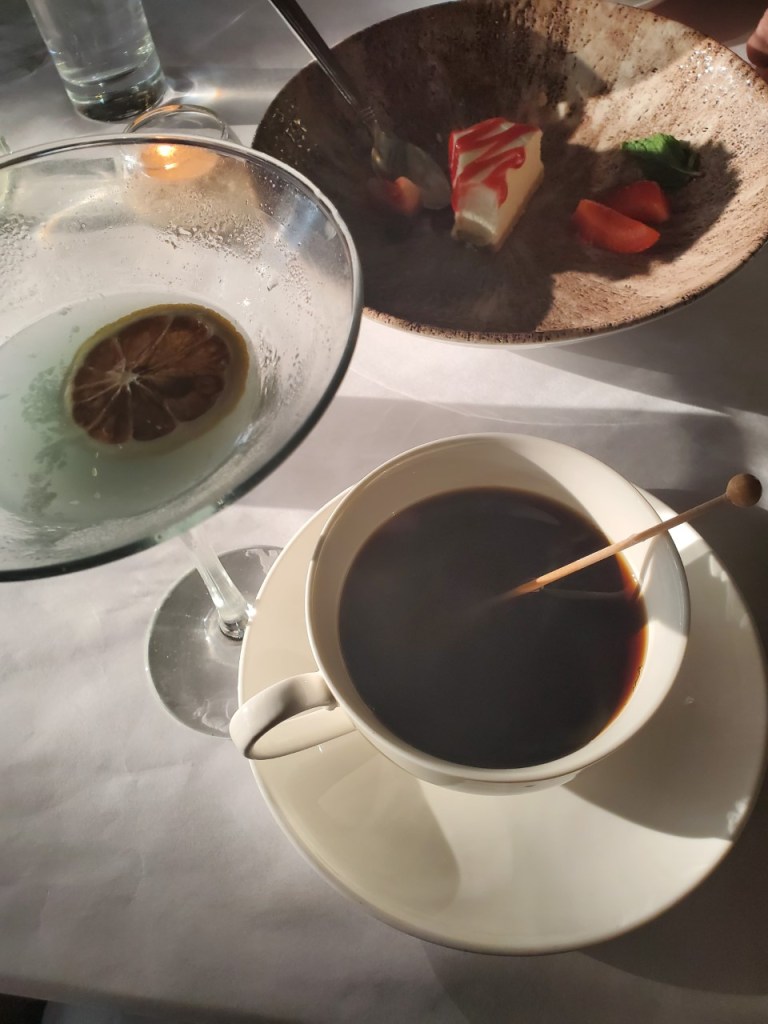
I had the presence of mind to snap of photo before the remnants of last night’s meal disappeared completely.

If Ms. Porter assumed that none of us would own a coffee maker, at least initially, she was not wrong.  My grandmother does not have one to this day, for why indulge such decadent bourgeois habits when one can simply boil water and mix in some powder?  In fact, at some point she when through a phase of only drinking hot water.  Why, you ask?  Well, it is actually quite simple.  Say you come to someone’s house, they ask if you want something to drink, and the beverage of your choice is not available.  The visit instantly becomes awkward and disappointing.  But, everyone has water, and everyone has the means to boil it.  Voilá—the day is saved, equanimity restored[3].

However, until she came up with this vaguely practical yet somehow grim practice, grandmother maintained fierce loyalty to that list and to Ms. Porter.  For years, I have encountered her passive aggression in my bathroom (“What, you do not use Crest?  It is necessary now to use some other brand?”), but that is nothing to the disdain heaped upon my kitchen.  I actually own a coffee maker, albeit at the insistence of my American-born spouse.  Whenever my grandparents visited, grandmother would arrive with a baggie containing a premeasured amount of Folger’s instant coffee in it.  Spouse would make a pot of coffee.  Grandparents would be invited to partake.  Grandpa would be hopeful that he might.  His hopes would be instantly dashed (if you pardon the pun).  Grandma would coldly inquire if the coffee was (1) Folger’s and (2) instant.  Both requirements had to be met.   We would perpetually fail at least one of them. 

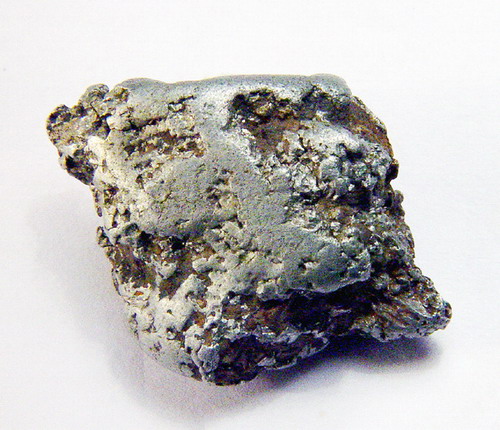
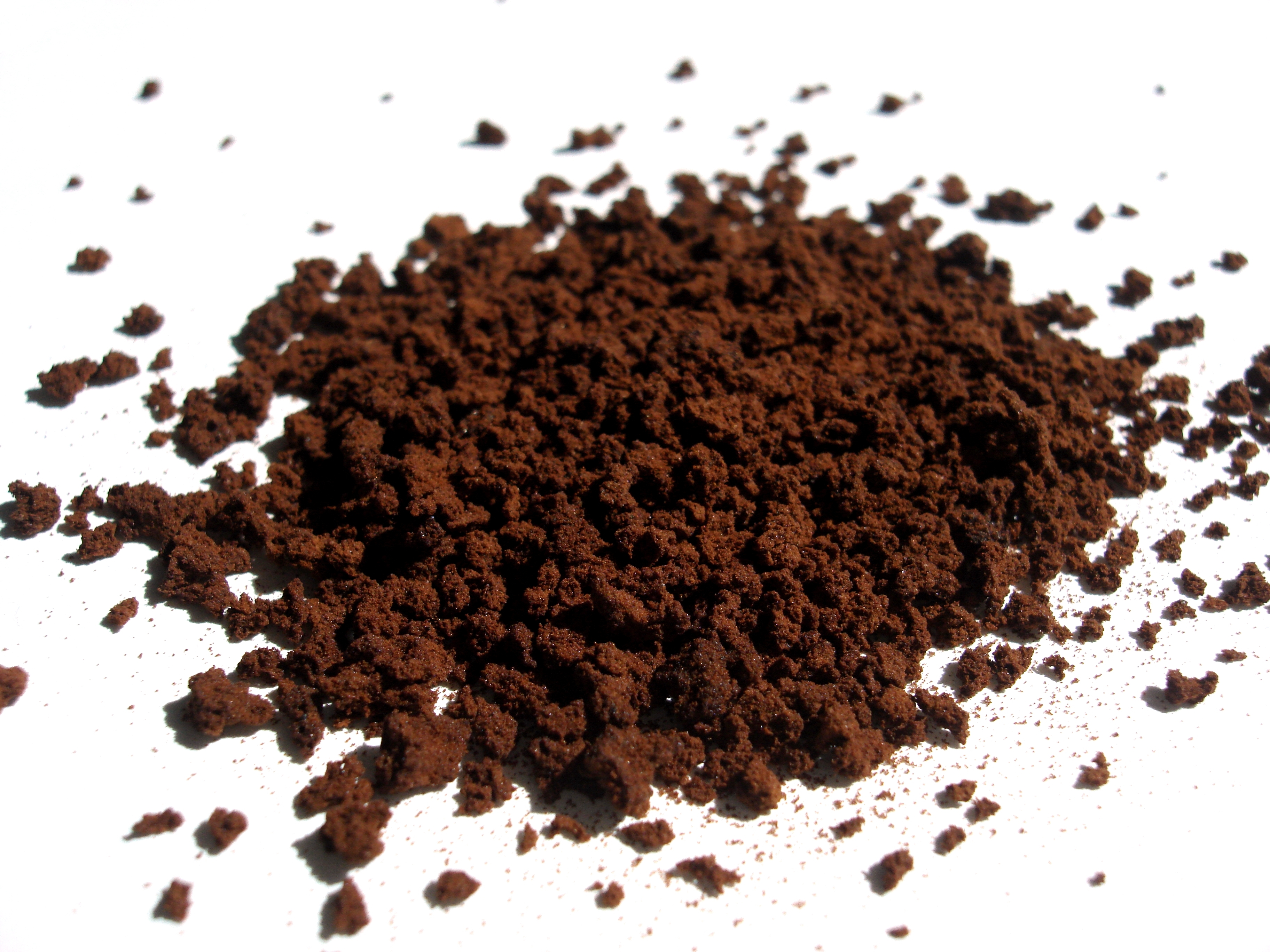
Ms. Porter’s endorsements, however handy they might have been in our first few months of American life, were probably never meant to last a lifetime.  And yet, here we are, with my grandmother still mixing those instantly soluble crystals into the water boiled on the stove top in a teapot with a hunk of silver for better purification, over forty years later.  Plus ça change…


[1] NYANA was founded in 1949 as a local arm of the Jewish United Service for New Americans to assist in the resettlement of refugees from the Holocaust coming to the United States in the aftermath of World War II…After Jews were allowed to leave the USSR in the mid-1970s, it expanded to assist large numbers of Jewish refugees from the former USSR, approximately 250,000 by 2004. 

NYANA sought from its inception to provide one-stop services to refugees, including assistance finding housing, health, mental health and family services, an English as a Second Language school, vocational training, and licensing courses in addition to legal help with immigration and adjustment. It was closed in 2008.  Source: Wikipedia

[2] Does Brim even still exist? (Judging by how hard it was to locate a picture of it, I would guess no…)

[3]Imagine, if you will, an invited guest at your house, for whose arrival you presumably prepared by stocking up on food and drink, responding thus to an offer of a beverage:  “What will you have, Rose?  Coffee, tea, hot chocolate, pop, juice, milk, beer, wine red or white, vodka, gin, any drink I can mix for you?  Just boiled water?  You are being serious right now?  Oh, you don’t want me to go to any trouble?  You don’t want to put me out? OK, boiled water for you, an Irish Coffee for me.  And I am making it a double”.