
“It is so fatally easy to make young children believe that they are horrible.”
― T.H. White, The Once and Future King
My grandmother departed this life about a month short of her 102nd birthday. Whenever anyone says that I have “good genes” and can expect a similarly lengthy tenure this side of paradise, I immediately rush to correct them. First, she was an outlier; we do not have longevity in my family, and my father did not make it to 75. Second, her long, long, LONG life was nowhere near a blessing that people imagine it to be, not to herself and not to her immediate family.
Grandmother lived life with an unshakeable belief that her way was always right. She tolerated no challenges to her authority, even in little things[1]. I would maybe concede that there might be something to this, being myself a person prone to doubts, regrets, and second-guessing, had any of it given her any joy. She often repeated her life’s philosophy: you have to hate yourself, and that will inspire you to be a better person. But even as a child, I suspected that deriving inspiration from self-hatred is not going to be my path in life. Years later, I came to the conclusion that her inflexibility was simply the result of lack of introspection, fear of the unknown and the unknowable, and an absence of curiosity.
She had a hard life, but that is neither an excuse nor an explanation. A lot of people have had hard lives. She lost her father as a teenager—but as far as losing fathers, I can certainly do her better. She lived through the wars—yes, plural, because she would always mention the Russo-Finnish War of 1939 in the same breath as The Great Patriotic War. I once read a book on history’s dumbest wars[2], and was delighted to recognize the Winter War as “Grandma’s War”. But again, the number of people who were affected by wars in their lifetime does not necessarily equal the number of people who permanently lose their joie de vivre. While I suspect that the privations and fear of the dark decade of the 1930s in the Soviet Union were not helped by one of history’s most stupid wars, our family did not lose anyone to it, or even to the massive devastation that followed, and did not live in a territory that was occupied by anyone since the Tatars-Mongols came to town in the 13th century. And even my grandmother was not old enough to remember that. All of my friends had grandparents (and some even parents) who lived through The War, yet most of them were not forced to wage their private battle for independence against their own families.
A nephew drowned in the 1950s, which seemed to affect grandmother more than the young man’s own mother, my grandfather’s older sister. Grandmother drew the following conclusions from his accidental death: (1) water must be feared, and learning to swim can only lead to trouble (which made my growing up on a river and spending all the summers of my childhood at the seaside that much less pleasurable), (2) a tragedy is sure to befall your children as soon as you look away (despite the fact that the beloved nephew was an adult when he died—it truly was just an accident, a tragic accident that can happen to anyone who is living a life and doing things in the world), and (3) daring to enjoy life after bad things happen to loved ones makes you a bad person. The strongest condemnation that grandmother voiced about her sister in law who survived the death of a son was that “she must have loved herself too much”—too much for what? For going on living? Yes, that was indeed the implication, for loving oneself was the greatest character flaw she could imagine.
To be fair—though fairness has never entered into our relationship—the world has changed quite a bit from the time she was taking life lessons from her own mother in the 1920s to the time she was attempting to impart these instructions to me half a century later, and more drastically still to the present day. Looking back, I have trouble recalling any words of wisdom from her which I have stored away or applied to any situation in my life. There was always a lot about decorum, much of it so embarrassing that my hand does not rise to share it here. There was quite a bit about appearances, equally outdated and, not surprisingly, heavy on body shaming. But nowhere did she stand out quite like she did in teaching me basic homemaking skills: plucking chickens[3], scrubbing floors (on hands and knees—never make it easy by using a mop), darning socks, etc. Maybe the last one is not entirely useless—but that is mostly because I enjoy the needle and thread crafts. Still, her point was that no one will marry a girl who could not do these things. Despite my reasonable and consistent academic success, she labeled me quite early on as a potential failure in life due to my lack of enthusiasm for cleaning supplies over books, and for my unswerving commitment to learn how to enjoy life rather than endure it.
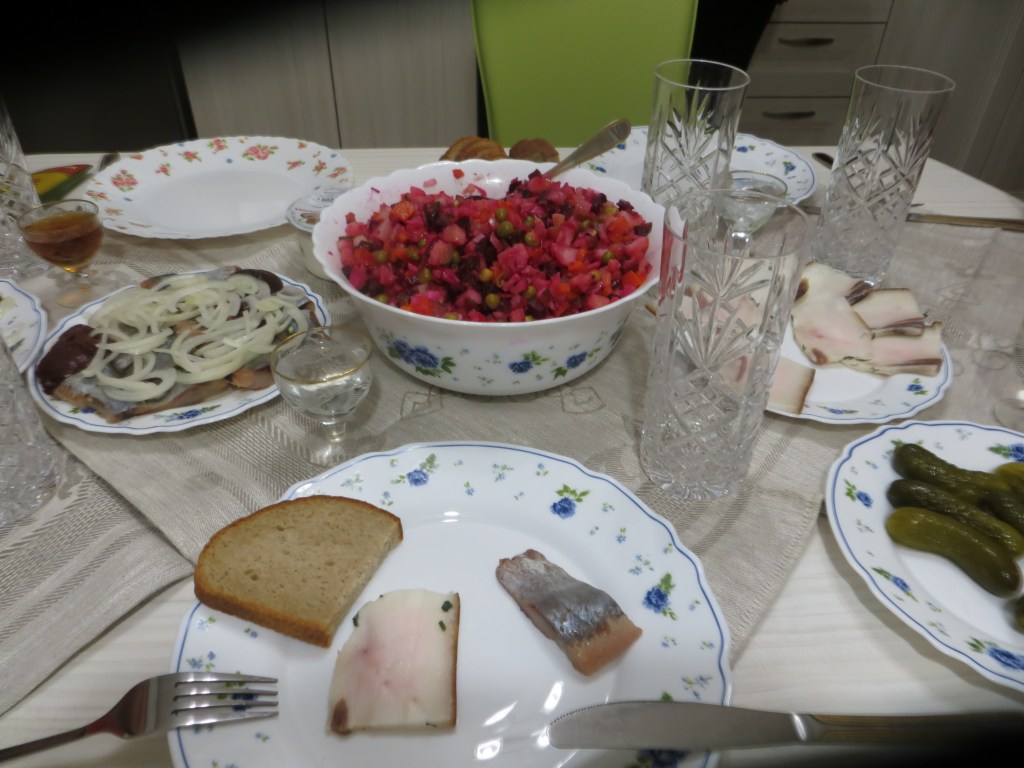
Food was the biggest and, in retrospect, the only language of love that she spoke. Talking about anything beyond the basic needs was simply not done. Are you hungry? If yes, have some bread with either salt or sugar. If not, go play outside. God, she was so tough when she was raising me, and in the era when it was no longer really necessary! She was always wearing an apron, always stirring a pot—no, literally, an apron was a part of her “uniform”. In her later years, when she would come to my house, she would bring an apron to wear around. Later still, she would bring a change of work clothes, an old dress that was no longer fit to be seen in public. My house was never clean enough for her.
She always made sure that I was well fed and clothed, and my physical needs were always met. She never said I looked nice without adding that something was off in my appearance. She never told me I did something well without mentioning that someone else did it better. She often lamented that I was not living the life that she felt I should be living in order to make her proud. I never tried hard enough, and I never measured up. I lived with her until I was almost 13, and it was possibly the greatest disappointment of her life that there came a day when she lost control of mine.
To many, she was a good friend, loyal, present, and generous. She never forgot a birthday and never refused a request for help. She kept in touch with several generations of acquaintances, neighbors, and distant relatives. Her tirelessness, which did not flag until her 90s, was remarkable, and I continue to hope that I inherited a sufficient fraction of it.
She outlived all her friends and most relatives, including some who were much younger. Only a handful of people remain who really knew her. There were some good times; I am deeply sad that there were not more.
[1] There was one thing—she did not monitor what I read, either among the books we had at home or the books I would pick up from the various libraries I frequented. Her loss of vigilance on this front was my saving grace, although she did think that I spent too much time reading and not enough outdoors.
[2] Stupid Wars: A Citizen’s Guide to Botched Putsches, Failed Coups, Inane Invasions, and Ridiculous Revolutions, by Ed Strosser and Michael Prince
[3] Did my aversion to poultry start in childhood? Over the past few decades, I worked my way from observing grandma burning feathers off chickens with a blowtorch to experiencing mild nausea at so much as a sight of a cooked chicken breast. It seems to be socially acceptable to be teased about this; I am happy to provide this cheap laugh.


























 Old Lady Writing