Featured

Poison, Fire, and Flood

One of the main villains of my raucous childhood was one Shturman.  This was, and is, his real last name.  I am not changing it here because (1) he is not likely to read this, (2) this unusual name[1] is too much a part of him, and (3) every word is true.

Shturman’s code name was “Douche”.  No, listen, in Russian, it just means “shower” (and in French as well, but we did not know it then).  And the reason he was “Shower” was because we called him “D.Sh.”, which stood for “Durak Shturman”, which means “Shturman the Fool”.  So it all fits together rather beautifully.  Since “fool” was the worst insult we knew, literally everyone’s code name started with “D”, but this was the only one that is not lost in translation[2].  At school, he was known as “Shturm Zimnego”, or “Storming of the Winter [Palace]” (the event that, according to what we were taught at school, started the Great October Socialist Revolution), but we did not feel that he deserved so much honor.
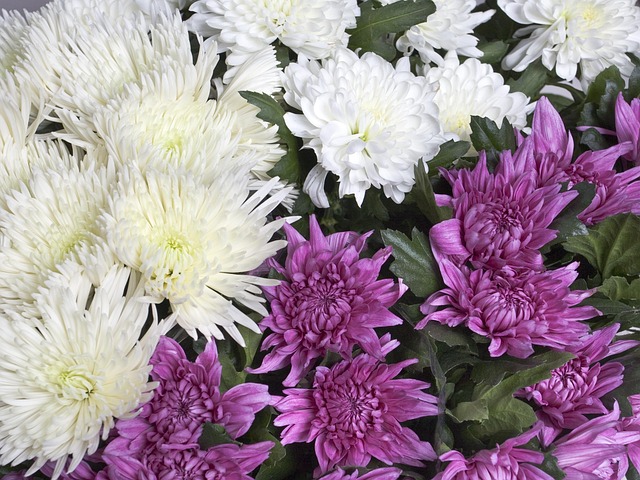
All positive comments regarding these flowers will be deleted

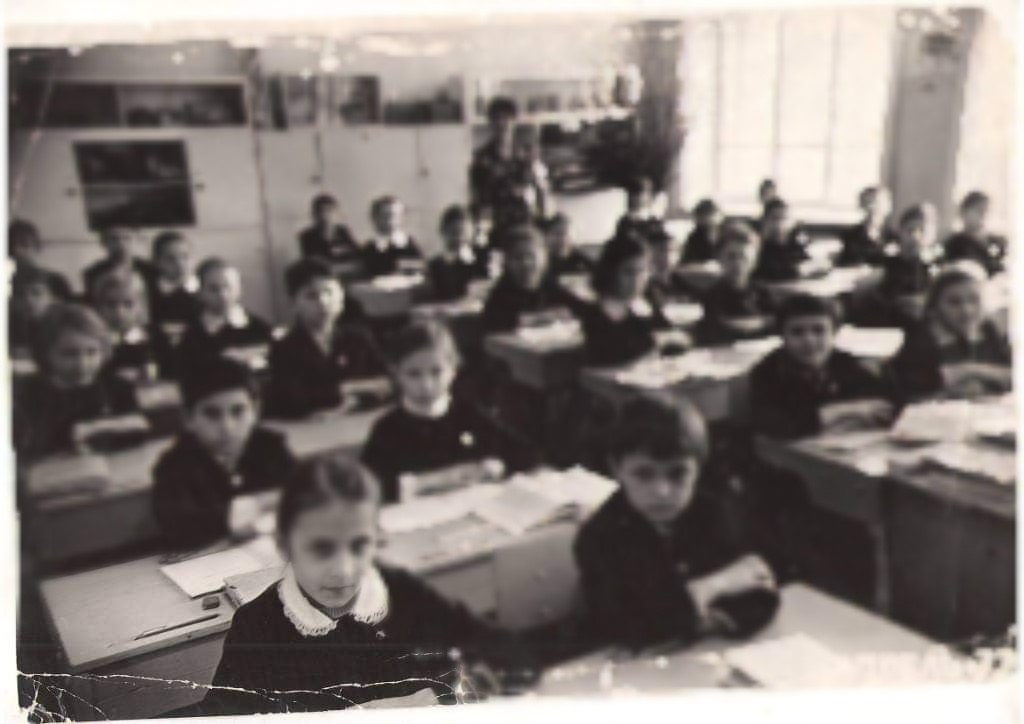
My BFF and I met him on the first day of school, September 1, 1975.  In fact, we all met each other for the first time that day.  It was not a good day for me, for it started out quite literally on the wrong foot.  All the girls were wearing pretty summer sandals (my friend’s were pink).  I, as was my lot in childhood, was wearing heavy, hideous black/brown booties.  I was perpetually overdressed in childhood by my overprotective grandmother; I always had a couple more layers on than anyone else.  My mother, who gets incredibly defensive about every single choice made for me not by me, would undoubtedly say that prettier shoes could not be found—and that would be a lie.  Everyone else wore common Soviet-style sandals readily available at any children’s clothing store in town.  My ugly orthopedic boots were imported.  And to top it all off, the trend of sending me off on the first day of school with a bouquet of chrysanthemums for the classroom teacher started that unfortunate day.  You guessed it—everyone else had lovely summer flowers.  I yearned for daisies, and cannot abide chrysanthemums to this day.  But I digress.
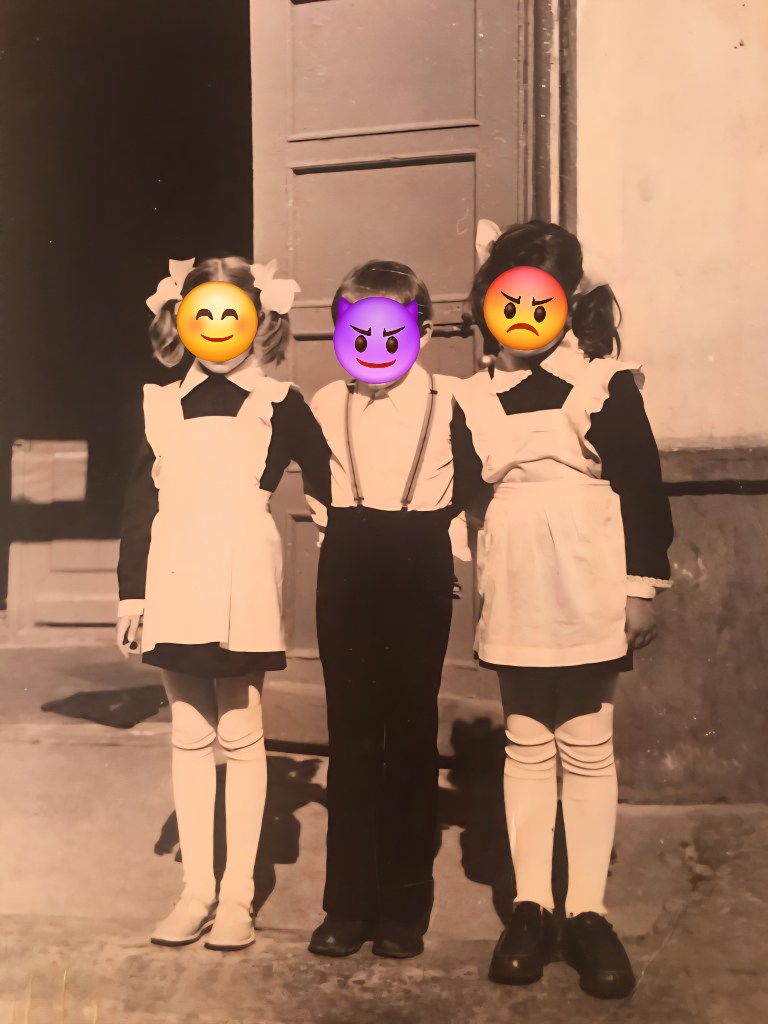
Mine and my BFF’s mothers and both of Shturman’s parents went to high school together.  Their paths diverged for a few short years after college and joined again on that day when it was discovered that they had children born in the same year (two in January, just a week apart, and one in November), who will be starting school not just at the same time, but at the same school and in the same class.  Of course, given that our parents were friends, we were thrown together a lot in those early years, for all the holidays, all the birthdays, summer trips to the countryside, etc.  Well, since I lived with my grandparents, I was not allowed to celebrate with my friends, so that was one very small benefit, having a bunch of 50+ year olds rather than Shturman over.  And since I was born in November, I did not have to share my birthday with him, only with the October Revolution, celebrated in November according to the “new”, Gregorian calendar.

To commemorate the Revolution, we got a few days off from school—basically, our fall break.  In that place and time, it was common to gather for all festivities.   One year, when I was maybe in second grade, we all met at my BFF’s apartment.  The adults, which consisted of Shturman’s parents and mine and my friend’s mothers (both divorced, but with or without boyfriends—memory fails) went for a walk.  Do not be shocked, it was a kinder, gentler time; neighbors looked out for each other and each others’ kids.  And it turned out that the real danger lurked within…

The adults departed for their nighttime stroll, and BFF and I hoped to have some fun:  sing along to Soviet pop music with pantyhose on our heads, make plasticine animals, read about astronauts and plan our own future space adventures—really, the possibilities were endless.   It was a Soviet studio apartment: one room, bathroom, and a kitchen at the end of the hallway.  We staked out the kitchen.  Shturman pestered us for a bit, at one point brandishing a bottle of wine[3] and boasting that he can drink it all.  We called his bluff with all the disdain we could muster; predictably, he did nothing but buzzed off to the room.  But our little gray cells were already activated.

As children, we were told that alcohol is poison. As we saw adults drink copious amounts thereof, the unspoken assumption was that it is poison specifically to children.  Which budding sociopath came up with the cunning plan of serving tea laced with alcohol to our arch enemy shall remain undisclosed.  I know that “Hey, Shturman, do you want some tea?” was not spoken by me.  He and I were never verbal with each other, letting our fists do the talking. 

My friend made him a cup of tea, which was actually mostly vodka.  Shturman, clearly feeling very pleased with himself and his imaginary superiority over us, took a sip, immediately choked and started coughing, eyes bulging.  You did not see this coming, right, because you thought Russians drink vodka from birth, and I am here to break down the stereotypes.  He dropped the cup, and there was that moment in which you know things can go either way—and this is how they went, with him screaming “I will kill you!” and us shrieking and running.  Studio apartment, where are you going to go?  Bathroom, of course—the only place with a lock.

Shturman started pounding on the door and screaming, “Come out or it will be worse for you!  I will break down this door!”  BFF was sort of turning on me: “So, alcohol is poison, huh?  He is alive and well, and even worse than he was!”  I was just hoping the door will hold, and besides, it was a modern apartment, with a “combined” bathroom, meaning toilet, sink, and tub were all in the same place.  We had all the conveniences, and could wait him out until our parents’ return.  Eventually our enemy calmed down and walked away, and we settled in the bathtub, lulled into a false sense of security.

Suddenly, a scratching sound alerted us to a new potential disaster.  Shturman procured matches and started lighting them and shoving them under the door.  He decided to smoke us out, that weasel!  But the joke was on him—we had access to plenty of water, and started pouring it on the matches, having emptied the toothbrush glass for this purpose. Neither side was going to surrender, but we assumed that the matches will run out before water.  As luck, good or bad depending on perception, would have it, adults came home before either, to a minor river in the hallway, with purses and shoes floating by.

We refused to leave the bathroom until the Shturman family departed.  I remember nothing of the aftermath of this event (not even the last of its kind), beyond never getting along with this Shturman until I left the country several years later.  I have not seen him since.  Wherever he is, I hope he is not holding a grudge.


[1] It literally means “navigator” in Russian.  Unusual and kind of cool, if one stops and thinks about it.

[2] For example, we referred to Shturman’s father as “D.P.”, i.e., “Durak Papasha”, meaning “Dad the Fool”.  We disliked him because his son looked just like him, and we never saw him as anything other than his son’s father.  Yet DP was the only father that was present in our group of friends.  Something to unpack here.

[3] Again I remind you, different time, different place, no burden of Puritan heritage. 
Featured

Tartuffe, Impostor, Hypocrite

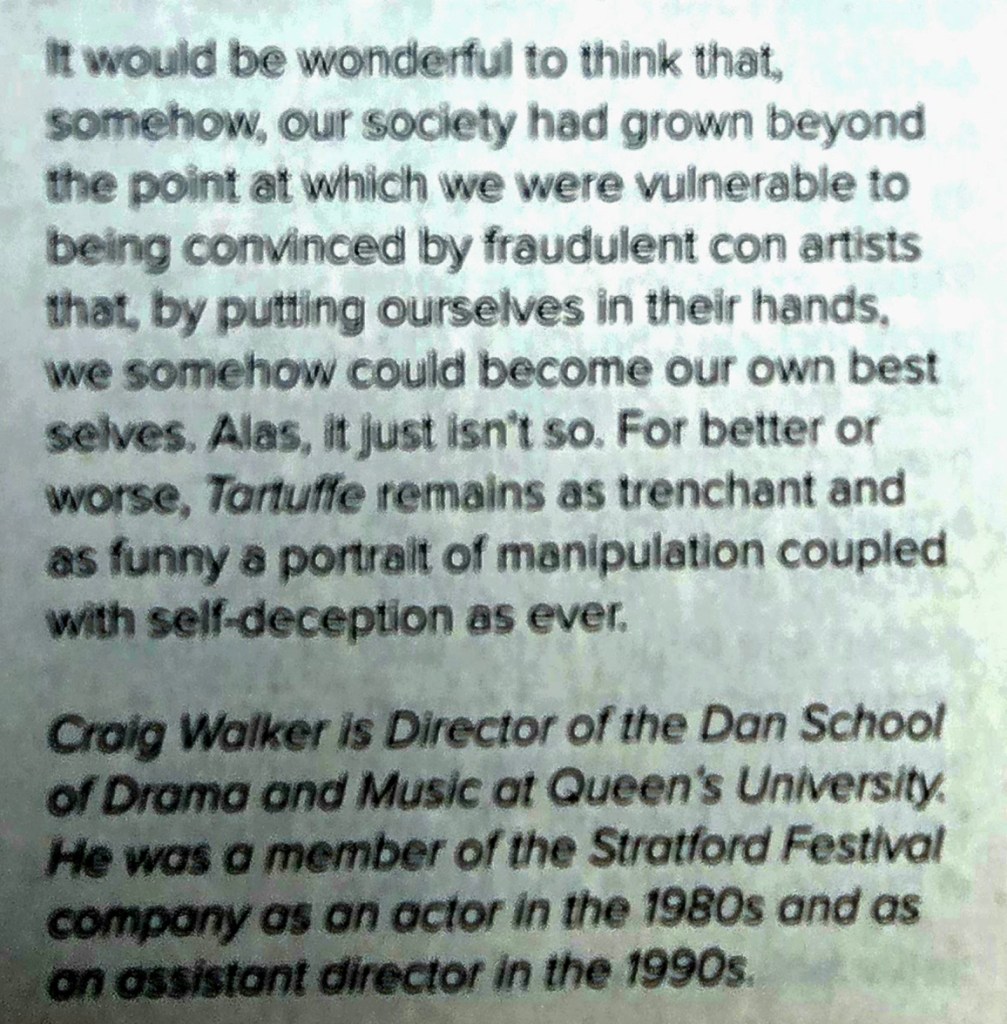
To mention, let alone stage, “Tartuffe” (or “The Impostor”, or “The Hypocrite”) in these turbulent times is almost too obvious.  There is nothing I can say about this brilliant enduring satire that scholars of history and literature have not already said with significantly greater insight.  I will just leave this quote here from the program from the best production of this play that I saw in Stratford in the summer of 2017 (and we thought times were turbulent THEN…):

“Tartuffe” was the first adult play I ever saw live.  It was also the only adult play I saw as a child in the Soviet Union, in our externally beautiful, internally uninspired, historic Volkov Theater [https://oldladywriting.com/2020/07/26/all-my-world-is-a-stage/].  Credit goes only and eternally to Molière (and to the translator, whoever he was[1]) that this experience did not sour me on either live theater or French literature.  That my enduring love of both has shaped my life is something that could not have been anticipated from that first chaotic encounter.

“Tartuffe” came to town when I was maybe 11, and my mother decided that this will make a fine mother/daughter afternoon of culture.  We had fewer such opportunities than one would expect, for reasons that are many, varied, and complicated, ranging from familial to societal.  Everything that pertained to cultural development in my childhood, every museum visit, every book about art, came from my mother.  I cannot bear to think what my early childhood would have been had we spent less time together, but I used to often wonder what it would have been like if we had spent more.  And this is most certainly a story for another time. 

In order to prepare for this momentous event, she decided that we will read the play aloud together.  It was a great idea.  I still remember the first lines spoken by Mme Pernelle to her maid Flipote and Elmire’s response, that opening scene that sets the stage long before the titular character makes his entrance .  To me, they are like the iconic opening bars of a musical.  We took turns reading it aloud, sitting on the stools in my mother’s kitchen.  It was pure joy: the relatable characters with fun names, the dialogue alternately wacky and clever, the ultimate victory of sane minds and loving hearts over liars and cheats.  After “Tartuffe”, I read the rest of the plays in the Molière “greatest hits” collection, and liked them all, but none had a lead character as deplorable and deserving of retribution as this one[2].  It aged extremely well, from the day it was written to the day I read it a little over three centuries later to our tense present. My oh my, plus ça change…

And then came the actual day.  I do not remember the time of year (but choose to set it on a beautiful springtime day) or what I wore (a good sign; I hold enough grudges from my childhood for not being able to choose what to wear on a special occasion).  I remember arriving and heading straight to the theater buffet for a glass of sparkling lemonade and a “basket” pastry.  (For how much I keep mentioning this pastry, I should just make it already—there are recipes online.  Of course, I fear it will not be as amazing as I remember it from childhood.  Nothing ever is.)  My mother cannot be credited with coining the phrase “eat dessert first”, but can definitely be trusted to always do it.  It was a matinee, the buffet was not crowded, and we enjoyed our pre-show treats before proceeding without undue hurry to our seats.  At which point we discovered that we arrived an hour late and missed the entire first act, Mme Pernelle’s opening speech that I memorized being the first, but by far not the only, casualty.

To be honest, I do not recall feeling particular distress at that moment.  I was happy to have enjoyed a pastry, and I did not expect much from the spectacle, for I have been to the Volkov before on school field trips.  Its reputation at the time was consistent with everything else in our stagnant provincial town.  We sat way in the back of the orchestra, under the balcony, a terrible spot in any theater.  Either the acoustics or the actors themselves were lacking, but we had trouble making out what was going on; the words were completely unintelligible (and this was back in the days when my young hearing was very keen, so if I could have heard anything, I would have).  And thus the second act passed in a haze of confusion.

After the second intermission (first for us), my mother, determined to see and/or hear the rest of the play, searched for better seats.  Fortified with more treats from the buffet, I was game.  We spotted an empty opera box and moved in, feeling pretty pleased with ourselves.  We actually started to enjoy the final act when the door behind us opened and two guys in their 20s rolled in, looking and smelling like they partook of something stronger than sparkling lemonade at the buffet.  Checking their tickets with some incredulity, they asked if these were in fact their seats.  My mother barked that the seats were ours, and they meekly retreated, presumably back to the buffet.  We felt triumphant.  It might not seem like much, but it was a perfect coda to a memorable and fun afternoon to which the play was merely an atmospheric backdrop.

I do not expect that I will live to see “Tartuffe” again performed in the language in which I first read and loved it, but I would like to someday experience it in the language in which it was written, the original words I studied in college, in the House That Molière Built, where it is allegedly the most produced play (where so far I only keep running into “Cyrano de Bergerac”). 

P.S.  About translations:  I am of the opinion that French and English are not entirely compatible when it comes to literature.  Established translations, to my ear, do not convey the lightness of the original—yet some modern translations are too colloquial to retain that time and place that is unmistakably Molière.  I have seen some adaptions of his plays that were competent, yet unrecognizable, although for “Tartuffe”, I prefer the crisp, sparkling translation by Ranjit Bolt to Richard Wilbur’s staid and stolid one.  This was the translation used in the 2017 production mentioned above.


[1] In this particular case, it was someone by the name of M. Donskoy.  I give credit where credit is due.

[2] What were the other plays in this collection, you ask? About what you would expect:  “Don Juan”, “L’avare”, “Le Bourgeois gentilhomme”, “Les Fourberies de Scapin”, and “Le Malade imaginaire”.  I saw a televised Moscow theater production of  “Le Bourgeois gentilhomme” as a child, and never forgot the hilarious part where M. Jourdain discovers that he has been speaking in prose his entire life.  Coincidentally, this play remains one of the few on my theater bucket list—I have not seen it live to this day.

Featured

On the Train to Crimea

I spent four summers of my life in Crimea, in a resort town called Yevpatoria; it was love at first sight, and the kind of love you never recover from.  Childhood memories burn so bright that some scenes of the movie from that era still play unbidden in my mind’s eye.  We then switched to the Baltics for several reasons, none of which seemed good enough to me: easier to find a room for rent, climate not as oppressively hot, wanting to spend more time with friends and family, or maybe something else entirely.  I mourned Crimea every summer in Estonia.  I mourn it still, and more so as it gets farther and farther from me “through wars, death and despair”[1].  My story is small and long ago, and does not begin to compare with the pain and loss of others, but it is my own.  I wish I could tell the story of my childhood in the magical land which I fear I might never see again, but I do not even know where to start.  Maybe with the annual train trip, which itself was the proverbial journey as wondrous as the destination?

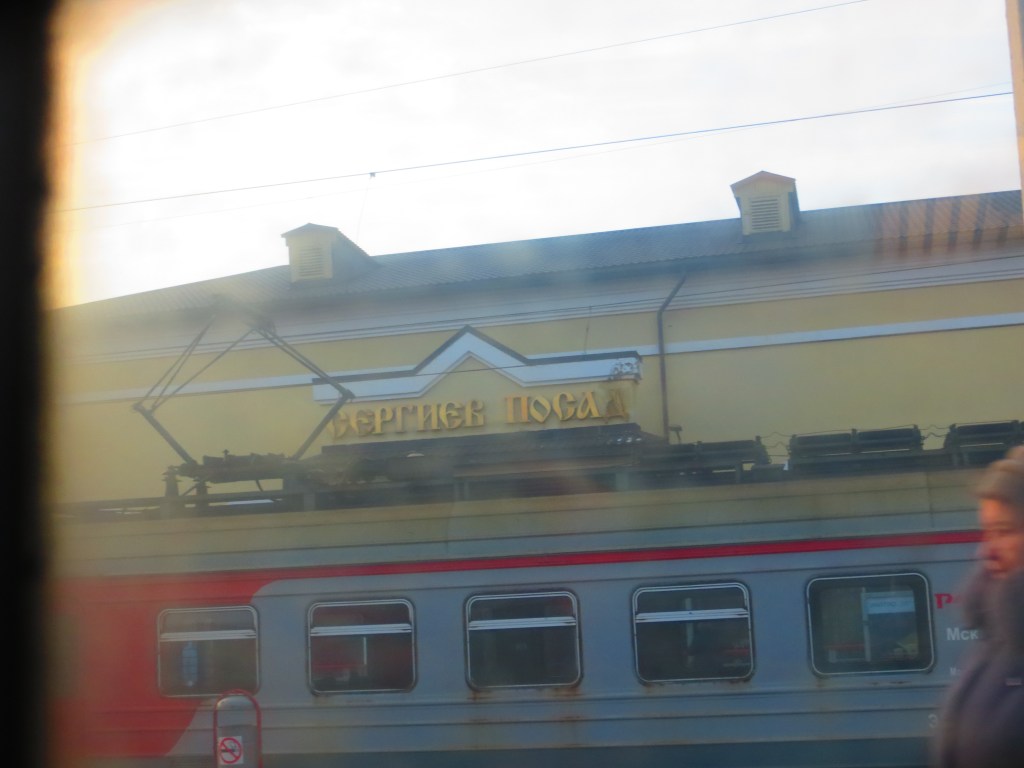
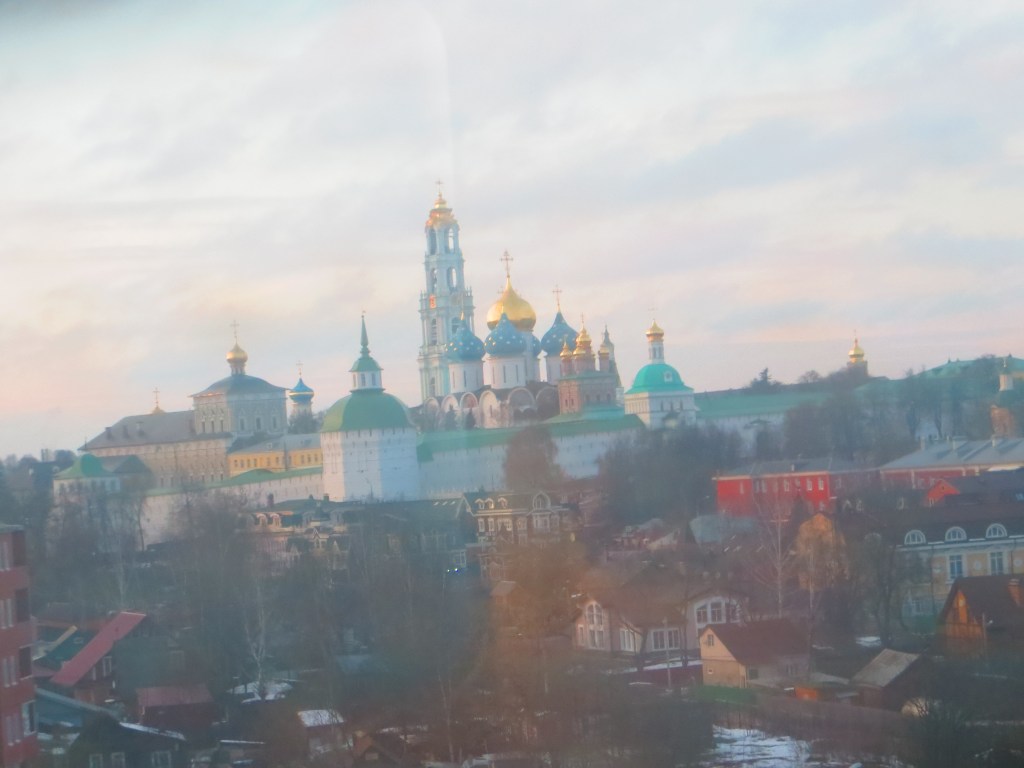
There was no direct train from Yaroslavl, of course, so first there were those four or so hours in a “suburban electric train”[2].  I always found this leg of the voyage excruciatingly boring.  I had the occasion to ride it again a few years ago, and can confirm that there is still something particularly tedious about it.  The big blue faux-leather chairs of old are gone, the new ones are not as spacious as they were when I was a fraction of the size I am now, and the view from the window is just as monotonous (with a tiny exception when the train passes by Sergiyev Posad).

We would arrive at one of Moscow’s nine train stations—Yaroslavsky (of course).  The train to Crimea would take off from another one, Kursky.  It was exciting to be in Moscow, which was huge and terrifying partially because it really is, and partially because my natal family is unusually prone to panic and aimless fuss.  However, while I was always trying to assert my independence and escape from my grandmother’s watchful, and baleful, eye in our provincial town, I would become entirely risk-averse during these long-distance travels.  In addition, Soviet cinematography and literature of the era was replete with fictional accounts of children lost in Moscow.  Although the stories always ended well, for stranger danger was not a thing in a society extolling the virtues of communal living, I found them anxiety-inducing rather than charming.  To this day, Moscow instantly turns me into a country bumpkin.  But I digress.

Yaroslavl Train Station in Moscow. The last time I took the commuter train.

The first year Grandma and I traveled in the regular compartment train which, as time told, was not dramatically different than European trains, with seats converting to bunk beds, four to a compartment. Occasionally, and I suspect it was simply because of availability, we rode in the strange “platzkart” wagon, a uniquely Soviet invention where there were bunks in the corridor as well and thus zero privacy.  Fun fact: there is no word for “privacy” in the Russian language.  I cannot imagine traveling in such a clown car now but, “c’est la vie” say the old folks, “it goes to show you never can tell”[3]. For as a child, I loved the “platzkart” setup, as it was easier to climb to the top bunk, with steps everywhere because of cramming so many people into the wagon, and because it always seemed like such a friendly throng. The only bad memory I have is when the radio in our overstuffed wagon somehow jammed while playing Carmen Suite’s Habanera for a quantity of some interminable hours; I could not hear that piece of music for years without it setting my teeth on edge, and have managed to stealthily avoid the entire opera.

There would have always been a dining car, but of course we never visited such a frivolous establishment.  We brought our own food, like everyone else: canned sprats in oil, black bread, boiled eggs, tomatoes, cucumbers, and salt wrapped in a piece of paper.  The conductor sold tea served in cut glasses with silver holders accompanied by sugar cubes.  Back then, sugar cubes seemed less fashionable than loose sugar, but now the sheen of nostalgia makes those hard blocks seem so retro cool.

It was a day and night’s journey across the land.  Without video stimulation of any kind, the entertainment consisted of eating, playing cards, reading glossy Soviet magazines like “Working Woman” or “Little Flame”, and looking out the window at the landscape gradually changing from north to south.  In the corridor, the windows had these little white curtains that said “Crimea” in light blue cursive letters.  I was always too short to lean on the curtain rod, and eventually too tall to fit under it, but I could stand there and stare out in wonderment for as long as my grandmother would let me. 

We never said “we are going to Crimea”, we said “we are going to the South”.  It was universally understood, same as where I live now, everyone knows the meaning of “Up North”.  Everyone was going on vacation; no one was going home. 

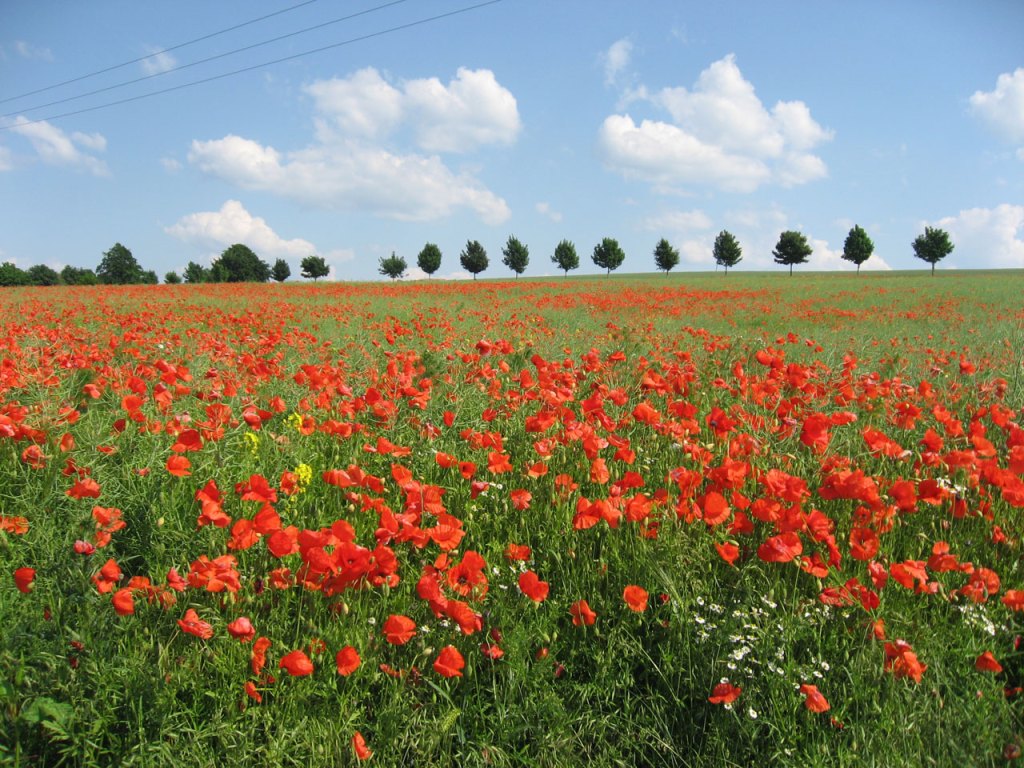
There was a granite plate built into a cliff, proclaiming “Glory to the heroes of Syvash”[4], commemorating events of the Civil War we never studied in school, which just added to the mystery of the land.  I looked for that granite plate every year, because I knew that once I saw it in the morning, I was in a different world.  Waking up in Ukraine, we saw idyllic white daub huts instead of our dark log ones, forests changing into fields, pale bluebells becoming blood-red poppies.  We were coming from the land of asphalt and dusty ash trees, constant strumming of trams, crowded streets.  And then the train just stops, giving the passengers a few enchanting minutes in a field of poppies, imagine that!

The following day would bring Black Sea with its friendly and nonlethal jelly fish, packets of little salty shrimps sold right on the hot sand of the beach, cafeteria “Kolos” with its delicious blintzes filled with sweet cottage cheese or ground beef, Frunze park with its exotic cypresses and statues of fairy tale characters, local history museum with two cannons in the front and a tiny zoo with a monkey in the back.  My grandmother then was younger than I am now, and we were going to the South for an entire summer on the beach.  As an adult, the longest vacation I have ever taken, since age 19, was the trip to, ironically, Russia (11 days).  A summer on the seashore has not been a part of my reality in adulthood.

Curiously enough, I remember nothing at all about the train rides to Estonia in the subsequent summers—not a single thing about the view from the window, people we met along the way, nothing at all.  It was still a summer by the seashore, but no longer the trip of wonders to one of the Seven Seas.

To be continued…


[1] Quoting “Anthem” from “Chess”.

[2] I had to look up the translation.  The Russian word is “elektrichka”.

[3] Quoting Chuck Berry.

[4] Alas, I cannot find any photographic proof of its existence—the plate, not the battle. 

Featured

Tooth Fairy

Last year, I lost my favorite tooth.  I mean, I did not misplace it, nor did it fall out.  It was surgically removed.  This tooth, #6, was my first root canal and my first crown.  My own grandfather put the crown on it, made from a melted down earring, and it lasted for decades.  Eventually, the crown wore out, and then the tooth itself.  There was even another root canal in the mix, so suffice it to say, #6 and I were bonded by hardship.  On the day when #6 and I finally parted ways, the nurse offered me nitrous oxide and oxygen, and how could I say no?  I welcome any option that results in less or no pain for me.

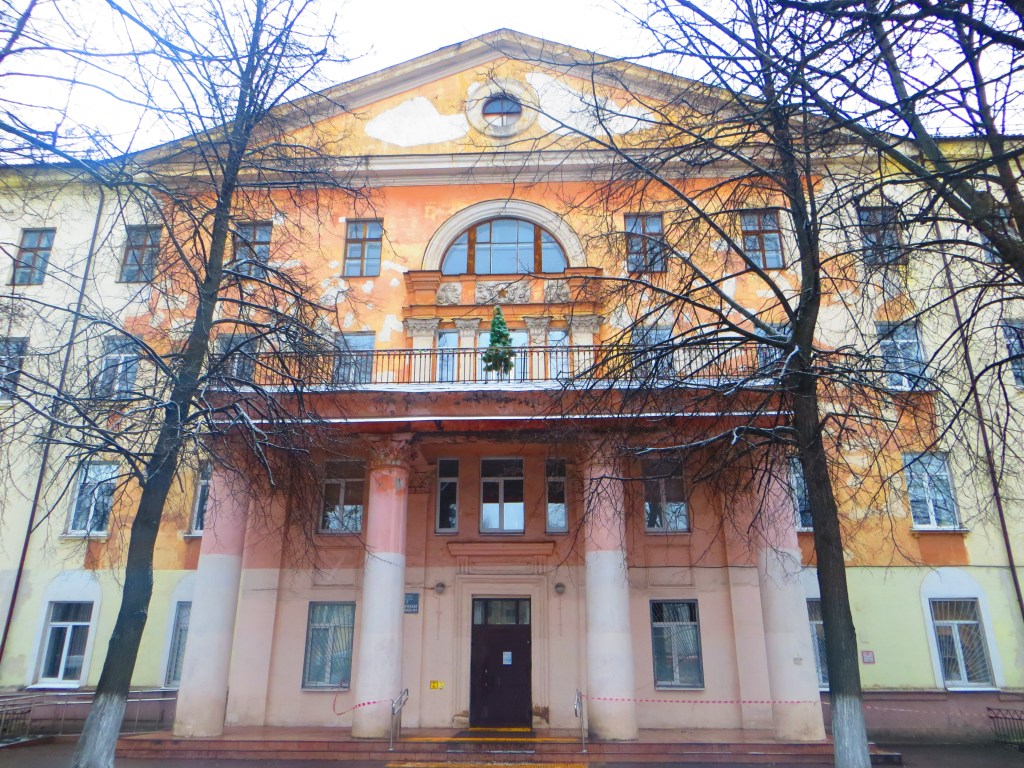
Jubilee Square. Motorbuilders Palace is on the left. The clinic is on the right.

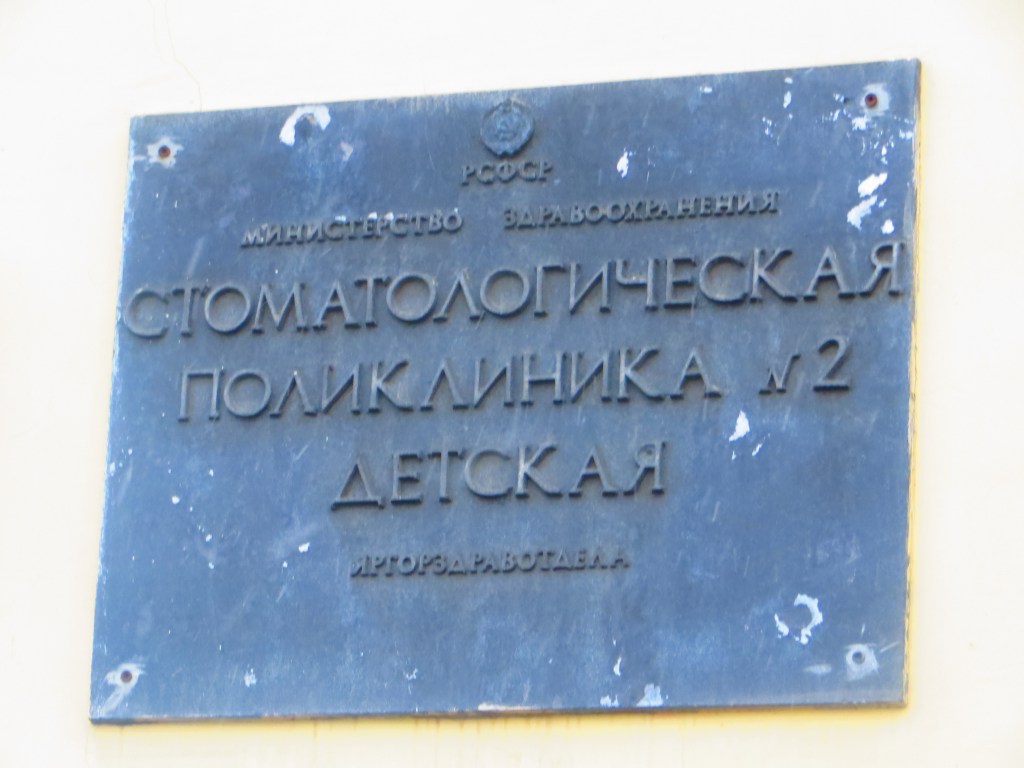
As I was dutifully breathing in and out, an unbidden memory came to me, of me and my classmates trooping down Lenin Avenue to the Jubilee Square (the one with the Motorbuilders Palace [https://oldladywriting.com/2020/08/18/valor-and-glory-of-the-motorbuilders/].  In my mind’s eye, I saw the golden Russian autumn sung by poets, maple leaves everywhere, the only melancholy season of an ever-sunshiny year.  The school year has begun long ago enough to be a bore and a burden, and the time has come for one of the most unpleasant organized events of the Soviet school system—the dental checkup.  It is about a mile from the school to the clinic—the longest mile.  If ever I felt like a lamb to the slaughter, this was most certainly the time.  Usually, I got some kind of exemption, being raised by dentists and being dragged to the children’s dental clinic by my grandmother on my own free time, but that day, I was all out of aces.  It is also possible that this was shortly after my grandmother took me to the clinic and I escaped, bolting out of the torture chair and making it halfway through Jubilee Square before I was captured (traffic in those days was unimpressive, but not nonexistent—I was absolutely in danger of being struck by a bus, a fate still preferable to any dental procedure).  I have to add, individual cabinets are a Western luxury.  In Soviet Russia, an army of Orin Scrivello clones with their whirring drills were leaning over screaming kids in one big room in a fog of ether.  

I have a lot to say about growing up in an apartment where our kitchen doubled as the prosthodontist’s office, but that is another story for another time.  But one thing I know is true, and that is that our home never smelled of ether.  Maybe grandpa had no access to it.  Maybe the smells of grandma’s cooking overwhelmed.  Regardless, the scents of home were not medicinal.  And I know this because had I been immune to these odors, I would not have been so jolted into panic each time I entered a Soviet dental clinic and been positively engulfed by that distinct piercing stench.  A mere whiff was enough to activate the fight-or-flight instinct.  It was always flight, because fighting presumes staying, and there are no fools.  Flee, always flee. 

The unintended consequence of my recurrent, determined, and frantic rejections of the most feared dental procedures was that my grandmother gave up (a precursor of things to come—a scythe came upon a stone, as in, she met her match when it comes to wills of iron), leaving me at the mercy of the school system.  And so began the long march.

The clinic where my grandmother worked. The was not just dentistry here, but other tortures as well. To be continued…

I always think of that BBC commercial, “They say one’s cows are mad, they say one’s dentistry is diabolical” when I think of the dentists of my childhood.  My grandfather did not work with children and was overwhelmingly busy with his relentless stream of patients, and my grandmother—well, I did not trust her.  More specifically, I did not trust in her not taking care to not inflict pain. (Well, that was a lot of “nots”—also emblematic of my childhood). 

That day, which my classmates and I anticipated with varying degree of fear but with unanimous distaste, was the source of much scheming.  While most of them were fairly resigned to this grim fate, I had one accomplice whose fear of the dentist actually exceeded my own.  His name was Max, and he was a freethinker.  I am told he eventually became an alcoholic, a fate not only unsurprising but entirely predictable given both his environment and spirit (no pun intended).  But when I knew him, ages seven to 12, he was a shrewd kid with a profound dislike of conformity and authority.  He was non-confrontational but steadfast in his avoidance of anything extra.  He was the epitome of “quiet quitting” decades ahead of its time. One of his catchphrases was “And the lesson is going on”, whispered to me whenever a teacher would get distracted and go off on a tangent, meaning that while time is getting wasted, no work gets done, and that is its own reward.  Max never got any exemptions from attending mandatory events, and yet he never attended them.  He just did not show up. He was reprimanded, chastised, shamed, and accused of being an “individualist”.  He gave zero you-know-well-whats.  He was, of course, a member of my Link. [https://oldladywriting.com/2023/11/11/scrap-metal-fiasco/]

Max and I conferred and confirmed that we were not going to the dentist, with the class or without.  Ever.  We did not have the audacity to just not show up to school that day—that seemed just too brazen, and we were not hooligans.  We were conscientious objectors.  And so, as the column of the condemned dragged itself along that familiar tree-lined alley, led by our fearsome homeroom teacher, the grammatically and socially challenged instructor of algebra and geometry, the two of us simply ducked into the labyrinth of yards off Lenin Avenue.  Without any regard for consequences, we ran for our lives.  We were not good friends, merely coconspirators.  We quickly went our own way, but for one brief shiny moment, we were bound by the shared taste of complete and utter freedom.

Lenin Ave. We escaped between those yellow buildings on the left. Photo taken in January; alas, I have no autumnal images to share.

And all these many years later, in a dental surgery under the calming influence of gas, it all came back to me, the sepia colors and the smell of fall leaves, the voices of my young comrades, the distinct flavor of childhood of unlimited future and potential, and the feeling of my long ago and far away home deep in my bones.  It never ceases to amaze me how memories can be summoned by the most unlikely agents and at the most unlikely times.  And how joy can be found even in the middle of pain.

Featured

Papa Taught Hebrew in Harbin

My grandmother used to tell me stories about her childhood, in the 1920s, which were both exotic and relatable.  She was only 45 when I was born, which seemed ancient to me, of course, but now I know that the half century mark is prime time for reflection and reminiscing.  We are unreliable narrators of our own lives, and the charm of her mischievous and adventurous early years in the small provincial town on the Volga remains the biggest shared treasure of our fraught relationship. 

Now that I am the age that she was when she was raising me, I realize how memory shifts as time goes by.  In her telling, she was a spirited and inquisitive child that was frequently in trouble with her humorless but loving parents.  The irony that these were the qualities she most deplored in me escaped me then.  I also bought into this portrayal of her parents for the time being, while years later it came to me that perhaps the character trait she most chose to emulate—grim rigidity—was the least praiseworthy attribute of this couple.  They never seemed quite real, just shadows of semi-forgotten ancestors, even though less time separated my childhood from them than from today.

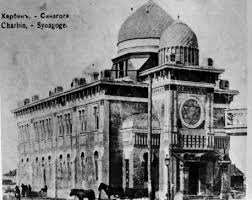
I recently read “People Love Dead Jews” by Dara Horn.  In this book, which had me both nodding in agreement and holding my breath, I came across a chapter about the Jewish community in Harbin in early 20th century.  I do not know if more is written about this place and time in history, but this was the first time I gasped in recognition:  “Papa taught Hebrew in Harbin”.  For among grandmother’s stories was always this nugget: her father spent several years in Harbin, teaching Hebrew to children while his brothers were running a business there.  This has always been just a naked, stand-alone fact, and when I was a child, it always seemed like enough information.  Great-grandfather, whom no one in my world besides grandma and her brother ever met, for he died before The War and before she left her hometown that neither my mom nor I ever even visited, was always described as a stern disciplinarian and seemed sufficiently boring to not merit additional investigation.  But grandma’s own childhood memories of her father speaking Chinese to make the neighborhood kids laugh echoed my own delight when her brother, my beloved great uncle, would pretend to speak Chinese to me.  I knew he was faking it, but he was so delightfully comical!

I finally learned that this interlude in great-grandfather’s life was not random, as I always assumed without additional thought.  Fortunately for me and mine, his ultimate fate was arguably better than that of many of the people he would have known in Harbin—and that is saying a lot, considering that he returned to his hometown of Lyozna, Belarus [1] (at some point before getting engaged to my great-grandmother on June 12, 1919 in Vitebsk[2]), got married and had two children, lived through the darkest years of Stalinism, and died before he was 60 in 1940.

I have been an immigrant since I was a teenager.  I have traveled.  I spent two summers in Europe, and I have been to China on a work trip, to the beautiful and sophisticated Shanghai, which is actually nowhere near Harbin and has a completely different history.  Every day of my professional life, I talk to people who have, at a minimum, spent several years in a foreign country.  Until now, I have not thought of this remote, unknown man’s journey, his years (how many?) in a much colder climate, in a completely different world.  I never imagined that he had his own “stranger in a strange land” journey.

Synagogue in Harbin

As a child I did not know enough about the world to imagine China at the beginning of the 20th century.  I never gave a single thought to how great-grandfather traveled so far—and back—what kind of business these nameless brothers of his had, why and when did he return to Belarus, eventually making his way to and settling in Russia proper. My grandmother was not a person who did not talk about the past, but I do not know how much she knew about that period of her father’s life.  Somewhere along the way, there was some falling out with these uncles that severed the family ties for all eternity (they were not welcome to attend their brother’s funeral).  It might have been related to this business in China, but grandmother’s own mother never told her.  In those days, people did not ask; children did not question their parents.  It is nearly impossible for me to understand the respectful yet reserved, affectionate yet distant relationships of that bygone era.  To the families of these great-uncles, whoever and wherever they are, my family is the missing link, the lost tribe.  Do their descendants remember today that there was another brother, another uncle?  Is this Harbin interlude a part of their family lore?  Sometimes I lament the loss of family memories to family feuds on top of the already precarious and unreliable way history was treated in the Soviet Union.  Other times, I concede that maybe it is only natural that the lives of ordinary people do not survive generational memories.

Dara Horn’s book gave me an unexpected glimpse into my great-grandfather’s unknowable life.  There is a connection that survives time and space, and a memory that is a blessing.

 זיכרונו  לברכה  אַבְרָהָם


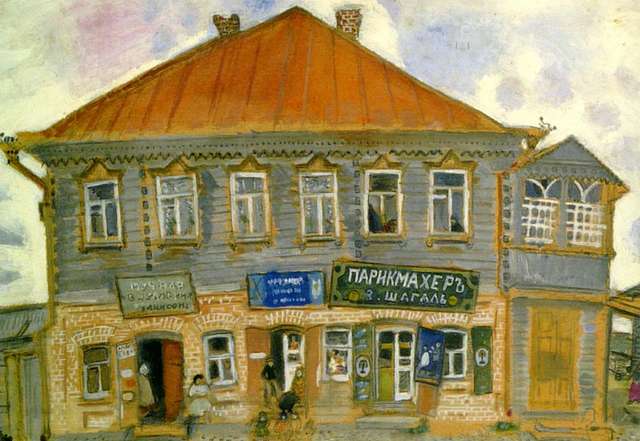
[1] The birthplace of Moishe Shagal, aka Marc Chagall.  I wonder if they knew each other?  They would have been contemporaries. 

[2] The only exact date in this narrative, because my great-grandparents’ engagement announcement somehow survived time and distance, and I treasure it.

Featured

Scrap Metal Fiasco

“Nothing that happens to us after we are twelve matters very much.” J.M. Barrie

I must preface the following with a disclaimer.  I have told this story so often that I am pretty certain I have already written it, so if you have already heard or read it, please let me know (and like it anyway). 

I was six years old when I cautioned myself to beware, for I was surrounded by people who were not smarter than me.  It might have been a devastating realization to a child that young.  Instead, it was an inspiration to rally and rely on myself—the old “trust but verify” (which is, in fact, a Russian proverb), minus the trust.  I proceeded to have an eventful childhood full of hijinks, camaraderie, and a singular focus on defying authority.  Almost half a century later, I stand by every shenanigan, and only wish I had made more mischief.  “Forget regret or life is yours to miss”—Jonathan Larson was also right.

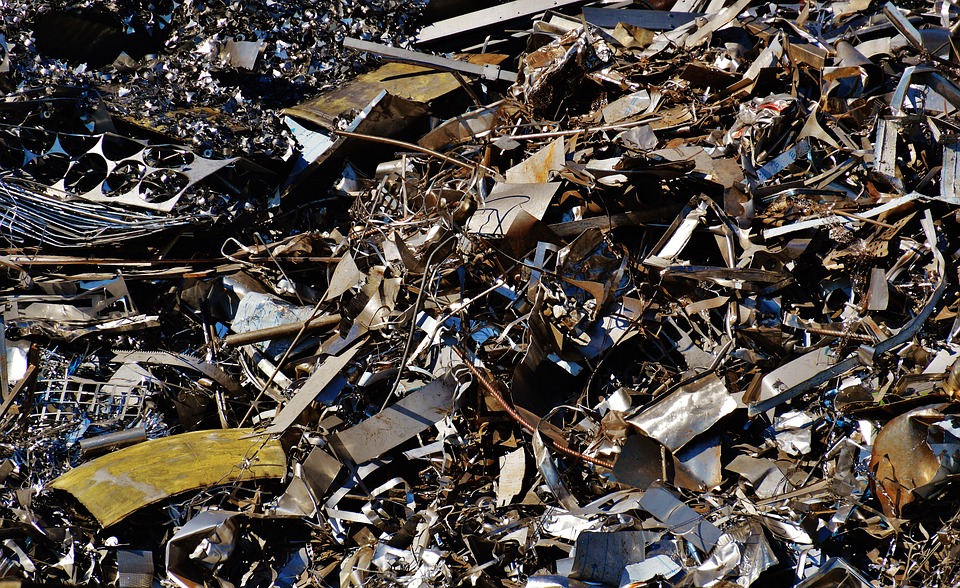
In some late years of the seemingly never-ending stagnation of Leonid Brezhnev’s rule, I was a Young Pioneer.  Surrounded by like-minded and like-spirited delinquents-in-training, I vacillated between apathy and active defiance, usually settling on an attitude of passive aggression.  My class of just under thirty pupils[1] was divided into three “links”, similar to a coed Cub Scout den without parents.  In the most disorganized, wild, and irresponsible class, I predictably belonged to the laziest and most undisciplined link.  There were eight of us, if memory serves, which included a core group of restless and adventurous girlfriends, and a couple of unpopular boys.  To snatch defeat out of the jaws of any potential victory was almost a point of honor for me and my young comrades.  To be fair, we usually started out doing what we were supposed to, and proceeded to fail in an epic manner.  None illustrates this better than the one time we collected scrap metal.  So unmitigated was this disaster that our entire school was banned from this time-honored activity for my remaining time back in the USSR.

The day of scrap metal collection, Link One and Three departed post haste in search thereof.  We members of Link Two briefly lingered in class.  Our Link Leader, an earnest, sweet girl who stood alone in our entire class as a follower of the prevailing ideology, made a short motivational speech along the lines of, do not attempt to evade your Young Pioneer duty.  This motivated the rest of us to want to bail on the whole thing, but someone yelled “Construction”, and we rallied.

There used to be a small park next to my school with a couple of see-saws and slides.  I used to come there on field trips with my daycare, and it was still there when I was in first grade.  However, by the start of second grade, the little friendly playground was demolished and taken over by construction of the regional archives.  Five years later, the site of the stalled construction was the school’s perpetual grim neighbor[2].  There was a crane which never seemed to move, and the more daring of us enjoyed crawling through the hole in the fence and all over what looked like the ruins of an old fortress[3].

And so of course construction (and we called it just that, as in “let’s go and find some metal at the construction”) became our first target.  Several of us filed through the habitual hole in the fence, but were dismayed to find that the site was picked over.  The better organized and more ideologically focused Links One and Three already raided it and carried off all the spare metal!  As I say, my little gang was always a day late and a ruble short. We took a couple of abandoned hammers and managed to detach a piece of pipe we determined to be nonessential, but it was not nearly enough.  (Surprisingly, no one thought to cut the fence down for scraps).

My school was located in a residential urban area, surrounded by apartment buildings.  It was an older, more established area of the city, though not quite the prestigious historic center.  Raiding the surrounding courtyards, we added a couple of unattended shovels and rakes to our bounty.  It was a bit of a task to stop the boys from hitting each other with the shovels, but I do not recall any significant injuries during this escapade.

In one of the courtyards, we spotted a child playing with a toy metal wagon and attempted to negotiate surrender, but his vigilant grandma chased us off with a broom.  We also kept losing link members with every encounter, kind of like when Three Musketeers started off for England in search of the queen’s diamonds.  Getting distracted, losing interest, and entirely changing course was typical behavior for me and my friends during any school-sanctioned undertaking.

Still, five intrepid girls persevered, and fortune really smiled on us when we encountered a clearly abandoned metal bed frame in one of the courtyards—with wheels, and even a mattress to boot!  Never questioning why a bed would be parked near an apartment building entrance, we immediately threw off the unnecessary ballast of a mattress, situated our rakes, shovels, and hammers on the springs, and proceeded to move the bed on out.  It was a swift and stealthy getaway, several middle-schoolers in school uniforms[4] earnestly pushing a bed along a lively avenue.  Some passers-by stared, some wondered, none dared to stop the purposeful Young Pioneers.

Not the image of that actual bed. It is surprising how a search for “metal bed with wheels” only comes up with images of hospital beds…

What should have been the long-sought success not just for our merry band of misfits but for the entire class went decidedly pear shaped, for the owners of the all this paraphernalia (neighbors in the process of moving, careless gardeners, construction supervisor) eventually found their way to our school and claimed their belongings.  The worst part was that the bulk of our bounty, the bed and garden tools, was easily returned with apologies because—private property, so a “remnant of the past”, in the ideology of the times.  It was the looting of the construction site—“plunder of state property”—that was the real offense, and our couple of hammers and the piece of nonessential pipe were the least of it.  The more proactive students got there before us and in their zeal carried off everything that was not nailed down, and some things that were, including the nails themselves.  I never got the opportunity to participate in collecting scrap metal again, but I will never forget our glorious entry into the school courtyard, riding on a bed, wielding a rake—Young Pioneer triumphant!


[1] In the Soviet Union, and I believe in today’s Russia as well, you moved from grade 1 to 8 with the same group of 30 or so students, took the same classes, and had the same teachers.  In my school, there were 3 classes to a “parallel”. After grade 8, a third of the students who did not pass the high school entrance exams would go on to trade and vocational schools, and the rest were reshuffled into 2 classes. My school, which housed grades 1 to 10 (and later, the added 11th grade), would graduate about 60 students from high school.

[2] First, not a uniquely Soviet issue.  Second, when I visited in 2018, I saw the unimpressive final product. I did not even take a picture of it. (I found this on GoogleMaps)

[3] If this is not a classic example of “attractive nuisance”, I do not know what is. What we thought we were getting versus what we got (not actual photos).

[4] Brown woolen dresses with black aprons.

…and Bratislava

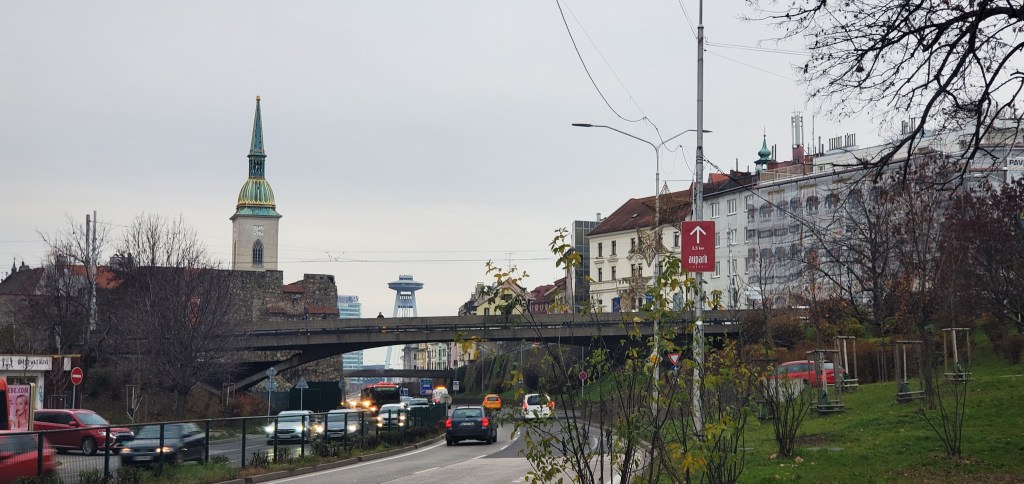
I always assumed that if I made it to Vienna, I would have to add a day for Bratislava.  Fun fact:  Vienna and Bratislava are two closest European capitals in terms of distance, so I understand that it is a common side trip, but that was never my reasoning.  I generally do not like to “gallop through Europe”, as the saying goes.  I learned to not overplan from experience (although my consequential plunge into underplanning has resulted in some unintended and occasionally hilarious jams—but that is another story for another time).  I like to take in the sights and go at my own pace, and I dislike leaving a place without exploring it fully.  So short story long, if I am going somewhere, I am not also going somewhere else.  However, what led me to Bratislava was not its proximity to Vienna, but that Trip That Never Happened 42 years ago.

To be fair, Bratislava was never going to be more than a train connection on our original journey.  We always knew that we were not going to see the town.  It was an almost unimaginably different world back then. Europe was still divided into East and West, and getting from East to West was complicated even with a passport.  A moot point, in any case, because we had no passports.  We no longer had passports because we no longer had citizenship of any country, none at all.  We were put on a train heading out of the USSR, and the first stop was Bratislava.  Czechoslovakia was still united, and Bratislava was not a national capital of anything. 

NOT what I remembered

We disembarked in Bratislava and waited for the train to take us into the *real* West, to Vienna.  On that cold and lonely platform in December of 1980, I do not remember any other passengers.  It was just the four of us, my mom and grandparents and I, and we stood there with our two suitcases per person for what seemed like hours.  This might be an invented memory, but I remember going into the train station itself and seeing chewing gum for sale (if you ever heard how prized it was in the Soviet Union—it’s all true!).  Could we have just walked into the city?  Were there any guards who would have stopped us?  It is impossible to know now, because the only tangible goal was to get on that train heading to Vienna.  These days, the hour-long trip between the two cities is almost akin to a suburban commuter ride.  Back then, one travelled from the Eastern Block to the Capitalist West in a fancy sleeper compartment, and I remember it taking hours—probably because of border control.  My mother remembers red velvet upholstery; I do not.

But there IS a vending machine selling dairy products

And so Bratislava remained something I never even pictured, just a footnote to a trip to Vienna.  The only part of a this visit I could envision was arriving at that train station and walking past that kiosk selling gum and sundries out into an unimaginable town.  Medieval? Baroque? Modern? The important part was the station, the kiosk, the sunlit town square.  None of them turned out to be real in 2022.

My persistence in going to Bratislava in the face of my mother’s mild opposition; my brisk realization that in this century, trains to and from Vienna connect to Bratislava via a suburban station and not the main one, preventing the recreation of that long ago voyage; brief panic about having to also get on a bus to get to city center—none of these are worth recounting.  Well, maybe the briefest of mentions—repeatedly seeing the words “Bratislava Petrzalka” instead of “Bratislava Central” or “Bratislava Hlavna” led this sophisticated traveler and polyglot to feverishly search the interwebs for a route into the city (get on the bus in this area, alarmingly advised the web, never take the taxi).  Otherwise, we would be walking out of the train station into a somewhat grim peripheral disappointment and then right back to Vienna, as per tradition. 

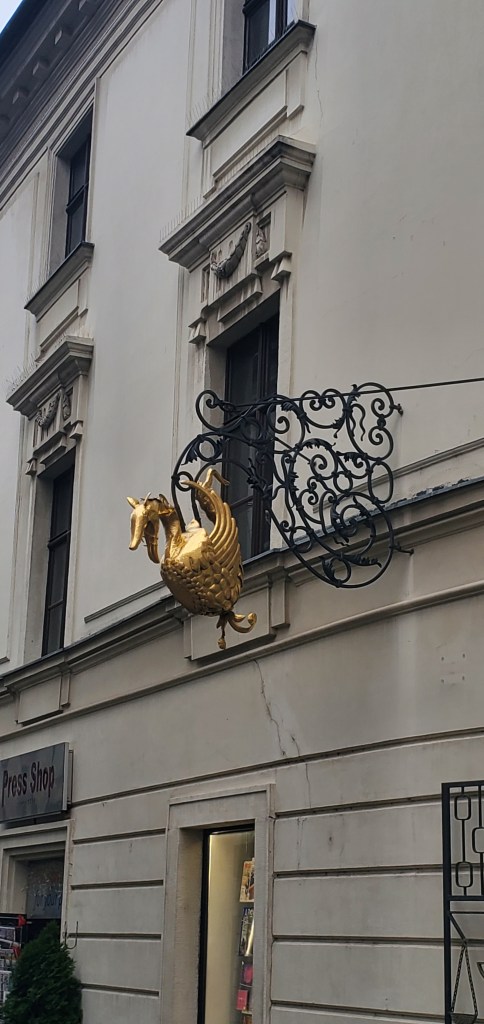
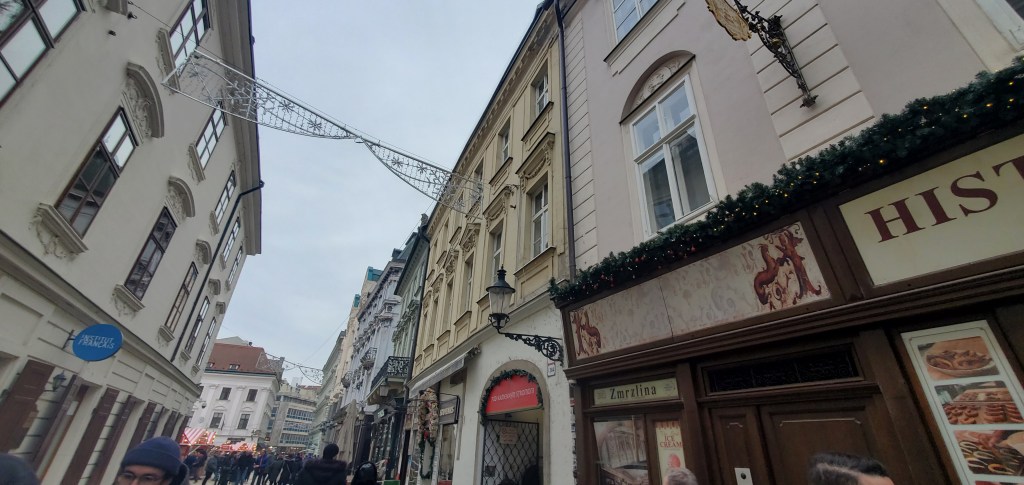
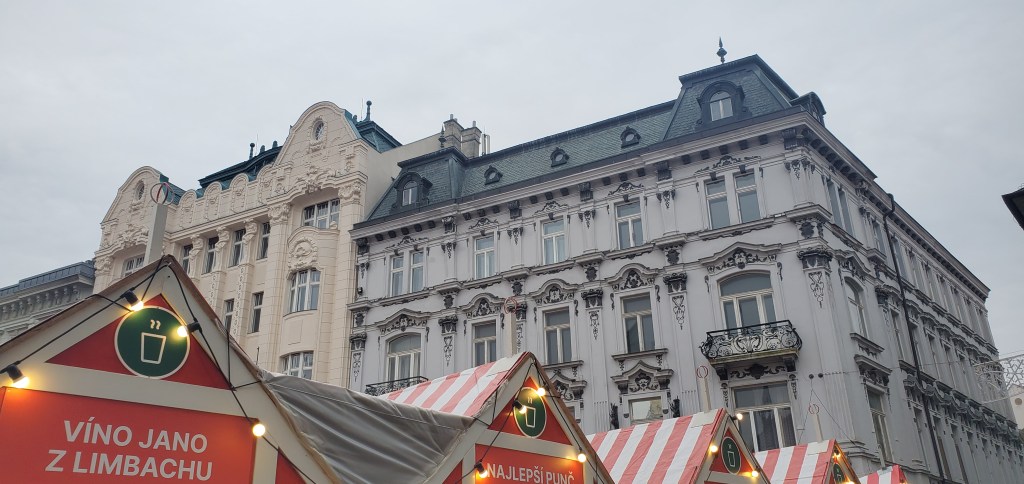
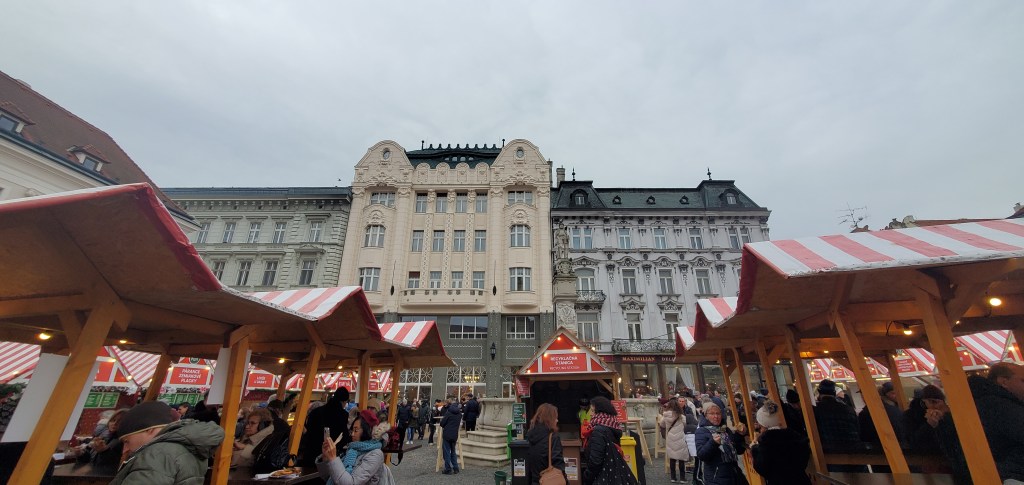
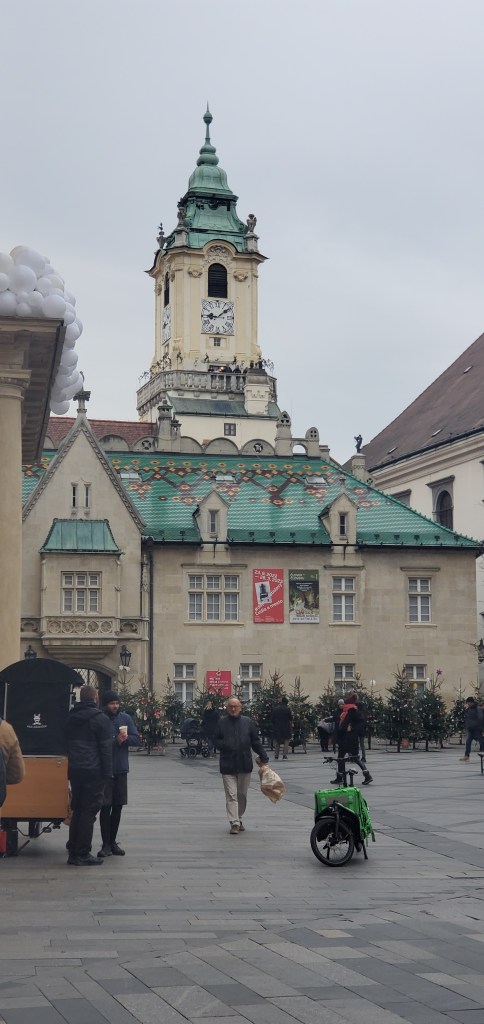
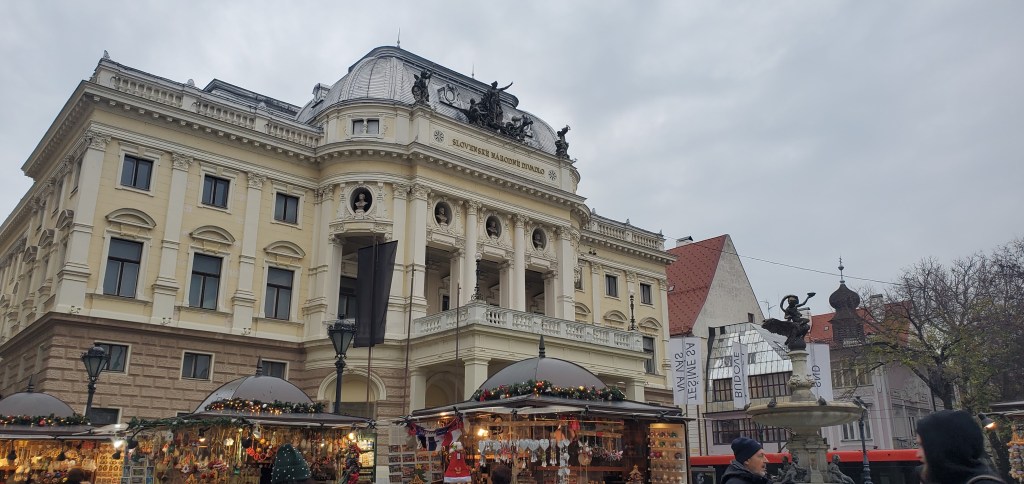
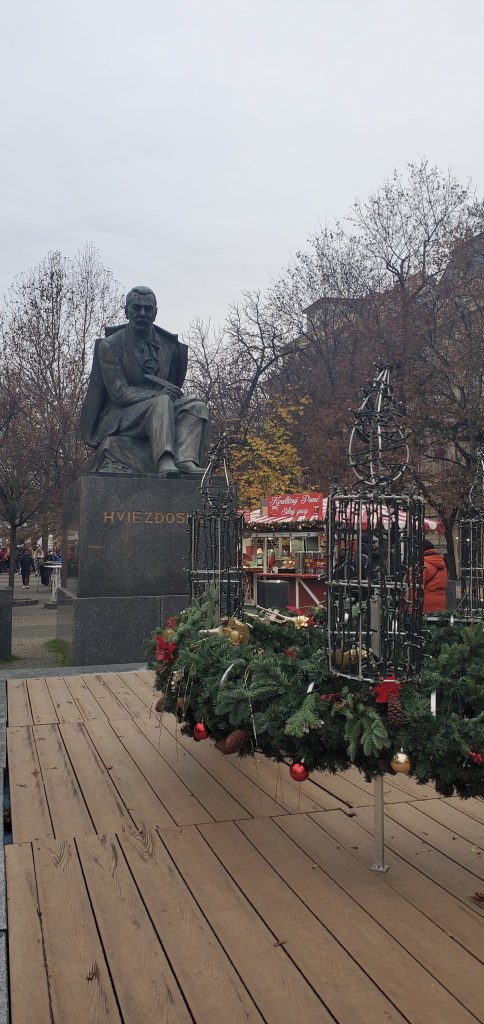
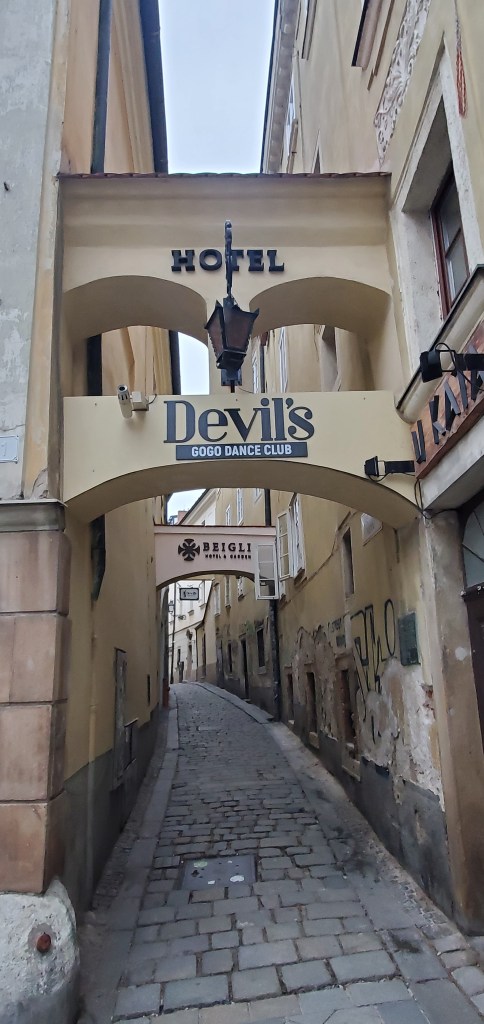
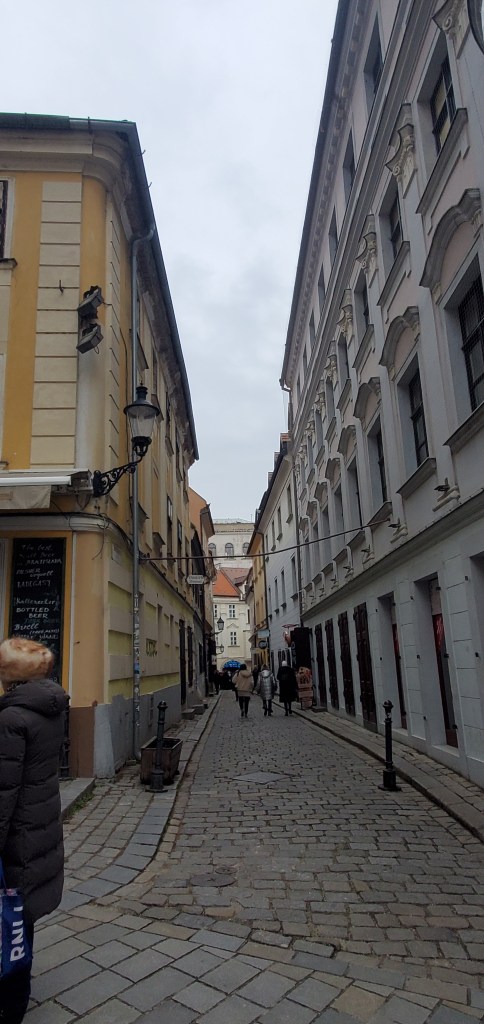
Ultimately, I feel like I gave Bratislava a short shrift.  We walked around a bit, enjoyed the most lavish meat feast I could ever imagine (allegedly for two people, but there were six meat servings), encountered another Christmas market (again, mostly meat), saw some charming medieval sites, and hightailed it back to Vienna before dark.  But I think Bratislava deserves more than just a couple of hours.  It seemed like a lovely town I would like to get to know better.  I would have liked to visit its castle high above the city, its churches and museums, taste the local wine at a very cool cellar by which I walked, and learn more about the effect the decoupling from Czechia had on Slovakia.  I could have researched and planned prior to going, but I think the existence of this town was simply too fantastic to contemplate.  Now that I know that it is real, we need to be properly introduced.

Thank You for Being a Friend

According to my recently unearthed diary (it was not missing or anything, I just do not like to refer to it too often because of the cringe factor), my teen years were full of seemingly perpetual anguish related to various betrayals which I would never recollect but for this traumatizing written record.  I was, at times, surrounded by The Mean Girls—but who wasn’t in their teen years?  But in a period of just three days recently, I interacted with a variety of people who, in various ways, reminded me how incredibly blessed I have been by friendships in this lifetime. 

  • I auditioned for several parts in a show at the local community theater.  I did not get cast for several reasons.
    • First, for one of the characters, my Russian accent is no longer convincing.  Yes, and I feel slightly stupid even writing this, but I am only identified as vaguely Eastern European to someone with a very good ear.  There were literally women on that stage who sounded authentically foreign-born (and weren’t), while I was doing a desperate impression of Crazy Russian Hacker.  And I am terrible enough with accents that I cannot just summon it.
    • Second, the director decided that the part of a “wanna be lawyer” should be played by a man, because, well, lawyers are men.  Triggering, and certainly nothing I have not heard from every corner over the past three decades, but for reasons passing understanding I always expect more parity from community theater.  What an unlikely source of optimism!  This actually reminds me of a time when I was not cast in another show.  It was a dual part—Eastern European mother in her youth in Act I, and then her daughter, a lawyer, a couple of decades later, in Act II.  The director called me and told me that I was believable as one but not as the other, and for the life of me I cannot remember which one was which.  There is great irony somewhere here, but ultimately, I guess I would prefer to think that I am an implausible lawyer.  Frankly, I usually feel that way anyway…
    • But, my point in all of this is that I ran into two women I know at the audition.  The camaraderie, the emotional support, the cheering each other on and complimenting each other even though we were up for the same couple of parts was absolutely lovely.  I have not known either of these fine humans in my youth, so cannot tell with certainty if we are all improving with age or if I am meeting a better class of people. Perhaps a little bit of both, which is both sensible and hopeful.
  • Not to make it sound like my American youth was misspent in the friendship department, the following day I drove to Hell (a real town; I am not this inventive) for a “Still 50” party of a high school classmate I have never met before.  Well, we met during a series of Zoom calls that were held on the regular during the darkest days of the pandemic, and encompassed a group of pals who all graduated within three years of each and now live all over not just the continental U.S., but as far as Hawaii.  I count myself more than a little lucky to enjoy the company of almost a dozen folks who knew me at my utmost awkward, clueless, and, in my mother’s characterization, gloomy, and who still willingly interact with me going on forty years later. 
  • The following day I had a lunch lasting several hours with a college friend.  We have not seen each other in about a decade, which is a ridiculous and inexplicable gap, but there it is.  The old saying of picking up where you leave off without missing a beat is always true with this friend, and has been for over thirty years.  I often see people question if there can be genuine, non-romantic friendship between men and women, and this long-standing unshakeable bond between an introverted engineer/scientist and a [seemingly] extroverted lawyer/amateur thespian is a testament to the fact that friendship, like love, is a gift that you take where you find it.
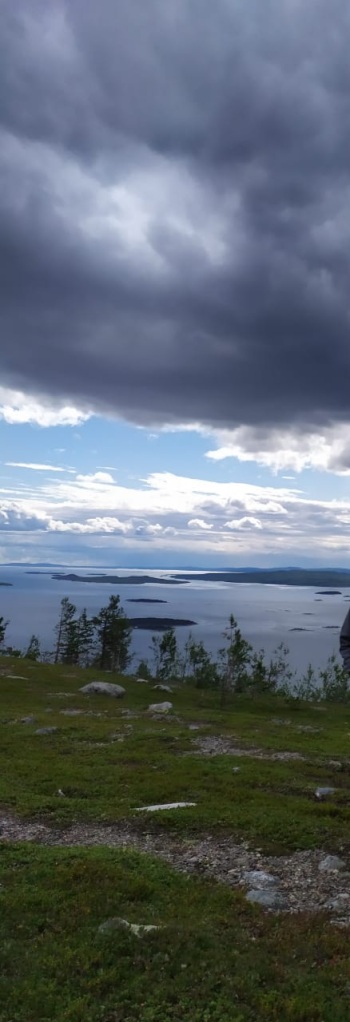
  • And finally, there is my childhood BFF.  She is the one whom I met on my first day of school, and who is the closest I have come to having a sister in this world (I have known my actual sister for a fraction of the time, both in quality and quantity—but that is another story for another time).  We have lived world apart for over forty years, and have averaged one in-person meeting per decade during this time.  Right now, she is on a road trip to the Russian Near North.  From each scenic stop, she has been sending me daily videos, narrating the town histories, telling fun local facts, showing scenic views.  They visited Novgorod the Great, Petrozavodsk the capital of Karelia, Murmansk above the Arctic Circle, stopped on the shores of the Barents Sea.  I have felt included in this wonderful adventure.  In return, I send videos of my foster dog.  And beer.  And my office.  And I feel unbelievably fortunate that my first school friend is still my best friend.  She is, and always will be, family.

The wisdom of the years taught me that not all friendships are for always.  Some relationships are for a season, and every season has its ups and downs.  Looking back, there have certainly been some downs.  But, as the song goes, thank you for having been a friend (this is the Russian/Georgian version—not to be confused with the theme to “The Golden Girls”).  The ups have, and continue to, fill this life with meaning, warmth, and laughter. 

So Many Books, So Little Time

I read a lot.  I have always read a lot.  It started one warm sunny summer afternoon when I was five.  My grandmother was reading “The Wizard of the Emerald City” to me (Russian version of “The Wizard of Oz”), but had to set it down because, as usual, household chores beckoned (this was some years before she started enlisting me and came to the swift conclusion that my lack of floor scrubbing and chicken plucking skills will never land me a husband.)  She put the book on a piano stool (a piano in that time and place was mandatory; I was not encouraged to touch it).  I circled it for a bit, unsure of how much trouble I will earn myself for touching a library book, but simply dying to know what happened when Ellie, Totoshka, and the gang encountered the savage сannibal.  I picked up the book and managed to put enough letters together to get through the rest of the chapter.  In my mind’s eye, I still see how the setting sun was streaming through the windows (we had northern exposure in our one room). 

Not a good moment to stop this book

And my most enduring, most comforting, most enriching, most faithful, most influential past time was born.  I have never stopped reading, not through years of university, child-rearing, long hours at work.  Backpacking through Europe at 19, I would go without a meal to spend what seemed like an extraordinary amount of money on English-language paperbacks in non-English speaking countries to read on trains (added bonus—lost weight).  I would choose the most pages for the money, which was not always the best literary value, alas.

My reading practices, however, changed over the decades.  As a child, if I liked a book, I would read and reread it.  I would go back, flip through pages, land on a random passage, read from that point, look for favorite passages, reread those, and so on.  This might explain why occasional quotes from “The Three Musketeers” or “Twelve Chairs” or even Chekhov’s short stories still come to me unbidden, but a book I read a month ago is so thoroughly forgotten that I might not recall either the title, the author, or the plot today (I mean you, “Where the Crawdads Sing”.  No offense).

My actual much-depleted pandemic stash

At some point, quality fell somewhat of a victim to quantity.  You know those Goodreads challenges, to read 50 books a year?  (Well, that’s the challenge I set for myself every year—doesn’t everyone?  A book a week, with a couple of weeks off for binge-watching Netflix seems very reasonable.) But why such a rush?  Is it because a friend said once, “I haven’t even read 1,000 books!” in a self-horrified manner?  But, that was probably about 20 years ago, so I have hit the quasi-magic number by now.  Or is it just because there is an embarrassment of riches out there?  I do not want to miss out on something great, and so gulp books down like Lindor truffles.

But I miss the reflection.  And what I really, really miss is the change in my relationship with books.

When I was a child, I read like a child.  The literary characters were my friends.  They lived in my imagination, and they were my counterlife[1].  I lived in their world, and they lived in mine. 

In my childhood, the counterlife was galloping through the vaguely unimaginable streets of Paris with the musketeers.  It was pure fantasy, as I never expected to walk the streets of Paris any more than I expected to walk on the surface of the moon[2]When Did the Arc de Triomphe Start Leaning? – Old Lady Writing

At some point, and I do not know when exactly that border into adulthood was crossed—and the crossing was, I imagine, inevitable—book characters stopped appearing in my reality.  Or, more accurately, I stopped going into theirs.  A certain detachment occurred where, while I remain entertained, enlightened, educated, and generally touched (and occasionally irritated and even bored) by what I read for pleasure, it is no longer my alternate reality.  It is just that—entertainment, education, etc.  It is enough—of course it is enough, there are so many great books that I have read and have yet to read—but I sometimes miss that untamed fantasyland of my childhood, where every story was examined through the lens of how it could play out in counterlife, and where I tried every character on for size as a potential friend or alter ego. 

It is unavoidable and logical, but it is occasionally sad when I stop and think about it.  That wild inventiveness would be very helpful right now, as the global pandemic still rages, theaters are still closed, and non-fictional friends are still remote.  This might be a good time to work on breathing new life into the counterlife… 


[1] Thank you for introducing this term in “The Glass Hotel”, Emily St. John Mandel.  I have always said “parallel universe”, but that implies, I think, something more impossible rather than improbable.

[2] I might add that the vast majority of my childhood literary heroes were male.  I am of the generation and culture that was not bothered by that.  In the childhood reenactments that I held with my girlfriends, we WERE the musketeers. I even won the top prize at a school New Year’s party, dressed as a musketeer in a costume made by my mom, wielding a plastic rapier, and performing the famous “Song about the sword”. What did I win? Probably an orange. Valor and Glory of the Motorbuilders – Old Lady Writing

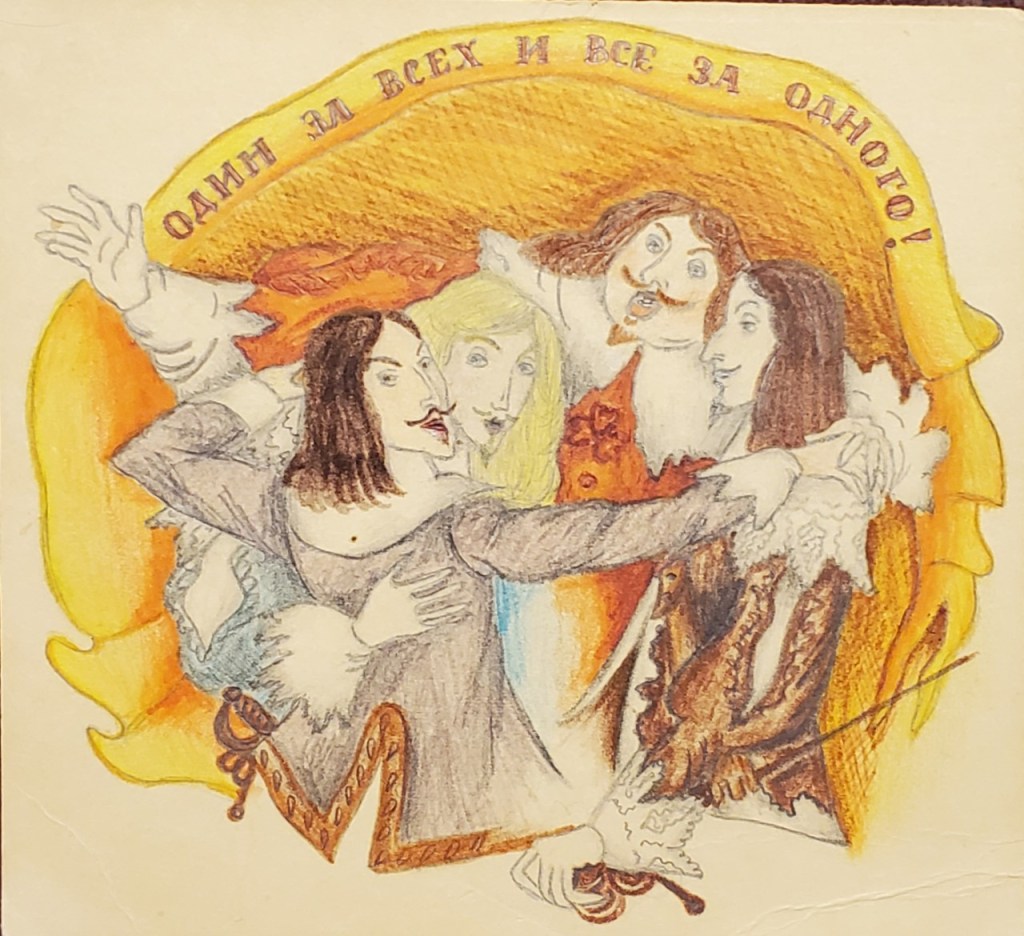
“One for All and All for One!” Again, by the author.

Featured

Always Nordic, Never Alpine

Pandemic winter is both harder, because there is no place to go, and easier, because there is no compulsion to go places.  I briefly interrupted my hibernation on a Saturday afternoon to engage in some cross-country skiing.  It was more like “cross-yard”—in fact, it was exactly that, because I literally skied out of my backyard and around the subdivision where I live.  Very Old Country.  Driving to a specified and possibly paid location just to ski around seems entirely too bourgeois, unless one is on a holiday.  

This is me, starting out in my actual back yard.

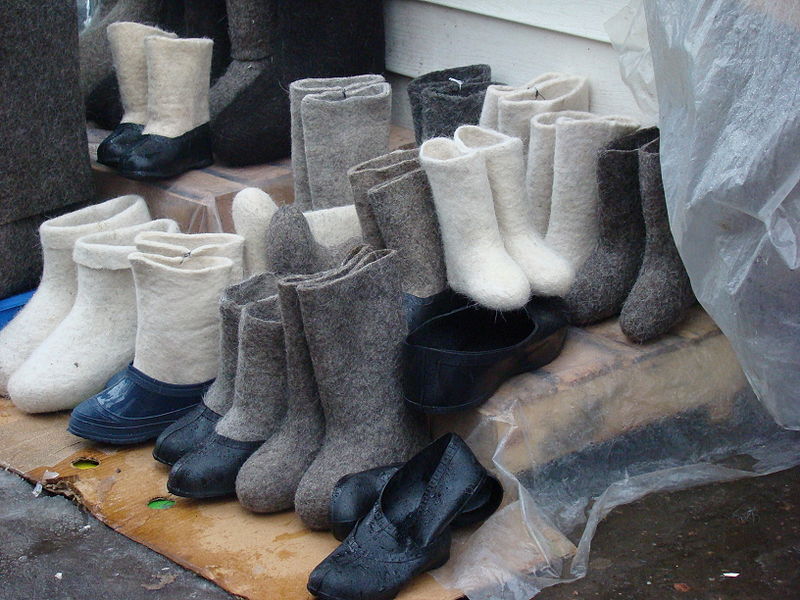
I would not say I was skiing before I was walking, but I certainly do not remember learning to ski.  It was just something children did all winter long, along with sliding down every snow drift and every patch of ice in our path.  All my skis in childhood were the kind that did not require special boots, but the type where you just slide your foot into a rubber band, and another rubber band goes around the heel (and sometimes not even that).  You put your “valenki” onto the rubber piece, because “valenki”, being just felted wool, are very slippery (Although I was always made to wear galoshes over mine.  I come by my indifference to fashionable footwear honestly).  In Russia, I never graduated to the adult skis which came with special boots that attached to the skis with the metal cage-like fastenings that looked complicated and somehow final, leaving no possibility of escape.

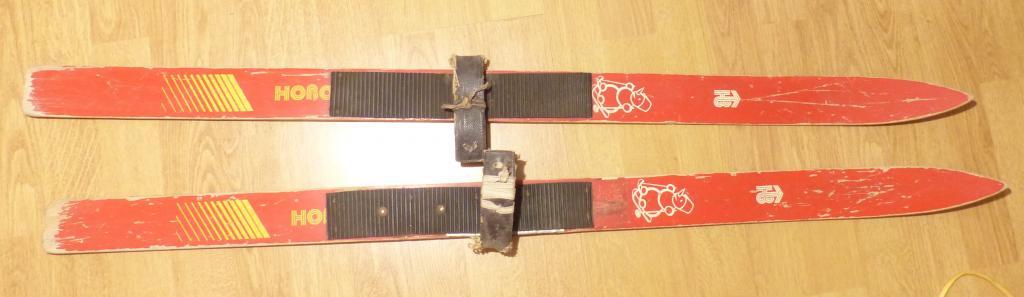
Not my actual skis, but a pretty accurate representation.

In my childhood, my main ski route was in the front yard of our house (so that my grandmother could watch me out of our kitchen window).  It was an easy and pleasant morning before going to school during the second shift, until it became less attractive when big garbage bins were installed in my direct path.  Occasionally, I was allowed to ski in the big field behind our house, a site of soccer matches in the summer.  Both of these have since been sacrificed to progress: the field is now home to an auto dealership, and an extremely shocking high rise is getting built right across from the old two- and three-story apartment buildings.  At least the trash bins have disappeared.

These are way fancier than anything we had back in the USSR

Skiing was the gym activity during the 2nd and 3rd quarters of the school year.  As a gym activity, it was terrible for many reasons.  First, the school-provided skis were awful and literally went nowhere, because they were never properly waxed and got stuck in the snow.  Choosing skis in the gym was a predictable pandemonium.  If you were not appropriately aggressive, you could end up with two left skis.  I usually brought my own skis, like some of the children of Soviet privilege, and because my grandmother was convinced that the school skis were unsanitary disease-bearers.  This involved hauling a pair of skis on the crowded trolley #4, an experience similar to riding the NYC subway during rush hour, but with worse smell (some of which was contributed by me, because at one point I had a winter coat with goat fur collar.  Let me tell you, nothing, nothing at all smells worse than goat fur, even after it was aired out AND sprayed with Red Moscow perfume.  This might explain why I have never found goats even remotely adorable).  Guarding my skis against breakage was a nerve-wracking experience for several winters. 

When I was very young, we were not allowed to use poles in school—the temptations of wielding them as swords or trying to poke someone in the eye was too great.  I am ashamed to confess I was not always able to resist either once the pole ban was lifted.

Second, although gym during the ski season was a double lesson to allow us time to change, returning to regular classroom after being outside for an hour and a half, sweaty and soaked, covered in snow, was entirely uninspiring.  In my later school years, I have taken to not returning.  Along with a few pals, we would ski away from the pack on the field where we raced in a long loop, right across the roundabout at October Square (luckily, there were not that many cars in my hometown in those days), grab our backpacks from the school vestibule, and keep going.  Who knows what kind of a delinquent I might have become had we stayed in Russia?  American schools sure scared me straight…

Third, we had to learn downhill skiing.  Now, there are no mountains where I come from.  In my entire life, I have never lived anywhere near a mountain range of any kind.  To me, anything taller than me is a mountain.  If I see an incline, it’s a mountain.  There was not so much as a hill in either our front yard or our back yard.  However, my hometown, like any medieval fortress, is built along a river.  The dramatic and terrifying hill, “Friday Descent” (probably referring to Good Friday, otherwise it is a pretty random name) was the location of our Alpine exercises. 

Although I am not particularly afraid of heights, I am strangely afraid of speed—or, more precisely, of my inability to control myself on runaways skis.  Thus, most my training on Friday Descent ended with practicing safe falling, which is the skill that serves me well to this day whenever I am confronted by any elevation while skiing.  I either fall immediately, or sit on my skis like they are a sled.  Occasionally, tired of rolling over into a snow bank, I would just find an opportune moment while the gym teacher was focused on observing students at the bottom of the hill and ski away on the hilltop, across the roundabout, and you know the rest.

Since I have not attended a gym class since I managed to get an exemption from my last one in the mid-80s, skiing, strictly of the Nordic kind, has been a pleasurable activity. And so, if you see a middle-aged woman gliding across your front yard—or your back yard—one  sunny winter afternoon, it just might be #oldladyskiing.

The Old Country. Front yard: behind the fence on the right is where I used to ski.