
Without any effort—or, indeed, desire—on my part, “A Midsummer Night’s Dream” has recently emerged as the Shakespeare play I have seen most often live on stage. From some initial encounters ranging from indifferent to downright embarrassing, our relationship has grown and developed into one of admiring understanding.
My favorite among the comedies was always “Twelfth Night”, simply because I saw a televised version of it as a child. The bumbling duo of Sir Andrew and Sir Toby impressed me the most, and remains my favorite pair of comedic incompetents in the entire canon. As for “Midsummer”, we did not meet until I was in college.
I saw several productions over the years, from my beloved Stage West Theatre in Fort Worth to the Stratford Festival in Canada. Most of them were competently entertaining if not affecting. Let’s face it, the young lovers’ plight and predictable resolution is not what makes this play so popular; it is Bottom and Co. and the fairies. And here is where it usually lost me—I have never really enjoyed them as characters on stage. I have always felt that so much effort goes into the fairies, their costumes, their makeup, their habitat that every else kind of gets lost in the forest, pun intended. The set is too green, or too blue, there is too much mood lighting, too much gauze/glitter/sparkle/fog/flutter of wings, etc. I think there is temptation—not entirely surprising—to just get overwhelmed by the external while putting on a play that involves the magic realm. If I remember nothing else from some of the productions of “A Midsummer Night’s Dream”, I remember a lot of shrubbery and a lot of wings. I never actively disliked it, but neither did I seek it out.

So imagine my surprise when, in a fancy suburb of Chicago which I have distrusted since that fateful day when I visited a client there and could not find my way back. https://oldladywriting.com/2021/08/08/bad-day-in-chicago/ Spoiler alert: Napierville redeemed itself with the most imaginative and heartfelt rendition of “Midsummer” I ever had the privilege of enjoying.
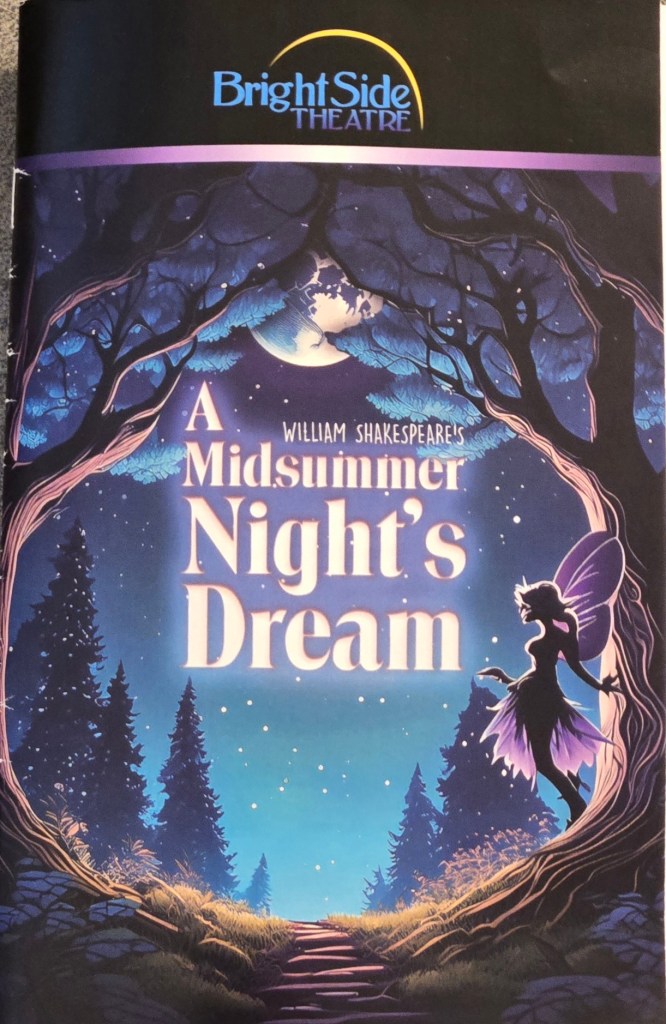
A Midsummer Night’s Dream – BrightSide Theatre
Aside from the quartet of young lovers, who just basically do their thing, the characters in this production are familiar and yet somehow new. In a smaller theater, with a thrust stage and actors occasionally breaking the proverbial fourth wall, you cannot help but feel part of the story. But in this version, the relatability is more than a function of proximity. Theseus of Athens and Hippolyta of the Amazons are played by the same actors as Oberon and Titania, and their attendants in the opening scene also morph into fairies and back again. Grounded in the corporal world, the fairies are certainly creatures imbued with supernatural powers, but, human-presenting, albeit gorgeously and colorfully costumed, they convey the message that magic is in and all around us. This double casting, for me, creates a more tightly knit, unified story that is more than just a series of connected plots. Regal Theseus’ humanity never leaves Oberon, wry elegance of a courtier stays with the mercurial Puck, and Hippolyta is both proud and hopeful as Titania. So powerful is this bond between the two worlds that I am not sure I ever want to see “Midsummer” again where these roles are *not* played by the same actors.
The play’s funniest scene, when the indomitable troupe of rude mechanicals perform the ill-rehearsed and even worse-written “Pyramus and Thisbe”, is as hilarious as anything I have ever seen. Peter Quince’s earnestly overwrought introduction, Tom Snout’s exasperated attempts to focus “the wall” on Nick Bottom’s pompous meanderings, Robin Starveling’s laborious attempts to handle two objects at once, and Snug’s brave overcoming of stage fright as the gentlest of lions are all full of humor that never spirals into caricature. In this production, you root for everyone, even the overly confident yet somehow endearing, wide-eyed Nick Bottom.
I am that pedant who pays attention to and gets distracted by false notes in costuming. This “Midsummer” did what I have seen once before in another play and remembered forever. It starts in monochrome and gradually becomes more and more colorful. It is not just that Athenians appear in shades of gray and citizens of the magic realm are in color. It is not just that Theseus goes from somber black as a ruler of Athens to royal purple as the ruler of the magic kingdom. The young lovers also gradually transform from gray business professional attire to red and blue silks and lace. With each exit and entry, I was anticipating the next development of the costumes (and coveted some for myself!).
As for the set, absent are the usual overpowering prop trees and astroturf. Truly, they just bog down the text and the action (I always knew that). Instead, there is an abundance of confetti, in all shapes and sizes, and strewn about in every way, including through cannons, which creates an atmosphere of joyful celebration. And original music written for this production adds another layer of enchantment and lyricism.
Finally, there is *that moment* that transforms everything https://oldladywriting.com/2021/05/25/who-tells-your-story/. Francis Flute, a mass of nerves as he should be, suddenly loses the high-pitched voice and simpering manner and delivers Thisbe’s farewell speech to the “corpse” of Bottom with the heartfelt pathos of the finest tragic heroes. I would like to have said that there was not a dry eye in the house, but that would not have been true—still, a hush fell over the audience, and that is no small feat for this play and for this scene.
It never ceases to amaze me how, while staying true to the text and the plot, some productions of Shakespeare’s plays find a truly unique voice. I give credit to The Bard, of course, for his words are timeless and multilayered. But I also have to give great credit to the immensely talented team that brought the old story to live in this particular, extraordinary way. If you are anywhere near Chicago for the next couple of weeks, see this show, before it disappears like so much fairy dust…




 Old Lady Writing