Featured

Time Shelter: Reminiscence, not Review

“The past is not just that which happened to you.  Sometimes it is that which you just imagined”*. 

The older I get, the more disappointed—and, frankly, disbelieving—I am that we cannot travel back in time.  The more years pass, the farther I get from certain cherished moments, the harder it is to accept the permanence of their departure.  Watching Doctor Who, the ultimate wanderer in time and space, I get a vague sense of unease from the episodes set in the future.  What is the far future to me?  I will not see it, so I am not curious about it and not invested in it.  But the past, well, it is full of second guesses disguised as second chances.  It is full of the comfort of nostalgia. “It’s been written that the past is a foreign country.  Nonsense.  The past is my home country.  The future is a foreign country, full of strange faces, I won’t set foot there”*.

In “Time Shelter”, Bulgarian writer Georgi Gospodinov creates the perfect scenario for which my soul has been yearning.  Gospodinov is Bulgarian, and we are exactly the same age.  I feel his story almost instinctively, beyond the words, for he writes not just about the decades he experienced, but as only an Eastern Block Gen-Xer experienced them.  It is rare that I hear the echoes of the voices in my head in print.

His first person narrator meets Gaustine, a mysterious psychiatrist who opens a “clinic for the past”.  It is meant to evoke recognizable memories for Alzheimer’s patients by reproducing the surroundings of their comforting past lives, but the concept takes off and everyone wants to starts seeking shelter from the relentless passage of time by stepping into the past. “Everything happens years after it has happened”*.

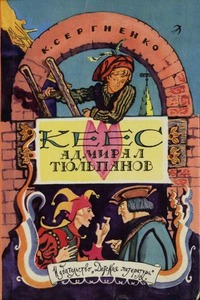
Like Gaustine’s patients, I am not even interested in the historical past, someone else’s past.  I do not want to meet Shakespeare (whoever he really was) or see dinosaurs or anything like that. (OK, maybe I want to meet D’Artagnan in his natural habitat, but that is all).  And fine, I don’t even want to change anything.  I saw “Sliding Doors”.  I read “Midnight Library”.  I am no longer sure which parts of my life I would want to erase if there is no guarantee that this would not have a detrimental effect.  I can no longer fathom what my life would look like today if I had made different decisions at some critical junctures.  I might have been spared some pain, but what unanticipated and ultimately avoided sorrows were waiting in the wings?   The decisions that I made, I stand by them.  The decisions that were made for me trouble me still with the passage of years but regret is useless. And it all basically worked out.

The pool would have been beyond that fence on the right

It is just that the melancholy longings come unbidden in the twilight, and that is when I sometimes wish I could revisit my past.  I want to see the sun rise over the roofs from the balcony of my mother’s apartment, for every occasion on which I visited her there seemed special and wonderful.  I want to sit in my childhood apartment’s dark room lit only by the lights of the Christmas tree, the only year my grandparents had a real tree and could finally hang up the one ornament that was too heavy for our little artificial tree—an orange, the size and weight of the actual fruit.  I do not want to forget either that orange that always stayed in the ornament box in the entresol except for that one brief appearance or my favorite ornament, wild strawberry with a human face.  I want to go to the grocery store on the first floor of our apartment building and buy birch juice by the glass and a hard block of coffee with milk, meant to be dissolved in boiling water and not gnawed like I did as a kid.  I want to watch my collection of film strips in the hallway of our apartment on the coldest winter days.  I want to marvel at the hollyhock mallow plants in our neighbors’ garden in the summer.  I want to see again that inground public pool that was filled in when I was just a toddler, leaving behind a weed-covered wasteland—was my memory of this thing even real, a random outdoor pool on our quiet little street?  And I want to sit on our old couch and read the books of my childhood.  There is so much from that era of gentle stagnation which seems positively utopian in comparison to our present cataclysmic times.  “Warning, history in the rearview mirror is always closer than it appears”*.

My favorite part of this mesmerizing novel, which I had to read twice in a row (and even that was not quite enough to fully take it all in; I am yearning to read it again), is when time shelters become so popular that European countries actually vote on returning to their respective favorite past eras.  The clinics of the past are no longer enough; entire countries become engulfed in nostalgia.  It is fascinating to read what decade each country chooses as representative of the glory of its people, yet still recognizable and not entirely devoid of modern comforts.  Some decades of the last century are obviously fraught; 30s and 40s have their devotees, but Gospodinov is not going there.  The story is not about that.  So many countries choose the 1970s or the early ‘80s (including most of the [former] Eastern Bloc—the whiff of freedom in the air, before reality bit), with only Italy choosing the ‘60s.  Bulgaria’s choice is not mentioned, but there is a hint.  “What decade would you choose?  “I’d like to be twelve years old in each of them.” * That would be my answer, too.

*All the quotes are from Georgi Gospodinov, “Time Shelter”, English translation by Angela Rodel

https://georgigospodinov.com/

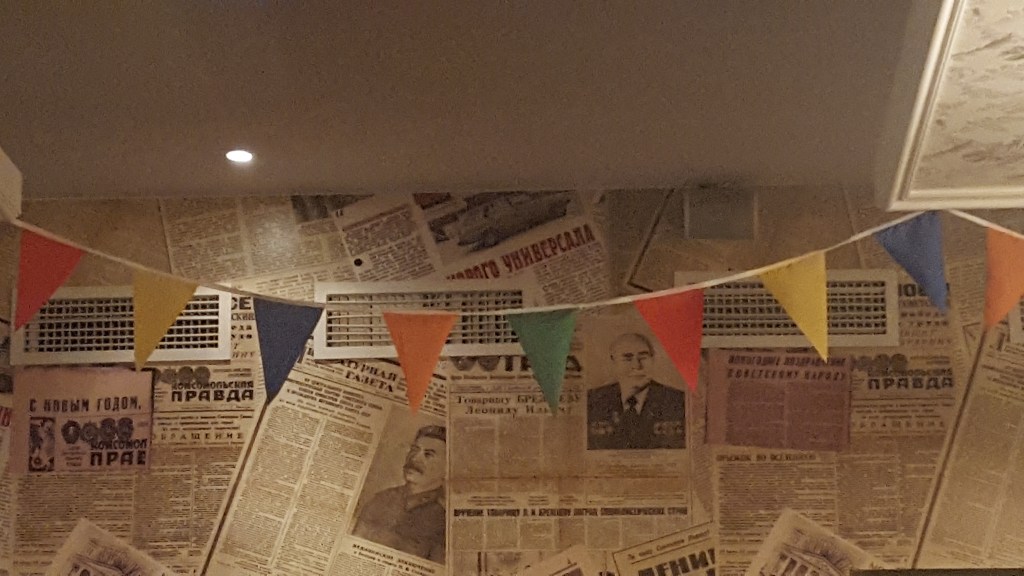
[Caption: my time shelter, for better or worse]

Featured

Poison, Fire, and Flood

One of the main villains of my raucous childhood was one Shturman.  This was, and is, his real last name.  I am not changing it here because (1) he is not likely to read this, (2) this unusual name[1] is too much a part of him, and (3) every word is true.

Shturman’s code name was “Douche”.  No, listen, in Russian, it just means “shower” (and in French as well, but we did not know it then).  And the reason he was “Shower” was because we called him “D.Sh.”, which stood for “Durak Shturman”, which means “Shturman the Fool”.  So it all fits together rather beautifully.  Since “fool” was the worst insult we knew, literally everyone’s code name started with “D”, but this was the only one that is not lost in translation[2].  At school, he was known as “Shturm Zimnego”, or “Storming of the Winter [Palace]” (the event that, according to what we were taught at school, started the Great October Socialist Revolution), but we did not feel that he deserved so much honor.

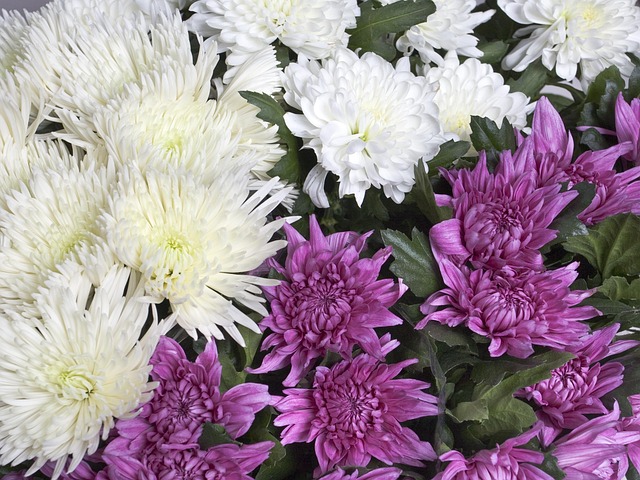
All positive comments regarding these flowers will be deleted

My BFF and I met him on the first day of school, September 1, 1975.  In fact, we all met each other for the first time that day.  It was not a good day for me, for it started out quite literally on the wrong foot.  All the girls were wearing pretty summer sandals (my friend’s were pink).  I, as was my lot in childhood, was wearing heavy, hideous black/brown booties.  I was perpetually overdressed in childhood by my overprotective grandmother; I always had a couple more layers on than anyone else.  My mother, who gets incredibly defensive about every single choice made for me not by me, would undoubtedly say that prettier shoes could not be found—and that would be a lie.  Everyone else wore common Soviet-style sandals readily available at any children’s clothing store in town.  My ugly orthopedic boots were imported.  And to top it all off, the trend of sending me off on the first day of school with a bouquet of chrysanthemums for the classroom teacher started that unfortunate day.  You guessed it—everyone else had lovely summer flowers.  I yearned for daisies, and cannot abide chrysanthemums to this day.  But I digress.

Mine and my BFF’s mothers and both of Shturman’s parents went to high school together.  Their paths diverged for a few short years after college and joined again on that day when it was discovered that they had children born in the same year (two in January, just a week apart, and one in November), who will be starting school not just at the same time, but at the same school and in the same class.  Of course, given that our parents were friends, we were thrown together a lot in those early years, for all the holidays, all the birthdays, summer trips to the countryside, etc.  Well, since I lived with my grandparents, I was not allowed to celebrate with my friends, so that was one very small benefit, having a bunch of 50+ year olds rather than Shturman over.  And since I was born in November, I did not have to share my birthday with him, only with the October Revolution, celebrated in November according to the “new”, Gregorian calendar.

To commemorate the Revolution, we got a few days off from school—basically, our fall break.  In that place and time, it was common to gather for all festivities.   One year, when I was maybe in second grade, we all met at my BFF’s apartment.  The adults, which consisted of Shturman’s parents and mine and my friend’s mothers (both divorced, but with or without boyfriends—memory fails) went for a walk.  Do not be shocked, it was a kinder, gentler time; neighbors looked out for each other and each others’ kids.  And it turned out that the real danger lurked within…

The adults departed for their nighttime stroll, and BFF and I hoped to have some fun:  sing along to Soviet pop music with pantyhose on our heads, make plasticine animals, read about astronauts and plan our own future space adventures—really, the possibilities were endless.   It was a Soviet studio apartment: one room, bathroom, and a kitchen at the end of the hallway.  We staked out the kitchen.  Shturman pestered us for a bit, at one point brandishing a bottle of wine[3] and boasting that he can drink it all.  We called his bluff with all the disdain we could muster; predictably, he did nothing but buzzed off to the room.  But our little gray cells were already activated.

As children, we were told that alcohol is poison. As we saw adults drink copious amounts thereof, the unspoken assumption was that it is poison specifically to children.  Which budding sociopath came up with the cunning plan of serving tea laced with alcohol to our arch enemy shall remain undisclosed.  I know that “Hey, Shturman, do you want some tea?” was not spoken by me.  He and I were never verbal with each other, letting our fists do the talking. 

My friend made him a cup of tea, which was actually mostly vodka.  Shturman, clearly feeling very pleased with himself and his imaginary superiority over us, took a sip, immediately choked and started coughing, eyes bulging.  You did not see this coming, right, because you thought Russians drink vodka from birth, and I am here to break down the stereotypes.  He dropped the cup, and there was that moment in which you know things can go either way—and this is how they went, with him screaming “I will kill you!” and us shrieking and running.  Studio apartment, where are you going to go?  Bathroom, of course—the only place with a lock.

Shturman started pounding on the door and screaming, “Come out or it will be worse for you!  I will break down this door!”  BFF was sort of turning on me: “So, alcohol is poison, huh?  He is alive and well, and even worse than he was!”  I was just hoping the door will hold, and besides, it was a modern apartment, with a “combined” bathroom, meaning toilet, sink, and tub were all in the same place.  We had all the conveniences, and could wait him out until our parents’ return.  Eventually our enemy calmed down and walked away, and we settled in the bathtub, lulled into a false sense of security.

Suddenly, a scratching sound alerted us to a new potential disaster.  Shturman procured matches and started lighting them and shoving them under the door.  He decided to smoke us out, that weasel!  But the joke was on him—we had access to plenty of water, and started pouring it on the matches, having emptied the toothbrush glass for this purpose. Neither side was going to surrender, but we assumed that the matches will run out before water.  As luck, good or bad depending on perception, would have it, adults came home before either, to a minor river in the hallway, with purses and shoes floating by.

We refused to leave the bathroom until the Shturman family departed.  I remember nothing of the aftermath of this event (not even the last of its kind), beyond never getting along with this Shturman until I left the country several years later.  I have not seen him since.  Wherever he is, I hope he is not holding a grudge.


[1] It literally means “navigator” in Russian.  Unusual and kind of cool, if one stops and thinks about it.

[2] For example, we referred to Shturman’s father as “D.P.”, i.e., “Durak Papasha”, meaning “Dad the Fool”.  We disliked him because his son looked just like him, and we never saw him as anything other than his son’s father.  Yet DP was the only father that was present in our group of friends.  Something to unpack here.

[3] Again I remind you, different time, different place, no burden of Puritan heritage. 

Godfather and Me

I had a client once who professed to be a disciple of The Godfather.  He claimed that he read the book daily to gain wisdom.  It was his Bible, or, as they say in Russia (for he was indeed Russian), “table book”—meaning, a book that you keep on your table for daily reference.  He was a product of The Wild 90s—a decade of extreme instability and possibilities back in the Old Country, so no wonder one or both Dons Corleone were his models and ideals.  It was quite a different time in the U.S. in the 90s, where I was focused on building a career and a family in a way that did not involve any bloodshed.  And so, the hopeful young me thought that there were many literary characters much worthier of admiration.

Coming to America (actually, already here, just out and about)

It took me quite a few years to appreciate The Godfather in my own way.  I first saw it as a teenager; my mother must have rented it in her quest to absorb American popular culture (a trend that, at least for her, turned out to be reversible).  I liked it—who wouldn’t—but I did not really “get” it, not completely.  It was certainly a big story, with an iconic score.  At the time of the first viewing, the death of Sonny Corleone touched me the most.  I was no stranger to similar scenes of unflinching and unfair brutality in Soviet cinema.

I am not posting any scenes of murder and mayhem in this family-friendly blog.

Some decades later I caught The Godfather Saga, a spliced chronological combination of the first two movies, when it was once (once!) shown on TV in 2012.  I thoroughly appreciated the sequential flow, and finally jumped on its bandwagon.  Since there were no more movies to be had once I watched the final part of the trilogy, I read the book and all its sequels, including the ones written after Mario Puzo’s death.  Conventional wisdom claims that the film is better than the book.  Nah, it’s just more recognizable.  The book is fine.  However, how that client of mine chose it to be his life primer is still incomprehensible.  What actual life lessons worth emulating did he really learn from it? I always suspected it was so much posturing…

The story and its characters are so ingrained in our culture that I think we just identify with the familiarity of it.  There was even an episode of “Married with Children” literally called “The Godfather”.  I do not remember the plot (nor is it relevant), but there is a moment when Bud, feeling excluded, exclaims that he is not Fredo, it’s Kelly who is Fredo. 

Going through a particularly turbulent time at work, my mind unearthed this memory, and I became mildly fixated on figuring out who I am in the Godfather universe.  Identifying with the hapless Bud Bundy for the purpose of this exercise, and this exercise only, I started suspecting that *I* was Fredo.  Somehow I came to accept the idea of The Godfather as a microcosm of both work and family life where everyone has a cinematic, if not literary, doppelganger.  Surprisingly (Or not?  No, I really was surprised) there are quizzes to tell you what Godfather character you are.  I took several, with the unexpectedly consistent results.  Spoiler alert: I am not Fredo. 

These highly scientific quizzes are based on the movies and not the books.  In the books, Fredo is a thoroughly debauched and deviant womanizer.  He is not, or not just, the stereotypical middle child, overlooked and unable to find his place among the stronger and smarter siblings.  He is simply unsympathetic and unredeemed.  He is most assuredly not an innocent victim—he is basically not a nice guy.  It was tempting to relate to the slightly less harmful, more sad-sack movie version of him for a hot minute while feeling sorry for myself, but fortunately, the feeling passed.

While I certainly do not, not have I ever, identify with Michael Corleone in any of the movies or the books, I quite [over]use the quote “Just when I thought I was out, they pull me back in.”  It has basically become one of my favorite sayings about the state of my career over the past few years.  But it is just one saying.  The rest of his character and destiny resemble mine not at all.

I would have thought I would be Tom Hagen, at least as a professional courtesy, but truth be told, I am no one’s consigliere, no one’s voice of reason, and much more of a perennial ethnic outsider walking along to a funky beat than he would ever want to be.

And so, the big reveal of the quiz is that I got Kay, Michael Corleone’s second wife.  The highly scientific explanation was that I allegedly can be naïve and foolish when it comes to judging others.  That much is true—I have been known to misplace my trust in folks. But who hasn’t?  I protest a lot, but despite my attempts at outward cynicism, I hope for the best—and “hope dies last” is another favorite mantra. 

Kay has always been one of my least favorite characters in The Godfather.  She is just not cool in the romanticized world of the mafia dons.  But, she is also smart, independent, and—this is a big one—not a ruthless killer.  She finds the strength to break with the evil empire and make a new life for herself, and, ultimately, I can relate to that so much more than to anything and anyone else in those movies and books.  It doesn’t change a thing, but even so, I am feeling pretty good about this.  It’s nice to know.

And yet sometimes—sometimes—I cannot help feeling that in the parallel Godfather universe, I am the horse’s head.

So Many Books, So Little Time

I read a lot.  I have always read a lot.  It started one warm sunny summer afternoon when I was five.  My grandmother was reading “The Wizard of the Emerald City” to me (Russian version of “The Wizard of Oz”), but had to set it down because, as usual, household chores beckoned (this was some years before she started enlisting me and came to the swift conclusion that my lack of floor scrubbing and chicken plucking skills will never land me a husband.)  She put the book on a piano stool (a piano in that time and place was mandatory; I was not encouraged to touch it).  I circled it for a bit, unsure of how much trouble I will earn myself for touching a library book, but simply dying to know what happened when Ellie, Totoshka, and the gang encountered the savage сannibal.  I picked up the book and managed to put enough letters together to get through the rest of the chapter.  In my mind’s eye, I still see how the setting sun was streaming through the windows (we had northern exposure in our one room). 

Not a good moment to stop this book

And my most enduring, most comforting, most enriching, most faithful, most influential past time was born.  I have never stopped reading, not through years of university, child-rearing, long hours at work.  Backpacking through Europe at 19, I would go without a meal to spend what seemed like an extraordinary amount of money on English-language paperbacks in non-English speaking countries to read on trains (added bonus—lost weight).  I would choose the most pages for the money, which was not always the best literary value, alas.

My reading practices, however, changed over the decades.  As a child, if I liked a book, I would read and reread it.  I would go back, flip through pages, land on a random passage, read from that point, look for favorite passages, reread those, and so on.  This might explain why occasional quotes from “The Three Musketeers” or “Twelve Chairs” or even Chekhov’s short stories still come to me unbidden, but a book I read a month ago is so thoroughly forgotten that I might not recall either the title, the author, or the plot today (I mean you, “Where the Crawdads Sing”.  No offense).

My actual much-depleted pandemic stash

At some point, quality fell somewhat of a victim to quantity.  You know those Goodreads challenges, to read 50 books a year?  (Well, that’s the challenge I set for myself every year—doesn’t everyone?  A book a week, with a couple of weeks off for binge-watching Netflix seems very reasonable.) But why such a rush?  Is it because a friend said once, “I haven’t even read 1,000 books!” in a self-horrified manner?  But, that was probably about 20 years ago, so I have hit the quasi-magic number by now.  Or is it just because there is an embarrassment of riches out there?  I do not want to miss out on something great, and so gulp books down like Lindor truffles.

But I miss the reflection.  And what I really, really miss is the change in my relationship with books.

When I was a child, I read like a child.  The literary characters were my friends.  They lived in my imagination, and they were my counterlife[1].  I lived in their world, and they lived in mine. 

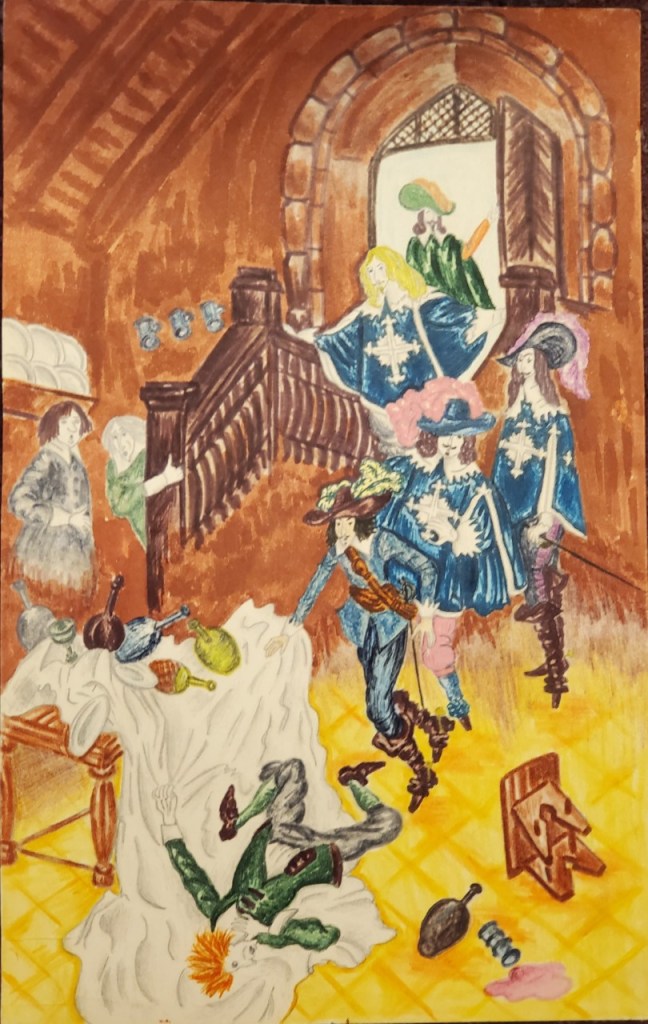
In my childhood, the counterlife was galloping through the vaguely unimaginable streets of Paris with the musketeers.  It was pure fantasy, as I never expected to walk the streets of Paris any more than I expected to walk on the surface of the moon[2]When Did the Arc de Triomphe Start Leaning? – Old Lady Writing

At some point, and I do not know when exactly that border into adulthood was crossed—and the crossing was, I imagine, inevitable—book characters stopped appearing in my reality.  Or, more accurately, I stopped going into theirs.  A certain detachment occurred where, while I remain entertained, enlightened, educated, and generally touched (and occasionally irritated and even bored) by what I read for pleasure, it is no longer my alternate reality.  It is just that—entertainment, education, etc.  It is enough—of course it is enough, there are so many great books that I have read and have yet to read—but I sometimes miss that untamed fantasyland of my childhood, where every story was examined through the lens of how it could play out in counterlife, and where I tried every character on for size as a potential friend or alter ego. 

It is unavoidable and logical, but it is occasionally sad when I stop and think about it.  That wild inventiveness would be very helpful right now, as the global pandemic still rages, theaters are still closed, and non-fictional friends are still remote.  This might be a good time to work on breathing new life into the counterlife… 


[1] Thank you for introducing this term in “The Glass Hotel”, Emily St. John Mandel.  I have always said “parallel universe”, but that implies, I think, something more impossible rather than improbable.

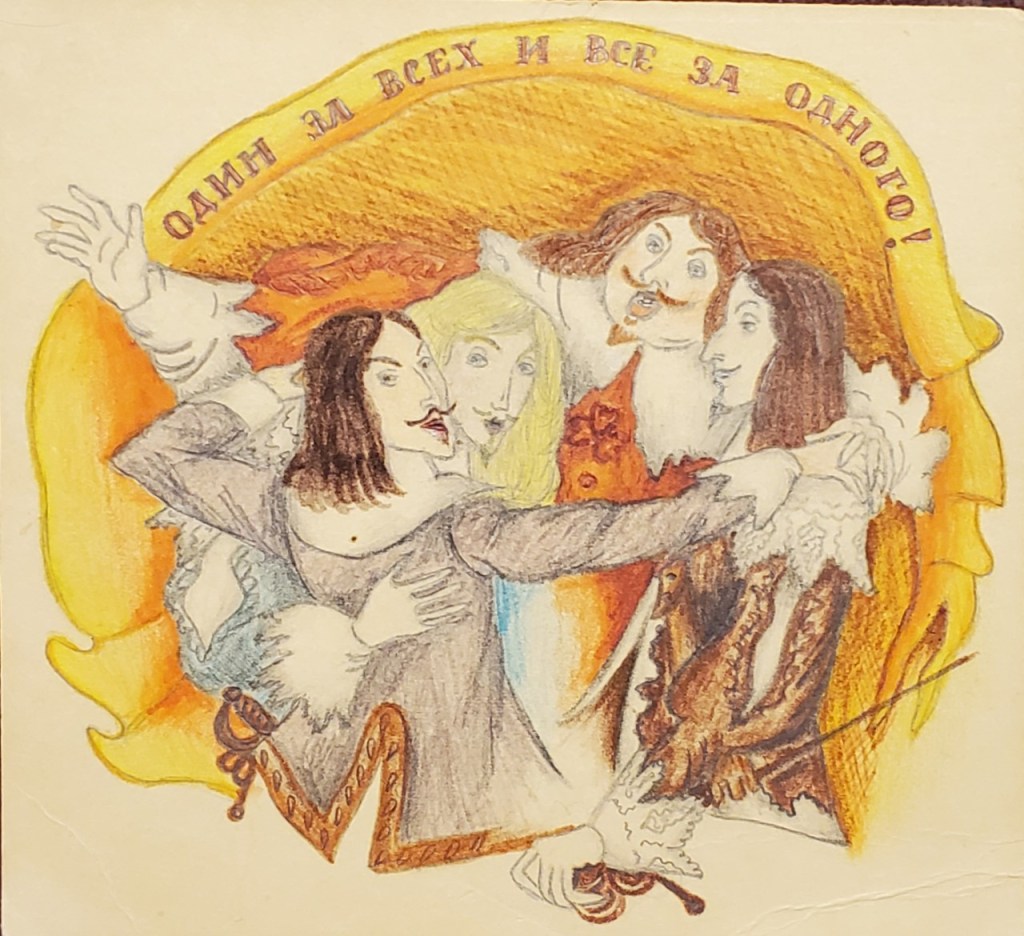
[2] I might add that the vast majority of my childhood literary heroes were male.  I am of the generation and culture that was not bothered by that.  In the childhood reenactments that I held with my girlfriends, we WERE the musketeers. I even won the top prize at a school New Year’s party, dressed as a musketeer in a costume made by my mom, wielding a plastic rapier, and performing the famous “Song about the sword”. What did I win? Probably an orange. Valor and Glory of the Motorbuilders – Old Lady Writing

“One for All and All for One!” Again, by the author.

The Road Not Taken

I used to think that nothing of interest happened in 1987.  No, really, when I look back on my life, it seems like the year that was boringly sandwiched between 1986 (graduated from high school, mother moved away never to live anywhere near me again, started college) and 1988 (that exciting summer in Europe, which changed my life and my personality for the better).  But 1987?  In the spirit of reflection, I have occasionally struggled to recall what it offered, and ultimately had to refer to my long-forgotten diary.  And so, here is what 1987 contributed for the good of the order (after removal of 99% of content consisting of petty interactions with frenemies, quasi-romantic interests, and neverending purchases of Monkees paraphenalia; no names changed due to expiration of statute of limitations):

 “Strange: exams are getting closer, but vacation is not.  The most disgusting thing is that now I have Friday classes—studying lions, birds, dinosaurs, and French playwrights”.

“Darlene [dorm roommate] moved out and will never return again.  And she took the rug with her! (but reimbursed me)”.

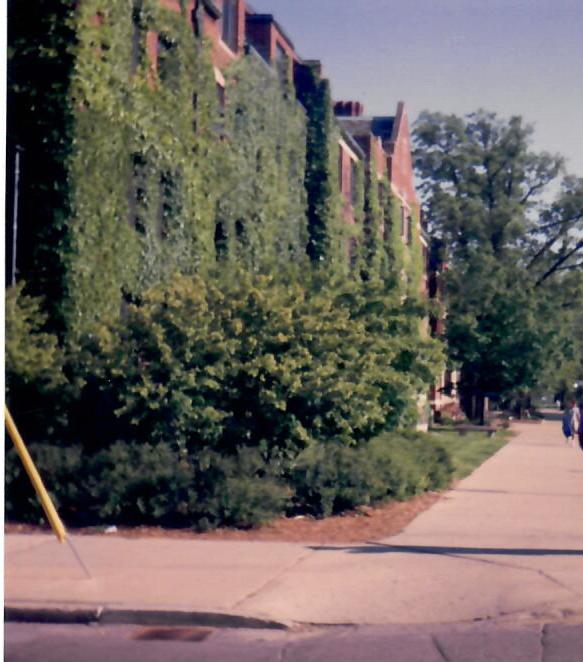
Don’t let the ivy fool you. A dorm in the ’80s was a miserable place to be.

“Kerri and Susan are planning to pose nude at the art school.  They will get paid $6 per hour for this, which does not seem like great compensation to me.  I might have decided to join them if I weighed 60 pounds less”.

“After poli sci I went by the bookstore, looking for some textbooks (didn’t find any)”.

“I am applying for citizenship, by myself.  To this end, I had to get fingerprints and photos.  I went to the police and took the bus to AAA, because I was too tired to walk.” [I find it ironic that a very shy and relatively busy 18 year old college freshman bravely handled a task for which her adult version gets paid as her day job.]

[Hanging out with dorm neighbors]:  “I drank a bottle of wine cooler.  Robin drank three.” (Thus is destroyed the myth that I never drank in college)

“Today nothing happened, if you do not count that I sang in the choir for almost three hours, and now have a slightly sore throat”.

“Today I signed a rental agreement for next [school] year.  It is a studio apartment with a window facing a brick wall”. [How I loved that apartment!  I lived there for three years]

Apartment building on the right. Brick wall of the neighboring building one the left.

“I was kicked out of class.  Five minutes before the end, zoology professor told me to go out into the hallway because I was talking throughout the entire lecture.  Class was incredibly boring, I have a cold, so perhaps I was talking louder than usual.” [This is still in the top three of the most embarrassing things that have happened to me in my lifetime]

“I have been wearing contact lenses for five days now.  Good thing I do not have three eyes!”

“I think that when I will finish my paper about the League of Nations, life will immediately become better”.

[Five days later] “Although I already finished my paper about the League of Nations, life did not become immediately better”.

“Today I was registering for next term.  I wanted to take American politics, something about “person and the law”. Of course, everyone is attracted to the magical word “law” like bees to honey.  Some of us want to become lawyers…  Class was closed and I ended up 31st on the waitlist.  So I registered for 20th century Russian literature, just in case.  If we will study Bulgakov, that’s OK, but what if it’s Pasternak, Nabokov, or even Solzhenitzyn?!”  [There was neither, or maybe I just forgot]

“Life is flashing, like in a silent movie.  Should I sum up the year?  I got Davy Jones’ autograph, became an American citizen, started working.  A lot happened this year, but overall I am happy that it’s over”.

But not so fast!  Buried in the middle of that year, on July 20 to be precise, is an innocuous paragraph about my grandmother calling, overwhelmed after hearing Sergei Dovlatov on Russian language radio program.  He was reviewing the edition of the almanac of the Russian writers abroad, in which two of my stories were published:  “Supposedly he said that he was utterly stunned by the stories of an 18 year old who not only did not forget her native language but instead perfected it.  To top it all off, he compared my writing to early work of Paustovsky [a particular favorite of mine, a writer of great lyricism and sensitivity, and a Nobel prize nominee, no less].  Funny enough, just the previous year I was lamenting how unlike Paustovsky is my prose.  And then I wrote a story that raised me to these heights, if Dovlatov is to be believed.  And I believe him, because he gains nothing by flattering me.  He does not know me, unlike relatives, who are impressed by my writings simply because it’s me.  Overall, I am awfully pleased.”

Konstantin Paustovsky – Wikipedia

How did it come to pass that this highly complementary review of my work by Dovlatov, one of the most prominent Soviet émigré writers, a friend of Joseph Brodsky, only the second Russian (after Nabokov) to have been published in The New Yorker, was not just the most significant event of that year, but not the turning point in my life?  Why did I not think to contact him, make a connection, ask for advice?  I have always maintained that I am most assuredly not a writer—why was this not the validation I remember desperately needing? 

Sergei Dovlatov – Wikipedia

Dovlatov died in New York City in 1990, right around the time I arrived there to start law school.  I have not written any fiction since then, and I stopped writing in Russian.  This is merely a coincidence.  But now, from the distance of three decades, the poetic injustice just seems so staggering.  I don’t want to make too much out of it, this road not taken, but today I need to take some time to grieve for the person I might have been.

Sergei Dovlatov – Russiapedia Literature Prominent Russians (rt.com)

  • Anticipation of happy days is sometimes much better than those days. (K. Paustovsky)