Pont du Gard and the Plague

In my adult life, I developed a fear of the plague.  I blame two fictional sources for this:

  • The film “Horseman on the Roof”.  Apparently it is based on a novel, which I have not read, and is set during the 1832 cholera epidemic in Provence.  Something must have gotten lost in translation and/or in my memory, as the latter is absolutely convinced that the story is about The Plague.  In all fairness, cholera is pretty nasty, too.  The film was made in 1995, and I would have seen it on video some few years later, so I have been frightened for 20+ years now. 
  • The book “Year of Wonders” by Geraldine Brooks. I read it in 2004, and have been *legitimately* frightened for almost 16 years.  It actually is about the plague, though the one from the 1600s, not the Black Death of the 14th century.  Which just goes to show that whatever century or whatever contagion, they are all awful[1]

Until literally three days ago, I assumed that the fear of the plague was the same as some of my other phobias, such as the irrational dread of large statues. (Yes, the Statue of Liberty is pretty much my worst nightmare.  I choose not to read too much into that…)  Turns out, the plague is back. 

Actual toilet paper purchased by me in France for no other reason that it was needed at the time. ‘What an auspicious purchase!

I am not making light of it.  Like everyone else, I am trying to adjust to the ever-changing environment in which the toilet paper is scarce like it was back in the USSR, borders are closing (like they were back in the USSR), and no one trusts the government as a source of correct information (I think I see a pattern…) Unlike many other folks, I spent the last week in France, and gained some unexpected perspective.  Spoiler alert:  I think that cancer or work-stress-induced-heart-attack are still my more realistic foes in this lifetime.

I had three modest goals for this past week in the South of France:

  1. To see the newest D’Artagnan statues.  Until the last decade, there were three in the world; now there are five.  If I had to drive for several hours to a couple of French villages to complete this quest, well, I did.  Of course I did.
  2. To see the Palace of the Popes in Avignon, and hopefully locate the mural of Gerard Philippe nearby.  Done.undefined
  3. To stop by my old stomping grounds in Nîmes.  This did not happen.  We woke up on the day for which we scheduled this visit to the announcement that the US borders were closing the next day.  Supposedly US citizens would still be allowed to enter the country, but tell this to someone with a different family history.  This refugee rallied, got on a train from Perpignan to Paris, and flew out of Paris as soon as Delta would let her on a plane.  Home is where the dogs are.  And a paycheck.

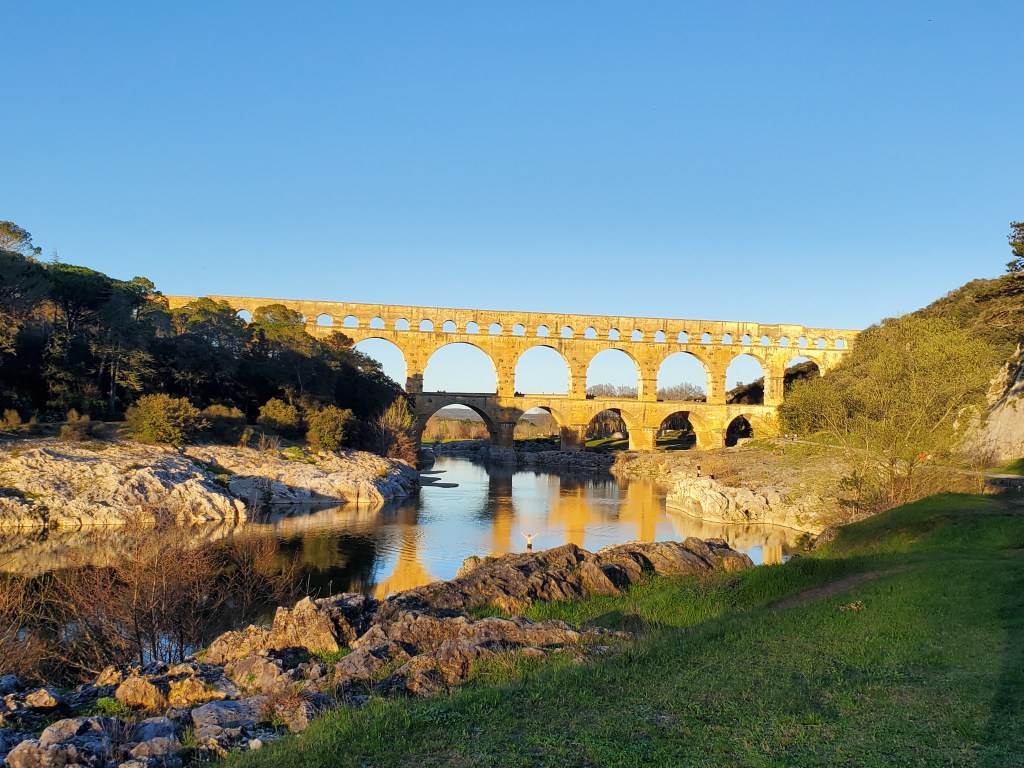
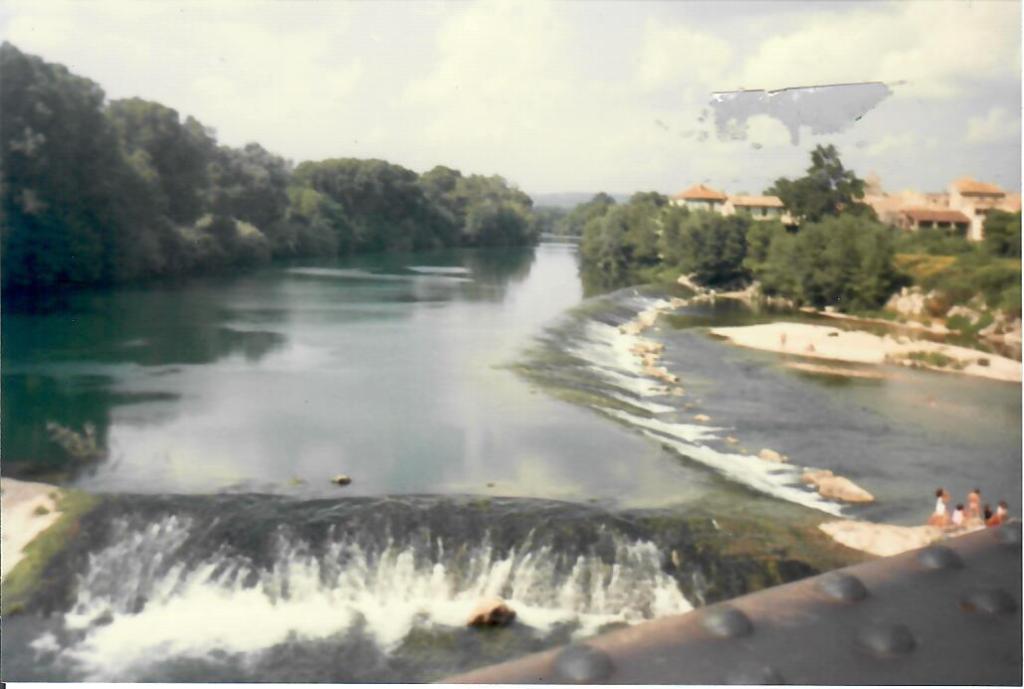
The last official day of vacation, on the way back from Avignon to our timeshare, we stopped at Pont du Gard.  I did not intend to stop there, because I had the most vivid memory of my previous visit there. Yes, it was during “that summer that I spent studying in France” https://oldladywriting.com/2019/06/09/when-did-the-arc-de-triomphe-start-leaning/.  It was such a good day!  I mean, I acutely remember it as a *Good Day*.  It was June of ’88[2], the sun was shining, and I was surrounded by friends.  Our summer program included an art class, so some were drawing the bridge.  I took two photos, which in the day of pre-digital cameras was the rough equivalent of the 19 I took this second time.
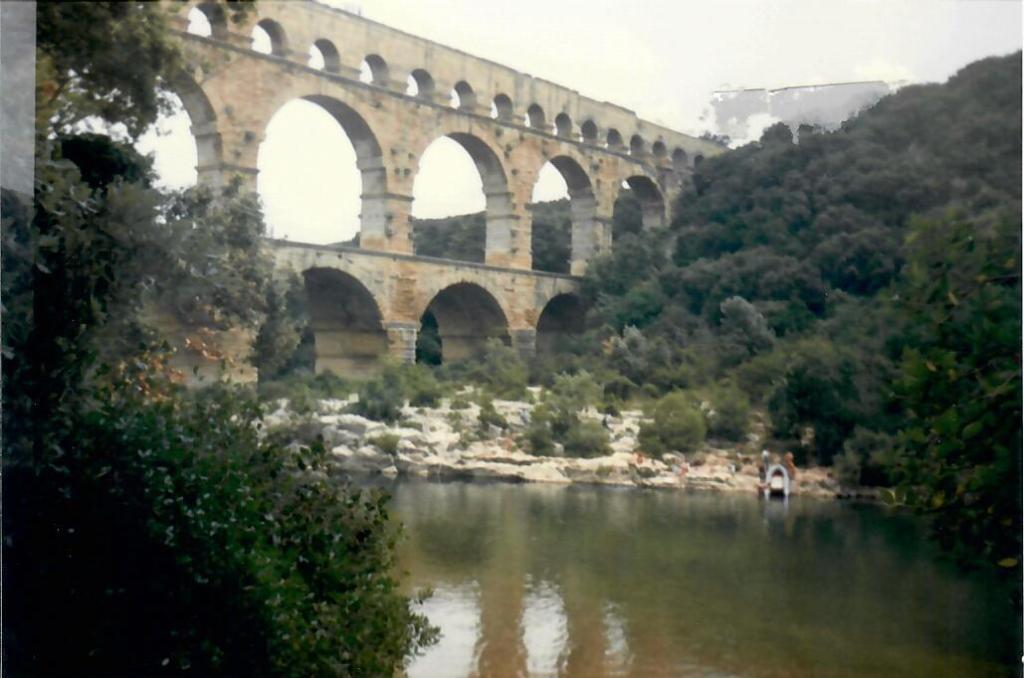
Pont du Gard then

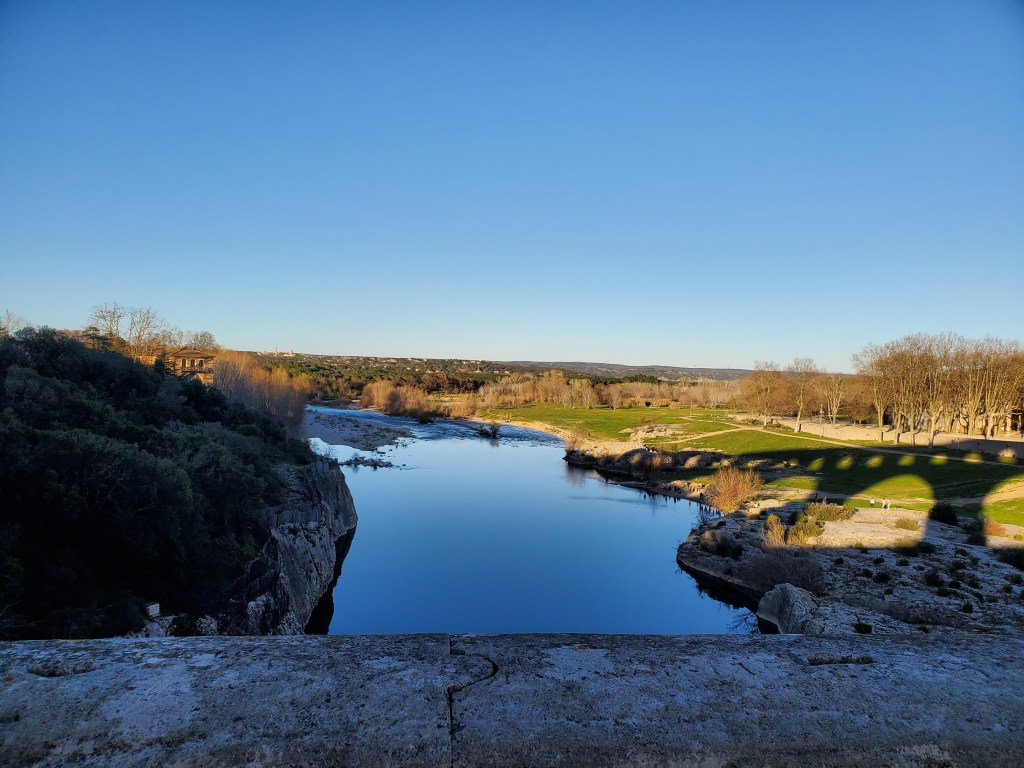
We went to Pont du Gard this past week because it was on the way, and we had time.  We waffled a little, because it costs $10+ per person to get into the surrounding area.  But if I have learned anything in this life it is that you cannot put a price on regret.  So we paid and started walking.  And there it was, standing since shortly after the death of Christ, towering through millennia over The Plague, my friends and me, my spouse and me, impassively watching people come and go, sun shining, river flowing, and the aqueduct still standing.
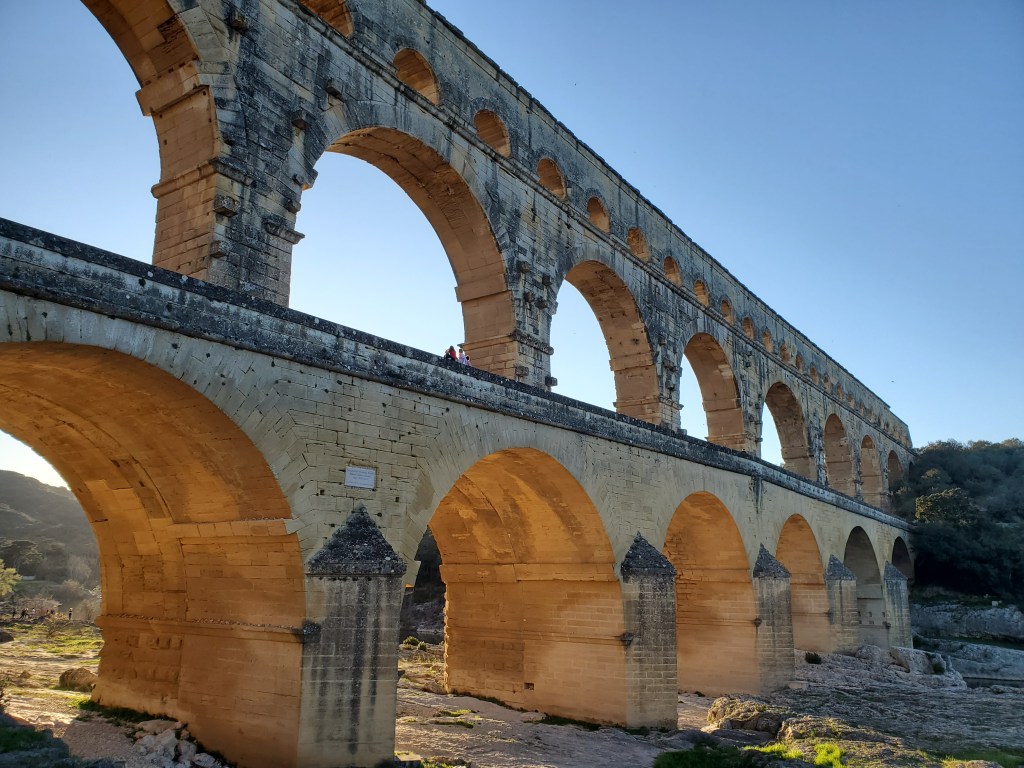
Pont du Gard now

It has been almost 32 years.  I have lost touch with all but three of the people in that group.  Yet on the last day of my “Feast During the Plague”, I felt surrounded by their ghosts.  I have never missed KIES Group ’88[3] as much as I did during that time and in that place! 

So, the ghosts of my friends from 1988.  The majestic mass of that huge ancient Roman aqueduct from the first century A.D.  Spouse and I, having a *Good Day*.  And I kept thinking, I’ve had an interesting life.  I was fortunate enough to see and be seen at this site twice in the past two centuries.  And I am still in touch with three of the people who shared that incredible summer with me, and share the memories of that day.  If the plague gets me, I have lived[4].  If the plague gets me, the bridge still stands.  Lalalalala….life goes on!  And that is how Pont du Gard helped me to deal with my fear of the plague. 

[1] Unrelated to this topic, I love Geraldine Brooks’ books except one.  I cannot recommend “The Secret Chord”.  It is shockingly violent.  I would rather read about the plague of any kind.  As of this writing, she has five novels out.  Read four of them in this order: “Year of Wonders”, “People of the Book”, “Caleb’s Crossing”, “March”. 

[2] June 28, 1988, to be precise. I know this, because I had to keep a diary in French for class.  Apparently I did not swim, because I felt fat in a bathing suit.  But it was still a great day!

[3] KIES—Kentucky Institute for European Studies.  Now it’s the Kentucky Institute for International Studies or KIIS (pronounced like “keys”), a consortium of public and private Kentucky colleges and universities which administers a variety of international studies programs in Central America, Europe, South America, and China. It was founded by Murray State University in 1975.  Back then, it was just Europe.  And it was incredible.  That summer changed my life, and unlike many other life-changing events, it changed it for the *better*! 

[4] But I am still betting on cancer or death-by-stressful-job.  Not morbid, just realistic.
Liechtenstein

That summer that I spent studying in France , https://oldladywriting.com/2019/06/09/when-did-the-arc-de-triomphe-start-leaning/ I decided to visit every country in Europe.  The Eurail Pass made it seem like an actual possibility, if not a likelihood.  So how did I do it?  Well, I did not, because a couple of caveats were built into this very vague plan, including:

  • British
    Isles did not count, because the Eurail Pass did not include them
  • Soviet
    Bloc did not count, for obvious reasons (it was the ‘80s, friends)
  • Germany
    and Austria did not count, also for obvious reasons

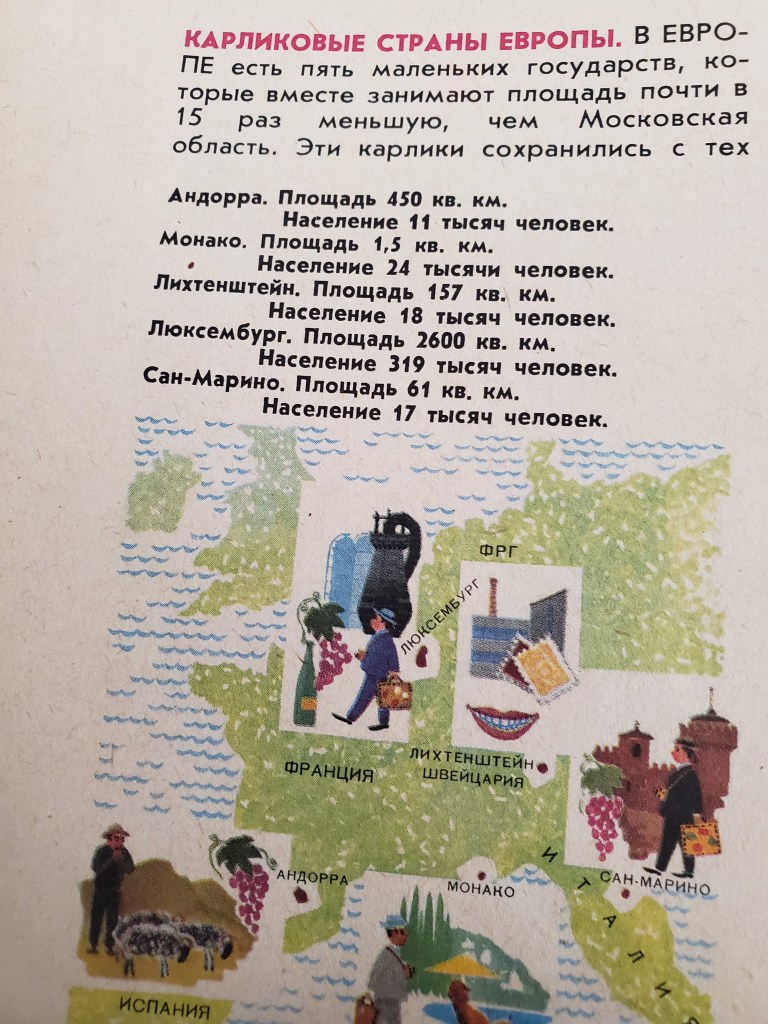
What did count were the “dwarf states”[1].  I first read about them in my beloved childhood encyclopedia, “What Is This, Who Is That?”  My mom bought it the year I was born, so as of this writing, pretty much all the information in it that does not pertain to fish or ancient history is outdated.  Even the fact that Malta is not included in the article on microstates is pretty telling—it was still part of the United Kingdom.  Yes, I date back to Malta’s pre-independence days!  Plus, it was published in the USSR, so literally, all the post-Renaissance history articles are pretty skewed. 

Liechtenstein is the one with the stamps and teeth. There is a stamp museum there, which we did not visit. I am not sure about the teeth. Unless they are just signifying a welcoming smile?

The original article listed, as anyone who can read Russian can plainly see on the attached, but I will translate for the rest, Andorra, Monaco, Liechtenstein, Luxembourg, and San-Marino.  Currently in Wikipedia, we currently also have Malta and Vatican, but not Luxembourg.  What happened to Luxembourg?  I suppose since it is bigger by area and population than all the others combined, by all means let’s exclude it.  I *have* been there, and survived a traumatic experience of being [almost] attacked by a knife-wielding maniac at a cemetery—but that is another story for another time! (I might be saving it for my memoirs)  And as for Vatican, it goes without saying that the Soviet version would make no mention of it under any circumstances, because “religion is an opiate of the people” (Karl Marx said this, not I).

And so, during that summer, I already had Vatican under my belt, having lived as a refugee in and around Rome some years before then, and then proceeded to have that encounter in Luxembourg[2].  In the past decade, I travelled to Malta (which is literally the most perfect place in terms of weather, history, food, ease of getting around, and the fact that all the signs are in English even if no one actually speaks it), and Monaco (which is also cool in many ways but is the opposite of easy to get around.  I mean, when there are elevators to get you from one street to another—take them!  Do not, I repeat, do not brave the stairs!)  I still have not been to Andorra or San-Marino, and frankly, they are a bit off the radar for me.  Someday—but not today, as I say. 

So when I planned the vacation to Munich for Oktoberfest this year[3], I noted how close Liechtenstein is.  Driving there was one of my motivating factors for renting a car, because I already learned from that European summer that the train does not stop in Liechtenstein.  It literally does not have an international train station!

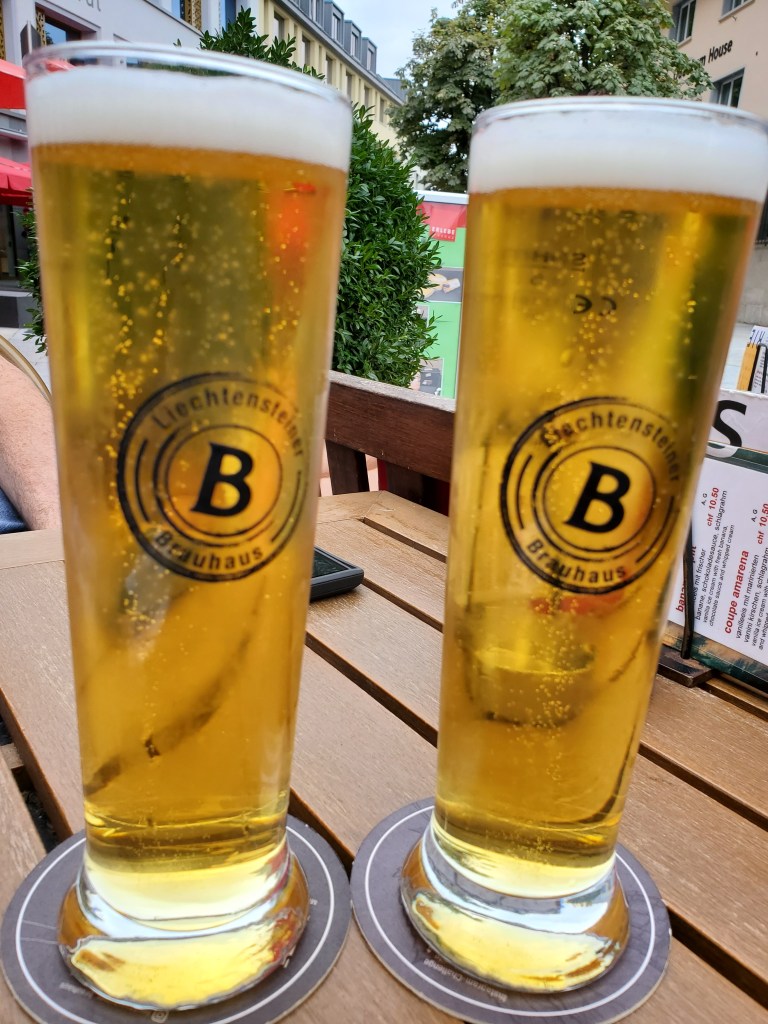
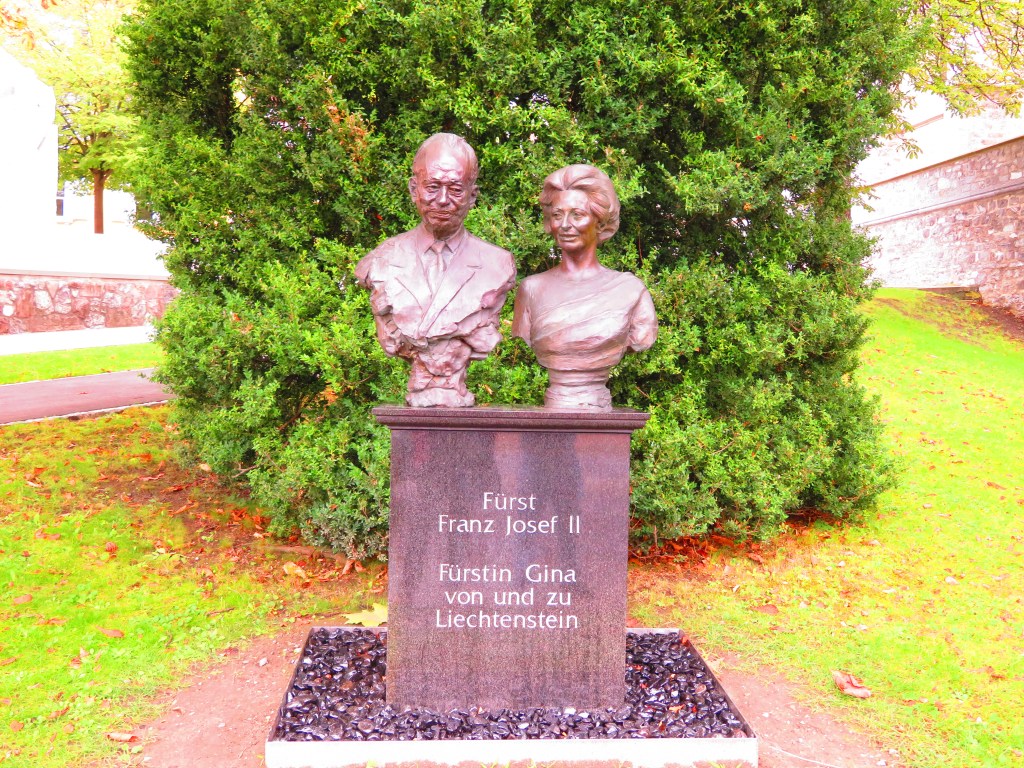
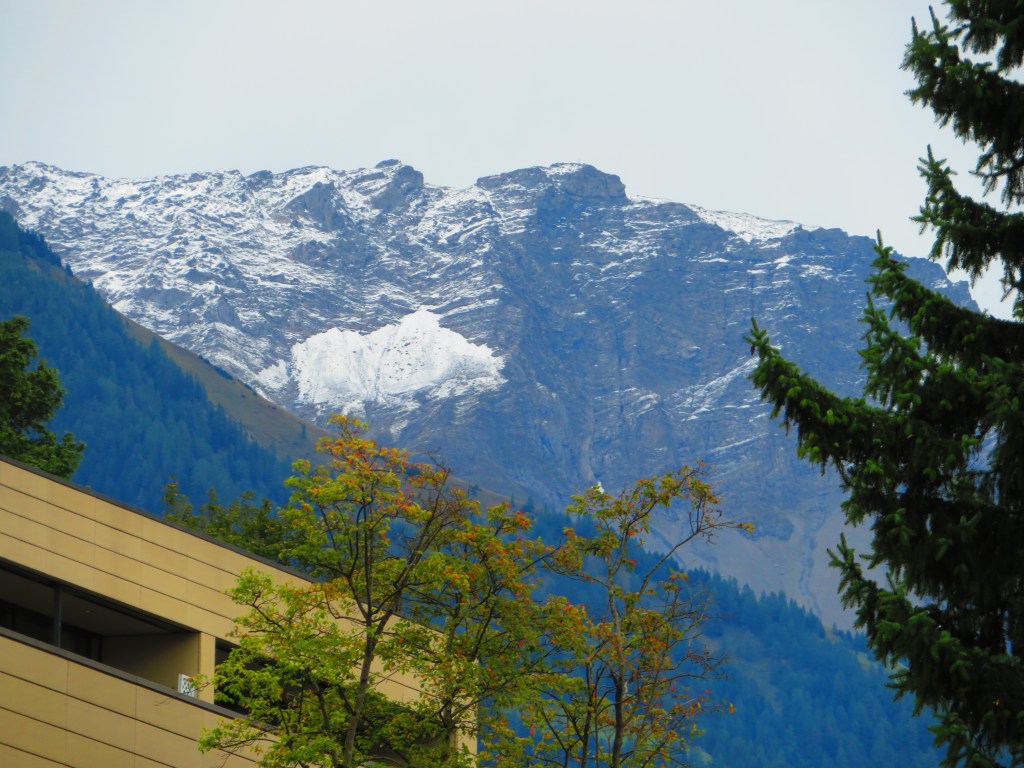
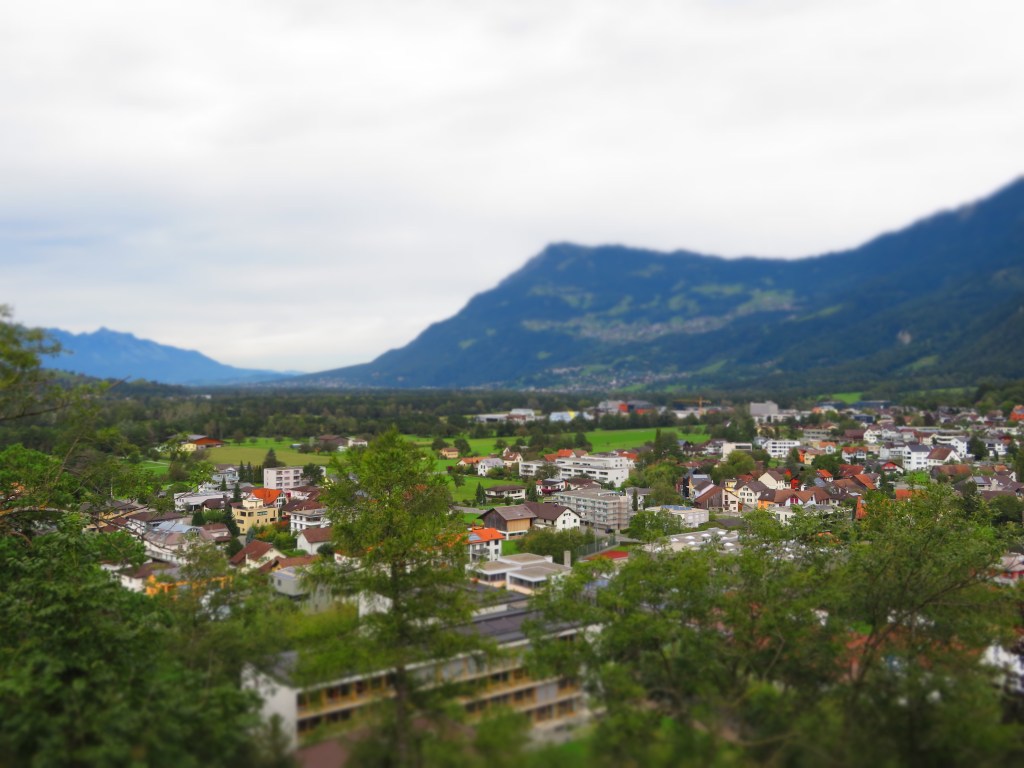
I could not find a tour book on Liechtenstein, so spouse and I decided to improvise.  We pretty much just drove into the country and looked for parking.  Everything is right there: a beautiful cathedral, an interesting history museum, and a town square with souvenir shops and cafes.  There is also a medieval castle within a short drive—it is apparently in a different town from the capital, Vaduz, which is basically one street over[4].  The views are breathtaking, since Liechtenstein is ¾ Alps.  The beer is not bad, though not as good as three countries over in Germany.

In short, I would highly recommend a visit to Liechtenstein, if you happen to be in the Alpine neighborhood, and like picturesque towns.  Do I feel like I visited a different country?  Well, not necessarily, but I do have another flag to prove that I did[5]!


[1] I apologize for the use of the term “dwarf” to anyone who might be offended by it.  This is, again, a direct translation from the Russian language, as again can be seen from the attached illustration.

[2] Faux-dwarf!

[3] I travel to Germany now.  My, how the world has changed!…

[4] I did not realize it was a different town until I looked it up just now.

[5] Fun fact—I collect flags from the countries I visit.  Soviet Union and Russia merit their own separate flags, as does the Republic of Texas.

Father’s Day Part II

I meant to add this as a follow up to Part I.  Like for Rose Tyler, it is certainly an unexamined subject for me.  I never had a father.  Well, strictly, it is not true.  He has always existed in the ether, and walks the Earth today. 

Here is how we first met.  Back in the pre-Afghan invasion days, before the Soviet Union reinstituted the draft, young men were only conscripted if they were not in college.  Those pursuing a higher education were exempt from the brute service.  My father failed out of college and was immediately snapped up.    One fine day during my fifth summer, I was told that my father was coming home.  I was made to wear a hideous sleeveless blue dress with pink trim, and have not forgiven my mother for it to this day.  It was made in Egypt, and had a head of Nefertiti on the inside tag.  It freaked me out, and I hated the dress because of it.  I also hated how my bangs were pulled back in a bow.  It seemed a lousy first impression to make on my father.

He arrived with a bouquet of flowers for my mother, and I recall turning away from a hug.  He was a stranger, and it was all completely embarrassing.  I lived with my grandparents, and young men were scarce in my world.  He was probably about 25 at the time.

I think my parents were only together for that one summer.  Several memories I have of that time are as follows:

Living with my other grandparents.  They had a two bedroom apartment. It was a standard and familiar layout of the times. I remember they had a vase on the floor with cattails. I must have had the urge to pick at them.  I probably did.  My other grandmother, who, as my father later confirmed, disliked my mother and her family (and me, I certainly felt so), was ironing a beige dress with white lace that I had and ironed out a crease on the front.  It was the design of the dress, and I protested, because “my” grandmother would not do such a thing.  She responded that she was also a grandmother of mine.  Whatevs, lady.  I never believed her, and she never really was.  I addressed her with the polite “vy” instead of the familiar “ty”, which irritated her.  I do not even have a photo of her. I would not know her in this life or the next.  She died just a few years ago. 

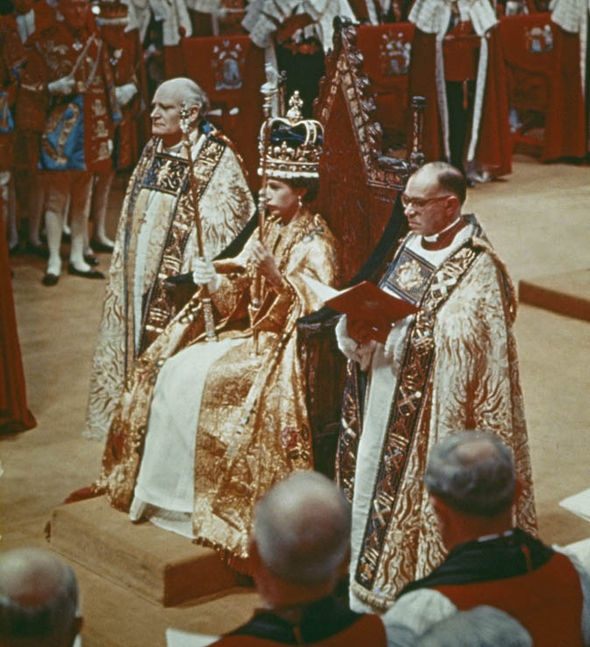
Toys. My other grandparents presented me with some cool toys.  There was a set of amazing dollhouse furniture, which I regrettably did not treasure.  Of course, it would have never made it to America anyway.  What did was an old Viewmaster which my father must have had as a child when his parents lived in India.  It had some amazing Western shows, such as a three-disk set of “Bambi”, “Three Little Pigs”, “Little Black Sambo” (it was a long time ago…), coronation of Queen Elizabeth II, lots of brightly colored parrots and one monkey (there is always one monkey), and incredible views of faraway Asian lands, particularly Mount Fuji and the Taj Mahal.  I brought it frequently to show and tell in my Russian school.  The collection made it to America but not past high school. When I went away to college, I neglected to supervise, and my mother, predictably, lost it.  It is a damn shame.  Damn shame.

Aunt.  My mother is an only child.  My father has a younger sister.  They seems to have retained a close relationship to this day.  She was a college student at the time, and he encouraged me to shake a fist at her and yell, “We will show you, students!”  Only recently did I learn that this was because of the famous Shurik the Student movie, “Operation Y”.  My father must have been a fan.  My aunt Tanya seemed a benign, but nondescript, presence.  I remember almost nothing about her.  My father was allowed to name his newborn baby sister Tatiana, which is apparently his favorite name.  He suggested it as a name for me, but of course my mother had to step in without something less “common”.  It appears that my father did not get a vote.  He managed to prevail with my sister, who has a different mother. 

Car.  My other grandfather had a car.  It was huge and green and white, but maybe it wasn’t either.  My father must have known how to drive, because I recall sitting in the front, which is quite illegal for very young children, Soviet Union being no exception, and he admonished me to slide under the dashboard if we saw the road patrol out in the country.  Great parenting right there! 

Not my other grandparents’ actual dacha

Dacha.  My family never had a dacha, a “beyond the Volga” country home, because my grandfather worked all the time.  It was not that my grandparents could not afford it, but more that they did not want to be bothered with working the land.  Besides, pretty much everyone we knew had a dacha.  My other grandparents’ dacha was a two story construction, which was very exciting.  The second story was some kind of a loft where my parents slept.  I wonder if that is what caused my affinity and longing for lofts.  I have never lived in one.  My father’s paternal grandmother was still alive at the time.  She seemed ancient.  She was dressed all in black and sat on the steps of the dacha and yelled at me whenever I ran in or out of the house.  I have no recollection of her being elsewhere, just on the steps of the dacha. 

And then there were the pranks.  Tall, handsome, fair, young, my father was not really a parent, but a fun older brother type.  One time we came to pick my mother up from work (he was not working—not then, not later).  My mother worked at the Synthetic Rubber Plant.  There was a mean old Soviet woman guarding the exit.  It was a secure facility, and those without authorization could not enter.  I saw my mother walk toward us down a long hallway.  Father urged me to run to her, past the mean woman—and I did.  It was, of course, unimaginable, but it was fun!

Another time we were waiting for my mother to come home.  My father came up with a basic, but ballsy, plan of cutting out eyes in a sheet, putting me on his shoulders, and scaring my mother as soon as she entered the apartment.  It was hilarious.  He was so much fun!

I never had any grievances against my father.  He was—and, I am afraid, remains—a stranger, but the memories are mine and lovely…

The Three Monuments

The Three Monuments

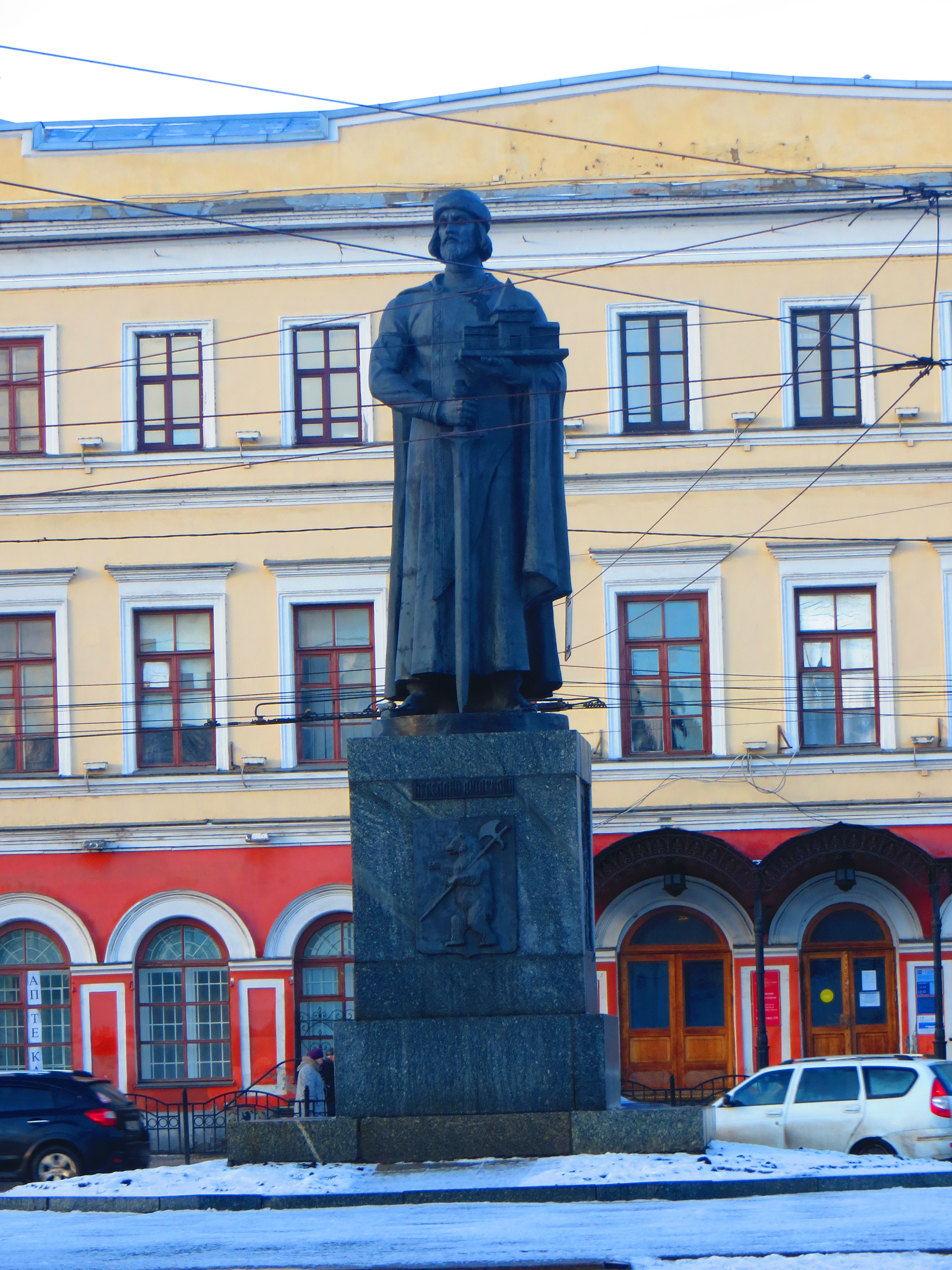
~Yaroslavl, capital of the Golden Ring of Russia and the oldest of the Volga towns, was founded in 1010 by Yaroslav the Wise, a prince of Kievan Rus.  Legend has it that Yaroslav went North and found a friendly spot by the Volga on which he would built a city.  A bear came out of the woods and charged at him. Yaroslav killed the bear with an ax. Almost a decade later, he became the Grand Duke of Kiev. He ruled wisely and well, despite his one known act of cruelty to bears.  He built the famous Cathedral of St. Sophia (which houses his tomb and the incredible fresco portraits of his family) and the Golden Gate of Kiev (cue Musorgsky’s “Pictures at an Exhibition”), and established the first Russian law code, Russian Justice.  Still, the town on the  Volga is his greatest achievement.  Memory eternal!

Yaroslavl on top, bear on bottom. But notice who is holding the ax…

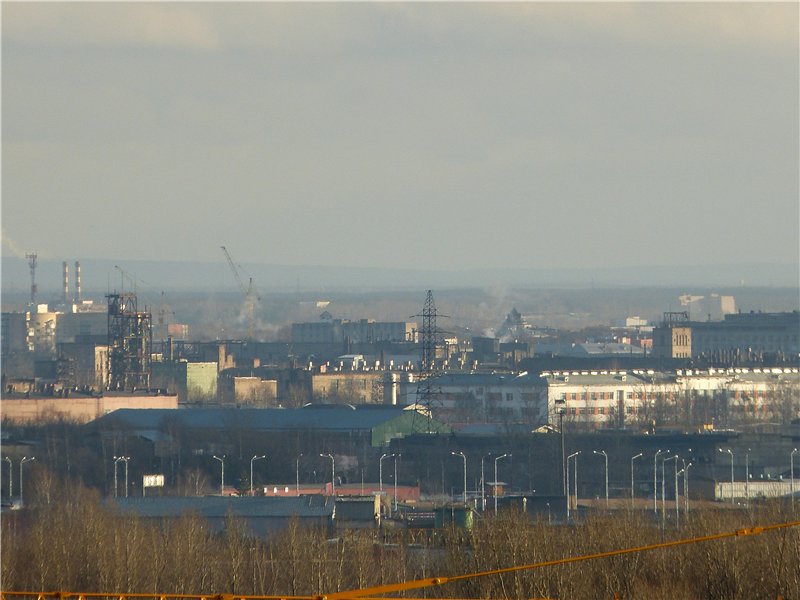
In Yaroslavl, time did not quite stand still, in terms of keeping up with internet and other modern conveniences, such as resplendently stocked grocery store shelves.  However, the general character and look of the town did not change.  One very comforting feature is the profound lack of attention to the destruction of the relics of the past—whether the long past, or *our* past.  Just as the name of the town never changed during the Communist era, but continued to evoke the long ago Grand Duke of Kiev who famously conquered a bear with his ax, so did the Lenin and October Prospects remain thusly named in the Yaroslavl of the Russian Federation.  And just as the 17th century churches were not detonated during the three quarters of the 20th century that comprised the entire history of the now defunct country of my birth, but merely consigned to store potatoes, so do the imposing monuments of that country remain as the scattered guideposts of the city today.  There are two Lenins; there always were the two Lenins.  One is standing on the Red Square (many Russian towns have a Red Square) and with his upraised arm shows the way to our bright future.  Meet you *by the arm*. 

By the arm

The other one is sitting and writing in his notebook upon a crossed knee, facing his namesake Prospect, with his back to Mother Volga, with the Soviet Street crossing in front of him.  I remember laying flowers at the base of this sculpture, as it was conveniently located near my school.  Kids were sworn into the Young Pioneers next to this Lenin every year on his birthday on April 22.  Meet you *by the leg*. 

By the leg

And then there is Karl Marx, my favorite monument ever.  I am emotionally attached to it because I remember when it was unveiled.  The year was 1972, if memory serves, and we were going to spend the summer “za Volgoi”, literally “beyond the Volga”, or simply, on the other bank of the Volga.  On the other bank is the countryside, and when I was really small, my grandmother rented a room in a hut in a village called Yakovlevskoye (Jacob’s).  Actually, we had two landladies, one after another, but this is so long ago that I barely remember the first one, Olga something or other. To be fair, I was 2 or 3 years old.  I remember only a very high bed with lace pillowcases, and trying to drown Vanechka, a doll to which I have taken a dislike, in my potty.  My grandmother seemed to have persisted that the doll’s demise was meant to be an accident, but I, in turn, persisted in trying to destroy it.  I do not recall who finally won, but, experience would suggest—not I.   

The second landlady was Anna Loginovna, and I can still see her low ceilinged house with the traditional wood burning stove, and our room with pictures of ladies from the fashion magazines tacked to the walls.  Anna Loginovna’s daughter died tragically during one of the summers we were living with her, when a drunk truck driver plowed through a window of a store in which she was shopping. I remember seeing photos of her in a coffin, stitches on her face, and her orphaned children, a girl and a boy older than me, maybe a teenager and a preteen, sitting forlornly at their grandma’s rough wooden table.  I do not recall, if I ever knew, if Anna Loginovna had other children, or what happened to the two kids, who ultimately took responsibility for them.  But I remember sitting at that table, in that house, almost half a century ago.  But I digress…

We were traveling to beyond the Volga in a bus, the #50.  I was looking out the window, and saw a dreadful and fearsome sight of a block of gray marble with a burlap sack at the top at the intersection of Lenin and October Prospects.  I did not know it then, and had no basis for comparison, but if I extract this memory now, I would compare it to a prisoner about to be beheaded.  The sight so alarmed me that I never forgot it.  Someone (logically, the responsibility would have fallen to my grandmother) explained to me that it is a new monument which will be shortly unveiled.  The ceremony happened during our summer sojourn on the other bank of the Volga.  I was immensely relieved to see that the bag was off his head and it was now an imposing gray torso with a familiar bearded head on what became (or maybe already was) Karl Marx Square.  The clemency shown to the prisoner made me feel proprietary and affectionate toward him.  Meet you *by the beard*.

This image has an empty alt attribute; its file name is img_5430.jpg
By the beard

The Patriot Game

When I was a young girl, Ireland was not on my list of “places I could only visit in my wildest dreams” (or in another lifetime).  So, when another lifetime arrived, I was not even mildly interested.  And who knows why?  Maybe it is just not a place that influenced my culture.  For some centuries, my people looked to Paris—the literature, the music, the films, and, aside from that brazen Corsican conqueror, the history.  Of course, we have forgiven the French after La Grande Armée was soundly defeated by the grander Russian winter.

In the ‘80s, as a Poli Sci college major, Ireland first burst on the scene of my life through a World Politics class.  I was so spectacularly ignorant of the land’s history, demographics, and political structure (and, in fairness, the professor was terrible), that it came as a bit of a surprise to me that the island is divided, in every possible way but geographically.  In that Dark Decade, The Troubles were someone else’s.  Car bombingswere often in the news, the IRA was a terrifying specter of terrorism, and Sinn Féin seemed scarier than the Nazi Party.  Bobby Sands and the other hunger strikers were already dead, and “The Crying Game” was not yet made.  In my mind, Ireland was a lawless, scary place, Belfast was Beirut, and no one in their right mind would go there.  This is how well they taught us in college—or how well I paid attention:  I figured that the entire country was a mess, with Belfast at the center of the steaming rubble.  It kind of sort of did not make sense to me that the island was partitioned and Ulster belonged to Great Britain.  It still totally does not make any sense—the 18 year old me was right on the money!

Quite obviously, I have no Irish roots.  But, many Americans do, and I have a “real American” (as my relatives initially referred to him) spouse.  At some point in our European travels, he started lobbying for an Ireland trip.  When the previous decade’s Big Birthday was coming up, it was his fervent wish.  This is how much I thought of Ireland:  we went to Greece.  (Don’t feel bad for him, he loved it.  Greece is great!  And we did eventually make it to Ireland.)

In the spring of last year, I had an opportunity to go to Dublin for work.  (Yes, there are occasional flashes of brilliance in this job…)  The week following my business trip, “Chess” was starting a very limited engagement with the English National Opera at the London Palladium.  Nigel Havers was touring England with “Art”, one of the best modern plays. And the original “Les Miz” was still at the Queen’s Theatre (sadly, no more, as of the date of this writing, replaced by the 25th anniversary abomination).  So, Dublin, then London, but I had the weekend in between at my disposal. 

In my lifetime, so many “enemies” changed.  As scary as the IRA was in the ‘80s and ‘90s (I know the 70s were even scarier, but not on my personal radar), 9/11 changed all that.  And then it came to me, for reasons passing understanding—Belfast.  I will go to Belfast for a couple of days, just to say I went.  It might be a terrible depressing place, but just the fact that The Troubles are over and I have the opportunity to visit—well, never could I imagine such a thing a couple or three decades before.  I mean, BELFAST!

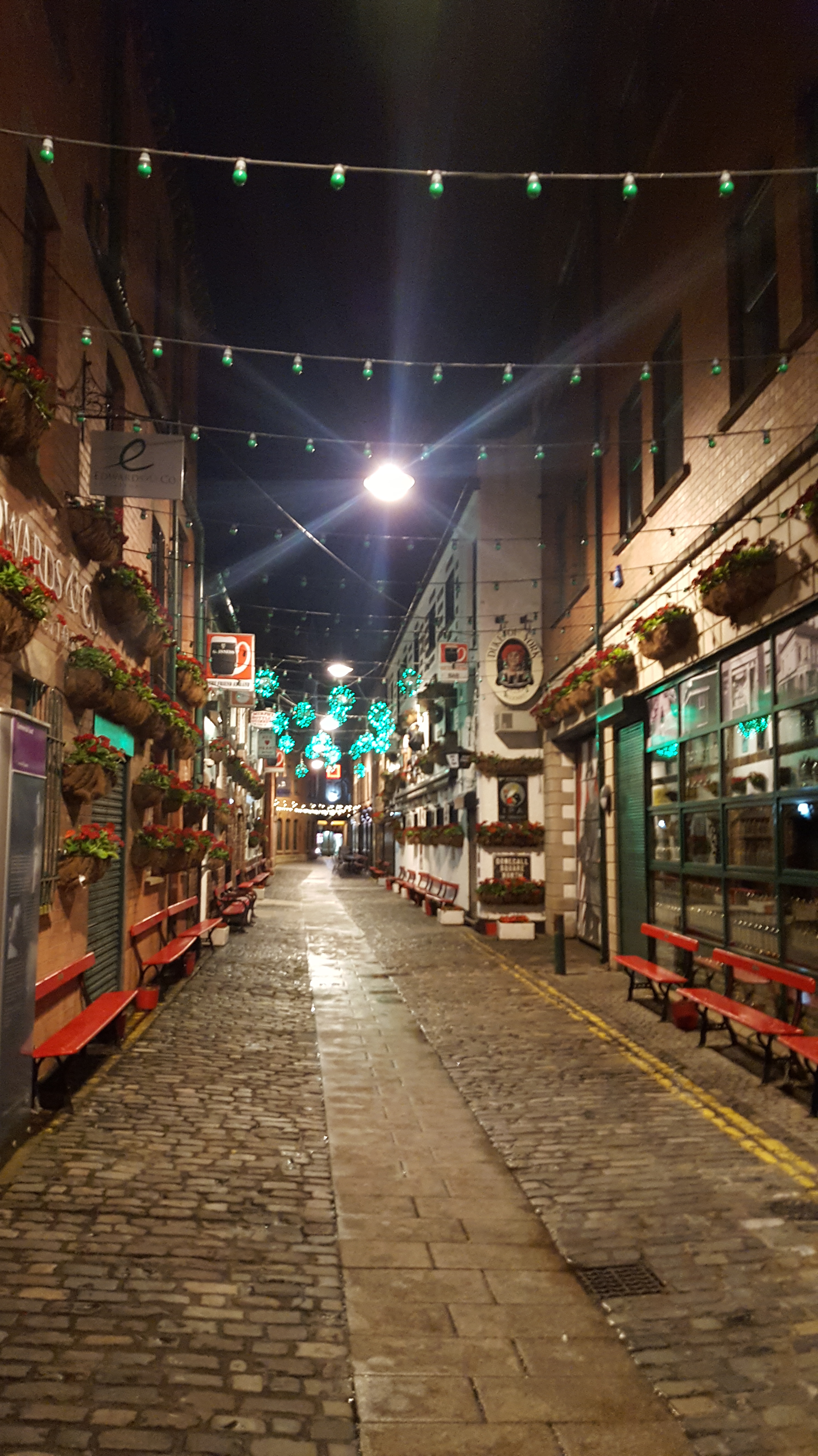
Belfast at night

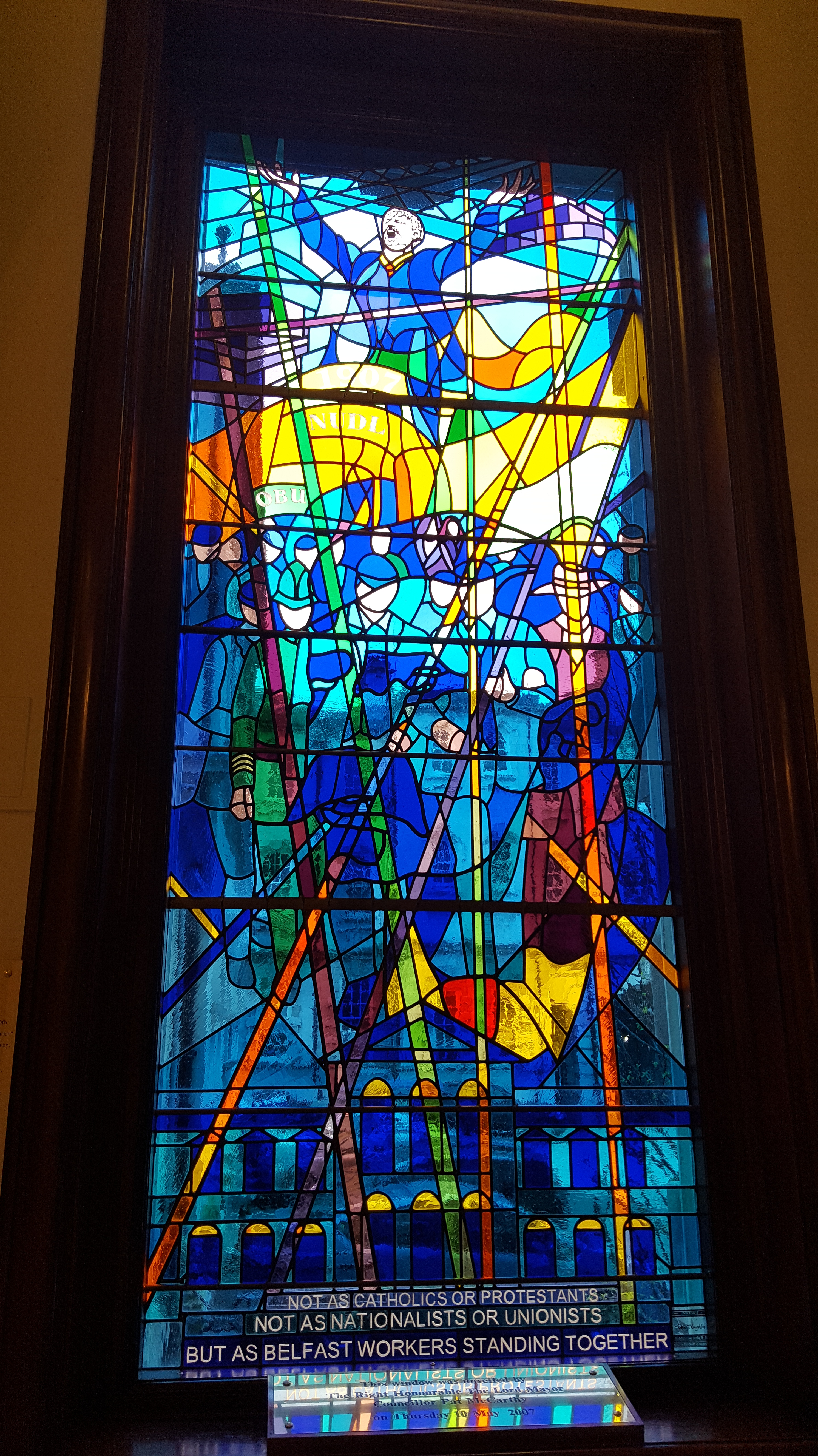
Words cannot do it justice.  Maybe more accurately, *my* words cannot do it justice, because I am simply not skillful enough in describing how this entirely foreign, previously unknown town of sorrow and rebellion got under my skin and into my heart.  I finally not only understood, but felt the history of these people, NOT my people, NOT my religion (on either side, really), yet still deeply moving and traumatic.  I sobbed throughout my visit—the walls surrounding the Catholic enclaves, the murals (oh, those murals!) depicting their struggles for self-determination and the right to join their ethnic brothers and sisters in the Republic, the room in the City Hall with quotes from the families of the disappeared and the murdered… 

City Hall

Dublin is like the continental South—joyful, friendly, party town.  There are some dark moments there, of course, and memories of the Empire’s oppression are alive and well.  But Dublin is a capital of its own country and people.  The Republic is still a comparatively new political entity, of course, but these days, it is a fabulous country with a rich heritage, and God bless it!

The Salmon of Knowledge

Belfast is a Northern city, beautiful but sad, the Empire not a distant memory but a giant wing over the skyline, the memories fresh in their defiance despite the recent reconciliation, the specter of the martyrs ever-present, the separation of religions still a reality, the most bombed street in Europe (not in Stalingrad, not in Dresden) eerie in its quiet, the very ground almost unsteady with the winds of unrest of those few recent decades. 

And what about the IRA, heroes or villains?  Hard for me to say now, after walking through Belfast.  The violence is suppressed, but it all just feels unfair, even to this semi-detached outsider.  In the immortal words of Rodney King, “Can we all just get along”?  It hurt my heart to think of what happened in that city and in that lovely land just a short time ago.  I left a little bit in love with Belfast, and over the past year, I have been aching to return.  It touched me in a way few other places have over the years.  It’s almost as if I find its troubled past enticing.  It’s almost as if I want to go back and be reassured that it continues to thrive.  And, as we say back in the Old Country, what is not a joke to the devil—might we see a United Ireland yet this side of paradise?

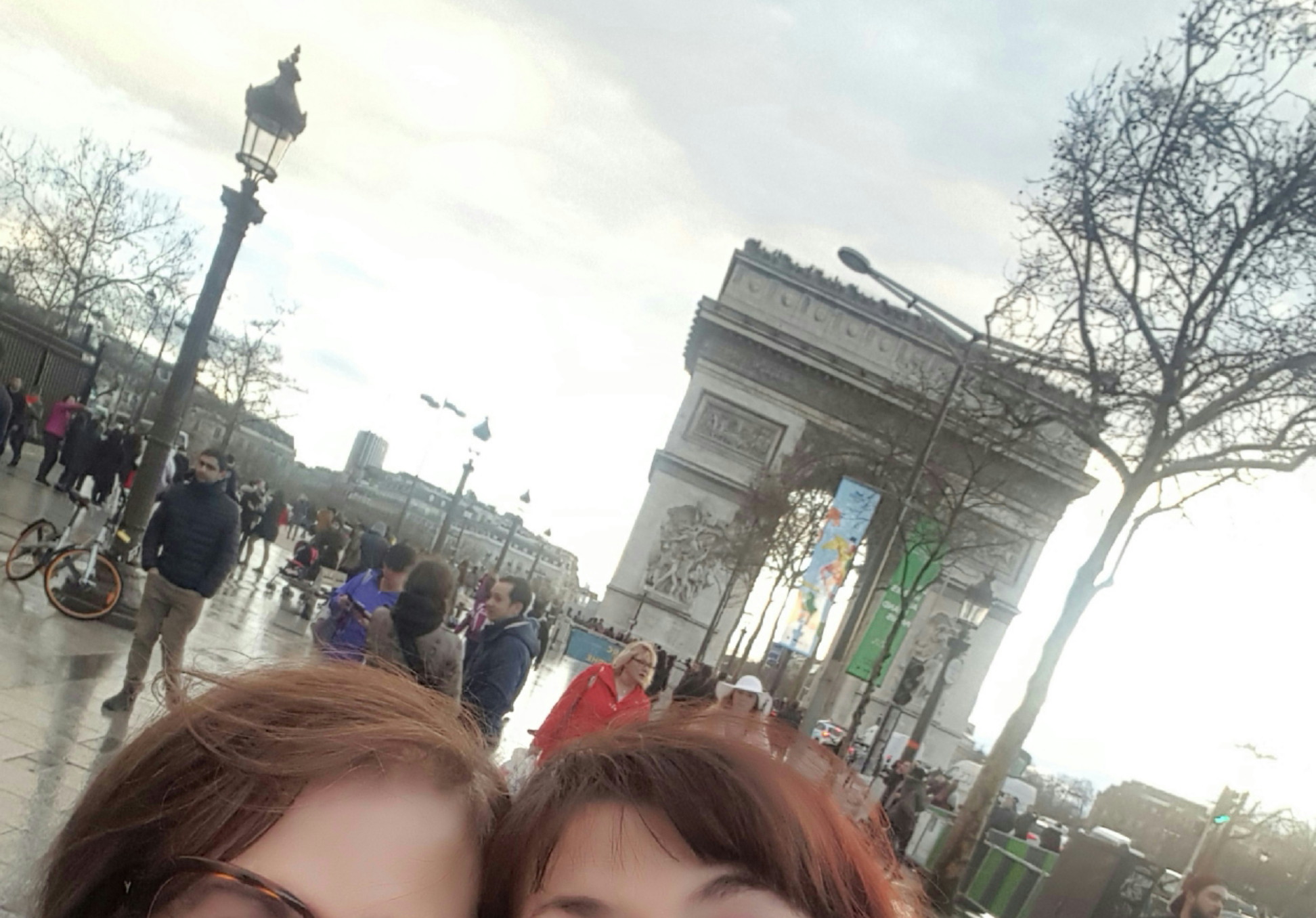
When Did the Arc de Triomphe Start Leaning?

In this lifetime, my relationship with Paris evolved and improved quite significantly.  I first spent a summer there as a student after my sophomore year of college.  It was the best of times, it was the worst of times. Dickens does not mention anything about lack of funds and lousy boyfriends, but that was an overriding influence of my Parisian summer.  Because 19 year old girls are inherently stupid in love (don’t argue, I know this!), spending three months with a total wastrel seemed somehow preferable to spending them without him, albeit in the City of Lights.  If I could travel back in time to slap the silliness out of the 19 year old me, I would absolutely do it—and the Butterfly Effect be damned. 

Another reason Paris was less fabulous the first time around was because I was poor.  New York, Rome, Paris, they are incredible cities under the worst of circumstances, but the best of circumstances are better.  And so, living in a boarding house with a shared bathroom in the Latin Quarter and not being able to afford even an occasional restaurant meal is a slight bit of a bummer.  I am a Right Bank girl at heart.  On all my subsequent trips to Paris, I made a point to only cross the Seine for sightseeing purposes.  C’est la vie.

Still, it was an amazing summer, because studying French language and cinema at the source of it all, at 19, with a group of new friends (some of whom are now old friends) was an experience of a lifetime. 

There have been several trips since that glorious, sunlit summer, and in various configurations (BFF and I; mom, grandma and I; spouse and I; spouse, younger son, BFF and her daughter and I, etc.)  In March of 2018, my mom and I made the pilgrimage.  It was our Second Annual Girls Trip. I had a purpose; she tagged along.  It was also my Big Birthday Year—we started celebrating months in advance.

It had to be March because Salvatore Adamo was giving a concert at the Olympia.  Salvatore Adamo at the Olympia, let that sink in!  It would be my second time seeing him live.  The first was several years earlier, at the Bataclan—we actually sat in those chairs that I would later see on TV and photo images, scattered on the ground after the horrific terrorist attack…  And now, Adamo, one of the fondest musical memories of my childhood, the iconic venue, my now beloved Paris, and my fiftieth year—the perfect combination if ever there was one.  I knew there was only one PIC* worthy of this type of shenanigan—my mom!

The topic of “MY MOM” can (and might) take up volumes.  But not today.  Today I will only say that she is a woman always ready for an adventure, which is a marvelous quality to possess when one is a parental unit of #oldladytraveling. She has the motive, method, and opportunity—in other words, the desire to travel (especially with her only child), the means to afford it, and a seemingly limitless supply of vacation days despite still being employed on a full-time basis. Eh voila, I offered, she accepted, we went.

I am a recovering Obsessive Overplanner. As of this writing, I do not have a single vacation planned for next year, and it’s already June.  The Paris trip, however, pretty much planned itself.  I bought the concert tickets, and proceeded to work in concentric circles from the epicenter that was Olympia.  The hotel had to be close to both the Olympia and the Opera, where the airport bus would drop us off, the Olympia and the Opera are already close to each other, and the Fragonard Museum of Perfume was determined to also be nearby.  And the rest, as they say, would be gravy.

Because this is decidedly not a travelogue, and because I leave scrapbooking to my mom, I will only mention the *firsts* that happened on this trip:

  1. The first time I actually bought perfume in Paris:  Yes, yes, I know, France is the motherland of perfume, and I do love and wear it (occasionally to excess), but I have never actually bought it there.  I mean, these days everything is available everywhere, and dollars are cheaper than euros.  Except Fragonard—it is not being exported to the US.  So we went to the Fragonard Museum of Perfume, learned a lot about the history and the process (all facts which I promptly forgot and cannot now recall a single one), and bought several bottles of scents with tremendous joy and glee.  This is truly an experience that can only be shared with another girl!
  2. The first time I rode in a cab in Paris: I mean, not to/from an airport, but just because.  And the “because” of it was that we were overserved champagne at some café on the Champs-Élysées—what better reason could there be?  On our first day, we walked along looking for food, were beckoned in by a friendly waiter named Pierre, and proceeded to have a raucous repast consisting primarily of various bubbly beverages and cheese. I am a ridiculous human being who will always walk when she can, take public transportation when she cannot, and only resort to cabs when there is literally no other option.  My mom felt there was no other option. She might not have been wrong.  I have to report that taxis in Paris are really no different than taxis the world over.  Enough said.

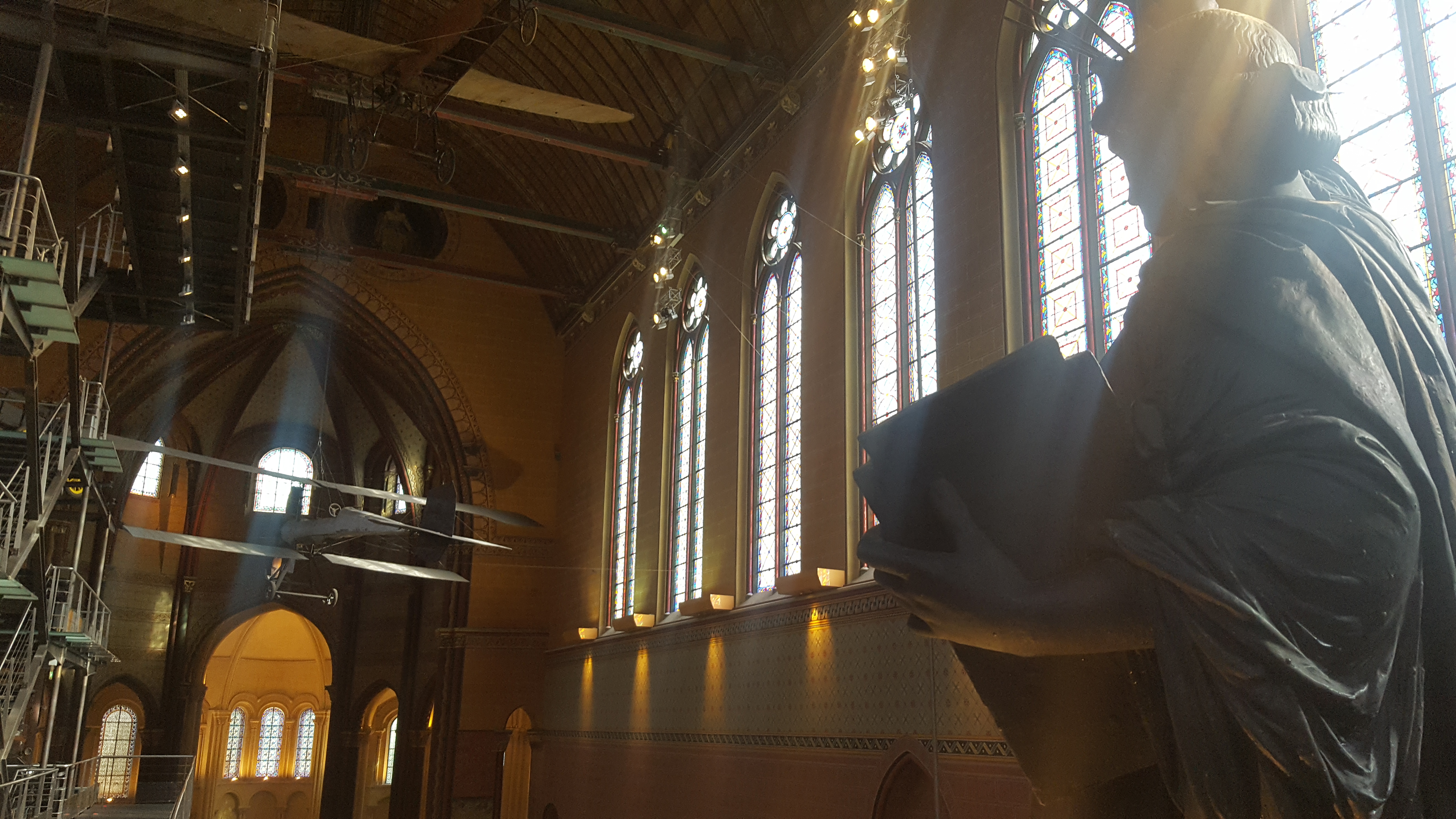
3. The first time I visited the Musée des Arts et Métiers:  Paris is full of museums, and every time I delude myself into thinking I have visited them all, or at least all the major ones, a new one springs up like a mushroom right in front of me!  My mom and I were wandering around, looking for covered shopping passages, feeling very hip and urban and deservedly European when we stopped for another obligatory kir and pâté at a café right across from this heretofore undiscovered gem.  Thus fortified, we entered and enjoyed many scientific curiosities, tools that mom recalled from her engineering training, music boxes, and other fun stuff.  Highly recommended!

4. The first time I visited Opéra Garnier:  As centrally located as it is, and as much of a Right Bank girl as I am, I have never been inside until that trip.  I decided that time has finally come to visit the Phantom’s old stomping grounds.  They do tours in English, and we signed up for an evening one, during which you not only explore the opulent stairwells and halls, but get to sit in *his* box.  It is exactly as I imagined—a gorgeous, luxurious, sparkling, and absolutely quintessentially French palace.  The Phantom was right in demanding only the highest standard of quality for the prima donnas to grace this magnificent stage, and if he had to smash chandeliers to achieve it, more power to him!

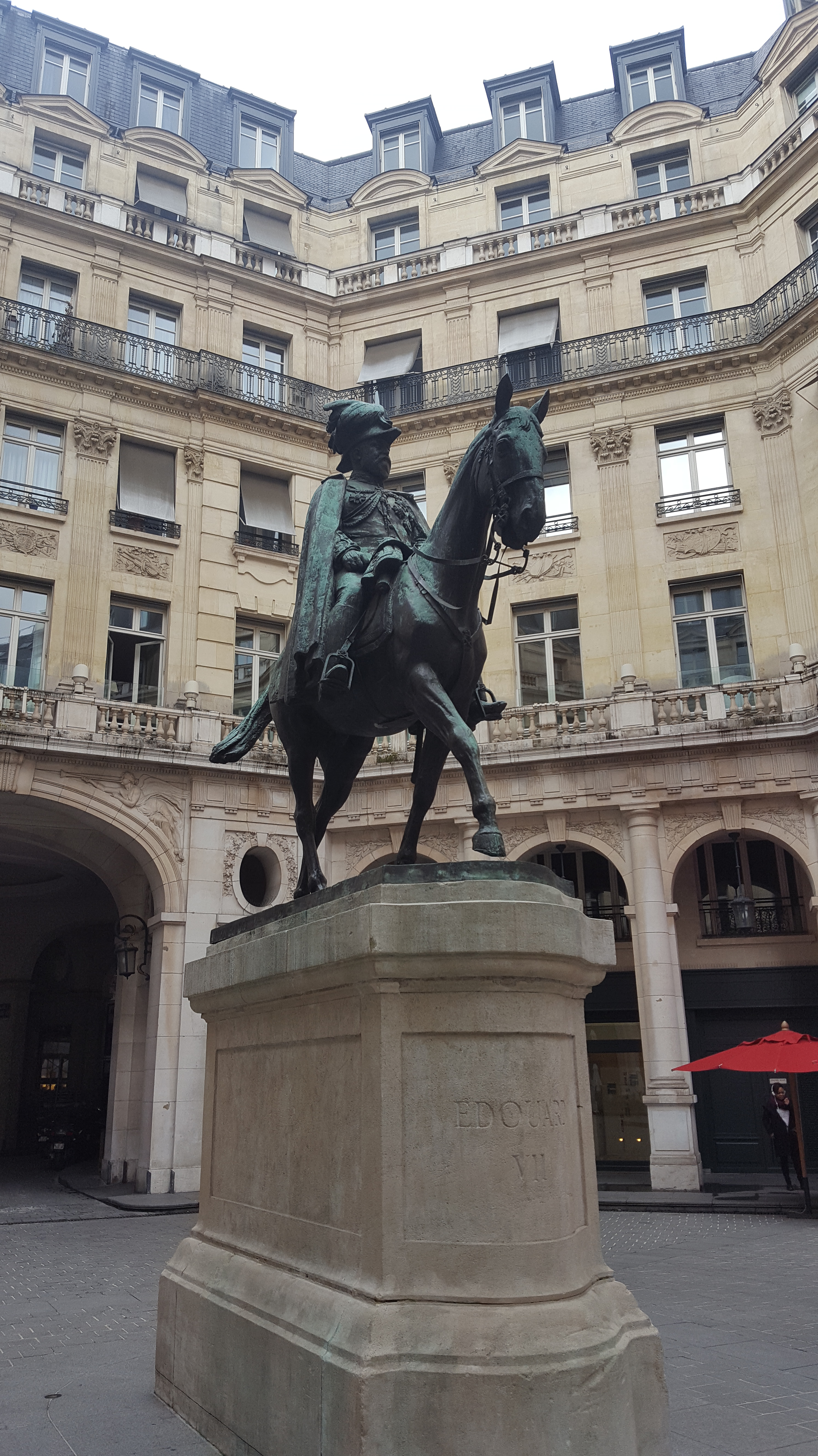
5. The first time I attended Theatre in Paris:  No, not theatre in Paris, but Theatre in Paris.  During our exploring of the area near Olympia, mom and I wandered into quaint little enclosed square with an imposing equestrian figure of what I, in a moment of unexpected lucidity, perceived to be an English king (well, it is just a parlor trick, isn’t it—his appearance was of a era significantly later than the end of French monarchy). It was, indeed, the visage of Edward II, the “most Parisian of all Kings”, and there was a theatre in the square as well–Théâtre Édouard VII**. My mom, who speaks not a word of French beyond what the general populace does (that is to say, a word of greeting, thanks, and farewell, if that), became immediately excited and said that she wants to see a play just for the experience, the understanding of the dialogue being a bonus she had no right to expect.  I dimly recalled some new-ish initiative of subtitling French plays for the English-speaking audience.  Thank you, the gods of Internet!  Not only did I confirm this, but we ordered tickets to a show, which provides an English language program and makes sure your seats have a good visibility of the subtitles scrolling at the top of the stage.  What a great deal!  The play we saw was “Somewhere in the Life”, adapted from “Park Your Car in Harvard Yard” by Israel Horovitz.  It was quite wonderful, one of those talky, relationship plays with two actors.  Maybe because it was a translation and an adaptation from English, I felt that I could understand about 60-70% without subtitles. Or maybe my French is that awesome.  Yes, definitely the latter.

6. Honorable mention goes to the first time I ate caviar in Paris—because wherever my mom is, there it is.  You can take a woman out of Russia, but…

And this was our Parisian adventure and Second Annual Mother and Daughter trip.  If you are mildly curious about the First, as well as subsequent, annual trips—stay tuned!

*PIC – [in this context] Partner in Crime

**“In the early to mid 1900s,under the direction of Sacha Guitry, the theatre became a symbol of anglo-franco friendship, and where French people could discover and enjoy Anglo Saxon works”.  (courtesy of Wikipedia)